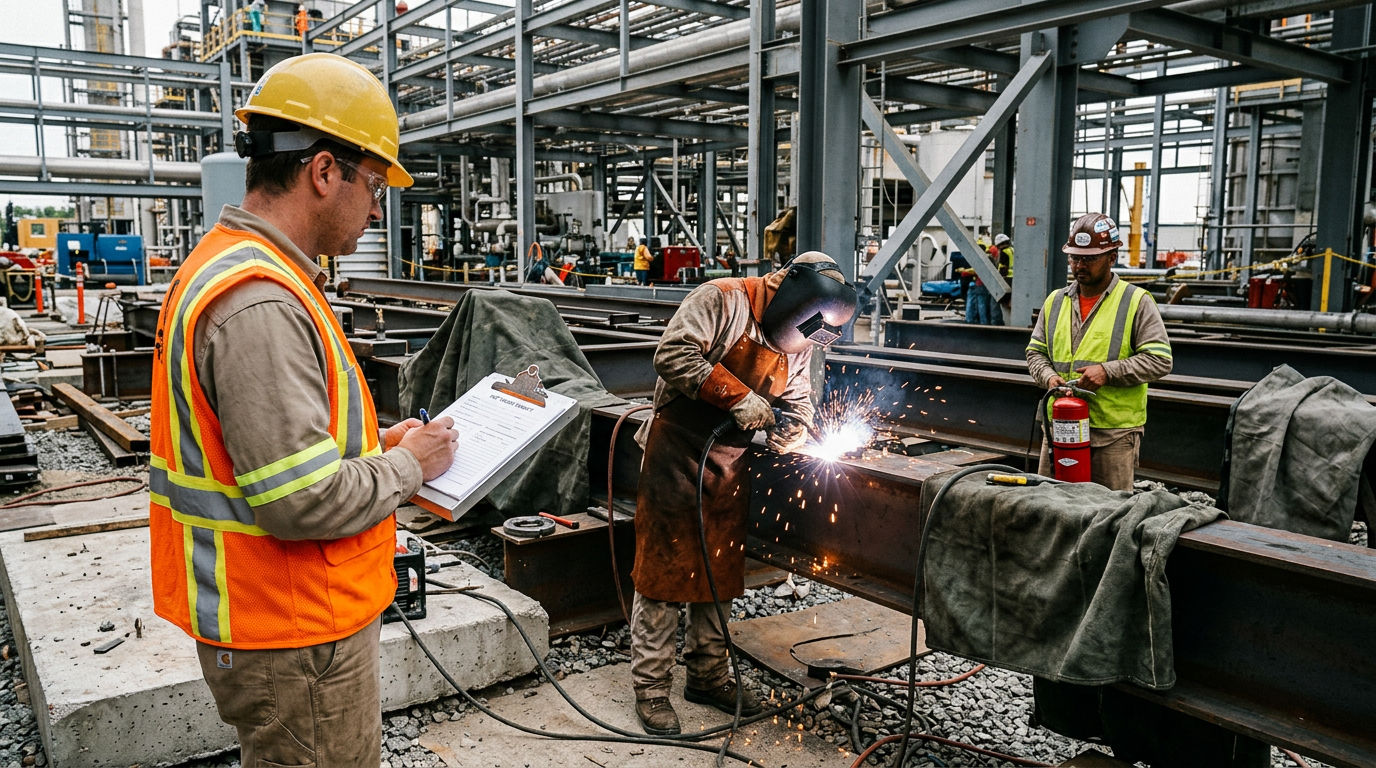
IMPORTANT DISCLAIMER: This guide references NFPA 51B, Standard for Fire Prevention During Welding, Cutting, and Other Hot Work; the International Fire Code (IFC), including Chapter 35 (Welding and Other Hot Work); NFPA 1, Fire Code; NFPA 101, Life Safety Code; NFPA 241, Standard for Safeguarding Construction, Alteration, and Demolition Operations; NFPA 51, Standard for the Design and Installation of Oxygen-Fuel Gas Systems for Welding, Cutting, and Allied Processes; NFPA 25 (impairments); ANSI/ASSP Z49.1 (Safety in Welding, Cutting, and Allied Processes, published by AWS); OSHA 29 CFR 1910.252 (general industry) and 29 CFR 1926 Subpart J (construction); and the adopted building and fire codes. NFPA 51B is the primary technical reference for hot work permit programs; IFC Chapter 35 is the code-enforceable requirement in jurisdictions that adopt the IFC. Requirements vary by edition and are frequently amended by state and local jurisdictions. Section numbers and time periods cited here follow the model codes and may differ in your adopted edition. Local amendments and the edition adopted by your Authority Having Jurisdiction (AHJ) always control. This guide is a starting point only. Always verify the requirements applicable to your project with your AHJ and your property insurer.
Hot work is one of the leading causes of fires in buildings under construction, renovation, and repair. Welding, cutting, grinding, soldering, brazing, and other spark- or flame-producing activities introduce an ignition source into environments that frequently contain combustibles. The fire that results is often invisible at first: a smoldering ember in insulation, a spark that lands in a wall cavity, hot slag that falls into a concealed space. It can develop into a serious fire hours after the work has ended and the workers have left.
The technical controls (removing or protecting combustibles, fire watch, extinguishers) are well understood but inconsistently applied. The hot work permit is the mechanism that forces those controls to be considered, documented, and verified before work begins and after it ends. NFPA 51B, IFC Chapter 35, and OSHA all treat the permit and the fire watch as central controls.
This article covers what hot work is, whether it can be avoided, what the codes require, where hot work is prohibited, how a permit program is structured, the roles of the permit authorizing individual, hot work operator, and fire watch, how contractors and special environments are managed, how impairments are coordinated, how the program is audited, and how to build a program from scratch.
◆ Section 1: What Counts as Hot Work
Hot work is any activity that produces flames, sparks, or heat sufficient to ignite combustible materials. The definition is functional, not nominal, and it is broader than many building operators assume.
| Category | Examples |
|---|---|
| Welding | Arc, gas, MIG, TIG, stick |
| Cutting | Oxy-fuel cutting, plasma cutting, arc cutting |
| Grinding | Angle grinding, abrasive cutting wheels, surface preparation (produces sparks) |
| Soldering and brazing | Torches, induction heating |
| Thawing | Pipe thawing with open-flame torches |
| Hot riveting | Rivet heating and installation |
| Roofing and waterproofing | Torch-applied membranes, hot-asphalt or bitumen kettles |
| Heat guns and hot-air tools | Paint stripping, shrink-fitting, when capable of igniting nearby combustibles |
| Any other spark-, flame-, or heat-producing activity | Activities not traditionally called “hot work” but producing an ignition source |
Key point: If an activity produces sparks, flames, or heat sufficient to ignite combustibles, treat it as hot work and cover it with the permit program.
Pro Tip: Include a catch-all line on the permit form (“any other activity producing sparks, flames, or heat”) so the program covers activities that do not fit a named category. Also confirm with your AHJ and insurer how they treat borderline tools such as powder-actuated fasteners and heat guns.
Can the Hot Work Be Avoided?
The safest hot work is the hot work that does not happen. Before issuing a permit, ask whether a cold method will do the job:
- Mechanical fastening or bolted connections instead of welding
- Mechanical pipe cutting, saws, or shears instead of torch or abrasive cutting
- Press-fit, grooved, or threaded pipe connections instead of brazing or soldering
- Mechanically attached roofing membranes instead of torch-applied membranes
- Moving the item to be welded or cut to a designated hot work area or shop
Pro Tip: Add a line to the permit form: “Alternatives to hot work considered?” It costs nothing and removes ignition sources.
◆ Section 2: What the Codes Require
Hot work is regulated by overlapping codes, standards, and regulations.
A. NFPA 51B
NFPA 51B is the primary standard for hot work fire prevention. It establishes:
- The permit system, with a written permit issued by a permit authorizing individual (PAI)
- Responsibilities of management, the PAI, the hot work operator, the fire watch, and contractors
- Precautions before, during, and after the work
- Where hot work is and is not permitted
- Special provisions for confined spaces, vessels and containers, and roofing operations
- Training requirements for each role
B. IFC Chapter 35
IFC Chapter 35 is the code-enforceable requirement in IFC jurisdictions. It addresses the permit, general precautions, fire watch, prohibited locations, record-keeping, and responsibilities of the permit holder. The IFC and NFPA 51B overlap, but their details (for example, post-work fire watch duration) can differ by edition, so check both.
C. OSHA 29 CFR 1910.252 and 1926 Subpart J
OSHA regulates hot work in general industry (1910.252) and construction (1926 Subpart J). Both require fire prevention precautions, protection of combustibles, fire watch where specified, ventilation, and personal protective equipment. OSHA’s fire watch minimum is shorter than NFPA 51B’s, so a program built only to the OSHA minimum may not satisfy the standard or the AHJ.
D. Other Referenced Documents
| Document | Scope |
|---|---|
| NFPA 241 | Safeguarding construction, alteration, and demolition, including hot work on construction sites |
| NFPA 51 | Oxygen-fuel gas systems for welding, cutting, and allied processes |
| ANSI/ASSP Z49.1 | Safety in welding, cutting, and allied processes (published by AWS) |
| NFPA 25 | Impairment procedures when sprinklers are shut off |
| NFPA 72 | Handling of detection and alarm devices disabled during work |
| Insurer standards (for example, FM Global hot work guidance) | Often stricter than the code; may be a policy condition |
| Local fire code amendments | May add requirements beyond the model codes |
Key point: Design the permit program to satisfy the most restrictive applicable requirement: code, standard, regulation, local amendment, or insurer condition.
Pro Tip: Many property insurers require their own hot work permit or specific procedures as a condition of coverage. Ask your insurer early; a missed policy condition can affect a claim after a fire.
◆ Section 3: Where Hot Work Is Permitted and Where It Is Prohibited
A. Designated Areas vs. Permit-Required Areas
A designated area is a location such as a maintenance shop that has been inspected and approved for repeated hot work and is free of combustibles and fire hazards. Hot work in a designated area can proceed without an individual permit, provided the area remains controlled. Hot work anywhere else requires a permit.
B. The 35-Foot (11 m) Rule
NFPA 51B, IFC Chapter 35, and OSHA use a 35 ft (11 m) radius around the work as the basic zone for protection:
- Combustible materials within 35 ft of the work should be removed or, if they cannot be removed, protected with fire-resistant blankets, shields, or guards.
- Floors within the zone should be swept clean, and combustible floors wetted or covered, as applicable.
- Openings in floors, walls, and ducts within the zone, including cracks and penetrations that sparks can travel through, should be covered or sealed.
- A fire watch is generally required where combustibles are within 35 ft, where combustibles are more than 35 ft away but would be easily ignited by sparks, where openings in walls or floors within 35 ft expose combustibles, or where combustibles are adjacent to the opposite side of walls, ceilings, or roofs that conduct heat.
C. Prohibited Locations and Conditions
Hot work should not be permitted:
- In areas with a flammable atmosphere, or where flammable gases, vapors, liquids, or combustible dust are present
- On or near containers or tanks that held flammables or combustibles unless they have been properly cleaned, purged, and tested
- Where sprinklers are impaired and no compensating measures are approved
- Near unprotected combustible construction or storage that cannot be moved or protected
- In areas the PAI cannot inspect, or where required precautions cannot be met
- In any condition the PAI or AHJ considers unsafe, including high winds that carry sparks to unprotected areas
Key point: If the required precautions cannot be met, the permit is not issued. The permit program is only credible if the PAI is willing to say no.
◆ Section 4: The Structure of a Hot Work Permit Program
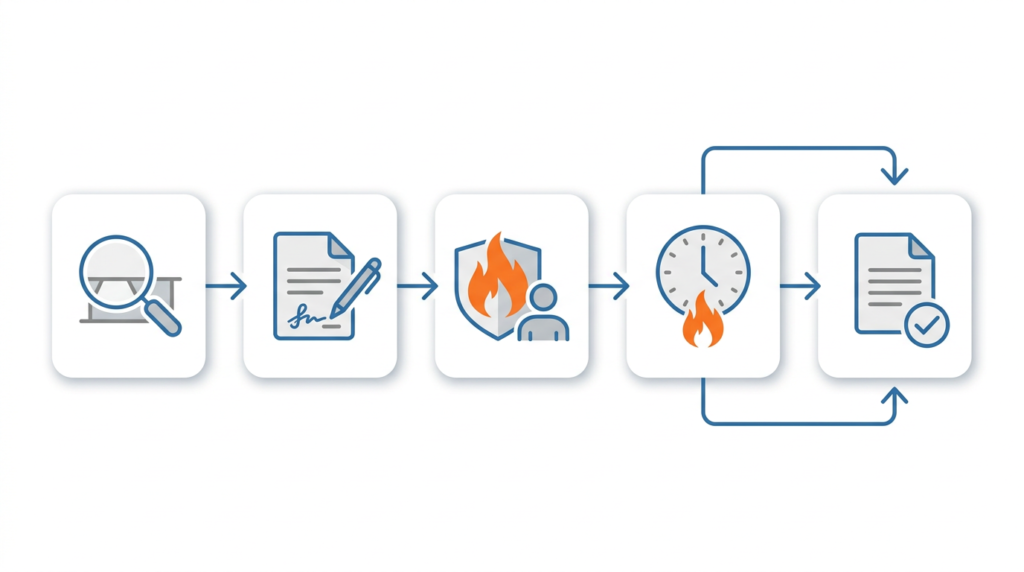
A program has four recognizable elements. The specific content depends on the organization, but the structure is consistent.
| Element | Content |
|---|---|
| Policy and governance | Written policy that hot work requires a permit; named program owner; designated areas; named PAIs; record retention |
| Permit process | Permit form, pre-work inspection, precautions, fire watch assignment, work authorization, post-work check, close-out |
| Training and qualification | Role-specific training for PAIs, hot work operators, fire watches, and contractors; refresher training; records |
| Audit and improvement | Permit audits, field audits, incident review, performance indicators, management review |
Key point: The permit program is a system, not a form. The form is the visible artifact, but the program includes the policy, the training, the audit, and the improvement cycle.
Pro Tip: If the program consists only of a form that contractors fill out, it is not a program. It requires named PAIs, training, audits, and management review.
◆ Section 5: The Permit Form: What It Must Capture
The permit form must capture enough information to demonstrate that the required precautions were considered and implemented.
A. Required Information
| Field | Purpose |
|---|---|
| Permit number | Unique identifier for tracking and audit |
| Date and time of issuance and expiration | Defines the validity period |
| Location of work | Specific address, floor, room, or area |
| Description of work and equipment | What will be done (welding, cutting, grinding, torch-applied roofing) |
| Alternatives considered | Confirms cold methods were evaluated |
| Hot work operator | Name and employer |
| PAI | Name and signature |
| Fire watch | Name and signature, and post-work watch duration |
| Precautions taken | Checklist of combustible removal, protection, ventilation, extinguishers |
| Nearby combustibles | What is near the work and how it is protected, including the other side of walls and floors below |
| Confined space or vessel | Whether the work is in or on a confined space, tank, or container |
| Sprinkler and detection status | Whether sprinklers and detectors are operational, or the impairment reference number |
| Post-work check | Verification that the area is safe after the watch period |
| Close-out signature | PAI or designee closing the permit |
B. The Precautions Checklist
The checklist should require the PAI to confirm that:
- Combustibles within 35 ft are removed or protected, and floor and wall openings are covered
- Combustible dust and flammable residues are removed
- No flammable atmosphere is present (tested where required)
- Ventilation is adequate for the work and the fumes it produces
- Fire extinguishers are in place, charged, and of a suitable type
- Fire watch is assigned, briefed, and equipped
- Sprinklers and fire alarm are operational, or alternative measures are in place
- A confined space permit has been obtained, if applicable
- Hot work equipment, hoses, and cylinders are in good condition and properly secured
C. The Permit Validity Period
The permit should be valid for a defined, short period, typically no longer than one shift or one workday. Conditions change as other trades work, materials are delivered, and the building is modified. A new shift or a new location means a new permit.
Key point: The permit is a point-in-time authorization, not a standing permission.
Pro Tip: Use a form tailored to the work type (welding and cutting, torch-applied roofing, confined spaces). A one-size-fits-all form tends to produce generic answers.
◆ Section 6: The Permit Authorizing Individual (PAI)
The PAI is the person authorized to issue permits. The role is central and often under-defined.
A. Who Can Be a PAI
The PAI should be trained on the permit program and applicable codes, familiar with the building and its fire protection systems, authorized in writing by the program owner, and available to inspect the work area before, during, and after the work. In practice the PAI is a facility manager, safety officer, or designated supervisor, and should not be the person performing the hot work.
B. PAI Responsibilities
| Responsibility | Detail |
|---|---|
| Pre-work inspection | Physically inspect the work area and surroundings before issuing the permit |
| Precautions verification | Confirm combustibles are removed or protected, extinguishers are in place, and systems are in service |
| Fire watch assignment | Assign, brief, and confirm the fire watch is equipped |
| Permit issuance | Sign and issue the permit |
| Monitoring | Check on the work periodically |
| Post-work check | Verify the area is safe after the watch period |
| Close-out and records | Sign the close-out; file the permit |
C. PAI Limitations
- The PAI should not be the hot work operator, to avoid conflict of interest.
- The PAI should not issue a permit for work they have not inspected.
- The PAI should not issue a permit when the required precautions cannot be met.
Key point: The PAI is the gatekeeper. If permits are issued without inspection, the program is not functioning regardless of how complete the paperwork appears.
Pro Tip: Require the PAI to physically inspect the area, including above, below, and on the other side of walls. A signed permit without an inspection is a paper trail, not a control.
◆ Section 7: The Hot Work Operator
The person performing the hot work has duties of their own, not just a signature line.
- Confirm a valid, signed permit is in hand and posted or available at the work location
- Understand the permit conditions and the work limits (location, time, type of work)
- Inspect equipment before use: hoses, regulators, torches, cables, grounding, guards
- Secure and protect gas cylinders, keep them upright and away from the work, and use flashback arrestors and check valves as required
- Do not begin until the PAI has issued the permit and the fire watch is in place
- Stop work immediately if conditions change, the fire watch leaves, or an unsafe condition appears
- At the end of work, shut off fuel gas and oxygen at the cylinder, de-energize equipment, and notify the fire watch and PAI
- Do not leave hot work equipment unattended while energized or lit
Pro Tip: Give every operator stop-work authority, and make it clear no one will be penalized for using it.
◆ Section 8: The Fire Watch
The fire watch is the person assigned to watch for fire during and after hot work. The role is critical and often under-trained.
A. Fire Watch Responsibilities
| Responsibility | Detail |
|---|---|
| Continuous observation | Watch the work area and all locations where sparks or slag can travel, including adjacent rooms and levels below |
| Extinguisher readiness | Have a suitable extinguisher or hose ready and know how to use it |
| Fire response | Extinguish incipient fires if safe to do so; activate the alarm; call the fire department |
| Stop-work authority | Stop the work if conditions become unsafe |
| Post-work watch | Continue watching for the required period after work ends |
| Close-out input | Confirm the area is safe before the permit is closed |
The fire watch should have no other duties while hot work is in progress. More than one fire watch may be needed when sparks can travel to areas the watch cannot see from one position, such as floors below or adjacent rooms.
B. Fire Watch Duration
The fire watch must continue after the work ends. Fires can smolder for hours before becoming visible.
| Source | Post-Work Fire Watch |
|---|---|
| NFPA 51B (recent editions) | Typically 1 hour after work ends, followed by a final check of the area up to about 3 hours after completion where the PAI judges it necessary |
| IFC Chapter 35 | Minimum period set in the code (often shorter than NFPA 51B); verify the adopted edition |
| OSHA 29 CFR 1910.252 | At least 30 minutes after completion |
| Insurers, local amendments, roofing operations | May require longer periods |
Verify: The post-work periods above differ between documents and between editions. Adopt the longest applicable period in your program and confirm it with your AHJ.
C. Fire Watch Qualifications
The fire watch should be trained in fire watch duties and extinguisher use, familiar with the building’s alarm and evacuation procedures, physically able to perform the role, and able to summon help immediately.
Key point: The fire watch is not a passive observer. The role requires active watching, extinguisher readiness, and the authority to stop work.
Pro Tip: Equip the fire watch with a two-way radio or phone and, where appropriate, a thermal imaging camera or infrared thermometer for checking concealed spaces. A fire watch who cannot call for help is a fire watch in name only.
◆ Section 9: Precautions Before, During, and After Work
A. Before Work
| Precaution | Detail |
|---|---|
| Alternatives | Confirm a cold method is not practical |
| Combustible removal and protection | Remove combustibles or protect with fire-resistant blankets, shields, or guards |
| Openings | Cover or seal floor, wall, and duct openings sparks could pass through |
| Dust and residues | Clean up combustible dust, lint, oils, and coatings |
| Atmosphere | Test for flammable gas or vapor where there is any possibility of its presence |
| Ventilation | Provide adequate general or local exhaust ventilation |
| Extinguishers | Place suitable extinguishers in the work area |
| Sprinklers and detection | Confirm they are operational, or start the impairment process (Section 13) |
| Confined space | Obtain a confined space permit if applicable |
| Equipment | Inspect hot work equipment, hoses, and cylinders |
B. During Work
- The fire watch is present at all times
- Extinguishers are charged and accessible
- The area is monitored for fire and changing conditions
- Work stops if conditions become unsafe
- Communication is maintained between the operator, fire watch, and PAI
C. After Work
- Fire watch continues for the required period
- The area, including concealed spaces, wall cavities, and floors below, is inspected for smoldering material
- Equipment is shut down and secured, and cylinders are closed
- The PAI or designee signs the close-out, and the permit is filed
Key point: The post-work period is when many hot work fires start. The permit is not closed until the area has been inspected after the watch period.
Pro Tip: Require the fire watch to check concealed spaces, wall cavities, and floor openings, not just visible surfaces.
◆ Section 10: Contractor Management
Most hot work is performed by contractors, and contractor non-compliance is the most common program failure.
A. Contractor Requirements
| Requirement | Detail |
|---|---|
| Orientation | Brief contractors on the building’s hot work program before work starts |
| Permit application | Contractor applies through the building’s process |
| PAI | The building’s PAI issues or countersigns the permit; where contractors have their own qualified PAIs, the building owner still approves |
| Qualifications | Verify insurance, training records, and operator qualifications |
| Subcontractors | Subcontractors are covered by the program and briefed |
| Close-out | Contractor returns the signed permit |
B. Common Contractor Issues
| Issue | Consequence |
|---|---|
| Contractor uses its own permit form | Bypasses the building’s program |
| Contractor performs hot work without a permit | Uncontrolled ignition source |
| Subcontractors not briefed | Unaware of building requirements |
| Permit not returned | No record of the work |
C. Contract Language
Contracts should require compliance with the building’s hot work program, use of the building’s permit form, building PAI approval before work begins, cooperation with audits, contractor responsibility for the fire watch and precautions, and contractor liability for damage caused by non-compliance.
Key point: The building owner or operator controls hot work in the building. The contractor’s own program may be adequate, but the building’s program is the one that applies.
Pro Tip: Put the hot work permit requirement in both the contract and the pre-work briefing.
◆ Section 11: Hot Work in Special Environments
Some environments require precautions beyond the standard permit.
A. Confined Spaces
- A confined space permit is required in addition to the hot work permit
- Atmospheric testing before entry and continuous monitoring as required
- Ventilation, rescue provisions, and a fire watch outside the space
- Fuel gas and oxygen cylinders and torches are removed from the space when work stops, to prevent leakage buildup
B. Tanks, Vessels, and Containers
- Never cut or weld on a container that held flammable or combustible material unless it has been cleaned, purged or inerted, and tested
- Follow NFPA 51B and the container-specific guidance it references
C. Elevated Work
- Sparks and slag can fall to lower levels and travel in wind
- A fire watch at the lower level may be needed; combustibles below must be removed or protected
D. Combustible Construction and Mass Timber
- Wood-framed buildings under construction, combustible cladding, and insulation present greater risk
- Mass timber buildings need specific attention: sparks and slag can ignite exposed timber, and smoldering can develop in wood fibers and concealed voids
- Additional fire watch, protection of timber surfaces, and extended post-work monitoring may be required
E. Roofing and Waterproofing
- Torch-applied roofing is hot work and often involves propane equipment
- Combustible insulation, roof decks, and concealed voids make fires hard to detect
- Fire watch periods are often longer than for general hot work; follow NFPA 51B, NFPA 241, IFC, and your insurer
F. Occupied Buildings
- Coordinate with tenants and occupants before work
- Consider smoke, fumes, and evacuation impact on occupants
- Protect adjacent occupied spaces from sparks and heat transfer through walls and ceilings
G. Outdoors and Yards
- Consider wind, rain, and nearby vegetation or stored materials
- Control sparks near vehicles, fuel storage, and waste containers
Key point: The standard permit may not be enough for special environments; additional permits, fire watch, or protection may be required.
◆ Section 12: Health and Environmental Hazards of Hot Work
Hot work also creates health hazards that the permit program should recognize.
- Welding fumes and gases (for example, hexavalent chromium, manganese, ozone) require adequate ventilation, local exhaust, or respiratory protection per OSHA and ANSI Z49.1
- Coatings, paints, and galvanized surfaces can release toxic fumes when heated, and may need to be removed first
- Arc flash, UV, and burn hazards require appropriate PPE and screening of the work area
- Fire watch personnel may also need eye protection and ventilation
Pro Tip: Add a ventilation and fume check to the permit checklist, and coordinate with the safety or industrial hygiene team.
◆ Section 13: Impairment Coordination
Hot work frequently requires impairment of fire protection systems, such as shutting off sprinklers in the area or disabling detection to prevent false alarms. The permit program must coordinate with the impairment program.
A. When Impairment Is Needed
- Sprinklers in the work area may need to be shut off to prevent accidental discharge (note that sprinklers near an open flame can be a protection, not just a risk, and should remain in service wherever possible)
- Detection in the work area may need to be bypassed to prevent false alarms
- Fire alarm notification in the area may need to be bypassed
B. Impairment Requirements
| Requirement | Detail |
|---|---|
| Authorization | The impairment coordinator authorizes the impairment |
| Notification | Notify the fire department, monitoring company, and occupants |
| Tagging | Tag the impaired system |
| Alternative measures | Fire watch, additional extinguishers, and permit conditions |
| Restoration | Restore and test the system before removing the impairment |
| Documentation | Record the impairment and its closure |
Key point: Hot work that requires impairment creates a compounded risk. The permit and impairment record should be linked, and the fire watch must be in place for the entire impairment period.
Key Article: Article 143 — Impairment Management and Fire Watch Procedures (NFPA 25) (planned)
Pro Tip: Require the hot work permit to reference the impairment record, and do not close the permit until the system is restored and verified.
◆ Section 14: Emergency Response and Incident Investigation
Even a well-run program needs a plan for when a fire starts.
A. If a Fire Starts
- The fire watch or operator attempts to extinguish an incipient fire only if it is safe and they are trained to do so
- Activate the fire alarm and call the fire department; do not rely on extinguishing the fire first
- Evacuate the area and account for the hot work crew
- Shut off fuel gas and oxygen at the cylinders if it is safe to do so
- Meet the fire department and tell them where hot work was performed and where hidden fire may be
B. Reporting and Investigation
- Investigate every hot work fire, near-miss, and stop-work event
- Identify whether the permit was valid, the fire watch was present, and the precautions were in place
- Feed lessons learned into training, forms, and audits
- Report as required to the insurer, the AHJ, and OSHA where applicable
Key point: Near-misses are free lessons. Programs that investigate them find the weak points before a fire does.
◆ Section 15: Training and Competence
All roles in the program require role-specific training.
| Role | Training Content |
|---|---|
| PAI | Program overview, applicable codes (NFPA 51B, IFC Ch. 35), pre-work inspection, precautions verification, fire watch assignment, close-out, record-keeping |
| Hot work operator | Safe work practices, PPE, equipment and cylinder handling, combustible protection, working with the fire watch, stop-work authority |
| Fire watch | Duties, extinguisher use, alarm activation, emergency response, post-work watch, communication |
| Contractors and supervisors | Building program requirements, permit process, contract obligations |
| Refresher | Periodic (annually or as required), after incidents or near-misses, and after program changes |
Key point: Training records show effort; behavior shows effectiveness. Measure both through field observation.
Key Article: Article 70 — How to Design and Implement a Fire Safety Training Program
Pro Tip: Use real case studies in training. A hot work fire in a similar building is more memorable than a code citation.
◆ Section 16: Audit, Performance Indicators, and Improvement
The program must be audited to confirm it is functioning.
A. Audits
| Type | Content |
|---|---|
| Permit review | Completeness, signatures, post-work watch documented, permits closed |
| Field observation | Observation of hot work in progress, including surprise audits |
| Record review | Training records, impairment links, retention |
| External | Third-party fire safety audit, insurer survey, AHJ inspection |
B. Performance Indicators
| Type | Indicators |
|---|---|
| Leading | Permits issued; percentage with complete documentation; permits with documented post-work watch; permits issued without pre-work inspection; PAIs, operators, and fire watches trained; contractors oriented |
| Lagging | Hot work fires; near-misses; audit findings; open corrective actions |
Watch data quality: incomplete forms, permits not returned, permits closed without a post-work watch, and permits issued by unqualified PAIs all distort the indicators.
Key point: The value of an audit is in the corrective action, not the report. Unclosed findings are a cost, not a benefit.
Pro Tip: Report indicators to management quarterly and conduct periodic surprise audits. Scheduled audits may miss the problems that occur between audits.
◆ Section 17: Implementation Roadmap
A program does not need to be built all at once. A phased approach is more likely to succeed.
| Phase | Activities |
|---|---|
| 1. Commit | Obtain management commitment; approve the hot work policy; appoint the program owner |
| 2. Baseline | Review existing practices; identify gaps against NFPA 51B, IFC Chapter 35, and insurer requirements |
| 3. Design | Develop the permit form, procedures, and training |
| 4. Train | Train PAIs, hot work operators, and fire watches |
| 5. Launch | Begin issuing permits; communicate the program to contractors and tenants |
| 6. Monitor | Track indicators; conduct audits; review incidents and near-misses |
| 7. Improve | Close audit findings; update procedures; refresh training |
For a portfolio, pilot the program on one or two buildings, then standardize.
Pro Tip: Start with contractor management and impairment coordination. Most hot work is performed by contractors, and these two gaps cause the most serious failures.
◆ Section 18: Common Challenges and Mistakes
| Mistake | Why It Happens | Solution |
|---|---|---|
| Program exists on paper only | Form developed without training or audit | Train PAIs and fire watches; audit permits |
| Contractor uses own permit form | Not in contract; not communicated | Contract language; pre-work briefing; PAI refusal |
| PAI issues permit without inspection | Lack of time or training | Require physical inspection; audit PAI performance |
| Fire watch absent, untrained, or given other duties | Role not understood | Define the role; train; audit |
| Post-work watch not performed | Work ends and everyone leaves | Close-out requires post-work watch documentation |
| Permit not closed or valid too long | No close-out process | Close-out signature; one-shift limit; audit open permits |
| Impairment not coordinated | Separate processes | Link permit and impairment record |
| Standard permit used for special work | Special environments not identified | Additional permits and precautions |
| Training treated as tick-box | Records valued over behavior | Competence checks; field observation |
| Subcontractors not covered | Prime manages only its own workers | Require subcontractor compliance |
Key point: The most common failure is the gap between the permit form and the practice.
Pro Tip: Walk the building during hot work. If you see hot work without a visible permit, the program is not functioning.
◆ Section 19: Conclusion
Hot work is one of the leading causes of fires in buildings under construction, renovation, and repair. The technical controls are well understood but inconsistently applied. The permit program is the mechanism that forces them to be considered, documented, and verified before work begins and after work ends.
A defensible program includes:
- Policy and governance: a written policy, a named program owner, and authorized PAIs
- A permit process: a form that captures the required information, pre-work inspection, and post-work close-out
- Precautions: specific requirements before, during, and after work, including the 35 ft rule and prohibited conditions
- Fire watch: a trained, equipped, and present individual during and after the work
- Training: role-specific training for PAIs, operators, fire watches, and contractors
- Audit and improvement: permit audits, field observation, incident review, and performance indicators
Key Takeaways
- Hot work is any activity producing flames, sparks, or heat sufficient to ignite combustibles; consider cold alternatives first.
- NFPA 51B and IFC Chapter 35 are the primary requirements; OSHA 29 CFR 1910.252 and 1926 Subpart J also apply, as may insurer requirements.
- The permit must be issued by a trained PAI after a physical inspection, with required precautions in place.
- Combustibles within 35 ft of the work must be removed or protected, and hot work is prohibited where precautions cannot be met or flammable atmospheres exist.
- Permit validity should match the work, typically one shift.
- The fire watch must be present during work and for the required post-work period; adopt the longest applicable period.
- Contractor hot work must be managed through the building’s program.
- Special environments (confined spaces, containers, elevated work, mass timber, roofing) require additional precautions.
- Hot work requiring impairment must be coordinated with the impairment program.
- Audits and performance indicators confirm the program works in practice.
Take Action Today
- Confirm a hot work policy is approved and a program owner and PAIs are named.
- Confirm the permit form captures the required information, including alternatives considered and impairment references.
- Confirm the fire watch duration is defined, documented, and based on the longest applicable requirement.
- Verify contractor hot work is covered by the building’s program, contract, and orientation.
- Train PAIs, hot work operators, and fire watches.
- Establish an audit program, an incident investigation procedure, and quarterly indicator reporting.
- Check insurer hot work requirements and the edition of NFPA 51B and IFC adopted by your AHJ.
- Walk the building during hot work to confirm the program is functioning in practice.
Continue Reading from Our Series:
-
Related guide: Article 141 — Fire Safety Management Systems and ISO 31000 Alignment
-
Related guide: Article 139 — Furniture, Contents, and Fire Load Management
-
Read more: Article 53 — How to Train Employees for Fire Emergencies