IMPORTANT DISCLAIMER: This guide references NFPA 1, Fire Code, Chapter 38 (Cannabis Growing, Processing, or Extraction Facilities); NFPA 101, Life Safety Code; NFPA 13, Standard for the Installation of Sprinkler Systems; NFPA 30, Flammable and Combustible Liquids Code; NFPA 45, Standard on Fire Protection for Laboratories Using Chemicals; NFPA 55, Compressed Gases and Cryogenic Fluids Code; NFPA 58, Liquefied Petroleum Gas Code; NFPA 70, National Electrical Code; NFPA 91, Standard for Exhaust Systems for Air Conveying of Vapors, Gases, Mists, and Particulate Solids; NFPA 660, Standard for Combustible Dusts and Particulate Solids; the International Fire Code (IFC); and the International Building Code (IBC). These codes vary significantly by edition and are frequently amended by state and local jurisdictions. NFPA 1 editions include 2021 and 2024. NFPA 101 editions include 2018, 2021, and 2024. NFPA 70 editions include 2020, 2023, and 2026. NFPA 660 (2025) superseded NFPA 652 and NFPA 654. The most recent published editions are NFPA 1 (2024), NFPA 101 (2024), NFPA 70 (2026), and NFPA 660 (2025), but AHJ-adopted editions commonly lag behind by one or more cycles. Cannabis remains subject to federal controlled-substance law, and its federal scheduling is in transition. State regulations vary widely. Local amendments and the edition adopted by your Authority Having Jurisdiction (AHJ) always control. This guide is a starting point only—always verify the specific requirements applicable to your project with your local AHJ. This article addresses fire safety and building code compliance for cannabis facilities in jurisdictions where they operate legally. It is intended for fire protection professionals and code officials. It does not address cannabis legality or promote cannabis use.
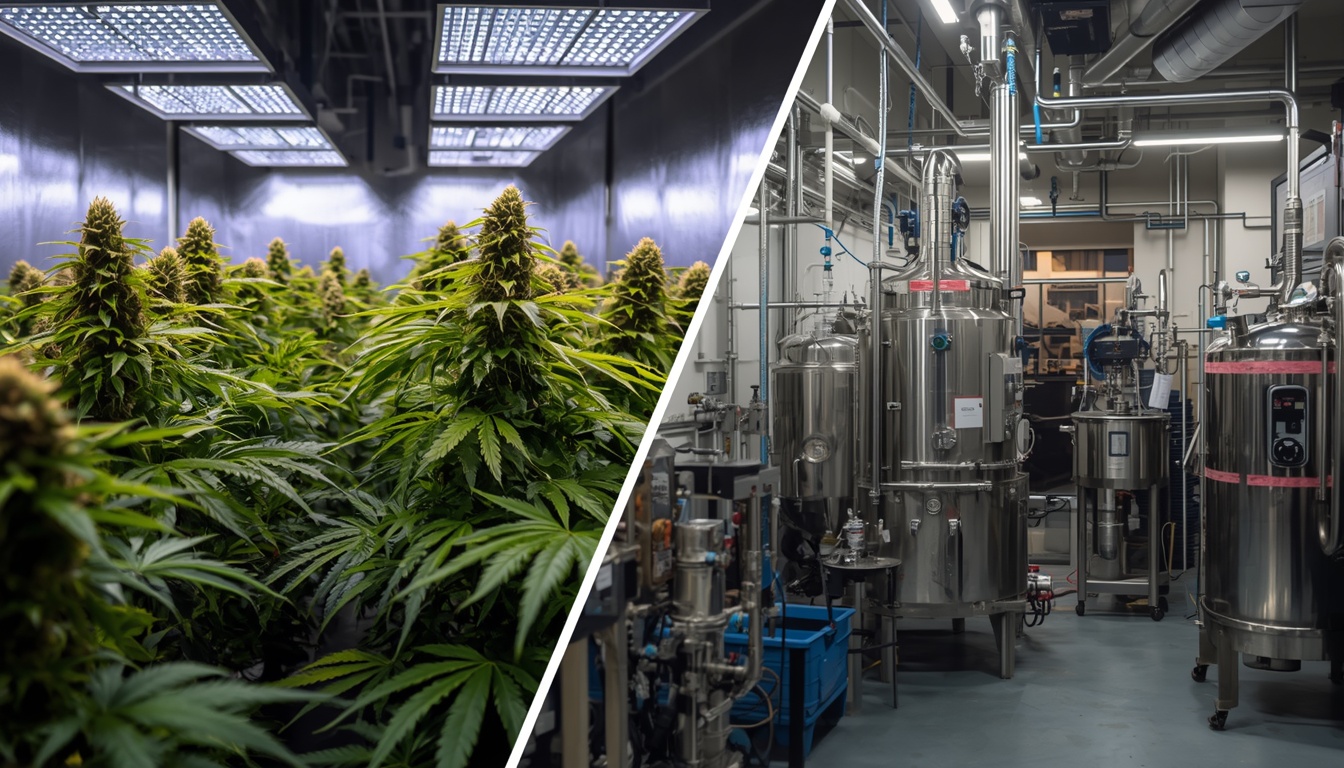
Cannabis facilities are among the newest and most complex occupancy types in commercial real estate. They combine hazards that rarely coexist in a single building: high-wattage electrical loads for cultivation lighting, carbon dioxide enrichment for plant growth, flammable solvents for extraction, and combustible plant dust from processing. Each hazard requires a different fire safety strategy. Together, they create a facility where the fire risk profile changes dramatically from room to room.
Adding to the complexity is the regulatory landscape. There is no federal fire safety standard specific to cannabis facilities. Adoption of national standards varies by state and local jurisdiction, creating a fragmented regulatory environment where NFPA 1 Chapter 38 provides the primary fire code framework where adopted, but state and local amendments often impose additional requirements—or leave gaps that the AHJ must fill on a case-by-case basis.
This guide covers the fire safety challenges of cannabis facilities across their three primary functions—cultivation, processing/extraction, and retail—and the practical solutions for protecting them.
◆ Section 1: Why Cannabis Facilities Are Different
Cannabis facilities present fire safety challenges that do not exist in conventional industrial, agricultural, or mercantile occupancies.
| Factor | Challenge |
|---|---|
| High electrical loads | Indoor cultivation uses high-wattage lighting; the Northwest Power and Conservation Council reports that some producers use approximately 200 kWh per square foot of canopy for lighting alone, while other estimates run higher depending on operational characteristics and cultivation type |
| Flammable solvents | Solvent extraction uses butane, propane, and ethanol, all with low flash points and explosive limits |
| Carbon dioxide enrichment | CO2 is an asphyxiant; systems require detection and ventilation |
| Combustible dust | Dried cannabis processing generates dust that presents explosion hazards |
| Regulatory fragmentation | Fragmentation comes mainly from state and local code adoption, not federal scheduling |
| Rapid industry growth | Facilities scale quickly, often without reassessing aggregate hazardous material quantities |
| Unique occupancy classification | Cannabis facilities do not fit neatly into traditional NFPA 101 occupancy classes |
Key point: The fire risk profile of a cannabis facility changes from room to room. A cultivation room with CO2 enrichment has different hazards than an extraction room with butane, which differs again from a retail dispensary. A single fire safety strategy cannot address all three.
Pro Tip: Map the facility by function before designing fire protection. Cultivation, extraction, processing, and retail each require separate hazard analysis and often separate protection strategies.
◆ Section 2: The Regulatory Framework
Cannabis facility fire safety is governed by a layered framework that includes national standards and state-specific amendments.
| Standard | Scope | Application to Cannabis |
|---|---|---|
| NFPA 1 Chapter 38 | Cannabis growing, processing, or extraction facilities | Primary fire code framework where adopted |
| NFPA 101 | Life Safety Code | Occupancy classification, egress |
| NFPA 13 | Sprinkler systems | Density, hazard classification, storage protection |
| NFPA 30 | Flammable and combustible liquids | Solvent classification, quantity, handling |
| NFPA 45 | Laboratories using chemicals | Referenced for fume hoods and solvent handling in extraction |
| NFPA 55 | Compressed gases and cryogenic fluids | CO2 systems, gas detection |
| NFPA 58 | Liquefied petroleum gas | Butane and propane storage and use |
| NFPA 70 | National Electrical Code | Article 512 (Cannabis Oil Equipment); 2026 edition now current |
| NFPA 91 | Exhaust systems | Referenced for LPG extraction exhaust |
| NFPA 660 | Combustible dusts and particulate solids | DHA requirement; superseded NFPA 652 and 654 |
| IFC Chapter 39 | International Fire Code | Corresponds to NFPA 1 Chapter 38 |
Key point: NFPA 1 Chapter 38 addresses fire protection of cannabis growing and processing facilities. Retail sale is not included in Chapter 38’s scope.
Federal scheduling in transition (as of September 2026): On April 22, 2026, the Justice Department placed FDA-approved marijuana drug products and marijuana subject to a qualifying state medical license into Schedule III. Unlicensed bulk marijuana, adult-use products, and synthetically derived THC remain in Schedule I. A DEA administrative hearing on broader rescheduling began June 29, 2026, and concluded its testimony phase July 15, 2026. The ALJ recommendation is pending, and no final rule has been issued.
Pro Tip: NFPA 1 Chapter 38 and IFC Chapter 39 are developed to correlate, so that requirements remain consistent regardless of which fire code your jurisdiction adopts.
Key Article: Article 46 — Hazard Classification (Low, Ordinary, High) and Hazardous Areas (NFPA 101)
◆ Section 3: Occupancy Classification (IBC/IFC and NFPA 101)
Cannabis facilities do not have a single classification. The occupancy classification depends on the specific function of each area and which code system your jurisdiction uses.
IBC/IFC Classification:
| Facility Type | Typical Classification | Rationale |
|---|---|---|
| Indoor cultivation | Factory Industrial (F-1) | Most indoor cultivation projects are classified as F-1 |
| Extraction (hydrocarbon) | High-hazard (Group H-2 or H-3) if MAQ exceeded | Depends on quantities and MAQ; LPG may trigger H-2 if MAQ exceeded |
| Extraction (CO2) | Factory Industrial (F-1) or Business | High-pressure and asphyxiation hazards; ethanol co-solvents change classification |
| Extraction (ethanol) | High-hazard (Group H-2 or H-3) if MAQ exceeded; otherwise F-1 or control area | Ethanol flash point 13°C (55°F); flammable liquid extraction follows NFPA 1 Chapter 38 provisions separate from CO2 |
| Processing (grinding, trimming) | Factory Industrial (F-1) | Combustible dust hazards may apply |
| Retail dispensary | Mercantile | Similar to retail sales occupancy |
NFPA 101 Classification:
NFPA 101 uses occupancy types such as Industrial, Mercantile, and Business, plus hazard-of-contents categories of Low, Ordinary, or High.
| Function | NFPA 101 Occupancy Type | Hazard of Contents |
|---|---|---|
| Cultivation | Industrial | Ordinary |
| Extraction | Industrial | High (if flammable solvents) |
| Processing | Industrial | Ordinary |
| Retail | Mercantile | Low or Ordinary |
Footnote: Hazard of contents is a separate axis from occupancy classification. Mercantile classes A/B/C are size-based, not hazard-based.
Key point: The occupancy classification determines sprinkler requirements, egress, and allowable quantities. A cultivation facility classified as Industrial has different requirements than an extraction room classified as High hazard of contents.
Mixed-use facilities: Many cannabis facilities combine cultivation, processing, and extraction under one roof. Each area must be classified separately, and separation requirements may apply between high-hazard and lower-hazard areas.
Pro Tip: For cultivation facilities, the most common sprinkler trigger under IFC is a fire area exceeding 12,000 square feet for F-1 occupancies. Verify the trigger for your occupancy and fire area.
Key Article: Article 93 — How to Design Fire Safety for Industrial Occupancies
◆ Section 4: Cultivation — Electrical Loads, CO2, and Lighting
Indoor cultivation is energy-intensive and presents hazards that are often underestimated.
A. Electrical Loads and Lighting
Indoor cannabis cultivation requires high-wattage lighting to replicate sunlight. The NFPA notes that horticultural lighting equipment was addressed in the 2020 NEC with new requirements for flexible cords, connectors, GFCI protection, and support.
| Hazard | Mitigation |
|---|---|
| High electrical loads | Dedicated circuits; proper overcurrent protection |
| Extension cords | Prohibited as permanent wiring |
| Horticultural lighting | Equipment must be listed; GFCI protection required |
| Water and electricity | GFCI protection; proper grounding |
Key point: The 2023 NEC added Special Purpose Ground-Fault Circuit-Interrupter (SPGFCI) protection for horticultural lighting circuits exceeding 150 volts to ground. The 2026 NEC reorganizes this into 410.184(A) for circuits ≤150 volts to ground (Class A GFCI) and 410.184(B) for circuits >150 volts to ground (SPGFCI) .
Scope note: The 2023 NEC requirement applies to horticultural lighting equipment employing flexible cords with one or more separable connectors or attachment plugs. Other NEC sections may still require GFCI protection in wet or damp locations. Verify against your adopted edition, as section numbering and scope have changed between editions.
B. CO2 Enrichment Systems
Carbon dioxide enrichment is used to accelerate plant growth. CO2 is an asphyxiant gas and requires careful handling.
| Requirement | Specification |
|---|---|
| Gas detection (for systems meeting IFC 5307.4 thresholds) | Required; sensors within 12 inches of floor |
| Low-level alarm | Not exceeding 5,000 ppm (8-hour TWA / OSHA PEL) |
| High-level alarm | Not exceeding 30,000 ppm (short-term exposure limit) |
| Ventilation | Required for purge |
Key point: Per IFC 5307.4, CO₂ enrichment systems are regulated when they contain more than 100 pounds (45.4 kg) of CO₂, or when they have a remote fill connection regardless of size. Storage, use, and handling must comply with NFPA 55 Chapter 13.
Pro Tip: CO2 is heavier than air. Sensors must be placed within 12 inches of the floor where gas is most likely to accumulate.
Key Article: Article 104 — Fire Safety for Laboratories and Research Facilities (CO2 handling parallels)
◆ Section 5: Extraction — Flammable Solvents and Explosion Risk
Extraction is the highest-hazard operation in a cannabis facility. The choice of solvent determines the hazard level.
A. Solvent Comparison
| Solvent | Flash Point | Lower Explosive Limit (LEL) | Hazard Level |
|---|---|---|---|
| Butane | -60°C (-76°F) | 1.8% | Extreme |
| Propane | -104°C (-155°F) | ~2.1% | Extreme |
| Ethanol | 13°C (55°F) | 3.3% | High |
| CO2 | N/A | N/A | Low (asphyxiant) |
Key point: Butane and propane are heavier than air. A leak settles and accumulates at floor level, in pits, and in floor drains. Their LELs are around 2%—meaning a modest release in a poorly ventilated room reaches ignitable concentration quickly, with no odor or visual indication.
Ethanol note: Ethanol is an alcohol, not a hydrocarbon. Its flash point of 13°C (55°F) makes it a flammable liquid, and extraction with ethanol can trigger H-2/H-3 classification if MAQ is exceeded.
B. Hydrocarbon Extraction Requirements
Hydrocarbon extraction (butane, propane) requires a Class I Division 1 classified environment.
| Requirement | Specification |
|---|---|
| Electrical classification | Class I Division 1 within extraction room/booth |
| Adjacent areas | Class I Division 2 extending to physical boundaries |
| Equipment rating | All equipment rated for Class I Division 1 |
| Bonding and grounding | All metal objects bonded/grounded |
| Ventilation | Continuous, interlocked with power/lighting |
| Gas detection | Continuous LEL monitoring; alarm at 25% LEL |
| Interlocks | Lighting and power receptacles interlocked with exhaust |
Key point: The area classification is not a one-time construction achievement—it is a maintained condition. Ventilation that is switched off, a monitor out of calibration, or an interlock bypassed returns the room to an unclassified space while the process continues.
C. Emergency Shutdown
Activation of the gas detection system must result in:
- Initiation of audible and visual alarms in the extraction room
- Deactivation of all heating systems
- Activation of mechanical ventilation (where interlocked)
Failure of the ventilation system must result in deactivation of the extraction process.
Pro Tip: Gas detection systems require annual inspection and testing, with sensor calibration at the frequency specified by the manufacturer. Recommended practice: monthly bump testing. Catalytic bead sensors lose sensitivity over time—a monitor reading zero may be reading zero because its sensor is dead.
Key Article: Article 104 — Fire Safety for Laboratories and Research Facilities (hazardous exhaust parallels)
◆ Section 6: Processing — Combustible Dust and Packaging
Processing cannabis generates combustible dust that presents both fire and explosion hazards.
A. Combustible Dust Hazards
Handling and processing dried cannabis material generates large amounts of dust—a fire and explosion hazard well known in agricultural processing.
| Dust Source | Control Measure |
|---|---|
| Trimming and milling | Dust collection equipment |
| Grinding and drying | Dust-rated vacuums for cleanup |
| Packaging and weighing | Regular housekeeping |
| Storage bins and conveyors | Grounding and bonding |
| Dust collectors | Explosion venting and isolation |
Key point: NFPA 660 (2025) now supersedes NFPA 652 and NFPA 654 for combustible dust requirements. The DHA requirement carried into 660, with revalidation every five years. NFPA 652’s original DHA deadline for existing facilities passed in 2020. Confirm any compliance timeline with the standard text and your AHJ.
B. Housekeeping
Regular and thorough cleaning is essential. Use industrial vacuums rated for combustible dust instead of brooms or compressed air. Surfaces, overhead beams, and hidden crevices must be cleaned routinely.
Pro Tip: OSHA’s General Duty Clause and combustible dust NEP apply to any workplace with combustible dust, including cannabis processing.
◆ Section 7: Retail Dispensaries — Occupant Load and Security
Retail dispensaries are typically classified as mercantile occupancies under NFPA 101.
| Consideration | Requirement |
|---|---|
| Occupant load | Per NFPA 101 mercantile factors |
| Egress | Per NFPA 101 Chapter 7 |
| Sprinklers | Per NFPA 13 based on occupancy and fire area |
| Security | Often required by state regulations; must not impede egress |
| Product storage | Limited quantities; combustible packaging |
Key point: Security requirements—including locked doors, limited access, and surveillance—must not conflict with egress requirements. NFPA 101 addresses egress door locking and access control; verify the applicable section number against your adopted edition, as section numbers shift between editions.
Pro Tip: Dispensary product packaging is often combustible. Store excess inventory in a separate storage area with appropriate fire protection.
◆ Section 8: NFPA 1 Chapter 38 — The Cannabis Facility Provisions
NFPA 1 Chapter 38 provides the primary fire code framework for cannabis growing, processing, and extraction facilities.
| Provision Area | Key Requirements |
|---|---|
| Enriched environments | CO2 systems, gas detection, ventilation |
| Extraction | Solvent classification, equipment listing, hazardous exhaust |
| Processing | Combustible dust, housekeeping |
| Fire protection | Sprinklers, detection, emergency shutdown |
| Electrical | Classified areas per NFPA 70 Article 512 |
Key point: NFPA 1 Chapter 38 is not a standalone design manual. It references NFPA 30, NFPA 45, NFPA 55, NFPA 58, NFPA 70, NFPA 91, and NFPA 13 for specific requirements.
Pro Tip: For extraction using flammable liquids, NFPA 1 Chapter 38 references NFPA 45 Chapter 7 for chemical fume hoods and NFPA 91 for exhaust systems. Verify the current edition requirements with your AHJ.
◆ Section 9: Design Checklist for Cannabis Facility Fire Safety
| Item | Status | Notes |
|---|---|---|
| Occupancy classification determined | ☐ | Per IBC/IFC and NFPA 101: cultivation (Industrial/F-1), extraction (High hazard contents/H-2 or H-3 if MAQ exceeded), retail (Mercantile) |
| NFPA 1 Chapter 38 applicability | ☐ | Growing, processing, and extraction; not retail |
| Sprinkler system | ☐ | Required per fire area, occupancy, and AHJ; cultivation often OH2, but racked cultivation may require in-rack sprinklers |
| Hazardous exhaust | ☐ | Required for extraction; interlocked with power/lighting |
| Gas detection (extraction) | ☐ | Continuous LEL monitoring; alarm at 25% LEL |
| Gas detection (CO2) | ☐ | For systems meeting IFC 5307.4 thresholds; sensors within 12 inches of floor; low/high alarms |
| Electrical classification | ☐ | Class I Division 1 for hydrocarbon extraction |
| Bonding and grounding | ☐ | All metal objects |
| Emergency shutdown | ☐ | Gas detection activates alarm, deactivates heating, activates ventilation |
| Dust hazard analysis | ☐ | Required per NFPA 660 for processing areas |
| Housekeeping | ☐ | Dust-rated vacuums; no compressed air |
| Firefighter access | ☐ | Coordinate with fire service; document hazards |
| Pre-incident planning | ☐ | Document extraction solvents, CO2, and electrical hazards |
◆ Section 10: Common Mistakes and How to Avoid Them
| Mistake | Why It’s a Problem | How to Fix |
|---|---|---|
| Treating all cannabis facilities the same | Wrong occupancy classification leads to wrong protection | Classify each function separately; cultivation ≠ extraction ≠ retail |
| Confusing IBC and NFPA 101 occupancy terms | F-1/H-2 are IBC/IFC, not NFPA 101 | Use the correct classification system for your jurisdiction |
| Misclassifying ethanol as low-hazard | Ethanol is flammable (flash point 13°C / 55°F) | Treat ethanol extraction as flammable liquid; H-2/H-3 if MAQ exceeded |
| Using unlisted extraction equipment | Not approved for hazardous location | Equipment must be listed or have technical report |
| Bypassing interlocks | Returns room to unclassified while process continues | Maintain interlocks; audit regularly |
| Neglecting sensor calibration | Dead sensors read zero | Annual testing (code); monthly bump test (recommended practice) |
| Under-sizing ventilation | Vapor accumulation | Commission with smoke test; verify actual room air changes |
| Storing excess solvent in extraction room | More fuel in fire scenario | Store minimum required; balance in exterior cage |
| Ignoring combustible dust | Explosion hazard; OSHA citation | Conduct DHA per NFPA 660; improve housekeeping |
| Assuming local approval = OSHA compliance | Federal enforcement separate from local | Address General Duty Clause and NEP for combustible dust |
| Citing NFPA 652/654 instead of 660 | Superseded standard | Use NFPA 660 (2025); note some AHJs may still reference older documents |
| Assuming ceiling-only sprinklers suffice for racked cultivation | Plastic trays and containers may be classed as Group A plastics | Evaluate in-rack sprinklers and storage rules with a fire protection engineer; confirm Miscellaneous Storage height limits against your NFPA 13 edition |
◆ Section 11: Conclusion
Cannabis facilities are among the most complex fire safety challenges in modern commercial construction. They combine high electrical loads, flammable solvents, asphyxiant gases, and combustible dust in a single building—each requiring a different protection strategy.
Key Takeaways:
- NFPA 1 Chapter 38 provides the framework for cannabis growing, processing, and extraction facilities; retail is not included.
- Occupancy classification varies by function and by code system—IBC/IFC uses F-1, H-2, H-3; NFPA 101 uses Industrial, Mercantile, and Low/Ordinary/High hazard of contents.
- Ethanol is a flammable liquid (flash point 13°C / 55°F), not a low-hazard solvent—treat ethanol extraction under flammable liquid provisions, with H-2/H-3 if MAQ exceeded.
- Hydrocarbon extraction requires Class I Division 1 electrical classification, continuous gas detection, and interlocked ventilation.
- CO₂ enrichment requires gas detection within 12 inches of floor, with low/high alarms; systems over 100 lb or with remote fill connections are regulated per IFC 5307.4.
- Combustible dust from processing requires a Dust Hazard Analysis per NFPA 660 (which superseded NFPA 652 and 654).
- The area classification is maintained, not built—interlocks and ventilation must function continuously.
- OSHA enforces combustible dust hazards through the General Duty Clause and NEP, separate from local fire code.
- Racked cultivation may require in-rack sprinklers—verify with a fire protection engineer.
Take Action Today:
- Classify each function area separately—cultivation, extraction, processing, retail.
- Confirm NFPA 1 Chapter 38 applicability for growing, processing, and extraction.
- Verify extraction room classification and equipment listings.
- Install and commission gas detection for extraction and CO2 systems.
- Conduct a Dust Hazard Analysis per NFPA 660 for processing areas.
- Establish housekeeping protocols with dust-rated equipment.
- Evaluate racked cultivation for in-rack sprinkler requirements.
- Coordinate with your fire service for pre-incident planning.
- Verify the NFPA 1, NFPA 101, NFPA 70, and NFPA 660 editions adopted by your AHJ.
Continue Reading from Our Series:
- Related guide: Hazard Classification (Low, Ordinary, High) and Hazardous Areas (NFPA 101)
- Learn more: Fire Safety for Laboratories and Research Facilities
- Read more: How to Design Fire Safety for Industrial Occupancies