IMPORTANT DISCLAIMER: This guide references NFPA 101, Life Safety Code; NFPA 1, Fire Code; NFPA 25 (inspection, testing, and maintenance of water-based fire protection systems); NFPA 72 (National Fire Alarm and Signaling Code); NFPA 1300 (Standard on Community Risk Assessment and Community Risk Reduction Plan Development); NFPA 1730 (Standard on Organization and Deployment of Fire Prevention Inspections and Code Enforcement, Plan Review, Investigations, and Public Education Operations); the International Fire Code (IFC); the International Building Code (IBC); ISO/IEC 42001 (Artificial Intelligence — Management System); ISO/IEC 23894 (Artificial Intelligence — Guidance on Risk Management); the NIST AI Risk Management Framework; and the requirements of the Authority Having Jurisdiction (AHJ). AI and machine learning are not currently governed by specific fire code provisions, and the regulatory framework is still developing. Models trained on historical data may not generalize to new conditions. Their outputs should support, not replace, professional judgment and prescribed code-required inspection, testing, and maintenance. This guide is a starting point only. Always verify the requirements for your project with your AHJ and a qualified fire protection engineer.
Fire risk prediction has traditionally been a qualitative exercise. A fire protection engineer or fire safety director assesses the building, applies judgment, and produces a risk rating. That judgment is informed by experience, codes, and standards, but it is inherently subjective. Two qualified professionals can assess the same building and reach different conclusions.
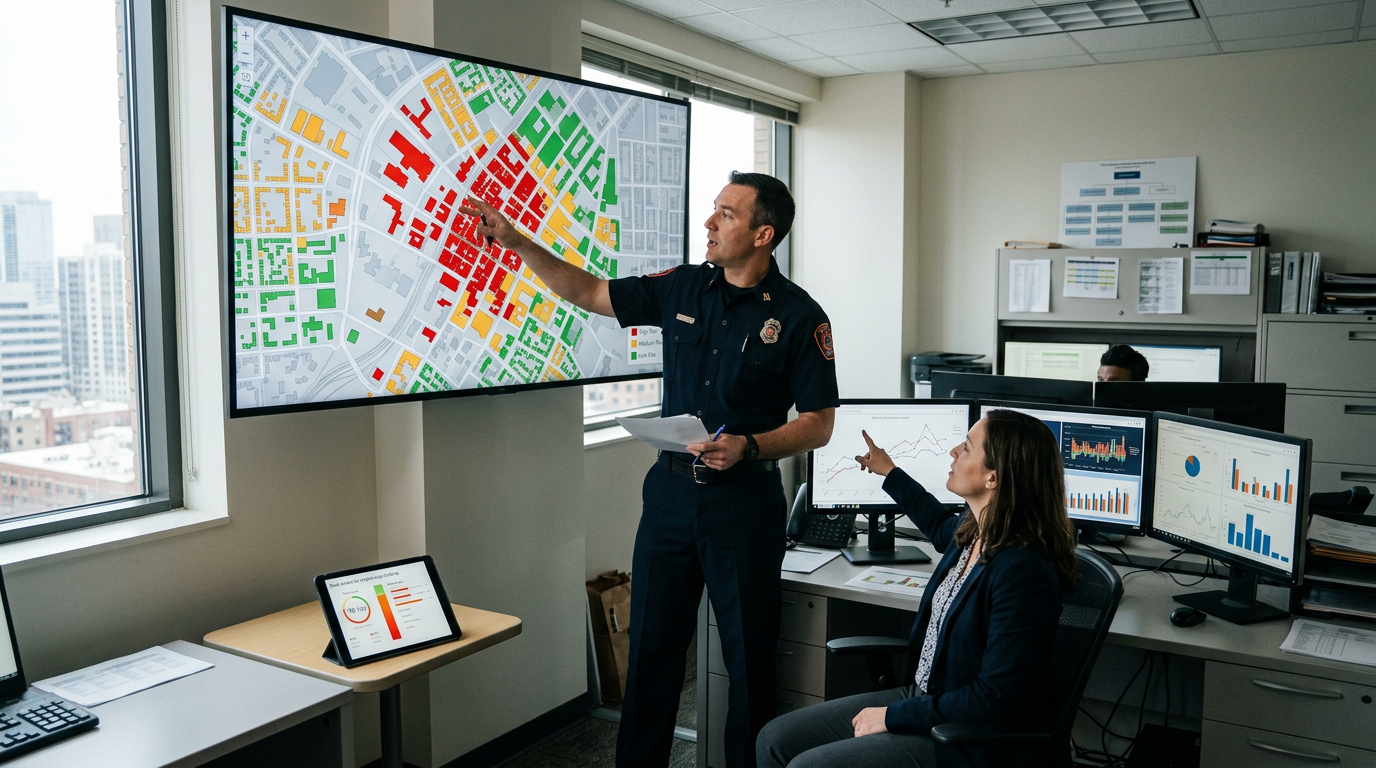
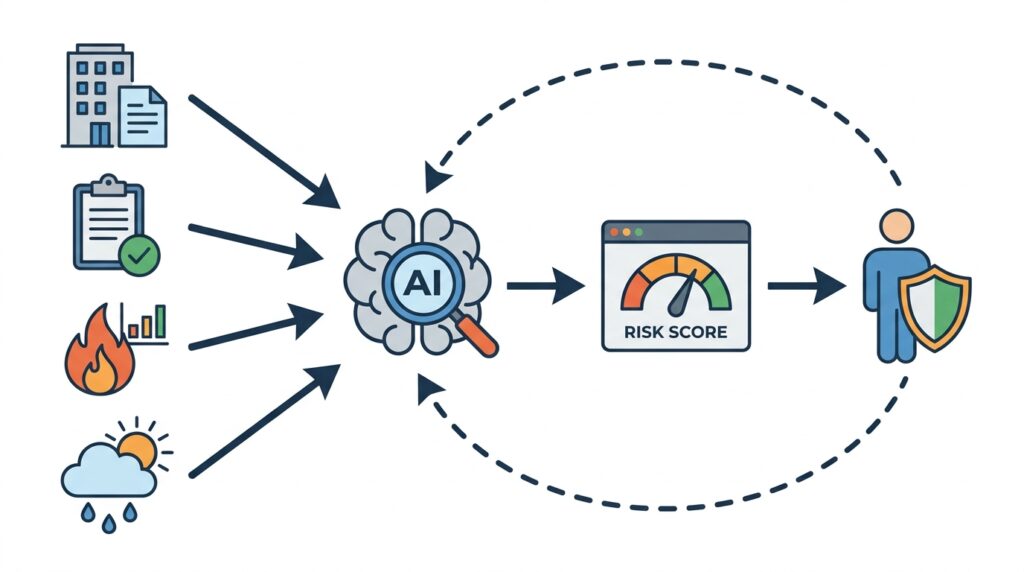
AI and machine learning (ML) offer a complementary approach. Models can analyze large datasets, such as building characteristics, inspection records, incident histories, sensor data, and weather, to find patterns associated with fire risk. They can score buildings, prioritize inspections, flag failing equipment, and learn from new data.
The promise is real. Some fire departments use data-driven models to prioritize inspections, and some insurers use predictive models in underwriting. The limitations are just as real. Models are only as good as their data, they can reproduce existing biases, and they cannot replace the professional judgment that fire safety requires.
This article covers what AI and ML can do, the data that feeds them, the model types, how to validate a model, the applications for fire departments and building owners, the risks, governance, and the regulatory picture.
◆ Section 1: What AI and Machine Learning Can Do for Fire Risk Prediction
| Application | Description | Example |
|---|---|---|
| Risk scoring | Assign a risk score to each building | A model that scores buildings on a 1–100 scale |
| Inspection prioritization | Rank buildings for inspection | A model that identifies the buildings most likely to have serious violations |
| Anomaly detection | Identify unusual patterns in data | A model that flags abnormal sprinkler system pressure readings |
| Predictive maintenance | Predict equipment degradation or failure | A model that flags a fire pump trending toward failure |
| Incident prediction | Estimate the likelihood of a fire | A model that estimates fire probability by building type and area |
| Resource deployment | Optimize station and apparatus locations | A model that tests coverage under different station layouts |
| Text analysis | Extract patterns from reports and narratives | A model that classifies inspection notes and complaints |
A. From Reactive to Proactive. Traditional fire safety is often reactive: inspect, find deficiencies, correct them. AI supports a proactive approach by predicting where problems are likely to occur so that limited resources go there first.
B. Prediction Is Not Prevention. A risk score changes nothing by itself. It is useful only if it changes what people do: which building is inspected, which pump is serviced, which neighborhood receives a prevention program.
C. The Human in the Loop. The model provides information. The fire protection engineer, fire safety director, or fire official makes the decision and is accountable for it.
Key point: AI and ML can support risk scoring, prioritization, anomaly detection, predictive maintenance, incident prediction, and resource deployment. They support judgment; they do not replace it.
Key Article: Article 158 — Digital Twins for Fire Safety Management
Pro Tip: Start with a single application, such as risk scoring for inspection prioritization or predictive maintenance on one equipment type, and demonstrate value before expanding.
◆ Section 2: Data Sources for Fire Risk Prediction
The quality and relevance of the data determine the quality of the predictions.
A. Building Data
| Data | Typical Source |
|---|---|
| Age, type, size, number of stories | Property and assessor records |
| Construction type | Building permits, assessor records |
| Occupancy and use | Business licenses, zoning, permit records |
| Fire protection systems present | Permits, inspection and ITM records |
| Impairments and deficiencies | Inspection and ITM records |
B. Inspection Data
| Data | Typical Source |
|---|---|
| Inspection history and frequency | Fire department records |
| Violations and severity | Fire department records |
| Complaints | 311 or fire department records |
| Corrective action and re-inspection results | Fire department records |
C. Incident Data
| Data | Typical Source |
|---|---|
| Fire incident history and cause | Fire department records; NFIRS or its successor, NERIS, where used |
| Property loss | Fire department and insurance records |
| Injuries and fatalities | Fire department records |
D. Sensor and System Data
| Data | Typical Source |
|---|---|
| Fire alarm events, troubles, and supervisory signals | Fire alarm control unit logs |
| Sprinkler pressure, flow, valve position, and tank levels | Monitored sprinkler system devices |
| Fire pump run data (pressure, vibration, temperature) | Pump controllers and condition-monitoring sensors |
| Battery and power supply condition | Panel and power supply diagnostics |
E. Environmental and Community Data
| Data | Typical Source |
|---|---|
| Weather and drought indices | Meteorological data |
| Wildfire exposure | Wildland-urban interface mapping |
| Flood risk | Flood maps |
| Neighborhood characteristics | Census data |
F. Data Quality
Data is often incomplete, inconsistent, or inaccurate. Addresses do not match across systems, inspection results are coded differently by different inspectors, and occupancy records go stale. Assess data quality before building a model.
G. Proxy Variables and Sensitive Data
Some variables stand in for characteristics that should not drive decisions. Neighborhood income, for example, can act as a proxy for race. Fire incident data can also reflect where the department has historically looked, not just where fires occur. Review every input for proxy risk, and handle personal data in line with privacy laws.
Key point: Data quality must be assessed before the model is built, and every variable should be reviewed for bias and privacy risk.
Pro Tip: Start with the data you have. A model built on imperfect data can still be useful if its limitations are documented and understood.
◆ Section 3: Model Types
A. Supervised Learning
Supervised models learn from labeled data where the outcome is known, such as “fire occurred,” “serious violation found,” or “pump failed.”
| Model Type | Typical Use |
|---|---|
| Logistic regression | Estimate probability of an outcome; highly explainable |
| Decision trees | Simple, rule-like predictions that are easy to explain |
| Random forest | Risk scores; handles complex interactions |
| Gradient boosting | Risk scores; often high accuracy on tabular data |
| Neural networks | Complex patterns, images, and time series |
B. Unsupervised Learning
Unsupervised models find structure in unlabeled data.
| Model Type | Typical Use |
|---|---|
| Clustering | Group buildings by risk profile |
| Anomaly detection | Flag unusual sensor or alarm patterns |
C. Natural Language Processing and Generative AI
NLP can analyze inspection reports, incident narratives, and complaints. Generative AI can summarize reports or help draft documents, but its output must be verified. It can produce plausible text that is wrong, and it should never be the sole source for code citations or compliance conclusions.
D. Computer Vision
Computer vision models analyze images and video, for example to help identify blocked exits, smoke, or flame. Such tools can supplement listed detection and human observation. They do not replace code-required, listed detection and alarm systems.
E. The Explainability Challenge
Some models, especially deep neural networks, are “black boxes.” For fire safety, explainability matters. The professional using the output needs to know why a building scored high, and an AHJ or a court may ask the same question. Explanation techniques (such as feature importance) can help, but a simpler, inherently interpretable model is often the better choice.
Key point: Choose the model based on the application and the need for explainability. A simpler model that people understand and trust may be more useful than a complex one they cannot explain.
Pro Tip: Always compare a complex model against a simple baseline. If gradient boosting barely beats logistic regression, use logistic regression.
◆ Section 4: Validating and Monitoring a Model
A model that has not been validated is a hypothesis, not a tool.
A. Test on Data the Model Has Not Seen
Hold back a portion of the data, or test on a later time period, to see how the model performs on new cases. Testing on the training data only measures memorization (overfitting).
B. Use Metrics That Fit the Problem
Fires and serious failures are rare, so a model that always predicts “no fire” can be 99% accurate and completely useless. Look at:
| Metric | What It Tells You |
|---|---|
| Recall (sensitivity) | How many of the real problems the model caught |
| Precision | How many of the model’s flags were real problems |
| Ranking quality (e.g., AUC, lift) | How well the model ranks high-risk above low-risk |
| Calibration | Whether a “20% risk” really means about 20% |
C. Weigh the Cost of Errors
A false negative (a dangerous building scored as low risk) and a false positive (a safe building flagged for inspection) have very different consequences. Set thresholds with those consequences in mind, and keep low-scored buildings in the regular inspection cycle.
D. Watch for Data Leakage
Leakage happens when the model is trained on information that would not be available at prediction time, such as post-fire inspection findings. It makes results look better than they will be in practice.
E. Test Fairness
Compare performance and inspection burden across neighborhoods and building types. If one area is flagged far more often, determine whether the cause is real risk or a bias in the data.
F. Monitor for Drift
Buildings, occupancies, codes, climate, and inspection practices change. A model that worked last year may degrade. Re-test on a schedule and retrain when performance drops.
G. Beware Feedback Loops
If the model sends inspectors to certain buildings, more violations will be found there, and those findings become the next round of training data. The model can end up confirming its own predictions. Keep a random or rotating sample of inspections outside the model’s priorities to test it.
Key point: Validate on new data, use metrics suited to rare events, test for fairness, and monitor for drift and feedback loops for as long as the model is in use.
Pro Tip: Define success before deployment (for example, “finds more serious violations per inspection hour than the current method”) and measure against it.
◆ Section 5: Applications in Fire Departments
A. Inspection Prioritization
Fire departments have limited inspection resources. Models can help decide which buildings to inspect first, which need more frequent inspection, and which are likely to have serious deficiencies. This works alongside, not instead of, the inspection frequencies required by the adopted code and local policy (see NFPA 1730 for guidance on organizing inspection programs).
B. Resource Deployment
Models can help evaluate station locations, apparatus coverage, and response patterns.
C. Community Risk Reduction
NFPA 1300 describes community risk assessment and risk reduction planning. AI can help identify higher-risk areas and populations so that smoke alarm programs, education, and other prevention efforts are targeted where they will matter most.
D. Examples
Several departments have piloted data-driven inspection prioritization. New York City’s FDNY developed a risk-based inspection approach (FireCast), and Atlanta Fire Rescue worked with Georgia Tech on a predictive model called Firebird. Programs of this type continue to evolve.
E. Results
Results are mixed. Some programs report better targeting of inspections, while others face questions about bias, transparency, or measurable benefit. Any program should be evaluated for both effectiveness and fairness.
Key point: Fire departments use AI for inspection prioritization, resource deployment, and community risk reduction. Programs must be evaluated for effectiveness and fairness.
Key Article: Article 147 — Annual Fire Safety Inspections: A Complete Guide
Pro Tip: Evaluate predictions against actual outcomes. A model that predicts risk but does not improve outcomes is not useful.
◆ Section 6: Applications for Building Owners
A. Predictive Maintenance
Condition data can help predict failures in:
- Fire pumps (vibration, temperature, pressure trends)
- Sprinkler system components (valves, tanks, compressors)
- Fire alarm panels, devices, and batteries
- Smoke control fans and dampers
Important: Predictive maintenance supplements, but does not replace, the inspection, testing, and maintenance required by NFPA 25, NFPA 72, and the adopted code. A model cannot be used to extend or skip required test intervals unless the AHJ accepts it, for example through an approved alternative method. Impairments still require proper impairment procedures.
B. Risk Scoring
Owners with multiple buildings can use scores to decide which sites need attention first, which systems should be replaced, and where to concentrate audits.
C. Anomaly Detection
Models can detect unusual patterns in system data, such as abnormal pressure readings, repeated nuisance alarms from one zone, or devices that report intermittently, before they become failures.
D. Insurance and Underwriting
Insurers increasingly use data models. Owners can use their own data (ITM records, impairment history, sensor trends) to demonstrate good risk management.
E. Integration with Digital Twins
Models can be integrated with digital twins (Article 158) to provide real-time risk assessment and maintenance prediction.
F. Cybersecurity
Connecting fire protection systems to analytics platforms creates cyber risk. Keep life safety systems isolated or protected so that a network problem cannot affect alarm or suppression operation, and confirm that any cloud or remote connection meets the listing and the AHJ’s requirements.
Key point: Building owners can use AI for predictive maintenance, risk scoring, and anomaly detection, but code-required ITM remains in force.
Pro Tip: Start with predictive maintenance. The data is often available, outcomes are measurable, and the value is clear.
◆ Section 7: Limitations and Risks
| Limitation | Description |
|---|---|
| Data quality | Incomplete, inconsistent, or inaccurate data produces unreliable predictions |
| Bias | Models reproduce biases in the training data, such as over-inspection of certain areas |
| Generalization | A model trained in one jurisdiction or building type may fail in another |
| Explainability | Black-box predictions are hard to trust and defend |
| Overfitting | A model can perform well on training data and poorly on new data |
| Rare events | Fires and major failures are rare, which makes them hard to predict |
| Drift and feedback loops | Performance degrades over time, and models can reinforce their own predictions |
| False reassurance | A low score can lead people to relax attention on a building that still needs it |
| The human judgment gap | AI cannot replace professional judgment or accountability |
Key point: These limitations must be understood and managed. The most serious failure is trusting a prediction more than the evidence supports.
Pro Tip: Treat a model’s output as one input among several. Never use a low risk score as a reason to skip a required inspection or a known corrective action.
◆ Section 8: Integrating AI into Fire Safety Programs
AI should be part of the fire safety program, not a standalone tool.
A. Integration Points
| Program Element | Integration |
|---|---|
| Risk assessment | AI scores inform the assessment |
| Inspection planning | AI helps prioritize; the code-required cycle still applies |
| Maintenance | AI flags emerging failures; ITM continues |
| Resource planning | AI informs deployment decisions |
| Training | Staff learn the tools and their limits |
| Governance | Humans review AI-informed decisions |
B. Governance Framework
| Element | Detail |
|---|---|
| Ownership | Who owns the AI system and its data |
| Accountability | Who is accountable for decisions informed by the model |
| Transparency | How the model works and what data it uses |
| Fairness | How bias is identified and mitigated |
| Validation | How and how often the model is tested |
| Review and change control | How the model is updated, retrained, or retired |
| Incident response | What happens when the model is wrong or fails |
ISO/IEC 42001, ISO/IEC 23894, and the NIST AI Risk Management Framework offer structures for these elements.
C. Vendors and Procurement
If the model comes from a vendor, ask:
- What data was it trained on, and does it resemble your buildings?
- Can the vendor explain how scores are produced?
- What validation evidence exists, and in which jurisdictions?
- Who owns the data and the outputs?
- What happens to your data if the contract ends?
- How are bias, drift, and security handled?
D. Records and Public Disclosure
Government use of AI may be subject to public records laws, and decisions informed by a model may be questioned in disputes or litigation. Keep documentation of the model’s purpose, data, validation, and limitations.
E. The Human in the Loop
The human makes the final decision and is accountable for the outcome. Give staff the authority to override the model, and record when and why they do.
Key point: Integrate AI with clear governance, documented validation, vendor accountability, and a human in the loop.
Pro Tip: Document the system’s purpose, data sources, model type, validation results, and limitations. That documentation is the evidence of responsible use.
◆ Section 9: The Regulatory Framework
AI in fire risk prediction is not currently governed by specific fire code provisions. The regulatory landscape is developing.
A. Fire Codes
NFPA 101, NFPA 1, and the IFC do not currently address AI as a risk assessment tool. The codes govern fire protection systems and required ITM, not the tools used to prioritize work. Any use of AI must still satisfy the prescriptive or performance requirements of the adopted code.
B. AI Standards and Frameworks
| Standard | Scope |
|---|---|
| ISO/IEC 42001 | AI management systems |
| ISO/IEC 23894 | AI risk management guidance |
| NIST AI Risk Management Framework | Voluntary, risk-based AI framework |
C. AI and Privacy Laws
Depending on location, AI use may be affected by data privacy laws (such as GDPR and U.S. state privacy laws), anti-discrimination and civil rights requirements, and emerging AI-specific laws (such as the EU AI Act and certain U.S. state laws). Public agencies may face additional obligations around transparency and fairness. Requirements vary and change quickly.
D. The AHJ’s Perspective
The AHJ may accept AI-informed assessments as supporting information in a fire safety plan, but acceptance is jurisdiction-specific. Using AI to modify or reduce a code requirement generally requires approval as an alternative method or a performance-based design.
Key point: No specific fire code provisions govern AI in fire risk prediction, but code requirements, privacy law, and civil rights obligations still apply.
Pro Tip: For any AI system used in fire safety, consult legal counsel and the AHJ early.
◆ Section 10: Common Challenges and Mistakes
| Challenge or Mistake | Why It Happens or Matters | Solution |
|---|---|---|
| Assuming data is accurate | Unreliable predictions | Data quality assessment |
| Ignoring bias | Historical biases are reproduced | Bias testing, proxy review, mitigation |
| Using black-box models without need | Predictions cannot be explained | Prefer explainable models; compare to a baseline |
| Over-relying on AI | Human judgment bypassed | Human in the loop; override authority |
| Not validating | The model may not work in practice | Validate on new data against outcomes |
| Judging by accuracy alone | Misleading for rare events | Use recall, precision, calibration |
| Ignoring drift and feedback loops | Performance decays and bias grows | Monitor, retrain, and keep random samples |
| Using AI to skip ITM | Code violation and real safety risk | Treat AI as a supplement to required ITM |
| Not documenting the model | No evidence of responsible use | Document purpose, data, limitations |
| Ignoring privacy and civil rights law | Legal risk | Legal review; privacy-by-design |
| Weak vendor diligence | Unknown training data and claims | Procurement questions; contract terms |
| Not consulting the AHJ | Regulatory risk | Engage the AHJ early |
| Not training staff | The tool is misused or ignored | Train on use and limitations |
| Expecting too much too soon | Disappointment and abandonment | Start with a pilot |
Key point: Most AI challenges are data, governance, and human-factors challenges, not technical ones.
Pro Tip: Start with a small pilot, validate the results, and expand only if the value is demonstrated.
◆ Section 11: Design Checklist
| Item | Status | Notes |
|---|---|---|
| Application and success measure defined | ☐ | Risk scoring, prioritization, maintenance |
| Data sources identified | ☐ | Building, inspection, incident, sensor, environmental |
| Data quality assessed | ☐ | Completeness, accuracy, consistency |
| Proxy and privacy review done | ☐ | Sensitive or proxy variables |
| Model type selected | ☐ | Based on application and explainability |
| Baseline comparison done | ☐ | Simple model vs. complex model |
| Validation plan | ☐ | New data; metrics suited to rare events |
| Bias and fairness testing | ☐ | Across areas and building types |
| Drift monitoring and retraining plan | ☐ | Scheduled review |
| Governance defined | ☐ | Ownership, accountability, change control |
| Human-in-the-loop and override process | ☐ | Human makes the final decision |
| Vendor due diligence | ☐ | If using a third-party model |
| Cybersecurity | ☐ | Life safety systems protected |
| Regulatory and privacy review | ☐ | AHJ, legal counsel |
| Confirmation that required ITM continues | ☐ | NFPA 25, NFPA 72 |
| Documentation | ☐ | Purpose, data, validation, limitations |
| Staff training | ☐ | Tools and limitations |
| Pilot plan | ☐ | Start small |
◆ Section 12: Conclusion
AI and machine learning offer a new way to approach fire risk prediction. Instead of relying solely on professional judgment, models can analyze large datasets to find patterns that help prioritize inspections, anticipate equipment failures, and direct prevention efforts.
But AI is not a replacement for professional judgment. The models are only as good as their data, they can reproduce existing biases, they can drift over time, and some cannot explain their predictions. A prediction does not remove the need for required inspection, testing, and maintenance, and it does not shift accountability away from the people who use it.
Key Takeaways:
- AI and ML can support risk scoring, prioritization, anomaly detection, predictive maintenance, incident prediction, and resource deployment.
- The model is only as good as the data it is trained on.
- Models can perpetuate bias, so test for it and review variables for proxy risk.
- Explainability matters for fire safety; prefer simpler models where they perform comparably.
- Validate on new data, with metrics suited to rare events, and monitor for drift and feedback loops.
- AI supplements, and does not replace, professional judgment or code-required ITM.
- No specific fire code provisions govern AI in fire risk prediction, but privacy, civil rights, and other laws may apply.
- Governance should cover ownership, accountability, transparency, fairness, validation, change control, and vendor oversight.
- Start small, validate the results, and expand only if the value is demonstrated.
Take Action Today:
- Define the application and how you will measure success.
- Identify data sources and assess their quality and bias risk.
- Choose an explainable model and compare it against a simple baseline.
- Plan validation, fairness testing, and ongoing monitoring.
- Define governance and a human-in-the-loop process.
- Confirm that code-required ITM and inspection cycles continue unchanged.
- Document the model and consult the AHJ and legal counsel.
- Train staff, and run a small pilot first.
Continue Reading from Our Series:
- Related guide: Article 159 — Drone and Robotics Applications in Fire Safety
- Related guide: Article 158 — Digital Twins for Fire Safety Management
- Related guide: Article 147 — Annual Fire Safety Inspections: A Complete Guide
- Read more: Article 161 — NFPA 101 vs. IBC: Key Differences Explained (planned)
About This Guide: This article is part of a series on commercial building fire safety, written for facility managers, architects, and code officials. It references model codes and standards for educational purposes. Always consult your local AHJ and a qualified fire protection engineer for project-specific requirements.