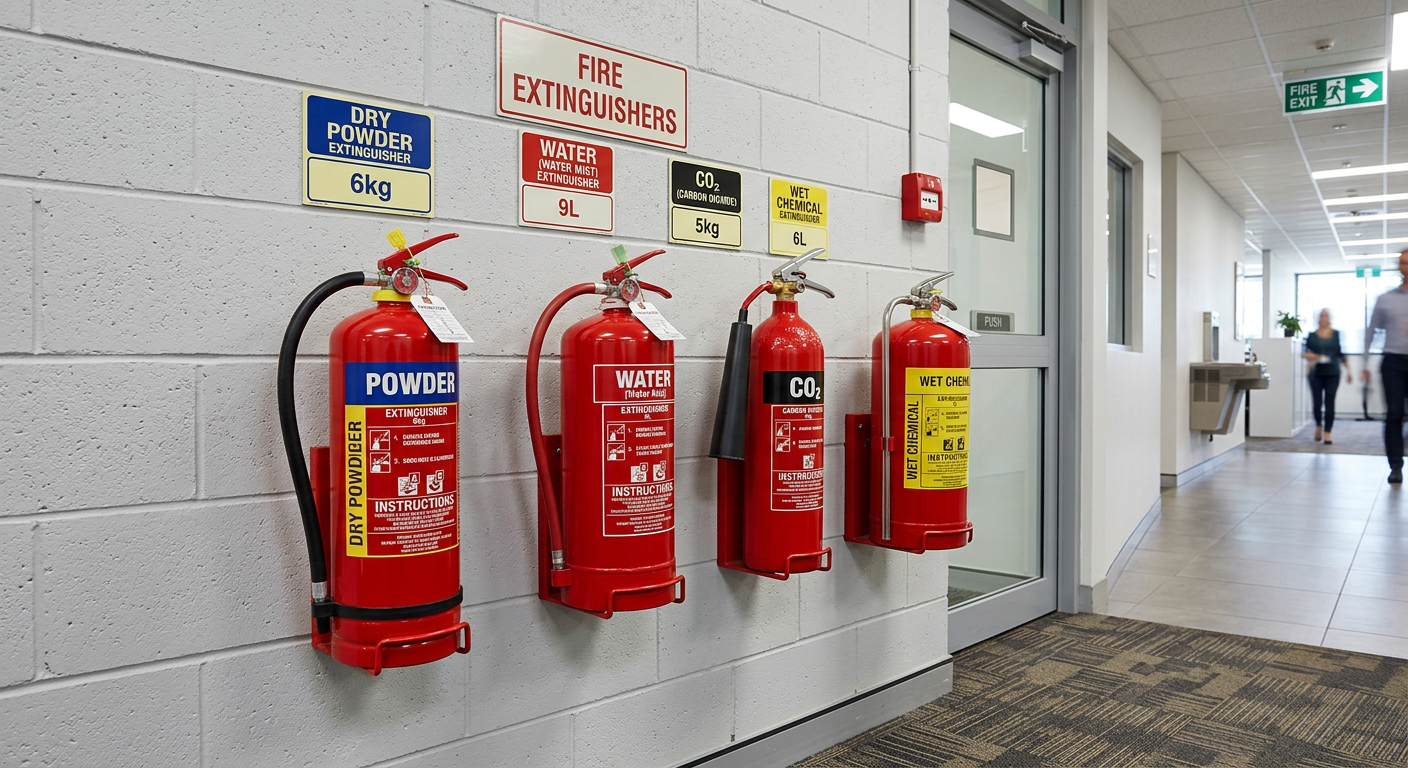
Portable fire extinguishers are your first line of defense against small fires in commercial buildings. However, simply having extinguishers on-site is not enough—they must be the right type, placed in the right locations, and supported by trained personnel.
This comprehensive guide covers:
- Which occupancies require portable fire extinguishers.
- What types to install in different building locations.
- Proper mounting and placement requirements.
- Training requirements for building occupants.
Section 1: Occupancy Requirements for Portable Fire Extinguishers [1]
NFPA 101, the Life Safety Code, specifies which occupancies require portable fire extinguishers. The requirements depend on the occupancy type and whether the building is sprinklered.
| Occupancy Type | Does Sprinkler Status Affect the Requirement? | Portable Extinguisher Required? | Code Reference |
|---|---|---|---|
| Ambulatory | No — required regardless of sprinklers | ✅ Yes | NFPA 101, 20.3.5.2 & 9.7.4.1 |
| Business | No — required regardless of sprinklers | ✅ Yes | NFPA 101, 38.3.5 & 9.7.4.1 |
| Healthcare | No — required regardless of sprinklers | ✅ Yes | NFPA 101, 18.3.5.6 & 9.7.4.1 |
| Mercantile | No — required regardless of sprinklers | ✅ Yes | NFPA 101, 36.3.5.3 |
| Educational | Not applicable — verify against the current chapter text | ❌ No (check sprinkler requirements) | NFPA 101, 14.3.5 |
| One & Two Family Dwellings | Not applicable — verify against the current chapter text | ❌ No (check sprinkler requirements) | NFPA 101, 24.3.5.1 |
| Hotels & Dormitories | Yes — required in hazardous areas lacking sprinkler protection | ✅ Required in hazardous areas without sprinklers | NFPA 101, 28.3.5.8 |
| Apartments | Yes — required in hazardous areas lacking sprinkler protection | ✅ Required in hazardous areas without sprinklers | NFPA 101, 30.3.5.12 |
| Storage | Not applicable | ❌ No | NFPA 101, 42.3.5 |
Key Takeaway: Even when not required, providing portable fire extinguishers in all commercial buildings is a best practice that can save lives and property.
Section 2: Fire Extinguisher Types by Location [2]
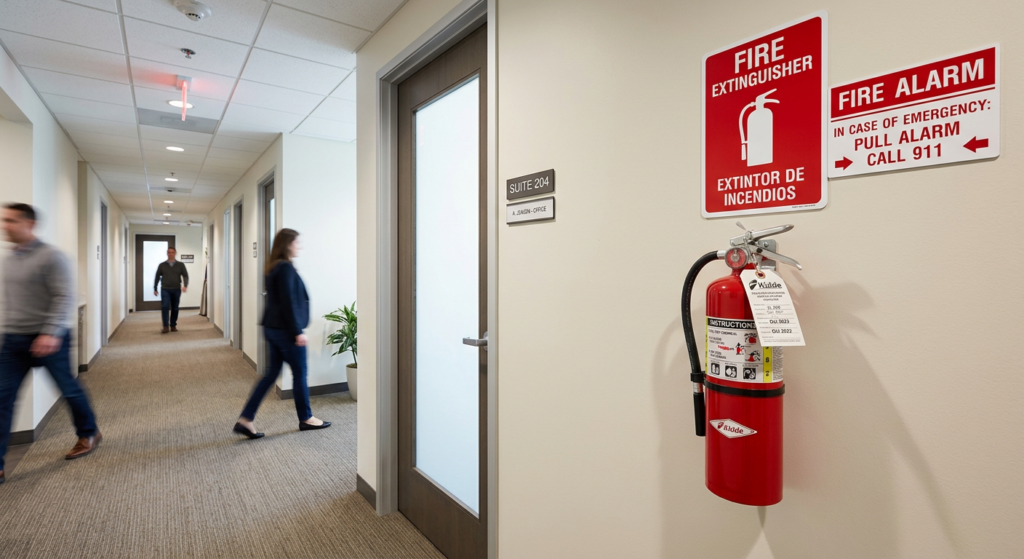
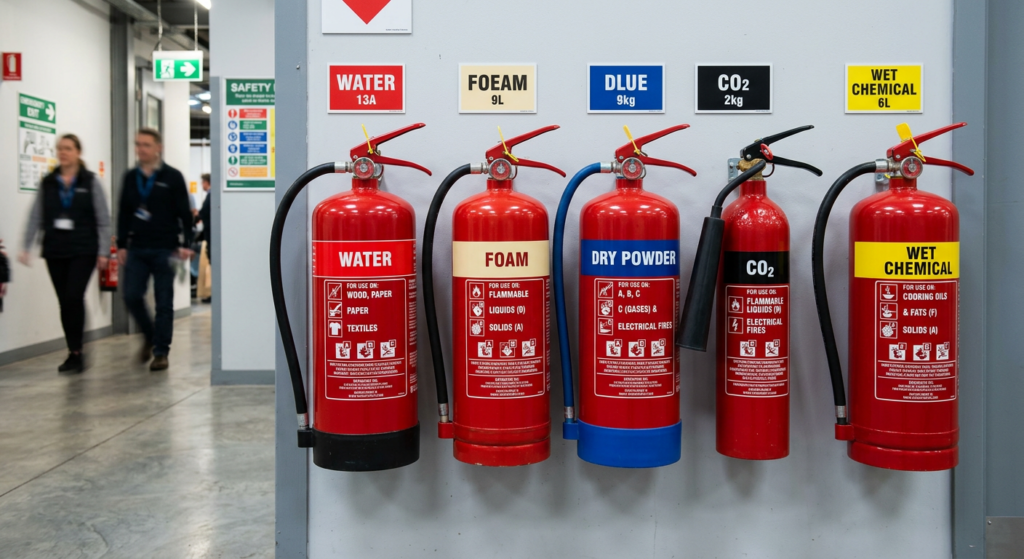
Different building areas present different fire hazards. Selecting the right extinguisher type for each location is critical for effective fire response.
Note: The table below reflects regional fire and life safety practice (Gulf Cooperation Council / Middle East civil defence guidance) and uses metric extinguisher sizes and travel distances. It is not derived from NFPA 10. Readers in U.S. jurisdictions should instead apply NFPA 10 Table 6.2.1.1 (Class A) and Table 6.3.1.1 (Class B) for extinguisher sizing and travel-distance requirements — see [2] below.
| Location | Recommended Extinguisher Types | Max Travel Distance |
|---|---|---|
| Offices | 9 Ltr Water (Class A) + 2 kg CO2 (Class B/C) | 15 m |
| Common Circulation Areas (Corridors, Lobbies) | 9 Ltr Water + 5 kg CO2 | 22.5 m |
| Electrical Rooms, Mechanical Plant Rooms | 4.5 kg Dry Powder (ABC) + 5 kg CO2 | 9 m |
| Parking Areas | 4.5 kg ABC Dry Powder + 2 kg CO2 + Foam Trolley (20 Gal) | 15 m (30 m along driveways) |
| Transformer Rooms | 4.5 kg Dry Powder + 5 kg CO2 + 25 kg Dry Powder Trolley | 9 m |
| HV / LV Rooms | 4.5 kg Dry Powder + 5 kg CO2 + 12 kg Dry Powder Trolley | 9 m |
| Diesel Generator Rooms | 4.5 kg Dry Powder + 5 kg CO2 + 20 Gal Foam Trolley | 9 m |
| Garbage Collection Rooms | 6 kg Dry Powder (ABC) | 9 m |
| Libraries | ABC Dry Powder (Class A, B, C) + 2 kg CO2 | 15 m |
| Laboratories | 9 Ltr Water + 2 kg CO2 + 4.5 kg Dry Powder | 9 m |
| Gymnasiums | 9 Ltr Water + 4.5 kg Dry Powder | 15 m |
| Theaters | ABC Dry Powder (Class A, B, C) + 2 kg CO2 | 15 m |
| Kitchens | 2 kg CO2 + 4.5 kg Dry Powder + Foam Extinguisher | 9 m |
| Patient Rooms | 9 Ltr Water + 2 kg CO2 + 4.5 kg Dry Powder | 15 m |
| Hotels | 9 Ltr Water + 2 kg CO2 + 4.5 kg Dry Powder | 15 m |
Important Note on Libraries and Theaters: Water extinguishers are not recommended for these locations due to the presence of electrical equipment. ABC Dry Powder is a safer, more effective alternative.
Section 3: Mounting and Placement Requirements [1]
Proper mounting ensures that extinguishers are accessible, visible, and secure.
| Requirement | Details |
|---|---|
| Maximum Mounting Height | Top of the fire extinguisher must be no more than 1.5 meters (5 feet) above the finished floor. |
| Minimum Mounting Height | Bottom of the fire extinguisher must be at least 10 cm (4 inches) from the finished floor. |
| Accessibility | Extinguishers must not be blocked by furniture, equipment, or storage. |
| Visibility | Extinguishers must be clearly visible or marked with a visible sign. |
| Securing | Extinguishers must be securely mounted on a wall or placed in an approved stand/cabinet. |
Compliance Tip: For extinguishers weighing over 18 kg (40 lbs), the maximum mounting height is 1.07 m (3.5 feet).
Section 4: Training Requirements [2]
Having fire extinguishers is not enough—your staff must know how to use them.
| Requirement | Details |
|---|---|
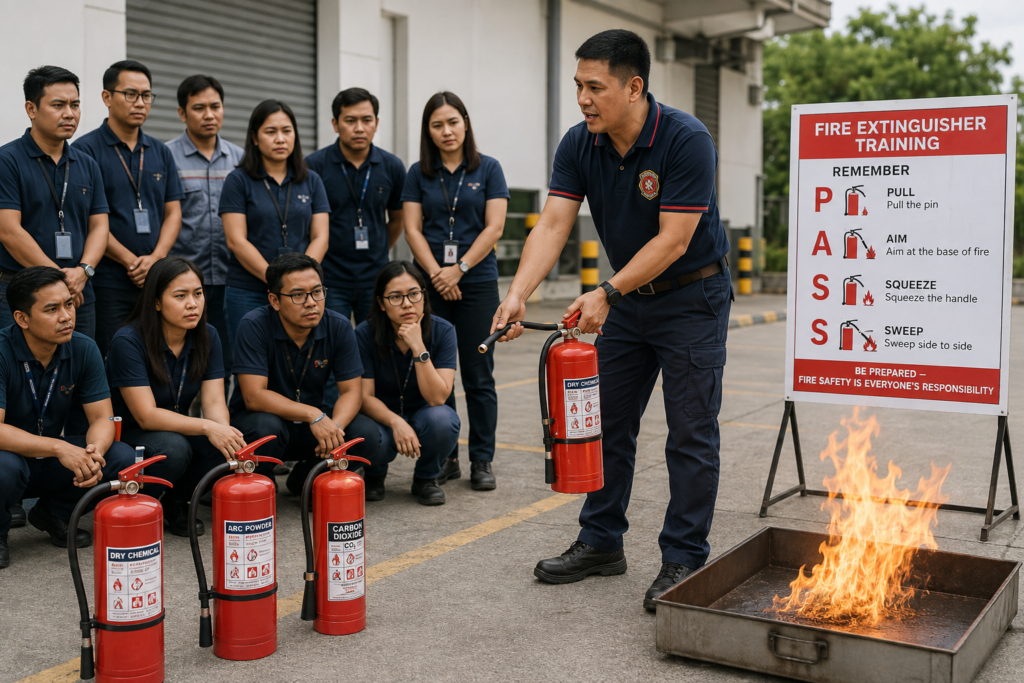
| Who Must Be Trained | At least 10% of Security Personnel, Occupants, Employees, and Supervisory Personnel. |
| Training Content | Basic fire awareness, extinguisher types, proper use, and operation in emergency situations. |
| Frequency | Initial training upon hire and annual refresher training thereafter. |
| Documentation | All training must be documented and records retained for inspection. |
Pro Tip: Consider incorporating “hands-on” training where staff can practice using a fire extinguisher on a controlled fire (using a training prop).
Section 5: Additional Resources
For more information, refer to these trusted resources:
- Fire Safety Advice Center: Portable Fire Extinguisher Guide
- Video: Fire Extinguisher Location and Use
- Reference Guide: Selection, Installation, and Distribution of Portable Fire Extinguishers
Conclusion
Portable fire extinguishers are a critical component of any commercial building’s fire safety plan. By understanding:
- Which occupancies require extinguishers.
- What types to install in each location.
- How to properly mount and place them.
- Who needs to be trained and how often.
You can ensure your building is prepared for fire emergencies.
Take Action Today:
- Audit your building’s fire extinguishers.
- Replace any incorrect types (especially water extinguishers in libraries/theaters).
- Schedule annual training for your staff.
- Document all inspections and training.
References & Notes
[1] NFPA 101, Life Safety Code, 2024 Edition — occupancy chapters as cited per row (9.7.4.1, 20.3.5.2, 38.3.5, 18.3.5.6, 36.3.5.3, 14.3.5, 24.3.5.1, 28.3.5.8, 30.3.5.12, 42.3.5); NFPA 10, Standard for Portable Fire Extinguishers, 2024 Edition — Section 6.1.3 (Mounting Height).
[2] Regional fire and life safety code guidance (Gulf Cooperation Council / Middle East civil defence practice) governing extinguisher type, agent quantity, and travel distance by building area and occupant training percentage; figures presented here are metric-native and are not derived from NFPA 10. Readers in U.S. jurisdictions should apply NFPA 10 Table 6.2.1.1 (Class A) and Table 6.3.1.1 (Class B) travel-distance and sizing requirements instead.