
IMPORTANT DISCLAIMER: This guide references ISO (Insurance Services Office, a Verisk business) Public Protection Classification (PPC), the Fire Suppression Rating Schedule (FSRS), and the Building Code Effectiveness Grading Schedule (BCEGS); FM Global Property Loss Prevention Data Sheets; NFPA 101, Life Safety Code; NFPA 1, Fire Code; NFPA 13 (sprinkler systems); NFPA 14 (standpipe systems); NFPA 20 (stationary fire pumps); NFPA 25, Standard for the Inspection, Testing, and Maintenance of Water-Based Fire Protection Systems; NFPA 51B (hot work); NFPA 70B (electrical equipment maintenance); NFPA 72, National Fire Alarm and Signaling Code; NFPA 80 (fire doors); NFPA 96 (commercial cooking); NFPA 10, Standard for Portable Fire Extinguishers; NFPA 291 (hydrant flow testing); the International Fire Code (IFC); and the requirements of individual property insurers and reinsurers. Insurance rating methodologies, credit schedules, policy forms, and underwriting requirements vary by insurer, by jurisdiction, and by property type. ISO PPC classifications are community-level ratings; individual commercial property ratings depend on building-specific characteristics. This guide is educational and is not insurance, legal, or engineering advice. It is a starting point only. Always verify the specific requirements and available credits with your property insurer, your broker, and your Authority Having Jurisdiction (AHJ).
Fire protection and insurance are inseparable. The systems that protect a building from fire also help determine what the building costs to insure. A building with a complete, maintained, and verified fire protection system is a better risk than a building without one, and insurers price that difference into premiums, deductibles, and coverage terms.
Fire protection credits are the mechanism by which insurers recognize the presence and quality of fire protection. They take many forms: a reduction in premium for a sprinklered building, a discount for a monitored fire alarm, a better rate for a building in a community with a strong fire department. But credits are not automatic. They depend on the system being installed correctly, maintained properly, and documented convincingly. A sprinkler system with no inspection records may earn little or no credit.
Fire protection is also more than a pricing matter. Many property policies make the continued operation of specific protective systems a condition of coverage, so a neglected system can affect not only the premium but also whether a fire loss is paid in full. This article therefore covers how insurers evaluate fire risk, the ISO Public Protection Classification and related community ratings, FM Global data sheets, the credits available for specific systems, the policy conditions that tie coverage to protection, the documentation insurers require, how to prepare for insurer surveys, and how to maximize credits while maintaining the underlying fire safety that the credits are meant to recognize.
◆ Section 1: How Insurers Evaluate Fire Risk
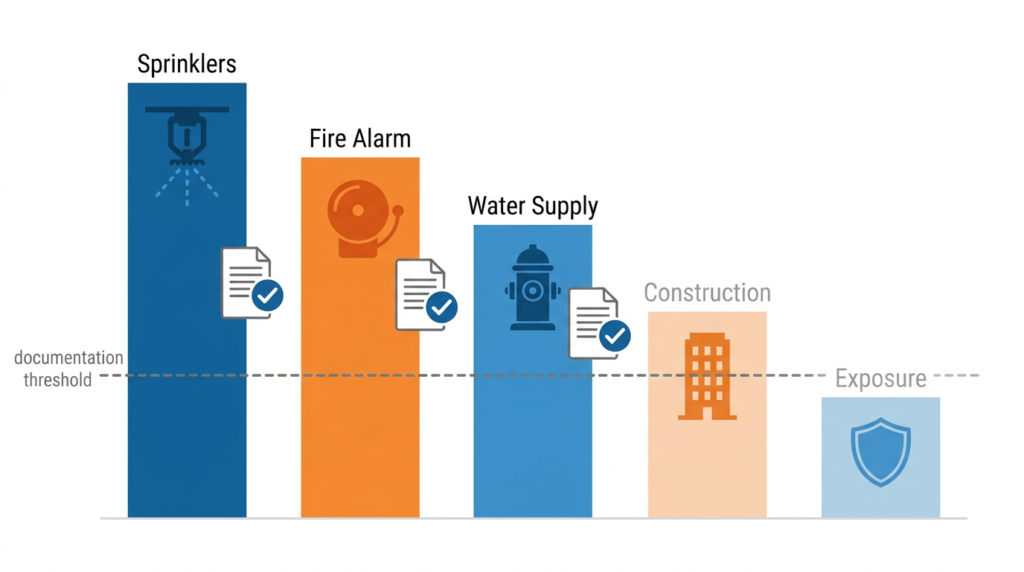
Insurers evaluate commercial property risk through a framework known as COPE: Construction, Occupancy, Protection, and Exposure.
| Factor | What Insurers Evaluate |
|---|---|
| Construction | Building materials, fire-resistance ratings, roof assembly, exterior walls, concealed spaces, age of building |
| Occupancy | What the building is used for; hazard classification; combustible loading; processes, storage, and ignition sources |
| Protection | Sprinklers, alarms, extinguishers, water supply, public fire department, private fire brigade |
| Exposure | Adjacent buildings, wildfire risk, flood and other natural hazards, external hazards |
A. The Underwriter’s Perspective
The underwriter is not evaluating code compliance. The underwriter is evaluating the probability and severity of loss. A building that meets code but has poor maintenance records is a worse risk than a building that exceeds code with documented maintenance.
Insurers typically consider two loss measures: the probable maximum loss (the large loss expected if protection performs as intended) and the maximum foreseeable loss (the large loss expected if protection fails or is impaired). Fire protection credits mostly reflect confidence in the first measure. Documentation, impairment control, and maintenance determine whether the insurer believes the first measure or the second.
B. The Role of Fire Protection Credits
Fire protection credits reduce the premium to reflect reduced risk. The logic is straightforward: a building with automatic sprinklers is less likely to suffer a total loss than a building without them. The credit reflects that reduced probability and severity.
Credits are only one input to the premium. Pricing also reflects loss history, limits and deductibles, location and catastrophe exposure, the insurer’s own rating plan (which may apply schedule credits and debits for building features and management), and market conditions. A strong fire protection program improves the insurer’s view of the risk, but it does not by itself guarantee a lower premium in a hardening market.
C. Credits Are Not Guaranteed
Credits are not automatic. The insurer must be satisfied that the system is:
- Designed for the occupancy and hazard
- Installed correctly
- Maintained per applicable standards
- Documented with current records
- Monitored where required
Key point: Fire protection credits recognize risk reduction. The system must actually reduce risk, not just exist on paper, to earn the credit.
D. Accurate Submissions Matter
The insurer’s view of the risk starts with the information supplied by the owner and broker: the application, the statement of values, and the COPE data. Describing protection that is not installed, not working, or not maintained can lead to denied credits, a reduced or denied claim, or, in serious cases, rescission of coverage. Describe the protection as it actually exists, and update the insurer when it changes.
Pro Tip: Ask your insurer for a written breakdown of the credits applied to your premium. Understanding what you are receiving helps you protect it and identify credits you may be eligible for but not receiving.
◆ Section 2: ISO Public Protection Classification and Related Community Ratings
The ISO Public Protection Classification (PPC) is a community-level rating that insurers use to help set premiums. It is one of the most widely used fire protection rating systems in the United States. It is produced by evaluating a community against the Fire Suppression Rating Schedule (FSRS).
A. What the PPC Measures
The PPC evaluates the community’s fire protection capability, not the individual building’s. The FSRS assigns up to 105.5 points across four areas:
| Category | Points (Approximate) | What Is Reviewed |
|---|---|---|
| Fire department | 50 | Engine and ladder/service company distribution, equipment, staffing, training, response |
| Water supply | 40 | Supply capacity, hydrant condition and spacing, hydrant inspection and flow testing |
| Emergency communications | 10 | Call receipt, alarm dispatch, telecommunicator staffing and training |
| Community risk reduction | 5.5 (additional) | Fire prevention code adoption and enforcement, public education, fire investigation |
The score is converted to a class from 1 to 10, where Class 1 (90 or more points) is the best and Class 10 indicates the community does not meet minimum criteria. Always confirm the current scoring details with ISO or your broker, as the schedule is updated periodically.
B. What the PPC Does Not Measure
The PPC does not evaluate:
- The individual building’s construction
- The building’s sprinkler system
- The building’s fire alarm
- The building’s housekeeping or maintenance
These are evaluated separately by the insurer through the commercial property rating process. For large, sprinklered, individually rated risks, the PPC often has a smaller influence on the premium than it does for small, unsprinklered buildings, because the building’s own protection dominates the loss expectation.
C. Building Code Effectiveness Grading (BCEGS)
A second ISO community-level rating, the Building Code Effectiveness Grading Schedule (BCEGS), grades a community’s adoption and enforcement of building codes on a scale of 1 to 10, with 1 the best. Insurers may consider the BCEGS grade alongside the PPC, because a community that enforces modern codes tends to have buildings that perform better in fire, wind, and other events. Like the PPC, the BCEGS grade is a community rating that the building owner cannot change directly.
D. Split Classifications
Some communities have split classifications (for example, 5/9 or 5/5Y). The first number applies to properties within five road miles of a responding fire station and within 1,000 feet of a creditable water supply (typically a fire hydrant). The second number applies to properties within five road miles of a station but beyond 1,000 feet of a creditable water supply. Properties more than five road miles from a responding station are generally Class 10. Classification letters and details vary, so verify the exact meaning with ISO or your broker.
E. What You Can and Cannot Control
You cannot change your community’s PPC or BCEGS grade. You can:
- Verify your property’s classification (some properties may qualify for a better split classification, for example when a hydrant is within 1,000 feet)
- Understand how the PPC affects your specific premium
- Participate in community fire protection planning where appropriate
- Focus on the building-specific protections you control
Key point: The PPC is a community rating. The building-specific protections (sprinklers, alarms, maintenance) are the part you control.
Key Article: Article 147 — Annual Fire Safety Inspections: A Complete Guide
Pro Tip: Ask your broker how the PPC affects your specific premium. In some cases, the building-specific credits matter more than the community classification.
◆ Section 3: FM Global and Property Loss Prevention Data Sheets
FM Global is a mutual insurance company that publishes Property Loss Prevention Data Sheets, which are detailed engineering guidelines for preventing property loss. Many insurers, not just FM Global, reference these data sheets in their underwriting.
A. What the Data Sheets Cover
FM Global data sheets are organized by numbered series:
| Series | Subject | Example Topics |
|---|---|---|
| 1 | Construction | Roof and wall assemblies, wind, fire-resistive construction |
| 2 | Fire protection | Sprinkler installation, fire safety inspection (DS 2-0, DS 2-81) |
| 3 | Water supply | Hydraulics, fire pumps, nonstorage occupancies (DS 3-7, DS 3-26) |
| 4 | Extinguishing equipment | Special protection systems, portable extinguishers |
| 5 | Electrical | Electrical equipment, automatic fire detection (DS 5-48), energy storage |
| 7 | Hazards | Flammable liquids, process hazards |
| 8 | Storage | Commodity classification and storage arrangements (DS 8-9) |
| 10 | Human element | Hot work management (DS 10-3), pre-incident planning, contractor control |
Series topics and data sheet numbers are updated over time. Obtain the current versions from FM Global or your insurer rather than relying on a list in an article.
B. How the Data Sheets Differ from Codes
FM Global data sheets are not codes. They are engineering guidelines that often exceed code requirements. They focus on preventing property loss and business interruption, not just life safety.
A building that meets code may not meet FM Global recommendations. A building that meets FM Global recommendations typically exceeds code.
C. FM Approval
FM Global also operates FM Approvals, which certifies products and services that meet FM Global standards. Products that are “FM Approved” have been tested and verified to perform as intended. Many insurers require FM Approved or equivalent listed equipment for certain applications.
D. When FM Global Data Sheets Apply
- When the property is insured by FM Global
- When the insurer references FM Global data sheets in the policy or underwriting requirements
- When the owner chooses to follow them as best practice
- When a lender or investor requires them
E. Recommendations and Risk Quality
FM Global and other insurers with strong loss-control programs typically evaluate each location, assign a risk-quality assessment, and issue written recommendations for improvement. Some insurers market “highly protected risk” (HPR) programs that expect protection and management well above code minimums. The value of these programs lies in lower expected loss; the price benefit comes from the insurer’s confidence that recommendations are completed.
Key point: FM Global data sheets are a benchmark for property loss prevention. Even if your insurer does not require them, following them can reduce risk and may improve your insurability.
Pro Tip: Ask your insurer whether they reference FM Global data sheets. If they do, obtain the relevant data sheets for your occupancy and verify compliance.
◆ Section 4: Credits for Specific Fire Protection Systems
Insurers offer credits for specific fire protection features. The specific credits and their value vary by insurer, but the categories are consistent.
A. Automatic Sprinkler Systems
Sprinklers typically carry the largest credit. The credit depends on:
| Factor | Why It Matters |
|---|---|
| Coverage | Full coverage earns more credit than partial; unsprinklered areas, concealed spaces, and exterior canopies are noted |
| Design adequacy | Design must match the current occupancy, storage height, and commodity class (NFPA 13; FM Global DS 8-9) |
| Type | Wet pipe, dry pipe, pre-action, deluge |
| Maintenance | NFPA 25 inspection and test records |
| Water supply | Reliable supply with adequate flow and pressure for the hazard |
| Monitoring | Waterflow and valve supervisory alarms to a central station |
A sprinkler system with no inspection records may earn no credit, or may be treated as if the building were unsprinklered, depending on the insurer’s rating approach. A system that was adequate when installed but not re-evaluated after storage or occupancy changes can also be judged inadequate.
B. Fire Alarm Systems
| Factor | Why It Matters |
|---|---|
| Monitoring | Central station or other supervising station monitoring earns more credit than a local alarm |
| Detection | Smoke and heat detection throughout, as required for the occupancy |
| Supervision | Valve supervision, signal circuit supervision |
| Certification | UL certificate of central station service or equivalent |
| Maintenance | NFPA 72 inspection and testing records; deficiencies corrected |
A monitored alarm with a UL certificate is the proof many insurers require.
C. Water Supply
| Factor | Why It Matters |
|---|---|
| Hydrant proximity | Closer hydrants earn more credit (the 1,000-foot distance is a key threshold in ISO rating) |
| Water main capacity | Adequate flow and pressure, verified by a flow test (NFPA 291) |
| Reliability | Looped or multiple-source supplies are more reliable than a single dead-end main |
| On-site storage | Tanks or reservoirs where municipal supply is inadequate |
| Fire pump | Booster pump where pressure is insufficient |
D. Construction and Exposure Credits
| Factor | Why It Matters |
|---|---|
| Fire-resistive construction | Reduces severity of loss |
| Fire walls and compartmentation | Limits the area exposed in one fire |
| Roof classification | Class A roof earns credit; roof-mounted equipment and PV arrays are considered |
| Setback | Distance from adjacent buildings reduces exposure |
| Exposure protection | Protection of openings, walls, and roofs |
| Wildfire defensibility | Defensible space and ember-resistant features in wildfire-prone areas |
E. Other Credits
- Portable extinguishers (basic code compliance, NFPA 10)
- Special hazard suppression (clean agent, foam, CO2)
- Commercial cooking suppression (NFPA 96 and the listed hood system)
- Electrical maintenance program with periodic infrared thermography (NFPA 70B)
- Lightning protection (NFPA 780) where the exposure warrants
- Security, arson prevention, and vacancy control
- Emergency lighting and exit signage
- Hot work permit program (Article 142)
- Housekeeping and maintenance programs
- Private fire brigade or emergency response team with documented training
Key point: The largest credits are typically for sprinklers and alarms. But all credits depend on documentation. A system that cannot be verified earns no credit.
Key Article: Article 23 — Commercial Building Code Requirements for Fire Sprinkler Systems
Pro Tip: Request a copy of your insurer’s rating worksheet. It shows exactly which credits are applied and which are missing.
◆ Section 5: Policy Conditions That Tie Coverage to Protection
Credits affect price. Policy conditions affect whether a loss is paid. This distinction is easy to miss, and it is one of the most important points in this article.
A. Protective Safeguards Endorsements
Many commercial property policies include a protective safeguards endorsement (for example, the ISO Protective Safeguards endorsement, which uses codes such as P-1 for automatic sprinkler systems and P-2 for automatic fire alarms). The endorsement lists protective systems that the insured agrees to maintain. Typical wording provides that the insurer will not pay for fire loss if, before the fire, the insured knew of a suspension or impairment in a listed safeguard and failed to notify the insurer, or failed to maintain the safeguard in complete working order.
The practical effect is that a sprinkler or alarm system listed in the endorsement is no longer just a source of credit. It is a condition of coverage. A closed valve, a lapsed monitoring contract, or an out-of-service alarm panel can jeopardize a claim.
B. Impairment Notification
Policies and insurer requirements commonly expect prompt notice when a protective system is out of service. A sound impairment program, consistent with NFPA 25 Chapter 15, includes:
- An impairment coordinator with authority to approve and track impairments
- Impairment tags at the control valve or panel
- Notification of the fire department, the monitoring company, and the insurer (as required by the policy and the insurer)
- Interim measures, such as a fire watch or temporary protection, when a system is out of service for an extended period (NFPA 25 addresses outages longer than 10 hours in a 24-hour period)
- Prompt restoration and a documented return to service, with a confirming test
See Article 143 for a full discussion of impairment management and fire watch.
C. Other Conditions and Warranties
Policies may contain additional conditions that relate to fire protection:
- Maintenance of specified fire protection equipment or services
- Requirements for hot work, cooking, or process controls
- Limits on coverage when a building is vacant or unoccupied for an extended period
- Requirements for alarm response, security, or watchperson services
- Notice requirements when occupancy, storage, or protection changes
Read these provisions with your broker. A condition you did not know about cannot be met.
D. Beyond Premium: Deductibles, Sublimits, and Terms
Insurers use more than premium to respond to protection quality. A weaker risk may see higher deductibles, sublimits for certain perils, restricted business interruption terms, or required improvements as a condition of renewal. A stronger risk may negotiate broader terms, lower deductibles, or more stable renewals. These effects are real even when they are not labeled as “credits.”
Key point: Credits are a price benefit. Protective safeguards and other conditions determine whether coverage responds. Protect both.
Pro Tip: Ask your broker for a plain-language list of every policy condition that depends on fire protection, and assign an owner to each one.
◆ Section 6: Insurer Expectations Beyond the Installed Systems
Insurers rate management as well as equipment. A property with the same sprinklers and alarms can be a better or worse risk depending on how the building is operated. Insurers commonly look at the following.
A. Hot Work
Hot work (welding, cutting, brazing, torch-applied roofing) is a leading cause of large property fires, particularly during construction and renovation. Insurers commonly require a written hot work permit program with fire watch, consistent with NFPA 51B, and many require contractors to follow it. See Article 142.
B. Vacancy and Unoccupied Buildings
Standard commercial property forms often reduce or restrict coverage when a building has been vacant beyond a stated period (60 consecutive days is typical in common forms). A vacant building has no occupants to detect or report a fire, and fire protection is more likely to be neglected. Check the vacancy provisions in your policy and tell your insurer before a building becomes vacant.
C. Construction, Renovation, and Change of Occupancy
Renovation work often impairs sprinklers and alarms, introduces hot work, and adds temporary heat and combustible materials. NFPA 241 and the IFC require fire safety planning during construction. A change in occupancy, storage arrangement, or process can also make an existing sprinkler design inadequate without anyone noticing. A management of change procedure (Article 141) that includes notification of the insurer is the reliable control.
D. Electrical Maintenance
Electrical failure is a common ignition source. Insurers look for periodic infrared thermography, switchgear and panel maintenance, and an electrical maintenance program consistent with NFPA 70B.
E. Housekeeping, Smoking, and Storage Controls
Clear aisles, controlled combustible storage, storage clearances below sprinklers, controlled smoking areas, and waste handling reduce fire load and fire spread. Insurers often observe these on a site visit and treat them as an indicator of overall management.
F. Cooking, Process, and Special Hazards
Kitchens, dust-producing processes, flammable liquids, and similar hazards carry specific requirements (for example, NFPA 96 for cooking exhaust, NFPA 652 for combustible dust). Insurers often review these separately from general building protection.
G. Emerging Hazards
Insurers are paying increasing attention to lithium-ion battery storage and charging, stationary energy storage systems (NFPA 855), rooftop photovoltaic arrays, combustible exterior wall assemblies, and mass timber construction. If your property includes any of these, discuss them with your insurer early. Requirements are developing quickly and can differ significantly between insurers.
Key point: Insurers credit a well-run building. Written programs, assigned responsibility, and records are the evidence.
Pro Tip: Give your insurer a short written summary of your fire safety management programs (impairments, hot work, housekeeping, management of change). Programs that are not described are often not credited.
◆ Section 7: The Documentation Insurers Require
Documentation is the bridge between the installed system and the insurance credit. Without documentation, the insurer cannot verify the system and may not apply the credit.
A. Required Documentation by System
| System | Documentation |
|---|---|
| Sprinkler | NFPA 25 inspection, testing, and maintenance reports; design drawings; hydraulic calculations; contractor’s material and test certificate from installation |
| Fire alarm | NFPA 72 inspection and test reports; record of completion; UL certificate; monitoring contract |
| Fire pump | NFPA 25 annual flow test; weekly or monthly churn run logs, as applicable to the driver type |
| Standpipe | NFPA 25 inspection reports; periodic flow and hydrostatic test records |
| Extinguishers | Monthly inspection records; annual maintenance records and tags; hydrostatic test records where due |
| Fire doors | Annual inspection records (NFPA 80) |
| Commercial cooking | Hood and duct cleaning certificates; extinguishing system semiannual inspection (NFPA 96, NFPA 17A) |
| Water supply | Hydrant flow test (NFPA 291); water main capacity data; tank and valve inspection records |
| Impairments | Impairment tags, notifications, fire watch logs, and return-to-service records |
| Hot work and housekeeping | Permits, fire watch logs, inspection checklists |
| Management programs | Written programs, training records, corrective action log |
B. The UL Certificate
For monitored fire alarm systems, a UL certificate (such as a certificate of central station service) is often the proof insurers require. Such certificates are issued through a UL-listed alarm service company for a specific protected property, and they remain valid only while the required service, inspection, and monitoring arrangements stay in place. Some insurers accept equivalent evidence, such as an FM-approved supervising station or a documented NFPA 72 compliant monitoring and testing program. Confirm what your insurer accepts.
C. NFPA 25 Records
Sprinkler credits depend heavily on NFPA 25 records. Depending on the insurer’s rating approach, a sprinklered property can be rated as if it had no sprinklers when the owner cannot show current inspection, testing, and maintenance. Reports should identify the system, the date, the technician, the results, and any deficiencies, along with the corrective action taken.
D. Records Retention
Retention requirements come from several places, and the longest applicable period governs:
- NFPA 25 and NFPA 72 require inspection, testing, and maintenance records to be kept for at least one year after the next test of that type
- The IFC (§901.6.3) requires inspection, testing, and maintenance records to be kept on the premises for at least three years and provided to the fire code official on request
- Initial acceptance test records, design documents, and hydraulic calculations should be kept for the life of the system
- Insurers may require longer periods under the policy; keep records longer for high-value or high-hazard properties
E. Records After a Loss
After a fire, the insurer will often ask for inspection, testing, impairment, and monitoring records for the protective systems. Complete, organized records support a prompt claim. Missing records, an unreported impairment, or an unmaintained system can slow or complicate a claim, particularly where a protective safeguards condition applies.
F. Organizing the Records
A single, indexed records system (paper or electronic) that is accessible to the facility manager, the broker, and the insurer’s risk engineer makes annual submission routine. Electronic reporting from the inspection contractor is common and reduces the risk of lost reports.
Key point: Documentation is not a formality. It is the evidence that the system exists, functions, and is maintained. Without it, the credit may be denied.
Pro Tip: Submit inspection records to your insurer proactively. Do not wait for the insurer to ask. Proactive submission demonstrates good management and protects your credits.
◆ Section 8: Insurer Surveys, Recommendations, and Preparing for the Visit
Most commercial property insurers send a risk engineer to evaluate significant locations, at inception and periodically thereafter. The survey is the point where the written submission meets the actual building.
A. What the Risk Engineer Reviews
- COPE: construction, occupancy, protection, and exposure as actually found
- Protective systems: sprinkler valves open and sealed or supervised, gauges reading normal, alarm panel normal, pump controller in automatic
- Records: NFPA 25 and NFPA 72 reports, impairment log, monitoring contract, UL certificate
- Management programs: hot work, impairment handling, housekeeping, management of change, emergency response
- Changes since the last visit: storage height, commodity, process, occupancy, or protection
B. Recommendations
The engineer issues written recommendations for improvement, often with a priority and a target completion date. Insurers track completion. Recommendations that are not addressed, or not even acknowledged, can lead to higher premium, restricted terms, or non-renewal. If a recommendation is not practical, respond in writing with a reasoned alternative rather than ignoring it.
C. Preparing for the Visit
- Assemble the records in one place, with a summary of current status
- Walk the building beforehand: valves, panels, storage clearances, blocked exits, obstructed sprinklers
- Correct visible deficiencies first, then document the corrections
- Prepare a list of changes since the last survey
- Assign someone knowledgeable to accompany the engineer
- Prepare a status report on open recommendations, with dates and owners
Key point: The survey is an opportunity, not an audit to endure. A prepared site with organized records earns confidence, and confidence is what the credits and terms reflect.
Pro Tip: Treat each recommendation like a work order: assign an owner, a due date, and a closure record, and report status to the insurer before it asks.
◆ Section 9: Common Reasons Credits Are Denied or Reduced
Credits are frequently denied or reduced for reasons that are preventable.
| Reason | Why It Happens | Prevention |
|---|---|---|
| No inspection records | Records not maintained | NFPA 25/72 records system |
| Lapsed monitoring | Contract expired, bill unpaid | Calendar reminders; automatic renewal |
| Impaired system | Valve closed, system drained, no notification | Impairment procedure (Article 143) |
| Design mismatch | Occupancy changed, storage increased | Management of change (Article 141) |
| Unrepaired deficiencies | Deferred maintenance | Corrective action log |
| Open insurer recommendations | No owner or deadline | Recommendation tracking |
| No UL certificate | System not under a qualifying service agreement | Service agreement with UL-listed provider |
| Records not submitted | Not proactive | Submit records to insurer annually |
| Contractor not qualified | Unlicensed or unregistered | Verify contractor credentials |
| Policy conditions not understood | Policy not reviewed | Annual policy review with broker |
| Insurer or FM Global requirements missed | Not aware | Obtain requirements in writing; verify compliance |
| Unchanged classification data | PPC or split class never verified | Verify with ISO or broker |
A. The Sprinkler Credit Loss
A sprinkler system that is not maintained per NFPA 25 may earn no credit. Depending on the insurer’s rating method, a system that cannot be verified may be treated as nonsprinklered. The building then pays a premium reflecting an unsprinklered risk despite having a sprinkler system installed. In an impairment or protective safeguards situation, the consequence can extend to the claim itself.
B. The Monitoring Lapse
A lapsed monitoring contract means the alarm is no longer monitored. The insurer may deny the monitoring credit and may also question the overall risk management of the property. If the alarm is a listed protective safeguard, the lapse may also be a condition breach.
Key point: Credits are lost through neglect, not through deliberate action. The most common causes are missing records, lapsed contracts, and unrepaired deficiencies.
Pro Tip: Conduct an annual insurance credit review. Verify that every credit is still being applied and that the documentation is current.
◆ Section 10: Maximizing Credits While Maintaining Compliance
The goal is not to maximize credits at the expense of safety. The goal is to ensure that the safety that is actually present is recognized and credited.
A. The Right Sequence
- Install the right protection for the occupancy and hazard
- Maintain it per applicable standards
- Document it with current records
- Submit it to the insurer
- Verify the credits are applied
- Review annually to maintain
B. Credits That Require Investment
| Investment | Potential Credit | Consideration |
|---|---|---|
| Sprinkler system | Highest credit | Capital cost; NFPA 25 maintenance |
| Monitored fire alarm | Significant credit | Monitoring contract; UL certificate |
| Fire pump or on-site storage | Credit where water supply inadequate | Capital and maintenance cost |
| Roof replacement (Class A) | Moderate credit | Capital cost; useful life |
| Setback or exposure protection | Moderate credit | Limited by site constraints |
| Special hazard suppression | Credit for the protected hazard | Design, listing, and maintenance |
| Housekeeping and electrical maintenance programs | Indirect credit (management) | Low cost; high impact |
C. Credits That Require No Investment
| Action | Benefit |
|---|---|
| Submit inspection records to insurer | Protects existing credits |
| Renew monitoring contract | Protects alarm credit |
| Repair deficiencies | Protects existing credits |
| Close insurer recommendations | Improves terms and renewal outlook |
| Document housekeeping and management programs | May improve underwriting |
| Verify PPC classification | May reveal a better classification |
D. Evaluating an Upgrade: A Simple Illustration
Before funding a protection upgrade, compare the expected insurance benefit with the cost. The numbers below are hypothetical and are shown only to illustrate the method.
| Item | Hypothetical Value |
|---|---|
| Annual property premium | $200,000 |
| Insurer’s estimate of premium reduction after upgrade | $30,000 per year |
| Upgrade cost | $150,000 |
| Added annual maintenance and monitoring | $5,000 per year |
| Net annual insurance benefit | $25,000 |
| Simple payback | 6 years |
A simple payback calculation is only a starting point. The justification for protection also includes reduced expected loss, lower business interruption exposure, code compliance, and lender or investor requirements. Ask the insurer for a written estimate of the credit before committing capital, because the actual change depends on the insurer’s rating plan and market conditions.
Key point: The easiest way to increase credits is to protect the ones you already have. Most credit losses are preventable through documentation and maintenance.
Pro Tip: Ask your broker to conduct a credit review before renewal. The review identifies missing credits and documentation gaps while there is still time to correct them.
◆ Section 11: The Limits of Credits
Fire protection credits are not the goal. They are a recognition of risk reduction. Three limits are important to understand.
A. Credits Do Not Replace Compliance
A building that earns insurance credits but does not meet code is still non-compliant. The AHJ can require corrections regardless of what the insurer credits. The reverse is also true: code compliance does not guarantee that the insurer will give credit.
B. Credits Do Not Guarantee Coverage
An insurer may decline coverage, impose higher deductibles, add sublimits, or exclude certain perils regardless of the fire protection in place. Credits affect the price of coverage; they do not determine whether the insurer will offer coverage or pay a particular claim. Policy conditions such as protective safeguards endorsements can condition payment on the continued operation of the protection.
C. Credits Do Not Prevent Loss
The best credit is worthless if a fire occurs. The purpose of fire protection is to prevent loss, not to earn a discount. The credit is a byproduct of good protection, not a substitute for it. Insurance also does not cover everything: uninsured losses such as lost customers, lost market position, and disruption of operations can exceed the insured amount.
Key point: Fire protection credits are a financial recognition of risk reduction. They are not the reason to install fire protection, and they are not a substitute for compliance or safety.
Key Article: Article 141 — Fire Safety Management Systems and ISO 31000 Alignment
Pro Tip: Do not make fire protection decisions solely based on insurance credits. Make decisions based on life safety and property protection; the credits will follow.
◆ Section 12: Design and Compliance Checklist
| Item | Status | Notes |
|---|---|---|
| Insurer’s fire protection requirements obtained | ☐ | In writing |
| Policy conditions and protective safeguards endorsements identified | ☐ | With broker; owner assigned to each |
| FM Global data sheets reviewed (if applicable) | ☐ | For occupancy and systems |
| Sprinkler system designed for current occupancy and storage | ☐ | NFPA 13; re-evaluate after changes |
| Sprinkler system maintained per NFPA 25 | ☐ | Records current |
| Fire alarm monitored | ☐ | Central station; UL certificate |
| Fire alarm maintained per NFPA 72 | ☐ | Records current |
| Fire pump maintained per NFPA 25 | ☐ | Annual flow test |
| Water supply adequate | ☐ | Hydrant flow test (NFPA 291) |
| Extinguishers maintained | ☐ | Monthly inspection; annual maintenance |
| Fire doors inspected | ☐ | Annual per NFPA 80 |
| Commercial cooking maintained | ☐ | NFPA 96 |
| Impairment program in place | ☐ | Coordinator, tags, notification, fire watch |
| Hot work permit program in place | ☐ | NFPA 51B |
| Electrical maintenance program | ☐ | NFPA 70B; infrared thermography |
| Housekeeping program | ☐ | Documented |
| Management of change includes insurer notice | ☐ | Occupancy, storage, process changes |
| Records submitted to insurer | ☐ | Annually |
| Insurer recommendations tracked to closure | ☐ | Owner and due date |
| Credits verified | ☐ | Rating worksheet reviewed |
| PPC classification verified | ☐ | With broker or ISO |
| Annual credit review scheduled | ☐ | Before renewal |
◆ Section 13: Common Mistakes and How to Avoid Them
| Mistake | Why It’s a Problem | How to Fix |
|---|---|---|
| Assuming credits are automatic | Credits require documentation | Submit records; verify |
| Not maintaining sprinklers | Credit may be denied; claim may be affected | NFPA 25 maintenance |
| Letting monitoring lapse | Alarm credit lost; possible condition breach | Automatic renewal |
| Not notifying the insurer of impairments | Protective safeguards condition may be breached | Impairment procedure with insurer notice |
| Not repairing deficiencies | Credit reduced or denied | Corrective action |
| Not submitting inspection records | Insurer assumes worst | Annual submission |
| Ignoring insurer recommendations | Terms worsen; renewal at risk | Track to closure or respond in writing |
| Not telling the insurer about changes | Protection may no longer match hazard | Management of change with insurer notice |
| Choosing lowest-bid contractor | Unqualified work; no records | Verify credentials |
| Ignoring FM Global or insurer data sheet requirements | Credit may be reduced | Obtain and verify |
| Not reviewing the policy | Conditions not understood | Annual policy review |
| Not verifying PPC | May qualify for better classification | Verify with broker |
| Making decisions solely for credits | Safety may be compromised | Prioritize life safety |
◆ Section 14: Conclusion
Fire protection credits are the financial recognition of risk reduction. They are earned through the presence, quality, and documentation of fire protection systems. They are lost through neglect, missing records, and lapsed maintenance. In many policies, the same systems are also a condition of coverage, which makes their maintenance more than a pricing matter.
The critical elements are:
- Understand the framework: COPE, ISO PPC and BCEGS, FM Global data sheets, and your policy conditions
- Install the right protection: sprinklers, alarms, water supply, construction
- Maintain it: NFPA 25, NFPA 72, NFPA 10, NFPA 80
- Control impairments and changes: impairment procedure, hot work, management of change
- Document it: inspection records, test reports, UL certificates
- Submit it: proactively provide records to the insurer
- Verify it: review the rating worksheet and credits annually
- Protect it: correct deficiencies, close recommendations, renew contracts, maintain records
The most common credit failures are documentation failures. The system may be in place, but the insurer cannot verify it.
Key Takeaways:
- Insurers evaluate fire risk through COPE: Construction, Occupancy, Protection, Exposure.
- Fire protection credits recognize risk reduction; they are not automatic.
- ISO Public Protection Classification and BCEGS are community-level ratings; building-specific credits are separate.
- FM Global data sheets are property loss prevention guidelines that often exceed code.
- Sprinklers and monitored alarms typically carry the largest credits.
- Protective safeguards endorsements and other policy conditions can make maintained protection a condition of coverage.
- Impairments should be controlled, tagged, and reported to the insurer as required.
- Insurers rate management too: hot work, housekeeping, electrical maintenance, vacancy, and change control.
- Documentation is the evidence that the system exists, functions, and is maintained.
- NFPA 25 records are critical for sprinkler credits; missing records may result in reduced or no credit.
- A UL certificate is often required for monitored alarm credits.
- Insurer surveys and recommendations should be prepared for and tracked to closure.
- Credits are lost through missing records, lapsed contracts, and unrepaired deficiencies.
- The easiest way to increase credits is to protect the ones you already have.
- Credits are a byproduct of good protection, not a substitute for it.
Take Action Today:
- Obtain the insurer’s fire protection requirements in writing.
- Ask your broker to identify every policy condition and protective safeguards endorsement tied to fire protection.
- Review FM Global data sheets if your insurer references them.
- Verify the sprinkler system is maintained per NFPA 25 with current records.
- Verify the fire alarm is monitored and has a current UL certificate.
- Confirm your impairment procedure includes notification of the insurer.
- Confirm inspection records are submitted to the insurer annually.
- Review the insurance rating worksheet for credits applied and missing.
- Verify the community’s PPC classification and your property’s split classification.
- Correct any deficiencies and close open insurer recommendations.
- Renew monitoring contracts automatically.
- Verify contractor credentials before engaging them.
- Conduct an annual credit review before renewal.
- Treat insurance credits as a fire safety management metric.
Continue Reading from Our Series:
- Related guide: Article 148 — Third-Party Fire Safety Audits and Peer Reviews
- Related guide: Article 147 — Annual Fire Safety Inspections: A Complete Guide
- Related guide: Article 143 — Impairment Management and Fire Watch Procedures (NFPA 25)
- Related guide: Article 142 — Hot Work Permit Programs and Procedures
- Read more: Article 150 — NFPA 25 Inspection, Testing, and Maintenance of Water-Based Systems (planned)
About This Guide: This article is part of a series on commercial building fire safety, written for facility managers, architects, and code officials. It references model codes and standards for educational purposes. Always consult your local AHJ and your property insurer for project-specific requirements.