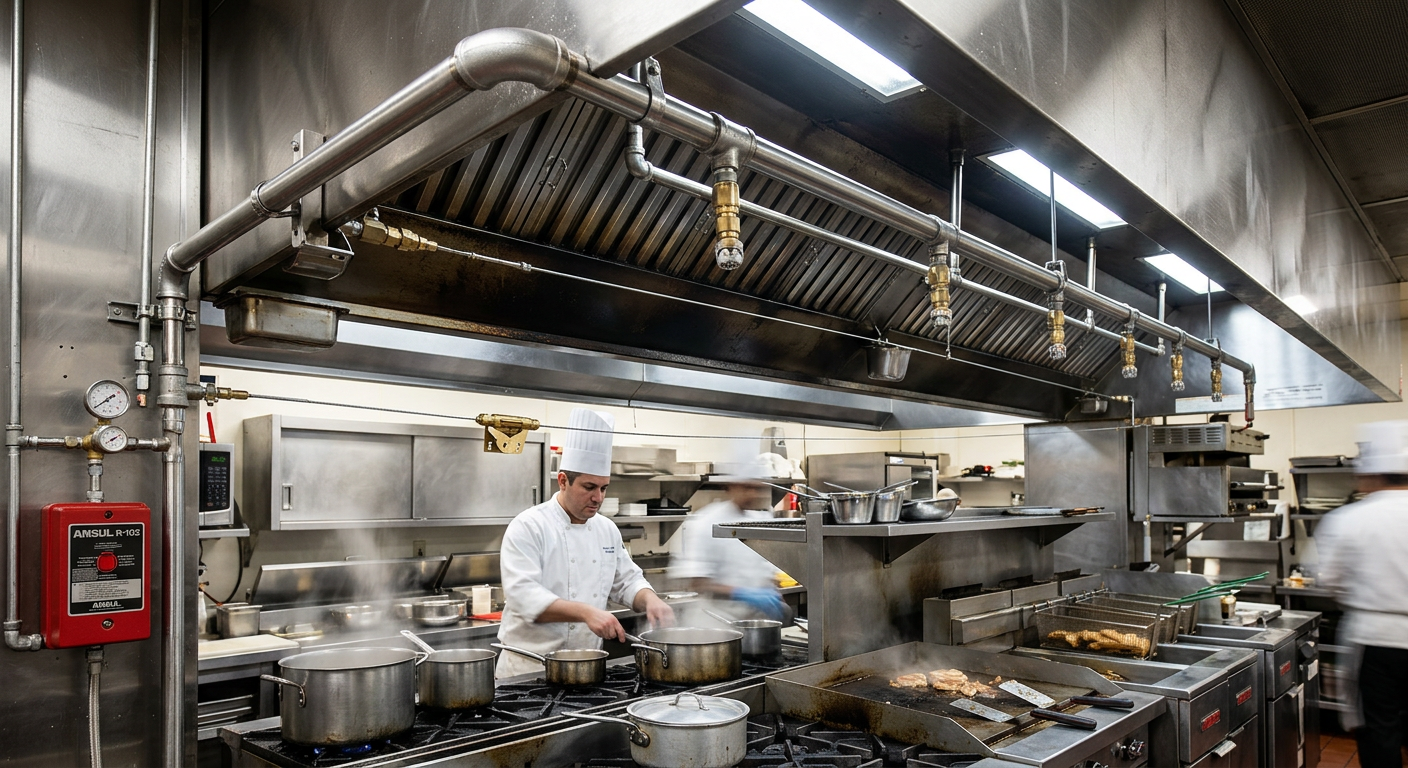
IMPORTANT DISCLAIMER: This guide references NFPA 96, Standard for Ventilation Control and Fire Protection of Commercial Cooking Operations; NFPA 17A, Standard for Wet Chemical Extinguishing Systems; NFPA 10, Standard for Portable Fire Extinguishers; and NFPA 72, National Fire Alarm and Signaling Code. These codes vary significantly by edition and are frequently amended by state and local jurisdictions. NFPA 96 editions include 2021 and 2024. NFPA 17A editions include 2021 and 2024. The most recent published editions are NFPA 96 (2024) and NFPA 17A (2024), but AHJ-adopted editions commonly lag behind by one or more cycles. Section numbers in NFPA 96 shifted in the 2024 edition — for example, the grease-buildup inspection provisions moved from Chapter 11 / Table 11.4 in the 2021 edition to Chapter 12 / Table 12.4 in the 2024 edition. Local amendments and the edition adopted by your Authority Having Jurisdiction (AHJ) always control. This guide is a starting point only—always verify the specific requirements applicable to your project with your local AHJ.
Kitchen hood suppression systems are a specialized discipline within fire protection. They combine wet chemical extinguishing, mechanical actuation, fuel shutoff interlocks, and exhaust system protection into a single pre-engineered system. Unlike sprinklers, which are designed to control or suppress a fire, kitchen hood systems are designed to extinguish a cooking fire—and to do so quickly, before the fire can spread into the exhaust duct.
Article 107 covered the broader landscape of restaurant fire safety. This article goes deep on the hood suppression system itself—the components, the actuation, the interlocks, and the inspection requirements that determine whether the system works when a grease fire ignites.
◆ Section 1: Why Kitchen Hood Suppression Is Different
Kitchen hood suppression systems operate on principles that differ from both sprinklers and clean agent systems.
| Factor | Challenge |
|---|---|
| Grease fires | Cooking oils and fats are Class K fuels; water can spread the fire |
| Wet chemical agent | Saponification—the agent reacts with hot grease to form a non-flammable soap |
| Mechanical actuation | Fusible links and manual pull stations, not electronic detection |
| Fuel shutoff | Gas and electric power must shut off automatically on system activation |
| Exhaust fan continuity | Hood exhaust fan must keep running to remove smoke and heat |
| Pre-engineered systems | System components are listed as a unit, not designed from scratch |
Key point: The kitchen hood suppression system is a pre-engineered system. It is not a custom-designed suppression system. The components, piping, nozzles, and agent quantity are all specified by the manufacturer’s listing—and installing anything other than the listed components voids the listing.
Key Article: Article 107 — Fire Safety for Restaurants and Commercial Kitchens
Pro Tip: The suppression system is the primary protection for a cooking fire. Portable extinguishers are backup—not the other way around. Train staff that the order of operations is: activate the system first, then use the extinguisher.
◆ Section 2: Regulatory Framework
Kitchen hood suppression is governed by two standards that work together.
| Standard | Scope | Application |
|---|---|---|
| NFPA 96 | Ventilation control and fire protection for commercial cooking | Exhaust systems, hoods, ducts, suppression requirements, ITM |
| NFPA 17A | Wet chemical extinguishing systems | System design, installation, operation, testing, maintenance |
| UL 300 | Fire testing of extinguishing systems for commercial cooking | Listing standard for pre-engineered systems |
Key point: NFPA 96 tells you what must be protected and when systems must be inspected. NFPA 17A tells you how the wet chemical system is designed and installed. UL 300 is the listing standard that verifies the system works.
Pro Tip: NFPA 96 requires automatic fire-extinguishing systems to comply with ANSI/CAN/UL/ULC UL-300 or other equivalent standards and be installed in accordance with the terms of their listing and NFPA 17A .
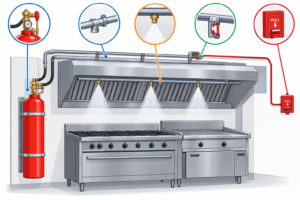
◆ Section 3: Wet Chemical Agent and System Components
The wet chemical agent is the heart of the system—and it works differently from other extinguishing agents.
A. How Wet Chemical Works
Wet chemical agents are potassium carbonate or potassium acetate-based formulations designed for flame knockdown and securement of grease-related fires. When the agent contacts hot cooking oil or grease, it undergoes saponification—a chemical reaction that converts the hot grease into a non-flammable soap-like substance.
Key point: This is why water cannot be used on a grease fire. Water causes the burning grease to splatter and spread. Wet chemical saponifies the grease, smothering the fire.
B. System Components
A pre-engineered wet chemical system includes:
| Component | Function |
|---|---|
| Agent storage cylinder | Contains the wet chemical agent and expellant gas |
| Regulated release assembly | Includes release mechanism and agent storage cylinder in a single enclosure |
| Distribution piping | Schedule 40 black iron, chrome-plated, or stainless steel |
| Discharge nozzles | Stainless steel with integral strainer; seal protects from grease |
| Fusible links | Heat detection devices that melt at a specific temperature to actuate the system |
| Manual pull station | Allows manual actuation; connected to release mechanism by stainless steel cable |
| Gas valve | Shuts off fuel supply on system actuation; manual mechanical reset type |
Pro Tip: Nozzle seals must be replaced after any discharge or test. A nozzle with a missing or damaged seal can become clogged with grease, preventing agent from reaching the fire.
◆ Section 4: Protection Coverage
The system must protect every surface where grease-laden vapors can accumulate and ignite.
A. Required Protection Areas
NFPA 96 requires fire-extinguishing equipment for the protection of grease removal devices, hood exhaust plenums, and exhaust duct systems .
| Area | Protection Required |
|---|---|
| Cooking surfaces | Nozzles above each appliance producing grease-laden vapors |
| Hood plenum | Nozzle(s) within the hood, above filters |
| Grease removal devices | Protected by hood plenum nozzles |
| Exhaust duct | Nozzle in duct if system is designed for duct protection |
Important: If the chemical system is not designed to fully protect the duct, the duct will also require fire sprinklers per NFPA 13.
B. Appliance-Specific Requirements
Different cooking appliances require different nozzle placement:
| Appliance Type | Nozzle Consideration |
|---|---|
| Deep-fat fryers | Nozzle aimed at fryer surface; drip board consideration |
| Charbroilers | Type of charbroiler affects nozzle placement |
| Woks | Depth of wok affects nozzle placement |
| Griddles, ranges, ovens | Nozzle positioned per manufacturer’s listing |
Key point: The nozzle placement is not a design choice—it is specified by the manufacturer’s listing for each appliance. Installing a nozzle in the wrong position voids the listing.
Pro Tip: If you change or upgrade cooking equipment, the suppression system may need modification. NFPA 96 inspections verify that the system matches the current appliances.
◆ Section 5: Actuation — Automatic and Manual
The system must actuate automatically on fire detection, and manually as backup.
A. Automatic Actuation — Fusible Links
The primary automatic actuation is by fusible links—metal alloy devices that melt at a specific temperature, releasing the mechanical actuation.
Key requirements:
-
A single listed detection device shall be permitted for more than one appliance when installed in accordance with the system’s listing
-
Fusible links of the metal alloy type shall be replaced at least semiannually
-
The year of manufacture and date of installation shall be marked on the system inspection tag; the tag shall be signed by the installer; fusible links shall be destroyed when removed
B. Manual Actuation
A remote manual pull station allows manual actuation if automatic detection fails or if a person discovers a fire.
Key requirements:
-
Manual actuators shall not require a force of more than 40 lbs (18.1 kg) or movement of more than 14 inches (355 mm)
-
Manual actuators shall clearly identify the hazard protected and be provided with instructions
-
Instructions for manually operating the system shall be posted conspicuously in the kitchen and reviewed with employees
-
A guard shall be provided where accidental operation could occur
Key point: The manual pull station is not optional. It is the backup actuation method if the fusible links fail or if a person discovers the fire before the links melt.
Pro Tip: Train all kitchen staff on the location and operation of the manual pull station. The system is the primary protection—the manual pull activates it.
◆ Section 6: Fuel and Power Shutoff Interlocks
When the suppression system activates, fuel and power to the cooking equipment must shut off automatically.
A. What Must Shut Off
Upon system actuation, the following must occur:
| Shutdown | Requirement |
|---|---|
| Gas supply | Gas valve closes; manual mechanical reset type |
| Electrical power | Power to cooking appliances shuts off |
| Makeup air (internally supplied) | Shuts off per NFPA 96 §8.3.2 |
| Makeup air (externally supplied) | Not required to shut down; generally should keep running to support smoke removal |
| Hood exhaust fan | Must continue running unless fan shutdown is required by a listed component or system design (§8.2.3.1) |
Key point on makeup air: NFPA 96 §8.3.2 requires makeup air supplied internally to a hood to be shut off on system activation. Externally supplied makeup air is not required to shut down—and fire protection engineers generally recommend keeping it running. Shutting down all makeup air spikes static pressure on the exhaust fan, can collapse exhaust airflow, and trap smoke and heat rather than clearing it.
B. Manual Reset Required
Shutoff devices shall require manual resetting prior to fuel or power being restored. Where an electrical gas valve is used, a manually reset relay shall be used to restore electrical power.
Key point: The system does not automatically restore fuel when the fire is out. A person must manually reset the shutoff devices after the system has been serviced and recharged.
Pro Tip: Verify that the hood exhaust fan continues running after system activation. The exhaust fan removes smoke and heat, improving visibility and reducing damage.
◆ Section 7: Exhaust Fan Activation and Alarms
The exhaust fan and alarm system must function correctly during and after a fire.
A. Exhaust Fan Activation
NFPA 96 §8.2.3.3 requires the exhaust fan to be arranged so that it activates automatically whenever any heat-producing cooking appliance under the hood is turned on .
Key point: The exhaust fan is not just a comfort system—it is part of the fire protection design. It must run whenever cooking equipment is operating.
B. Local Alarm
Upon actuation of the automatic fire-extinguishing system, an audible alarm or visual indicator shall be provided to show that the system has actuated .
C. Fire Alarm System Interface
Where a fire alarm signaling system serves the occupancy, activation of the extinguishing system shall activate the fire alarm signaling system in accordance with NFPA 72 .
Key point: The fire alarm interface ensures that the fire department is notified and that occupants throughout the building are alerted—not just kitchen staff.
Pro Tip: If the building has a fire alarm system, verify that the kitchen suppression system is properly interfaced. A system that activates locally but does not notify the fire department delays response.
◆ Section 8: Inspection, Testing, and Maintenance
The system must be inspected, tested, and maintained to ensure it works when needed.
A. System Maintenance — Every 6 Months
Maintenance of fire-extinguishing systems and listed exhaust hoods shall be made by properly trained, qualified, and certified persons at least every 6 months .
Key inspection activities:
-
All actuation and control components tested for proper operation
-
Fusible links of the metal alloy type replaced semiannually
-
Fixed-temperature-sensing elements other than metal-alloy fusible links (including bulb-type detectors) inspected and cleaned or replaced as needed at least every 12 months (NFPA 96 §12.2.7)
-
Nozzle seals/caps replaced after inspection
-
Gas shutoff valve and microswitch tested
B. System Impairment
Cooking equipment shall not be operated while its fire-extinguishing system or exhaust system is nonoperational or impaired .
Where the system is impaired:
-
The system shall be tagged as noncompliant
-
The owner or owner’s representative shall be notified in writing
-
Where required, the AHJ shall be notified
C. Grease Buildup Inspection
The exhaust system must be inspected for grease buildup per Table 12.4 (2024 edition) or Table 11.4 (2021 edition) :
| Type of Cooking | Inspection Frequency |
|---|---|
| Solid fuel cooking | Monthly |
| High-volume (24-hour, charbroiling, wok) | Quarterly |
| Moderate-volume | Semiannually |
| Low-volume (churches, seasonal) | Annually |
Cleaning trigger: If grease depth reaches 0.078 of an inch (2000 μm) on most surfaces, or 0.125 of an inch (3175 μm) in fan housings, cleaning is required .
Key point: The 6-month suppression system inspection and the grease buildup inspection are separate requirements. Both must be satisfied.
Pro Tip: Keep records of all inspections and cleaning. The AHJ will ask for them—and the 2024 edition now requires reports for grease-buildup inspections with follow-up reporting within two weeks of cleaning .
◆ Section 9: Design Checklist for Kitchen Hood Suppression Systems
| Item | Status | Notes |
|---|---|---|
| System is UL 300 listed | ☐ | Pre-engineered system; components listed as a unit |
| Protection coverage verified | ☐ | Cooking surfaces, hood plenum, grease removal devices, duct |
| Duct protection provided or sprinklers added | ☐ | If chemical system does not protect full duct |
| Nozzle placement per manufacturer’s listing | ☐ | Appliance-specific; no obstructions to spray pattern |
| Fusible links installed | ☐ | Metal alloy type; replaced semiannually |
| Manual pull station installed | ☐ | Identifies hazard; instructions posted; ≤40 lbs force |
| Fuel shutoff valve installed | ☐ | Gas valve; manual mechanical reset type |
| Electrical power shutoff provided | ☐ | Power to appliances shuts off on activation |
| Internally-supplied makeup air shuts off | ☐ | Per NFPA 96 §8.3.2 |
| Externally-supplied makeup air continues running | ☐ | Not required to shut down; supports smoke removal |
| Exhaust fan continues running | ☐ | Unless listed component requires shutdown (§8.2.3.1) |
| Exhaust fan activates with appliances | ☐ | Per NFPA 96 §8.2.3.3 |
| Manual reset required | ☐ | Fuel/power not restored until manual reset |
| Audible/visual alarm provided | ☐ | Local alarm on actuation |
| Fire alarm interface | ☐ | Where building fire alarm system exists |
| Class K extinguishers provided | ☐ | Within 30 feet; no CO2 in cooking areas |
| 6-month maintenance scheduled | ☐ | By certified personnel |
| Grease inspection scheduled | ☐ | Per Table 12.4 based on cooking volume |
| Records maintained | ☐ | Inspection certificates; cleaning reports |
◆ Section 10: Common Mistakes and How to Avoid Them
| Mistake | Why It’s a Problem | How to Fix |
|---|---|---|
| Operating with impaired system | Violates NFPA 96; life safety risk | Tag as noncompliant; no cooking until repaired |
| Using CO2 extinguishers in kitchen | Prohibited; not suitable for grease fires | Provide Class K extinguishers |
| Nozzle placement not per listing | System may not extinguish fire | Verify per manufacturer’s manual |
| Fusible links not replaced semiannually | Links may fail to actuate | Replace at each 6-month inspection |
| Manual pull station obstructed | Cannot actuate system manually | Maintain clear access; post instructions |
| Fuel shutoff does not require manual reset | Fuel restored before system serviced | Verify manual reset type |
| Shutting down externally-supplied makeup air | Can collapse exhaust airflow; traps smoke | Only internally-supplied makeup air must shut off |
| Exhaust fan shuts down on activation | Smoke and heat not removed | Verify fan continues running |
| Exhaust fan not activated with appliances | Smoke accumulates during normal cooking | Verify §8.2.3.3 activation |
| Grease inspection frequency wrong | Grease accumulates; fire risk | Follow Table 12.4 based on cooking volume |
| No records of inspection/cleaning | AHJ cannot verify compliance | Maintain all certificates and reports |
◆ Section 11: Conclusion
Kitchen hood suppression systems are pre-engineered life safety systems that protect one of the most hazardous environments in commercial buildings. They must be installed per their listing, actuated by fusible links and manual pull, and interlocked with fuel and power shutoff.
Key Takeaways:
-
NFPA 96 and NFPA 17A work together — NFPA 96 defines what must be protected; NFPA 17A defines how the system is designed .
-
Wet chemical agents saponify hot grease — converting it to a non-flammable soap .
-
Protection covers cooking surfaces, hood plenum, grease removal devices, and duct .
-
If the duct is not protected by the chemical system, sprinklers are required .
-
Fusible links must be replaced semiannually .
-
Manual pull stations must be accessible and identified .
-
Fuel and power must shut off on activation — with manual reset required .
-
Only internally-supplied makeup air must shut off (NFPA 96 §8.3.2); externally-supplied makeup air generally should keep running to support smoke removal.
-
Exhaust fan must continue running unless a listed component requires shutdown (§8.2.3.1), and must activate whenever a heat-producing appliance is turned on (§8.2.3.3).
-
System maintenance is required every 6 months .
-
Grease buildup inspection frequency varies by cooking volume — monthly to annually .
Take Action Today:
-
Verify your system is UL 300 listed and components are compatible.
-
Confirm protection coverage for cooking surfaces, plenum, and duct.
-
Verify nozzle placement matches manufacturer’s listing.
-
Confirm fusible links are replaced semiannually.
-
Verify manual pull station is accessible with posted instructions.
-
Confirm fuel and power shutoff with manual reset.
-
Verify only internally-supplied makeup air shuts off.
-
Verify exhaust fan continues running on activation and activates with appliances.
-
Schedule 6-month maintenance and grease inspection per Table 12.4.
-
Maintain all inspection and cleaning records.
-
Train staff on system activation and extinguisher use.
Continue Reading from Our Series:
-
Related guide: Fire Safety for Restaurants and Commercial Kitchens (Article 107)
-
Learn more: Fire Safety for Places of Worship (Article 106)
-
Read more: Portable Fire Extinguishers – Requirements by Occupancy and Location (Article 13)