IMPORTANT DISCLAIMER: This guide references NFPA 2001, Standard on Clean Agent Fire Extinguishing Systems; NFPA 70, National Electrical Code; NFPA 72, National Fire Alarm and Signaling Code; NFPA 75, Standard for the Fire Protection of Information Technology Equipment; and the International Fire Code (IFC). These codes vary significantly by edition and are frequently amended by state and local jurisdictions. NFPA 2001 editions include 2018, 2022, and 2025 (current). The most recent published edition is NFPA 2001 (2025), but AHJ-adopted editions commonly lag behind by one or more cycles. The 2025 edition added clarification for when time delay is to be utilized. Local amendments and the edition adopted by your Authority Having Jurisdiction (AHJ) always control. This guide is a starting point only—always verify the specific requirements applicable to your project with your local AHJ.
Clean agent and inert gas suppression systems protect the spaces where water would cause unacceptable damage: data centers, control rooms, archives, museums, and laboratories. They extinguish fires by removing heat (halocarbon agents) or reducing oxygen (inert gases), leaving no residue and causing no collateral damage to sensitive equipment.
But these systems are unforgiving of design errors. A clean agent system that discharges into a leaky enclosure will not maintain the required concentration long enough to prevent re-ignition. An inert gas system that displaces too much oxygen can asphyxiate occupants. A system sized for the wrong hazard class will fail to extinguish the fire it was designed for.
This guide covers the design requirements for clean agent and inert gas systems under NFPA 2001, with a focus on the decisions that determine whether the system works when it matters.
◆ Section 1: Why Clean Agent Systems Are Different
Clean agent systems operate on principles that differ fundamentally from water-based suppression.
| Factor | Challenge |
|---|---|
| Total flooding | Agent must fill the entire enclosure to the design concentration |
| Enclosure integrity | Leaks prevent agent retention; hold time fails |
| Agent toxicity | Halocarbons cause cardiac sensitization; inert gases cause hypoxia |
| Design concentration | Must be above extinguishing concentration but below NOAEL/LOAEL |
| Hold time | Agent must remain at concentration long enough to prevent re-ignition |
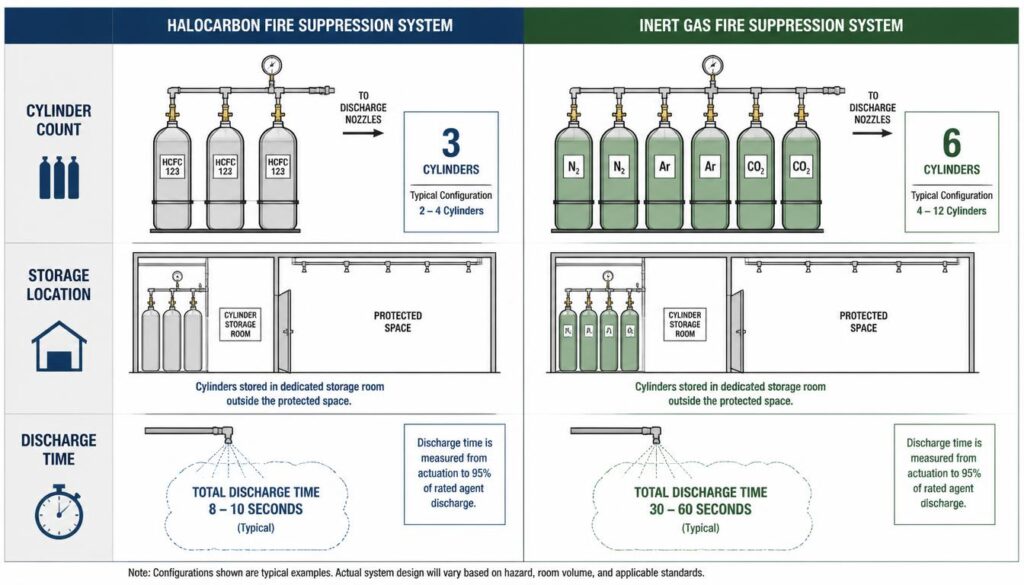
| Discharge time | Halocarbons discharge in 10 seconds; inert gases in 60 seconds |
Key point: The clean agent system is a total flooding system. It does not “spray” the fire—it fills the room. If the room leaks, the agent leaks out, and the fire re-ignites.
Pro Tip: The enclosure is part of the system. A perfectly designed agent supply discharging into a leaky room is a failed system.
◆ Section 2: Agent Types — Halocarbon and Inert
NFPA 2001 recognizes two categories of clean agents: halocarbon agents and inert gas agents.
A. Halocarbon Agents
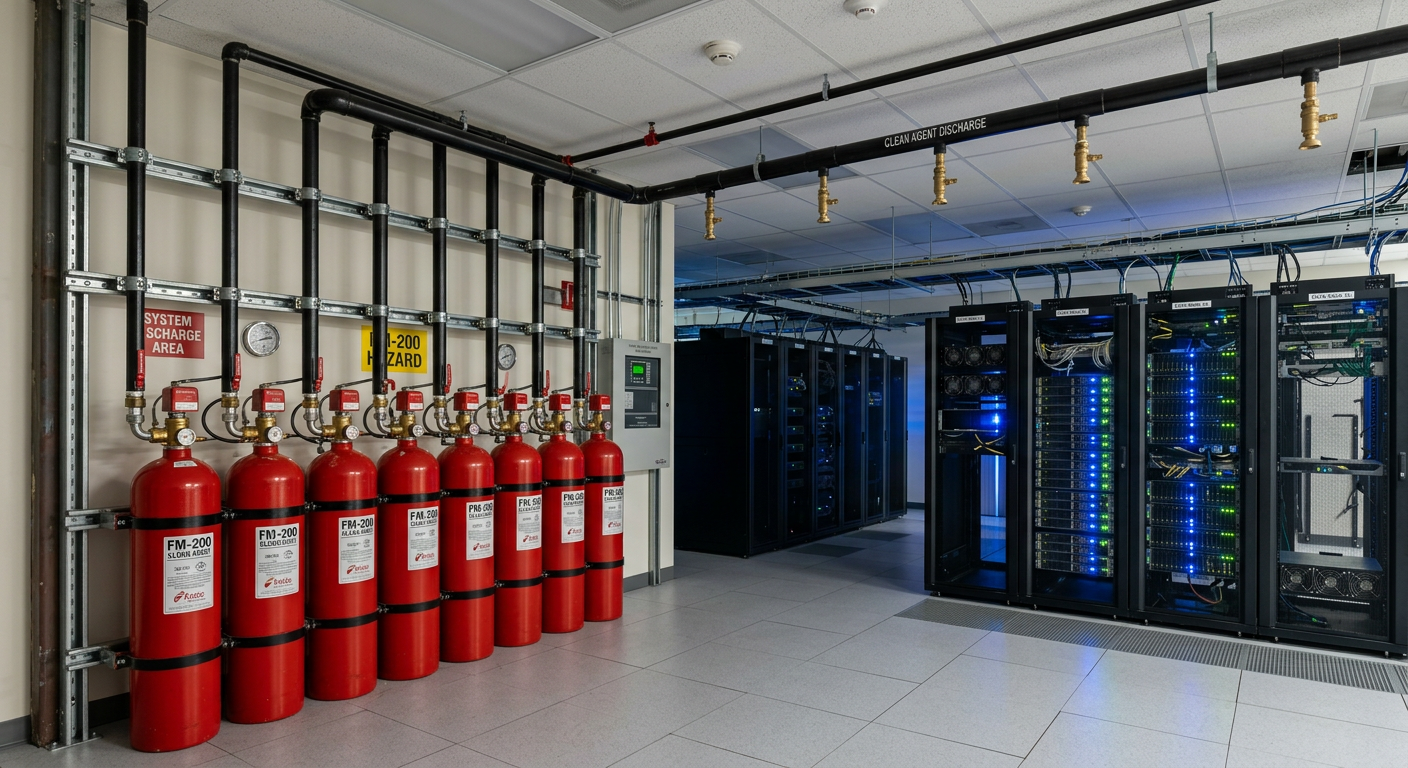
Halocarbon agents extinguish fires primarily by absorbing heat. They are stored as liquefied compressed gases and discharge in approximately 10 seconds.
| Agent | Common Name | NOAEL | LOAEL |
|---|---|---|---|
| HFC-227ea | FM-200 | 9.0% | >10.5% |
| FK-5-1-12 | Novec 1230 | 10.0% | >10.0% |
| HFC-125 | — | 7.5% | >10.0% |
| HFC-23 | — | 30.0% | >50.0% |
Cardiac sensitization: Halocarbon agents can cause cardiac sensitization—a condition where normal or elevated epinephrine levels trigger dangerous arrhythmias, including ventricular fibrillation. The NOAEL is the highest concentration at which no adverse cardiac effect occurred; the LOAEL is the lowest concentration at which an adverse effect was measured.
For FM-200, the NOAEL is 9% and the LOAEL is 10.5%. For Novec 1230, the NOAEL is 10%.
B. Inert Gas Agents
Inert gas agents extinguish fires by reducing oxygen below the level required for combustion. They are stored as gases and discharge in approximately 60 seconds.
| Agent | Composition | NOAEL | LOAEL |
|---|---|---|---|
| IG-541 | Nitrogen, argon, CO₂ (Inergen) | 43.0% | 52.0% |
| IG-100 | Nitrogen | 43.0% | 52.0% |
| IG-55 | Nitrogen, argon | 43.0% | 52.0% |
| IG-01 | Argon | 43.0% | 52.0% |
Hypoxia: Inert gases create reduced-oxygen environments. Exposure limits are based on oxygen concentration:
| Agent Concentration | Residual Oxygen | Exposure Limit |
|---|---|---|
| ≤43% | ≥12% | 5 minutes |
| >43% and ≤52% | <12% and ≥10% | 3 minutes |
| >52% and ≤62% | <10% and ≥8% | 30 seconds |
Key point: Halocarbons remove heat; inert gases remove oxygen. The choice depends on the hazard, the enclosure, and the occupancy.
Pro Tip: Inert gas systems require more cylinders and more storage space than halocarbon systems for the same protected volume, but the cylinders can be located further from the protected space.
◆ Section 3: Design Concentration
The design concentration is the agent concentration required to extinguish the fire, plus a safety factor.
A. Minimum Design Concentration
NFPA 2001 defines the minimum design concentration as the extinguishing concentration for the specific fuel plus a 20 percent safety factor for Class A fuel.
| Hazard Classification | Minimum Design Concentration (HFC-227ea) |
|---|---|
| Class A | 6.7% |
| Class C | 7.0% |
| Class B (Heptane) | 8.7% |
Recommendation: When protecting multiple hazards with a single agent supply, use 6.9% for Class A and 7.2% for Class C to provide additional margin.
B. Maximum Design Concentration and Occupancy
The maximum design concentration depends on occupancy type and the relationship between the design concentration and the agent’s NOAEL/LOAEL:
| Occupancy Type | Concentration Range | Exposure Limit |
|---|---|---|
| Normally Occupied | At or below NOAEL | No exposure-time limit |
| Normally Occupied | Between NOAEL and LOAEL | Limited time per physiologically based pharmacokinetic (PBPK) modeling; egress calculations and AHJ approval required |
| Not Normally Occupied | Above LOAEL | Limited exposure time (60 sec or 30 sec depending on concentration) |
Key point: The design concentration must be above the extinguishing concentration. For normally occupied spaces, the design concentration should be at or below the NOAEL — which imposes no exposure-time limit. Concentrations between the NOAEL and LOAEL are permitted only with limited exposure time, documented egress calculations, and AHJ approval.
Pro Tip: For a normally occupied space, if the required design concentration exceeds the NOAEL, consider whether a different agent, a different hazard classification assumption, or treatment as a not-normally-occupied space is the right approach. The decision is not just technical — it is a life safety decision.
◆ Section 4: Enclosure Integrity
The enclosure is not just a container—it is a critical component of the suppression system.
A. Why Enclosure Integrity Matters
After discharge, the agent-air mixture is heavier than air and creates a slight positive pressure at the floor. If the enclosure leaks, the agent escapes through lower leaks, and fresh air enters through upper leaks. The agent concentration decays, and if it drops below the minimum required to prevent re-ignition, the fire can reignite.
The descending interface: If air-moving equipment is off during the hold period, the agent drains out like water from a bucket—a “descending interface” forms between the agent-air mixture below and fresh air above.
Continual mixing: If air handlers continue to run, the infiltrating air mixes with the agent, and the concentration decays uniformly throughout the enclosure.
B. Door Fan Test
The door fan test (also called a room integrity test) measures enclosure leakage by pressurizing or depressurizing the room with a calibrated fan and measuring the airflow required to maintain a pressure differential.
Test requirements per NFPA 2001:
-
Test in both directions (pressurization and depressurization)
-
Bias pressure during test must be less than 5 Pa (NFPA 2001 C.2.7.1.2(6))
-
Test readings at 2 points per direction
-
Test pressure range: 10 Pa to 50 Pa
Key point: The door fan test does not require agent discharge. It measures leakage using air.
Pro Tip: Enclosure integrity is not a one-time test. Retest after any significant change to the enclosure—new cable penetrations, equipment installation, or HVAC modifications.
◆ Section 5: Hold Time
The hold time is the period during which the agent concentration must remain above the minimum required to prevent re-ignition.
A. The 10-Minute Requirement
NFPA 2001 requires a hold time sufficient to ensure that the agent concentration at the top of the protected equipment does not fall below 85 percent of the design concentration for the duration of the hold time.
Typical hold time requirement: 10 minutes for most applications.
Small enclosure reductions: For small enclosures, a reduced hold time may be justified under the Annex C technical judgment provisions — 6 minutes for enclosures of 1,250 cubic feet or less, and 3 minutes for enclosures of 350 cubic feet or less. These are not automatic allowances; they require engineering judgment and are subject to AHJ approval.
B. Factors Affecting Hold Time
| Factor | Effect on Hold Time |
|---|---|
| Leakage area | Larger leaks = shorter hold time |
| Leak location | Lower leaks drain agent faster |
| Enclosure height | Taller enclosures = longer hold time (more reserve) |
| Air handlers | Continual mixing reduces hold time |
| Initial concentration | Higher initial concentration = longer hold time |
Increasing hold time: If continual mixing will occur, increase the initial concentration by 15 percent over design concentration to ensure adequate hold time.
Key point: The hold time is not just about the agent—it is about the enclosure. A leaky enclosure cannot hold agent regardless of how much is discharged.
Pro Tip: Keep the height of protected equipment to a minimum. If equipment height exceeds 75 percent of enclosure height, continual mixing may be the only way to ensure reasonable retention time.
◆ Section 6: Detection and Control Interface
Clean agent systems require a detection and control system that is integrated with the agent release.
A. Detection Requirements
NFPA 2001 Chapter 9 addresses detection, actuation, alarm, and control.
| Requirement | Specification |
|---|---|
| Automatic detection | Required; cross-zoned or dual-detection for release |
| Manual release | Required at approved location |
| Time delay | Required for occupied spaces; allows evacuation |
| Abort switch | Required; allows manual abort during time delay |
| Predischarge alarm | Audible and visual; required before discharge |
B. Time Delay
The 2025 edition of NFPA 2001 added clarification for when time delay is to be utilized. Time delay provides occupants time to evacuate before discharge.
Key point: The detection system must be cross-zoned—two independent detectors must alarm before agent is released. This prevents accidental discharge from a single detector fault.
Pro Tip: The abort switch must be located at the point of egress. It allows a person who knows the alarm is false to stop the discharge during the time delay.
◆ Section 7: Life Safety and Personnel Protection
Clean agent systems protect property, but they can harm people. Life safety is the first priority.
A. Halocarbon Agents — Cardiac Sensitization
Halocarbon agents can cause cardiac sensitization, leading to dangerous arrhythmias. The NOAEL is the concentration below which no adverse effect was observed. Concentrations at or below the NOAEL impose no exposure-time limit.
Concentrations above the NOAEL: Occupancy may be permitted between NOAEL and LOAEL for a limited time, based on PBPK modeling, egress calculations, and AHJ approval. Above the LOAEL, the space must be classified as not normally occupied, and exposure is limited to 60 seconds (or 30 seconds at higher concentrations).
B. Inert Gas Agents — Hypoxia
Inert gases reduce oxygen concentration, creating a hypoxic environment.
| Agent Concentration | Residual Oxygen | Exposure Limit |
|---|---|---|
| ≤43% | ≥12% | 5 minutes |
| >43% and ≤52% | <12% and ≥10% | 3 minutes |
| >52% and ≤62% | <10% and ≥8% | 30 seconds |
Key point: The life safety requirements are not optional. Exposure limits apply based on the design concentration and the resulting NOAEL/LOAEL relationship. If the design concentration exceeds the NOAEL for a normally occupied space, occupancy is permitted only for a limited time with documentation and AHJ approval.
Pro Tip: Post signage at all entrances indicating the agent type, design concentration, and evacuation procedures. Train occupants on the predischarge alarm and evacuation routes.
◆ Section 8: Design Checklist for Clean Agent Systems
| Item | Status | Notes |
|---|---|---|
| Hazard classification determined | ☐ | Class A, B, or C |
| Agent type selected | ☐ | Halocarbon or inert gas |
| Design concentration calculated | ☐ | Above extinguishing concentration; verify against NOAEL for occupied spaces |
| NOAEL/LOAEL relationship evaluated | ☐ | At/below NOAEL = no limit; NOAEL–LOAEL = limited with AHJ approval |
| Agent quantity calculated | ☐ | Using flooding factors or formula |
| Enclosure integrity verified | ☐ | Door fan test; bias <5 Pa |
| Hold time calculated | ☐ | 10 minutes typical; 85% of design concentration at equipment top |
| Small-enclosure hold time reduction | ☐ | Only if justified under Annex C technical judgment and approved by AHJ |
| Leakage remediation completed | ☐ | Seal lower leaks first |
| Detection system cross-zoned | ☐ | Two detectors required for release |
| Time delay provided | ☐ | For occupied spaces |
| Abort switch installed | ☐ | At point of egress |
| Predischarge alarm installed | ☐ | Audible and visual |
| Life safety evaluation complete | ☐ | NOAEL/LOAEL vs. design concentration |
| Post-discharge procedures | ☐ | Ventilation, re-entry, recharge |
| NFPA 2001 ITM scheduled | ☐ | Annual inspection; semiannual agent quantity check |
◆ Section 9: Common Mistakes and How to Avoid Them
| Mistake | Why It’s a Problem | How to Fix |
|---|---|---|
| Design concentration exceeds NOAEL without documentation | Cardiac sensitization or hypoxia risk | Document egress calculations; obtain AHJ approval; or treat as not normally occupied |
| Assuming design concentration must always be below NOAEL | Over-restricts design; may not be needed | Apply the correct rule: at/below NOAEL = no limit; NOAEL–LOAEL = limited |
| Enclosure not tested for integrity | Agent leaks out; fire re-ignites | Perform door fan test; seal leaks |
| Hold time not calculated | Agent decays before fire is controlled | Calculate hold time; increase agent or seal enclosure |
| Small-enclosure hold time treated as automatic | Not a code allowance | Justify under Annex C; obtain AHJ approval |
| Detection not cross-zoned | Accidental discharge | Use cross-zoned detection |
| No time delay for occupied space | Occupants exposed to agent | Provide time delay and predischarge alarm |
| Abort switch not at egress | Cannot stop false discharge | Install at point of egress |
| Air handlers running during hold time | Continual mixing reduces hold time | Shut down air handlers or increase agent quantity |
| Equipment height exceeds 75% of enclosure | Difficult to maintain hold time | Keep equipment low or use continual mixing design |
◆ Section 10: Conclusion
Clean agent and inert gas systems are the right choice for spaces where water would cause unacceptable damage. But they are unforgiving of design errors. The enclosure must be tight. The concentration must be correct. The hold time must be adequate. And the life safety requirements must be satisfied.
Key Takeaways:
-
Halocarbon agents remove heat; inert gases reduce oxygen.
-
Design concentrations vary by hazard class: FM-200 is 6.7% (Class A), 7.0% (Class C), and 8.7% (Class B Heptane).
-
At or below NOAEL imposes no exposure-time limit; between NOAEL and LOAEL permits limited exposure with egress calculations and AHJ approval.
-
Novec 1230 design concentration is typically 5.3%; NOAEL is 10%.
-
Inert gas exposure limits are based on oxygen concentration: 5 minutes at ≤43%, 3 minutes at 43–52%, 30 seconds above 52%.
-
Enclosure integrity is tested by door fan test; bias pressure must be <5 Pa.
-
Hold time is typically 10 minutes; agent concentration at equipment top must remain ≥85% of design concentration.
-
Small-enclosure hold time reductions (6 min at ≤1,250 ft³; 3 min at ≤350 ft³) are available only under Annex C technical judgment and AHJ approval.
-
Detection must be cross-zoned; time delay and abort switch are required for occupied spaces.
-
NFPA 2001 ITM includes annual inspection and semiannual agent quantity check.
Take Action Today:
-
Verify hazard classification and design concentration.
-
Confirm NOAEL/LOAEL relationship for occupied spaces.
-
Confirm agent type and quantity for the protected volume.
-
Perform door fan test to verify enclosure integrity.
-
Calculate hold time; seal leaks if necessary.
-
Verify detection is cross-zoned.
-
Confirm time delay, abort switch, and predischarge alarms are installed.
-
Evaluate life safety for occupied spaces (NOAEL/LOAEL vs. design concentration).
-
Schedule NFPA 2001 ITM.
Continue Reading from Our Series:
-
Related guide: Fire Safety for Data Centers and IT Facilities (Article 98)
-
Learn more: Fire Safety for Laboratories and Research Facilities (Article 104)