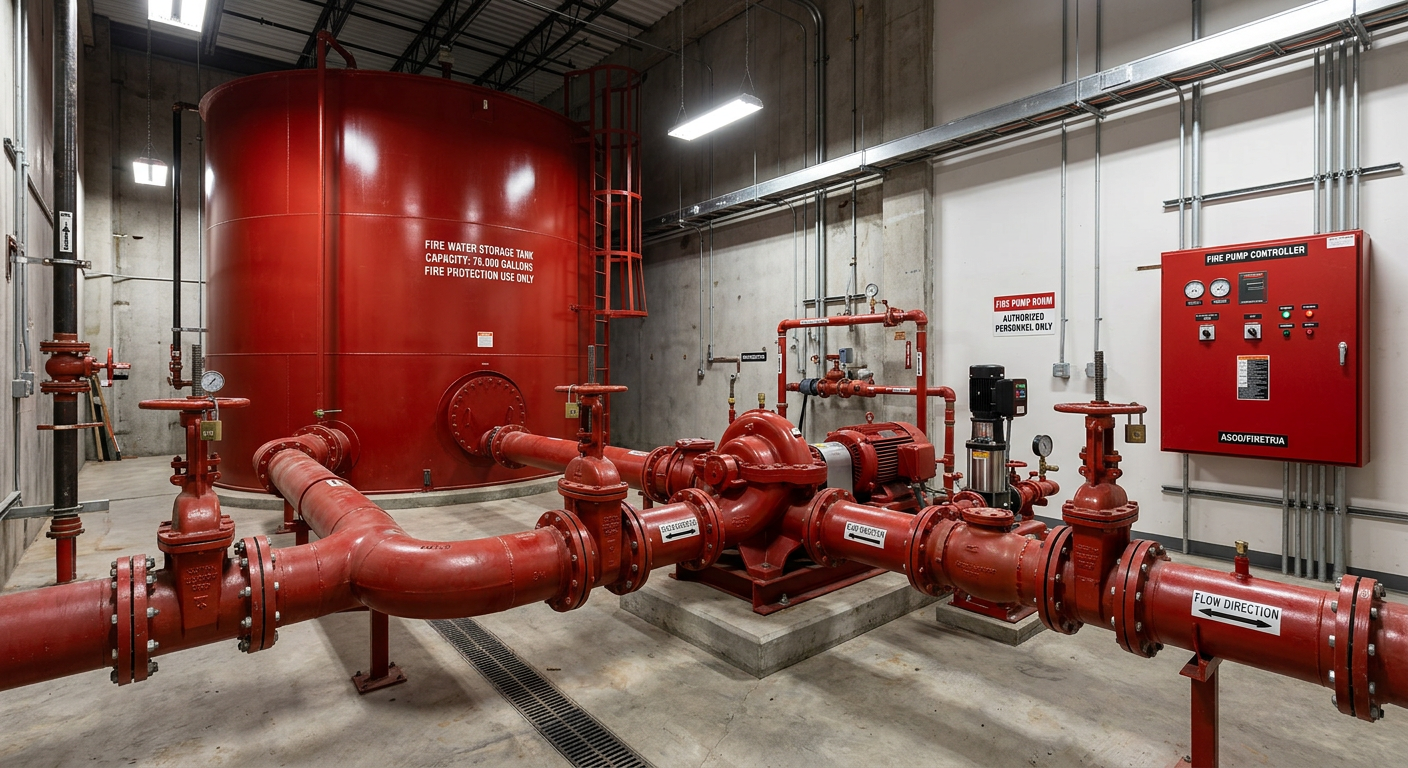
IMPORTANT DISCLAIMER: This guide references NFPA 22, Standard for Water Tanks for Private Fire Protection; NFPA 24, Standard for the Installation of Private Fire Service Mains and Their Appurtenances; NFPA 25, Standard for the Inspection, Testing, and Maintenance of Water-Based Fire Protection Systems; NFPA 13, Standard for the Installation of Sprinkler Systems; NFPA 14, Standard for the Installation of Standpipe and Hose Systems; NFPA 20, Standard for the Installation of Stationary Pumps for Fire Protection; and NFPA 1142, Standard on Water Supplies for Suburban and Rural Firefighting. These codes vary significantly by edition and are frequently amended by state and local jurisdictions. NFPA 22 editions include 2018 and 2023. NFPA 24 editions include 2019 and 2025. NFPA 13 editions include 2019, 2022, and 2025. The most recent published editions are NFPA 22 (2023), NFPA 24 (2025), and NFPA 13 (2025), but AHJ-adopted editions commonly lag behind by one or more cycles. Local amendments and the edition adopted by your Authority Having Jurisdiction (AHJ) always control. This guide is a starting point only—always verify the specific requirements applicable to your project with your local AHJ.
The fire protection water supply is the foundation of every suppression system. Sprinklers, standpipes, and hydrants are only as effective as the water that feeds them. If the supply cannot deliver the required flow and pressure for the required duration, the system fails—regardless of how well it is designed.
Water supply design is a discipline of flow, pressure, and duration. The flow must be adequate for the hazard. The pressure must be sufficient at the most remote connection. And the duration must be long enough to control the fire until manual suppression can complete the job.
This guide covers the design requirements for fire protection water supplies under NFPA 22, NFPA 24, and NFPA 13, with a focus on the decisions that determine whether the supply works when it matters.
◆ Section 1: Types of Water Supplies
Fire protection water supplies come from several sources, each with distinct characteristics.
| Supply Type | Description | Typical Application |
|---|---|---|
| Public water main | Municipal supply; capacity varies by jurisdiction | Urban and suburban buildings |
| Private fire service main | On-site piping from a source to the building | Industrial campuses; large sites |
| Ground-level suction tank | At-grade tank with fire pump suction | Where public supply is inadequate |
| Elevated gravity tank | Elevated tank providing pressure by gravity | Where pump reliability is a concern |
| Pressure tank | Tank with compressed air providing pressure | Limited-duration applications |
| Reservoir or pond | Natural or constructed water body | Rural and industrial sites |
Key point: The water supply is the foundation. A fire pump can supplement pressure, but it cannot create water. If the supply itself is inadequate, no amount of pumping will fix it.
Key Article: Article 112 — Fire Pump Sizing, Selection, and Testing (NFPA 20)
Pro Tip: Verify the water supply before designing the suppression system. A sprinkler system that meets code on paper but draws from an inadequate supply will fail in a real fire.
◆ Section 2: Public Water Main Requirements
The public water main is the most common supply source where municipal infrastructure exists.
A. Capacity Verification
The water supply must be capable of delivering the required flow at the required pressure during the required duration. The fire protection designer must verify:
| Requirement | What to Verify |
|---|---|
| Static pressure | Pressure at the point of connection with no flow |
| Residual pressure | Pressure at the point of connection during the required flow |
| Flow capacity | Available flow at the required residual pressure |
| Duration | Whether the main can sustain the flow for the required duration |
B. Flow Test
A fire flow test is required to verify the public main’s capacity. The test measures static pressure, residual pressure at flow, and the flow rate. The results are plotted on a graph to determine available flow at the required pressure.
Key point: The flow test is not a one-time event. Water supply conditions change over time due to system modifications, seasonal variations, and development. Verify the supply is still adequate before relying on it.
Pro Tip: Coordinate with the water purveyor before conducting a flow test. They can provide system information and may need to be notified.
◆ Section 3: Private Fire Service Mains (NFPA 24)
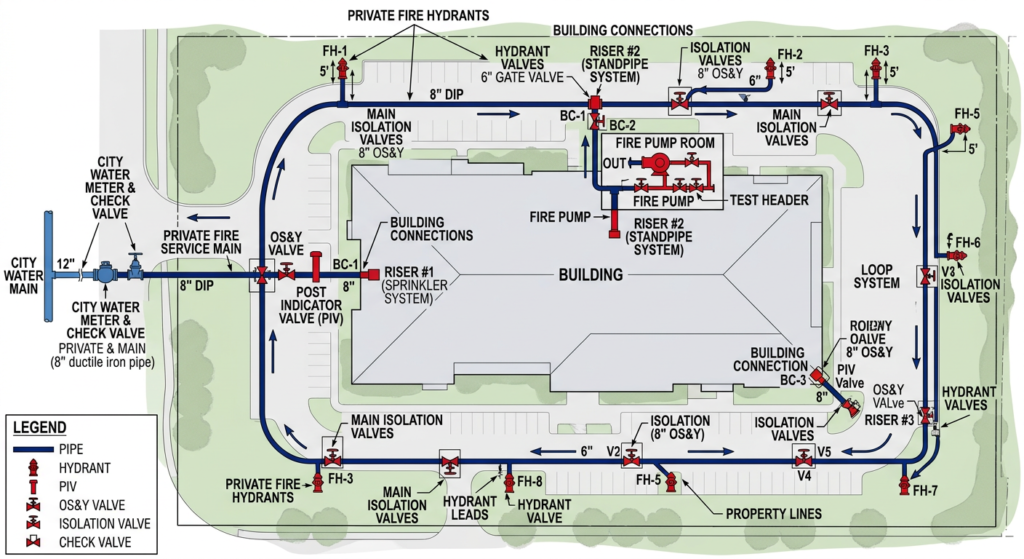
Private fire service mains are on-site underground piping that supplies fire protection systems.
A. Scope of NFPA 24
NFPA 24 provides the minimum requirements for the installation of private fire service mains and their appurtenances, which include supplying :
-
Automatic sprinkler systems
-
Open sprinkler systems
-
Water spray fixed systems
-
Foam systems
-
Private hydrants
-
Monitor nozzles or standpipe systems
-
Hose houses
B. Key Installation Requirements
| Requirement | Specification |
|---|---|
| Pipe materials | Approved for underground fire service; PVC, C900 Class 150 or greater listed for such use |
| Galvanized pipe | Not approved for underground supply piping |
| Non-metallic pipe | Not permitted within five feet of a building |
| Pipe bedding | Six-inch bed of sand or natural gravel; twelve-inch fill |
| Locator wire | No. 10 gauge solid soft drawn copper taped on top of non-metallic pipe |
| Thrust blocks | Required at all locations where piping changes direction |
C. Piping Under Buildings
Pipe running under a building or building foundation shall be UL Listed, stainless steel, solid sweep and shall not contain mechanical joints .
Key point: Private fire service mains are the link between the water source and the building. Installation defects—improper bedding, missing thrust blocks, or unapproved materials—can cause failures that go undetected until a fire occurs.
Pro Tip: Verify the contractor’s qualifications before installing private fire service mains. NFPA 24 compliance is not optional.
◆ Section 4: Water Storage Tanks (NFPA 22)
Where the public supply is inadequate, a water storage tank provides the required volume.
A. Types of Tanks
NFPA 22 addresses several tank types :
| Tank Type | Description | Application |
|---|---|---|
| Welded-carbon steel | Gravity and suction tanks; welded construction | Large capacity; permanent installations |
| Factory-coated, bolted carbon steel | Bolted construction with factory coating | Rapid installation; relocatable |
| Pressure tanks | Compressed air provides pressure | Limited duration; compact |
| Wood gravity tanks | Wood construction; gravity supply | Historic; specific applications |
| Embankment-supported coated fabric | Fabric tanks supported by embankment | Temporary or remote sites |
B. Tank Sizing
Tanks must be sized to meet the remote area demand for the intended duration . The calculation is:
Tank Size = Flow Demand × Duration
The flow demand includes:
-
Sprinkler system demand (per NFPA 13)
-
Hose stream allowance (per NFPA 13)
-
Standpipe demand (per NFPA 14, if combined)
C. Effective Capacity
The net capacity of a suction tank is the volume between the inlet of the overflow and the level of the vortex plate . Water below the vortex plate (“dead water”) is not available for firefighting and must not be counted in the tank’s usable capacity.
Key point: The tank’s nameplate capacity is not its usable capacity. The effective capacity is what the fire pump can actually draw—and that is what must meet the system demand.
Key Article: Article 112 — Fire Pump Sizing, Selection, and Testing (NFPA 20)
Pro Tip: Size the tank with a safety factor. Evaporation, fluctuation, and vortex plate clearance all reduce the available volume. A tank that meets the calculated demand with no margin may not perform as expected.
◆ Section 5: Duration Requirements
The water supply duration depends on the hazard classification and whether the system is electrically supervised.
A. NFPA 13 Duration Table
The duration requirements are in NFPA 13 Table 19.3.3.1.2 (formerly Table 11.2.3.1.2 in the 2013/2016 editions):
| Hazard Classification | Hose Allowance | Duration (Supervised) | Duration (Unsupervised) |
|---|---|---|---|
| Light Hazard | 100 gpm | 30 minutes | 30 minutes |
| Ordinary Hazard | 250 gpm | 60 minutes | 90 minutes |
| Extra Hazard | 500 gpm | 90 minutes | 120 minutes |
B. The Supervision Reduction
The lower duration values are permitted where the sprinkler system waterflow alarm and supervisory devices are electrically supervised and monitored at an approved, constantly attended location . This supervision ensures prompt response to abnormal conditions, reducing the time the system must be self-sufficient.
Key point: If the system is not electrically supervised and monitored, the higher duration value applies. This is a significant difference—a 50% increase in required water volume for Ordinary Hazard.
C. Combined Systems
Where a tank serves both sprinklers and hose stations, the tank must provide the duration for both demands . The hose stream allowance is added to the sprinkler demand, and the total is multiplied by the duration.
Pro Tip: Verify the supervision status of the system before sizing the tank. The difference between 60 and 90 minutes for Ordinary Hazard is 50% more water—and 50% more tank.
◆ Section 6: Fire Pump Interface
The fire pump draws from the water supply and delivers it to the system. The interface between the tank and the pump is critical.
A. Suction Piping
The suction piping from the tank to the pump must be sized to minimize friction loss. Undersized suction piping can cause cavitation—the formation of vapor bubbles that damage the pump impeller.
B. Vortex Plate
The vortex plate prevents air from being drawn into the pump suction as the tank level drops. The plate is located above the tank outlet and creates a stilling area that allows water to flow without creating a vortex.
C. Tank Fill
The tank must have a fill line to replenish the water supply. NFPA 22 requires a fill rate capable of refilling the tank within 8 hours . Where a permanent water supply is installed to refill the tank, it can be factored into the design if it activates simultaneously with the fire pump.
Key Article: Article 112 — Fire Pump Sizing, Selection, and Testing (NFPA 20)
Pro Tip: Verify the fill line capacity and activation controls. A tank that cannot be refilled during an extended fire will eventually run dry.
◆ Section 7: Water Supply Testing and Maintenance (NFPA 25)
The water supply must be maintained to ensure it remains capable of meeting the demand.
A. Inspection and Testing
| Component | Frequency | Reference |
|---|---|---|
| Water supply tank(s) | Per Chapter 9 | NFPA 25 |
| Water supply piping | Per Chapter 7 | NFPA 25 |
| Control valves | Per Chapter 13 | NFPA 25 |
| Fire pump(s) | Per Chapter 8 | NFPA 25 |
B. Tank Inspection
NFPA 25 Chapter 9 addresses water tank inspection, testing, and maintenance. Tank inspections verify:
-
Water level
-
Structural condition
-
Corrosion
-
Heating (where required)
-
Accessories (gauges, valves)
Key point: The water supply is not a “set and forget” system. Tanks corrode, valves seize, and water levels drop. NFPA 25 inspection and testing keeps the supply ready.
Pro Tip: Keep records of all water supply inspections and tests. The AHJ will ask for them during inspections.
◆ Section 8: Design Checklist for Fire Protection Water Supplies
| Item | Status | Notes |
|---|---|---|
| Water supply type determined | ☐ | Public main, private main, tank, reservoir |
| Flow test performed | ☐ | If public main; verify flow at residual pressure |
| Private main design (NFPA 24) | ☐ | Pipe materials, bedding, thrust blocks, locator wire |
| Tank type selected (NFPA 22) | ☐ | Welded steel, bolted, pressure, wood, fabric |
| Tank sizing calculation | ☐ | Flow × Duration; include hose allowance |
| Effective capacity verified | ☐ | Vortex plate to overflow |
| Duration determined | ☐ | Supervised vs. unsupervised per NFPA 13 |
| Suction piping sized | ☐ | Minimize friction loss; prevent cavitation |
| Vortex plate installed | ☐ | Prevent air entrainment |
| Tank fill rate | ☐ | Refill within 8 hours |
| Fire pump interface verified | ☐ | Per NFPA 20 |
| NFPA 25 ITM scheduled | ☐ | Tanks, piping, valves, pumps |
| Records maintained | ☐ | All inspections and tests |
◆ Section 9: Common Mistakes and How to Avoid Them
| Mistake | Why It’s a Problem | How to Fix |
|---|---|---|
| Using nameplate tank capacity | Dead water not available for firefighting | Use effective capacity (vortex plate to overflow) |
| Ignoring supervision status | Under-sizing tank by 50% | Verify supervision; use correct duration |
| Undersized suction piping | Cavitation damages pump | Size per NFPA 20; minimize friction loss |
| Missing thrust blocks | Piping movement causes failure | Install at all direction changes |
| No locator wire on non-metallic pipe | Cannot locate pipe for repair | Install No. 10 copper wire |
| No flow test on public main | Supply may be inadequate | Perform flow test; verify capacity |
| Tank fill rate inadequate | Tank cannot be replenished | Verify 8-hour refill |
| No NFPA 25 ITM | Supply degrades; failure at fire | Schedule and document ITM |
◆ Section 10: Conclusion
The fire protection water supply is the foundation of every suppression system. It must deliver the required flow, at the required pressure, for the required duration. The tank must be sized correctly—using effective capacity, not nameplate. The private main must be installed correctly. And the entire system must be maintained.
Key Takeaways:
-
Water supply is the foundation — a fire pump supplements but does not replace it.
-
NFPA 24 governs private fire service mains — pipe materials, bedding, thrust blocks, and locator wire .
-
NFPA 22 governs water storage tanks — sizing, construction, and accessories .
-
Tank sizing is Flow × Duration — and effective capacity is vortex plate to overflow .
-
Duration depends on hazard and supervision — supervised systems can use lower values; unsupervised must use higher .
-
Combined systems require combined duration — sprinkler + hose stream .
-
Tank fill must refill within 8 hours — verify fill rate and controls .
-
NFPA 25 ITM is mandatory — tanks, piping, valves, and pumps .
Take Action Today:
-
Verify the water supply type and capacity for your project.
-
Perform a flow test if relying on a public main.
-
Confirm NFPA 24 compliance for private fire service mains.
-
Verify tank sizing uses effective capacity (vortex plate to overflow).
-
Confirm duration is based on correct supervision status.
-
Verify suction piping size and vortex plate installation.
-
Confirm tank fill rate meets 8-hour refill.
-
Schedule NFPA 25 ITM for all water supply components.
Continue Reading from Our Series:
-
Related guide: Fire Pump Sizing, Selection, and Testing (NFPA 20) (Article 112)
-
Learn more: Standpipe and Hose System Design (NFPA 14) (Article 111)
-
Read more: Commercial Building Code Requirements for Fire Sprinkler Systems (Article 23)