IMPORTANT DISCLAIMER: This guide references NFPA 101, Life Safety Code; NFPA 1, Fire Code; NFPA 25, Standard for the Inspection, Testing, and Maintenance of Water-Based Fire Protection Systems; NFPA 72, National Fire Alarm and Signaling Code; NFPA 10, Standard for Portable Fire Extinguishers; NFPA 80, Standard for Fire Doors and Other Opening Protectives; NFPA 105 (smoke door assemblies); NFPA 92 (smoke control systems); NFPA 96 (ventilation control and fire protection of commercial cooking operations); NFPA 17A (wet chemical extinguishing systems); NFPA 110 (emergency and standby power systems); the International Fire Code (IFC), including Chapter 4 (Emergency Planning and Preparedness) and Chapter 9 (Fire Protection Systems), notably Sections 901.6 (inspection, testing and maintenance) and 901.7 (impairments); the International Building Code (IBC); ASME A17.1 (elevators); OSHA 29 CFR 1910.157 (Portable Fire Extinguishers) and 29 CFR 1910.38 (Emergency Action Plans); and local fire code amendments. Inspection requirements and frequencies vary by jurisdiction, occupancy, and system type. Annual inspection is one element of a broader inspection, testing, and maintenance (ITM) program that includes weekly, monthly, quarterly, semiannual, annual, and multi-year activities. Section numbers and requirements cited here follow the model codes and standards and may differ in your adopted edition. Local amendments and the edition adopted by your Authority Having Jurisdiction (AHJ) always control. This guide is a starting point only. Always verify the requirements applicable to your project with your AHJ.
Every commercial building is subject to fire safety inspections. Some are conducted by the fire department or AHJ; some by the building owner or facility manager; some by insurers or third-party auditors. They vary in scope, frequency, and formality, but they share a common purpose: to verify that the building’s fire protection features are in place, functioning, and maintained.
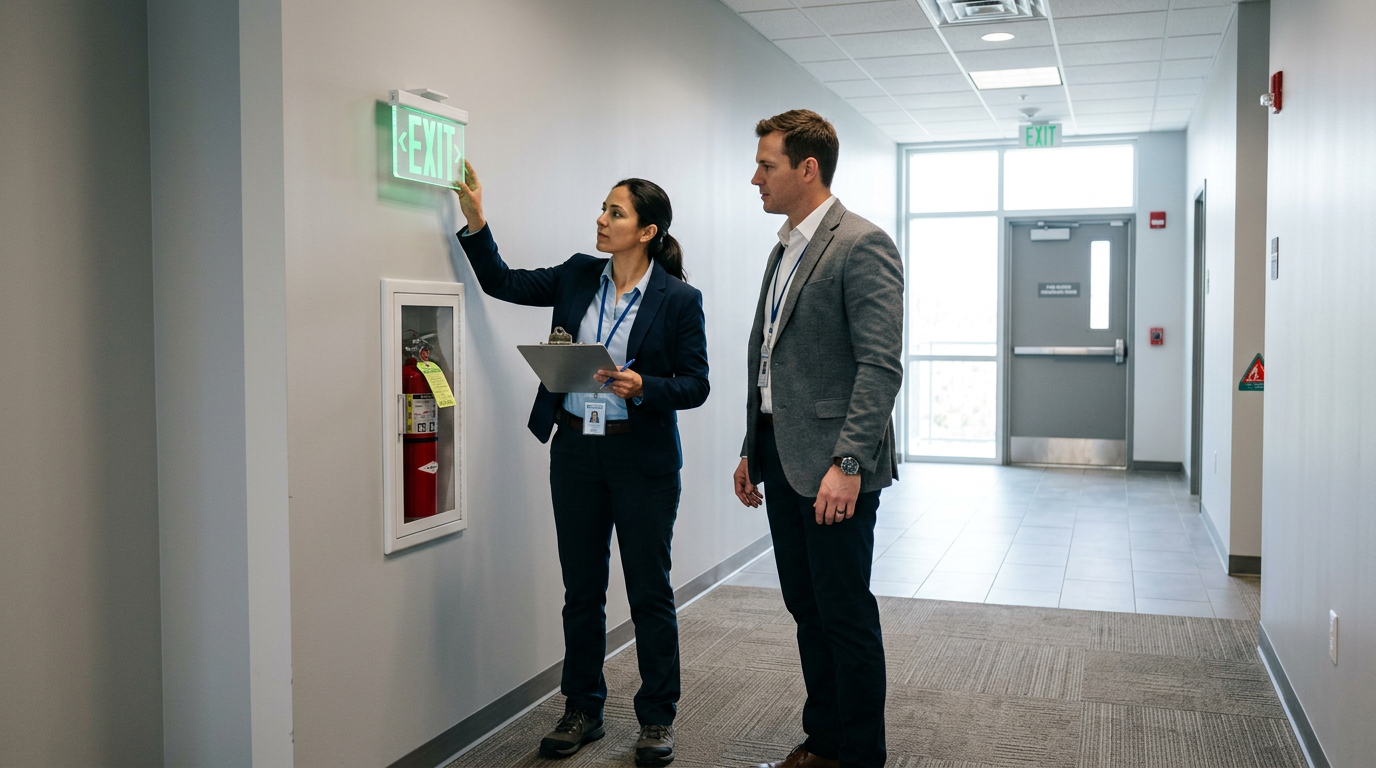
The annual fire safety inspection is the most common form of comprehensive inspection. It is not a single inspection but a family of inspections: the AHJ’s annual fire code inspection, the annual inspection of specific systems (alarms, sprinklers, fire doors, emergency lighting, extinguishers), and the owner’s own annual review of the building’s fire safety program. Understanding what each inspection covers and how to prepare for it is essential to maintaining a compliant and safe building.
This article covers the types of annual inspections, what inspectors look for, inspection frequencies beyond annual, impairments and fire watch, how to prepare, common violations, records, what to do after an inspection, and how to use inspections to improve building fire safety year over year.
◆ Section 1: The Types of Annual Fire Safety Inspections
“Annual fire safety inspection” is not a single activity. It is a family of inspections conducted by different parties with different scopes.
| Inspection | Who Conducts | Scope | Typical Frequency |
|---|---|---|---|
| AHJ fire code inspection | Fire department or fire marshal | Code compliance, egress, fire protection systems, housekeeping, permits | Annual or as required by local code |
| Fire alarm inspection and test | Qualified technician; AHJ may witness | Detection, notification, panel, monitoring | Annual per NFPA 72 (some components semiannual) |
| Sprinkler inspection and test | Qualified technician | Gauges, valves, alarm devices, main drain | Annual per NFPA 25 (many activities more frequent) |
| Standpipe inspection | Qualified technician | Valves, FDC, hose stations | Annual per NFPA 25 |
| Fire pump inspection and test | Qualified technician | Pump operation, controller, flow test | Annual flow test per NFPA 25 (weekly/monthly no-flow tests) |
| Underground piping, hydrants, tanks | Qualified technician | Flushing, hydrant operation, tank condition | Annual and multi-year per NFPA 25 |
| Extinguisher inspection | Building staff or certified technician | Visual inspection, maintenance, hydrostatic test | Monthly visual; annual maintenance; hydrostatic per NFPA 10 |
| Fire door inspection | Qualified person | Operation, latching, labels, gaps | Annual per NFPA 80 and NFPA 101 |
| Emergency lighting inspection | Building staff or technician | Functional test, duration test | Monthly functional; annual duration per NFPA 101 |
| Emergency/standby generator | Qualified technician and building staff | Inspection, load test, transfer switch | Weekly inspection; monthly exercise; periodic extended test per NFPA 110 |
| Commercial cooking inspection | Qualified technician | Hood, duct, extinguishing system | Suppression semiannual; exhaust cleaning monthly to annual per NFPA 96 |
| Smoke control and special hazard systems | Qualified technician | Smoke control, clean agent, other suppression | Semiannual or annual per applicable standard |
| Insurance inspection | Insurer | Fire protection, housekeeping, construction | Annual or as required by policy |
| Owner’s annual review | Facility manager or fire safety director | Overall fire safety program | Annual |
Key point: The annual fire safety inspection is a family of inspections, not a single event. Each has its own standard, frequency, and scope.
Key Article: Article 141 — Fire Safety Management Systems and ISO 31000 Alignment
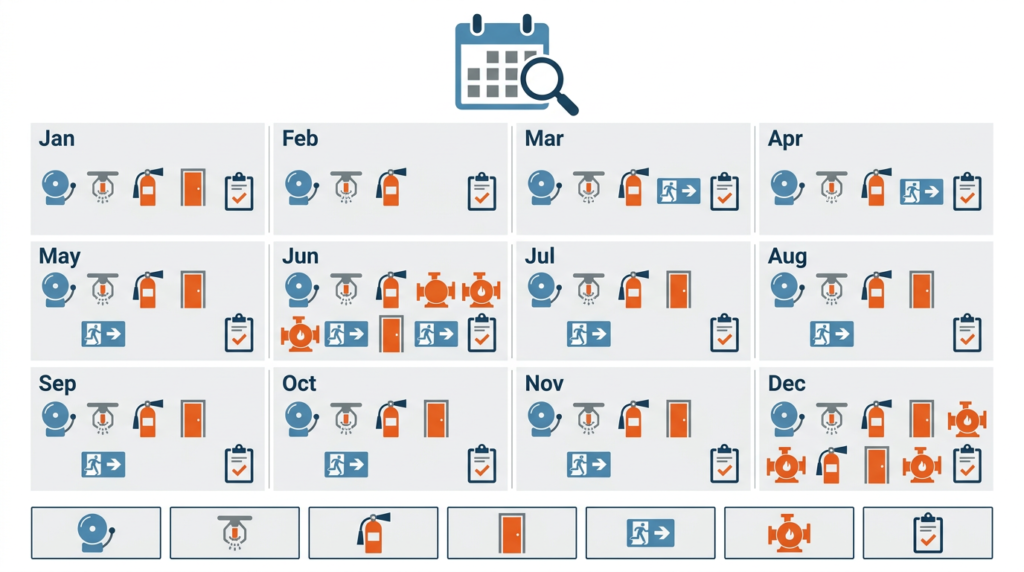
Pro Tip: Build an inspection calendar that shows every inspection, its standard, its frequency, and its responsible party. The calendar is the operating document for the annual inspection program.
◆ Section 2: What the AHJ Inspects
The AHJ’s annual fire code inspection is the most visible and often the most consequential inspection. It verifies compliance with the adopted fire code and can result in violations, fines, or closure if deficiencies are found.
A. Common AHJ Inspection Areas
| Area | What Inspectors Look For |
|---|---|
| Means of egress | Exit doors unobstructed, exit signs illuminated, emergency lighting functional, exit paths clear, doors not locked against egress |
| Fire protection systems | Sprinkler control valves open, fire alarm panel normal, extinguishers in place and charged, current inspection tags |
| Fire doors | Self-closing, latching, unobstructed, not propped open |
| Housekeeping | No storage in corridors or exit enclosures, combustible accumulation controlled |
| Electrical | No extension cords as permanent wiring, panel access clear (typically 36 in. clearance) |
| Heating and cooking | Clearances, hood and duct condition, extinguishing system current |
| Hazardous materials | Storage quantities within limits, proper containers, labeling |
| Fire department access | Access roads and fire lanes clear, FDC accessible, hydrants accessible, key box (Knox Box) contents current |
| Occupancy | Occupant load posted and not exceeded (assembly), use matches approved occupancy classification |
| Permits | Operational permits current where required (e.g., hazardous materials, assembly, hot work) |
| Fire safety plan | Current, posted, staff trained |
| Records | Inspection, testing, and maintenance records current |
B. The Inspector’s Perspective
The AHJ inspector is verifying that the building is safe for its occupants and that the owner is maintaining the fire protection features. The inspector is not looking for perfection. The inspector is looking for compliance and for good-faith maintenance.
C. The Inspection Report
The AHJ typically issues a written report identifying:
- Compliant items
- Violations (with code sections)
- Required corrective actions
- Deadlines for correction
- Follow-up inspection requirements
Key point: The AHJ inspection is a compliance event. The inspector is verifying that the building meets the adopted fire code and that the owner is maintaining the fire protection.
Pro Tip: Accompany the inspector during the inspection. The inspector can explain the reasoning behind a finding, and you can learn what to look for in future self-inspections.
◆ Section 3: What Annual System Inspections Cover
Beyond the AHJ inspection, individual systems have their own annual inspection requirements.
A. Fire Alarm (NFPA 72)
| Annual Test | What It Verifies |
|---|---|
| Initiating devices | Each detector, pull station, and flow switch operates (smoke detector sensitivity is tested per the schedule in NFPA 72) |
| Notification appliances | Each horn, strobe, and speaker operates |
| Panel functions | Panel responds correctly to all inputs; trouble and supervisory signals operate |
| Monitoring | Signals received at the monitoring company |
| Batteries | Battery capacity and charging under load |
| Voice systems | Speakers operate and messages are clear; intelligibility is verified at acceptance and re-verified where changes could affect it |
Some NFPA 72 items are tested more often than annually. Waterflow switches and valve tamper switches, for example, are typically tested semiannually.
B. Sprinkler Systems (NFPA 25)
| Annual Test | What It Verifies |
|---|---|
| Gauges | Correct pressure on supply and system sides (gauges are replaced or recalibrated every 5 years) |
| Control valves | Open, sealed or supervised, and operable |
| Alarm devices | Water motor gong or electric alarm operates |
| Main drain | Flow test verifies water supply and that the supply is not impaired |
| Dry pipe valve | Annual trip test (full flow trip test every 3 years) |
| Antifreeze solution | Concentration test (annual, per NFPA 25) |
| Sprinklers | Visual check for corrosion, paint, damage, and obstruction; spare heads (correct number, type, and wrench) available |
C. Standpipe Systems (NFPA 25)
| Annual Test | What It Verifies |
|---|---|
| Hose valves | Operate, no leaks |
| FDC | Accessible, caps in place, clappers function |
| Piping | No visible corrosion or leaks |
| Pressure regulating devices | Operate correctly |
| Hoses and racks | Condition and, where installed, hose service test intervals |
Five-year hydrostatic and flow tests also apply to certain standpipe types.
D. Fire Pumps (NFPA 25)
| Annual Test | What It Verifies |
|---|---|
| Pump operation | Starts, runs, delivers design pressure |
| Controller | Operates correctly, alarms function |
| Flow test | Delivers design flow at design pressure (typically at 100%, 150%, and churn) |
| Relief valve | Operates correctly |
E. Underground Piping, Hydrants, and Water Storage Tanks (NFPA 25)
| Component | Typical Activity |
|---|---|
| Private fire hydrants | Annual operation and flushing; inspection after each use |
| Underground mains | Flow tests at intervals set by NFPA 25 |
| Water storage tanks | Periodic inspection of level, heating, valves, and condition; internal inspection at multi-year intervals |
| Backflow preventers | Annual forward-flow test |
F. Extinguishers (NFPA 10 and OSHA 1910.157)
| Test | Frequency |
|---|---|
| Visual inspection | Monthly |
| Maintenance (by a certified person, with tag) | Annual |
| Internal maintenance (stored-pressure dry chemical) | Every 6 years |
| Hydrostatic test | Every 5 or 12 years depending on type |
| Recharge | After use or as required |
OSHA 1910.157 also requires an annual maintenance check with documentation for employer-provided extinguishers.
G. Fire Doors (NFPA 80 and NFPA 101)
| Test | Frequency |
|---|---|
| Annual inspection | Annually |
| Functional test | Annually (opening, closing, latching) |
| Label verification | Annually |
| Gap measurement | Annually |
Smoke door assemblies (NFPA 105) are inspected on the same cycle. Fire and smoke dampers have their own testing intervals under NFPA 80 and NFPA 105.
H. Emergency Lighting and Exit Signs (NFPA 101)
| Test | Frequency |
|---|---|
| Functional test | Monthly (30 seconds) |
| Duration test | Annually (90 minutes) |
I. Emergency and Standby Power (NFPA 110)
Generators serve exit lighting, fire pumps, alarms, and smoke control, so they are a core element of the inspection program.
| Activity | Typical Frequency |
|---|---|
| Visual inspection | Weekly |
| Exercise under load | Monthly (typically at least 30 minutes) |
| Automatic transfer switch test | Monthly |
| Extended load bank or supplemental test | Per NFPA 110 (annual or longer, depending on load and conditions) |
| Battery and fuel checks | Per NFPA 110 schedule |
J. Commercial Cooking Systems (NFPA 96 and NFPA 17A)
| Activity | Typical Frequency |
|---|---|
| Hood and exhaust inspection | Based on cooking volume and type: monthly for solid-fuel and high-volume operations, quarterly, semiannually, or annually |
| Exhaust system cleaning | Per inspection results and NFPA 96 frequency |
| Wet chemical or other suppression system service | Semiannual |
| Fuel shutoff and alarm interface | Tested during suppression service |
K. Smoke Control and Special Hazard Systems
| System | Typical Activity |
|---|---|
| Smoke control (NFPA 92, IFC 909) | Dedicated systems tested semiannually; non-dedicated systems annually |
| Stair pressurization | Functional test, door opening force, and pressure differential checks |
| Clean agent and other special hazard suppression | Semiannual inspection; periodic container and hose tests per the applicable standard |
| Elevator fire service recall | Periodic testing per ASME A17.1 |
L. Who Is Qualified to Perform the Work
Most standards require inspection, testing, and maintenance to be performed by qualified personnel. Many jurisdictions also require:
- State or local contractor licenses for sprinkler and alarm work
- Certification (for example, NICET levels for alarm and sprinkler technicians)
- Certified extinguisher technicians, often with a tag or license number
- Registration with local reporting portals
Confirm that the contractor’s credentials are accepted by your AHJ. A test performed by an unqualified person may not count.
Key point: Each system has its own annual inspection requirements. The owner is responsible for ensuring that all systems are inspected, tested, and maintained per their standards by qualified people.
Key Article: Article 150 — NFPA 25 Inspection, Testing, and Maintenance of Water-Based Systems (planned)
Pro Tip: Use the sample inspection and testing forms in the annexes of NFPA 25 and NFPA 72, or your contractor’s equivalents. They ensure that every required test is performed and documented.
◆ Section 4: Beyond Annual: Weekly, Monthly, Quarterly, Semiannual, and Multi-Year Activities
An annual inspection program fails if it only looks at annual items. Many of the most important checks are more frequent, and some are less frequent.
| Frequency | Typical Activities |
|---|---|
| Weekly | Sprinkler control valves (sealed), gauges on dry, preaction, and deluge systems, diesel fire pump no-flow test, generator inspection |
| Monthly | Extinguisher visual inspection, emergency lighting functional test, sprinkler gauges (wet systems), locked or supervised valves, electric fire pump no-flow test, generator exercise, fire alarm panel and battery visual check |
| Quarterly | Sprinkler alarm device tests, FDC inspection, hydraulic nameplates, priming water in dry systems, high-volume cooking exhaust inspection |
| Semiannual | Fire alarm waterflow and valve tamper tests, commercial kitchen suppression service, smoke control (dedicated), special hazard system inspection |
| Annual | AHJ inspection, fire alarm test, sprinkler main drain, standpipe, fire pump flow test, fire doors, emergency lighting duration, extinguisher maintenance, owner’s review |
| Multi-year | Sprinkler gauge replacement (5 years), internal pipe inspection (5 years), extinguisher hydrostatic tests (5 or 12 years), generator extended tests (3 years in some cases), standpipe flow and hydrostatic tests (5 years), tank internal inspection, sprinkler sample testing at 20, 25, or 50 years depending on type |
These frequencies are typical. Your edition of the standard and your AHJ’s amendments control.
Key point: The annual inspection is only one layer. A missed monthly or quarterly activity is often what the inspector finds first.
Pro Tip: Put every weekly, monthly, and multi-year activity on the calendar next to the annual ones. If it is not on the calendar, it will not happen.
◆ Section 5: Impairments and Fire Watch
Inspections often reveal that a system is out of service. A system that is impaired must be managed, not ignored.
A. What Counts as an Impairment
- A sprinkler or standpipe valve closed for maintenance or repair
- A fire alarm panel or zone out of service
- A fire pump out of service
- Smoke control or other required system not operating
- Any condition that prevents a system from working as designed
B. Impairment Program Elements (NFPA 25 Chapter 15, IFC 901.7)
| Element | Purpose |
|---|---|
| Impairment coordinator | One person responsible for the program |
| Impairment tag | Marks the system and records the date and person |
| Preplanned impairment procedure | Work, parts, and personnel ready before shutdown |
| Notification | AHJ, insurer, monitoring company, and occupants informed |
| Fire watch or interim measures | Where required, trained people patrol the affected area |
| Restoration and verification | System tested and returned to service; tags removed |
| Records | Date, duration, reason, and measures taken |
C. Fire Watch
When a required system is out of service for longer than the code permits, the AHJ may require a fire watch or other interim safety measures. Fire watch personnel must be trained, equipped to raise an alarm, and keep a log. In healthcare occupancies, impairments trigger Interim Life Safety Measures (ILSM).
Key point: An impairment is a temporary condition with a plan, a log, and an end date. An impairment without a plan is a violation.
Pro Tip: Add impairment records to the inspection file. Inspectors often ask for them, and a clean impairment history shows good management.
◆ Section 6: Preparing for the Inspection
Preparation is the difference between a smooth inspection and a difficult one. The building should be inspection-ready at all times, not just before the inspector arrives.
A. Pre-Inspection Preparation Checklist
| Item | Status |
|---|---|
| Exit doors unobstructed and functional | ☐ |
| Exit signs illuminated | ☐ |
| Emergency lighting functional | ☐ |
| Corridors clear | ☐ |
| Stairwells clear | ☐ |
| Fire doors self-closing and latching | ☐ |
| Fire doors not propped open | ☐ |
| Extinguishers in place, charged, and tagged | ☐ |
| Sprinkler control valves open | ☐ |
| Sprinkler heads unobstructed (storage clearance maintained) | ☐ |
| Fire alarm panel normal | ☐ |
| Fire department access clear | ☐ |
| FDC accessible | ☐ |
| Hydrants accessible | ☐ |
| Knox Box keys current | ☐ |
| Housekeeping in good order | ☐ |
| Electrical panels accessible | ☐ |
| Hazardous materials stored properly | ☐ |
| Permits current | ☐ |
| ITM records current | ☐ |
| Impairment log current | ☐ |
| Fire safety plan current | ☐ |
| Staff trained on emergency procedures | ☐ |
B. Records Preparation
The inspector will ask for records. Prepare:
- Fire alarm inspection and test reports
- Sprinkler inspection reports
- Standpipe inspection reports
- Fire pump test reports
- Generator and transfer switch test records
- Extinguisher inspection records
- Fire door inspection records
- Emergency lighting test records
- Kitchen hood cleaning and suppression service reports
- Fire safety plan
- Training records
- Drill records
- Impairment records
- Corrective action log from the previous inspection
C. Staff Preparation
Staff should be prepared to:
- Answer questions about fire safety procedures
- Demonstrate evacuation routes
- Explain their role in an emergency
- Locate the fire safety plan and records
D. During the Inspection
- Assign one knowledgeable escort to accompany the inspector
- Bring the records binder or have electronic records ready to open on request
- Answer questions honestly and directly; do not guess
- Take notes on each finding, including the code section cited
- Correct simple items on the spot if possible (for example, clearing a blocked exit) and tell the inspector
- Ask for clarification rather than arguing; save disagreements for the formal appeal process
- Confirm at the end what was found, what is required, and the deadlines
Key point: The best preparation for an inspection is a building that is inspection-ready every day. The inspection is not a performance. It is a verification of ongoing practice.
Pro Tip: Conduct a self-inspection two weeks before the AHJ inspection. The self-inspection finds the issues you can fix before the inspector finds them.
◆ Section 7: Common Violations Found in Annual Inspections
The same violations appear in building after building. Knowing them is the first step to preventing them.
A. Egress Violations
| Violation | Why It Happens | Prevention |
|---|---|---|
| Exit door blocked | Storage, equipment, furniture | Daily egress check |
| Exit door locked against egress | Security concerns | Use delayed egress or access-controlled egress per NFPA 101 |
| Exit sign not illuminated | Bulb out, power off | Monthly inspection |
| Emergency lighting not functional | Battery dead, bulb out | Monthly functional test |
| Exit path obstructed | Storage, equipment | Daily egress check |
| Exit enclosure used for storage | Space pressure | Zero-tolerance policy |
B. Fire Door Violations
| Violation | Why It Happens | Prevention |
|---|---|---|
| Fire door propped open | Convenience, airflow | Hold-open devices released by the alarm; zero-tolerance policy |
| Fire door not self-closing | Closer removed or adjusted | Annual inspection; repair closers |
| Fire door not latching | Hardware misaligned | Annual inspection; adjust hardware |
| Fire door label painted over | Renovation | Label protection; replacement |
| Fire door gaps too large | Installation error or damage | Annual measurement; repair |
C. Housekeeping and Storage Violations
| Violation | Why It Happens | Prevention |
|---|---|---|
| Corridor storage | Space pressure | Daily housekeeping |
| Stairwell storage | Space pressure | Zero-tolerance policy |
| Storage too close to sprinklers (typically less than 18 in. below deflectors) | Stacking, racking changes | Clearance markings and staff training |
| Combustible accumulation in mechanical rooms | Neglect | Regular inspection |
| Waste not removed | Schedule | Daily housekeeping |
| Extension cords as permanent wiring | Convenience | Electrical inspection |
| Blocked electrical panels | Storage | Marked clearance zones |
D. Fire Protection System Violations
| Violation | Why It Happens | Prevention |
|---|---|---|
| Sprinkler control valve closed | Unauthorized closure | Supervision and routine valve inspection |
| Painted, corroded, or damaged sprinkler heads | Renovation, neglect | Contractor oversight; annual inspection |
| Fire alarm panel in trouble | Sensor fault, battery fault | Monitor panel daily |
| Extinguisher not charged | Discharge, age | Monthly inspection |
| Extinguisher blocked or missing | Storage, theft, relocation | Monthly inspection |
| Expired or missing inspection tags | Service missed | Calendar and contractor tracking |
| FDC blocked or caps missing | Landscaping, damage | Quarterly inspection |
| Impaired system with no plan | Repair work without a program | Impairment program |
E. Records and Administrative Violations
| Violation | Why It Happens | Prevention |
|---|---|---|
| ITM records missing | Not maintained | Records management system |
| Inspection records out of date | Schedule missed | Inspection calendar |
| Training and drill records missing | Not documented | Training tracking system |
| Fire safety plan not current | Not reviewed | Annual review |
| Required permit expired | Not tracked | Permit register |
| Contractor not licensed or certified | Not verified | Contractor credential check |
Key point: The most common violations are egress obstructions, fire doors propped open, housekeeping, and missing records. All are preventable with daily discipline.
Pro Tip: Track the violations from each inspection and compare year to year. Recurring violations indicate a management system problem, not a one-time issue.
◆ Section 8: After the Inspection
The inspection is not over when the inspector leaves. The findings must be addressed.
A. Immediate Response
| Activity | Purpose |
|---|---|
| Review the inspection report | Understand the findings |
| Prioritize violations | Determine what needs immediate action (life safety first) |
| Assign responsibility | Designate who will correct each violation |
| Establish deadlines | Align with AHJ deadlines |
| Communicate to management | Inform leadership of findings |
B. Corrective Action
| Activity | Purpose |
|---|---|
| Correct each violation | Address the finding |
| Document the correction | Evidence of compliance (photos, work orders, contractor reports) |
| Verify the correction | Confirm the violation is resolved |
| Notify the AHJ | Provide evidence of correction |
| Schedule follow-up inspection | If required by AHJ |
C. Consequences of Uncorrected Violations
Depending on the jurisdiction and the severity, uncorrected violations can lead to:
- Reinspection fees
- Citations and fines
- Orders to vacate or restrict occupancy
- Closure for imminent hazards
- Insurance consequences, including coverage or premium impact
- Liability exposure after a fire
D. Disputes, Appeals, and Extensions
If you disagree with a finding or cannot meet a deadline:
- Ask the inspector to explain the code basis for the finding
- Request a written extension with a corrective action plan if the work needs lead time
- Use the formal appeal or board of appeals process, within the filing deadline, for disputed findings
- Request an alternative means of compliance or variance where the code allows it, supported by engineering documentation
E. Root Cause Analysis
For recurring violations or serious findings:
- Identify the root cause (not just the symptom)
- Determine the corrective action (systemic, not individual)
- Implement the correction
- Verify the correction is effective
F. Continuous Improvement
The inspection should result in improvement, not just compliance. Consider:
- Updating the fire safety plan
- Revising inspection schedules
- Adding training
- Changing procedures
- Investing in system upgrades
Key point: The inspection’s value is in the corrective action, not the report. A finding that is corrected but not prevented from recurring is a missed opportunity.
Key Article: Article 49 — How to Conduct a Fire Safety Audit: A Step-by-Step Guide
Pro Tip: Track corrective actions in a log with due dates and closure verification. The log is the evidence that violations were addressed.
◆ Section 9: Records and Documentation
Records are the evidence that inspections happened. An inspection without a record is, to an inspector, an inspection that did not happen.
A. What a Good Inspection Record Contains
- Date and time of the activity
- System and location
- Name, company, and credentials of the person performing the work
- Standard and edition followed
- Results, including deficiencies and impairments
- Corrective actions and follow-up dates
- Signature or electronic authentication
B. Retention
Retention periods vary by standard and jurisdiction. Typical requirements include:
- IFC 901.6.3: ITM records kept for at least 3 years, or longer if the AHJ requires
- NFPA 25: Records kept for the period stated in the standard, generally at least until the next inspection or test and one year after
- NFPA 72: Test and maintenance records kept until the next test and one year thereafter; the original record of completion and acceptance retained for the life of the system
- NFPA 110, NFPA 10, NFPA 80, and NFPA 101: Per the individual standard
When in doubt, keep records longer than the minimum. Many owners keep ITM records for the life of the system.
C. Reporting to the AHJ
Many jurisdictions require contractors or owners to submit inspection reports to the AHJ through an online reporting portal or third-party compliance platform. Confirm whether your AHJ requires this and who is responsible for submitting the report.
Key point: Records must be complete, legible, retrievable, and retained for the required period.
Pro Tip: Store records electronically with a search function and a backup. Paper binders are lost, damaged, and left in the wrong building.
◆ Section 10: The Owner’s Annual Review
Beyond the AHJ inspection and system inspections, the owner should conduct an annual review of the building’s fire safety program.
A. What the Owner’s Annual Review Covers
| Area | Review Questions |
|---|---|
| Policy and governance | Is the fire safety policy current? Are roles assigned? |
| Risk assessment | Has the risk assessment been updated? |
| Fire safety plan | Is the plan current and accurate? |
| Inspection, testing, and maintenance | Are all systems inspected per their standards? |
| Impairments | Were impairments managed and closed out? |
| Training | Are all staff trained? Are records current? |
| Drills | Have drills been conducted per occupancy requirements? |
| Records | Are all records complete and retrievable? |
| Incidents | Have incidents and near-misses been investigated? |
| Code changes | Have there been changes to codes or AHJ requirements? |
| Changes to the building | Have renovations, occupancy changes, or new tenants affected fire protection? |
| Capital needs | Are there fire protection systems that need replacement or upgrade? |
B. The Annual Review Report
The annual review should produce a written report that includes:
- Summary of the year’s fire safety activities
- Results of inspections and tests
- Violations and corrective actions
- Incidents and lessons learned
- Recommendations for the coming year
- Resource needs
C. Management Review
The annual review should be reviewed by top management as part of the fire safety management system. Decisions about resources, priorities, and improvements should be documented.
Key point: The owner’s annual review is the mechanism by which the building’s fire safety program is evaluated and improved. It is not a compliance exercise. It is a management activity.
Key Article: Article 141 — Fire Safety Management Systems and ISO 31000 Alignment
Pro Tip: Schedule the owner’s annual review immediately after the AHJ inspection. The inspection findings are fresh, and the review can incorporate them.
◆ Section 11: Inspection Calendar
A well-run building has an inspection calendar that shows every inspection, its standard, its frequency, and its responsible party.
Annual inspection calendar showing monthly fire protection system inspections across a 12-month grid
A. Example Inspection Calendar
| Inspection | Standard | Frequency | Responsible |
|---|---|---|---|
| Fire alarm | NFPA 72 | Annual (some tests semiannual) | Alarm contractor |
| Sprinkler gauges | NFPA 25 | Weekly (dry/preaction/deluge); monthly (wet) | Building staff |
| Sprinkler control valves | NFPA 25 | Weekly (sealed) or monthly (locked/supervised) | Building staff |
| Sprinkler alarm devices | NFPA 25 | Quarterly | Sprinkler contractor |
| Sprinkler main drain | NFPA 25 | Annual | Sprinkler contractor |
| Standpipe | NFPA 25 | Annual | Sprinkler contractor |
| Fire pump | NFPA 25 | Annual flow test (weekly/monthly no-flow) | Fire pump contractor |
| Hydrants and underground piping | NFPA 25 | Annual and multi-year | Sprinkler contractor |
| Extinguisher visual | NFPA 10 | Monthly | Building staff |
| Extinguisher maintenance | NFPA 10 | Annual | Extinguisher contractor |
| Fire doors | NFPA 80 | Annual | Qualified person |
| Emergency lighting functional | NFPA 101 | Monthly | Building staff |
| Emergency lighting duration | NFPA 101 | Annual | Qualified person |
| Generator and transfer switch | NFPA 110 | Weekly inspection; monthly exercise | Building staff and generator contractor |
| Commercial cooking suppression | NFPA 96 / NFPA 17A | Semiannual | Suppression contractor |
| Commercial cooking exhaust cleaning | NFPA 96 | Monthly to annual by usage | Hood cleaning contractor |
| Smoke control | NFPA 92 / IFC 909 | Semiannual or annual | Qualified contractor |
| AHJ fire code inspection | Local code | Annual | AHJ |
| Owner’s annual review | Owner’s policy / ISO 31000 | Annual | Fire safety director |
B. Building the Calendar
- Start with the code and standards requirements
- Add the insurer’s requirements
- Add the AHJ’s requirements
- Add the owner’s requirements
- Assign responsibility for each
- Set reminders
Key point: The inspection calendar is the operating document for the annual inspection program. Without it, inspections are missed.
Pro Tip: Use a computerized maintenance management system (CMMS) or a shared calendar to track inspections. Automated reminders prevent missed inspections.
◆ Section 12: Training and Competence
The staff who conduct inspections and who respond to inspectors must be trained.
A. Who Needs Training
| Role | Training |
|---|---|
| Facility manager | Inspection requirements, records, corrective action |
| Maintenance staff | System inspections, extinguisher inspection, emergency lighting, impairment procedures |
| Fire safety director | Overall program, AHJ coordination, annual review |
| All staff | Egress routes, alarm response, extinguisher use |
| Contractors | Building-specific requirements, hot work, impairment |
B. What Training Should Cover
- The building’s fire safety plan
- The inspection calendar and responsibilities
- The AHJ’s inspection process
- Common violations and prevention
- Records management
- Corrective action process
C. Verification
Training should be verified by:
- Attendance records
- Competency assessment
- Demonstration of inspection procedures
- Q&A with the trainer
Key point: Training is what turns the inspection program from a list of tasks into a functioning system. Staff who understand why inspections matter are more likely to perform them.
Key Article: Article 70 — How to Design and Implement a Fire Safety Training Program
Pro Tip: Include the AHJ in annual training. The inspector can explain what they look for and why.
◆ Section 13: Special Cases
Some buildings and occupancies have additional inspection requirements.
A. Healthcare Facilities
Healthcare facilities subject to CMS certification have additional inspection requirements:
- Life Safety Code compliance surveys
- Statement of Conditions (SOC)
- Plans for Improvement (PFI)
- ILSM assessment during deficiencies
- Documented testing of fire and smoke dampers, doors, and generators
B. High-Rise Buildings
High-rise buildings have additional inspection requirements:
- Smoke control system testing
- Stair pressurization testing
- Elevator recall testing
- Standpipe flow testing
- Emergency responder radio coverage system testing where installed
C. Assembly Occupancies
Assembly occupancies have additional inspection requirements:
- Occupant load verification
- Seating arrangement
- Decorative materials
- Crowd management
D. Educational and Residential Occupancies
Schools and residential buildings (apartments, hotels, dormitories) have their own requirements:
- Fire drill frequency and records (schools)
- Smoke alarm and carbon monoxide alarm testing in sleeping units
- Door and corridor requirements for sleeping areas
E. Industrial and Storage Facilities
Industrial plants and warehouses have additional requirements:
- Storage height and commodity classification
- Flammable and combustible liquids storage
- Hot work permits
- Process-specific fire protection
F. Historic Buildings
Historic buildings may have unique inspection considerations:
- Installation and maintenance of fire protection systems with minimal impact on historic fabric
- Preservation of historic features
- Alternative compliance methods
Key point: Special occupancies have special inspection requirements. The inspection calendar must reflect them.
Pro Tip: Understand the specific inspection requirements for your occupancy type. The general requirements are the baseline; the occupancy-specific requirements are additional.
◆ Section 14: Common Challenges and Mistakes
Most inspection program failures are management failures: the program was not planned, scheduled, or resourced. The violations are the symptoms.
| Challenge or Mistake | Why It Is a Problem | Solution |
|---|---|---|
| No inspection calendar or responsible party | Inspections missed; no one accountable | Build and maintain a calendar; assign responsibility |
| Inspections performed but not recorded | No evidence of compliance | Records management system |
| Records not retrievable | AHJ cannot verify | Electronic records with search |
| Violations not corrected | Compliance issue | Corrective action log with due dates |
| Violations corrected but not prevented | Recurring findings | Root cause analysis |
| Fire safety plan not current | Not effective | Annual review |
| Self-inspection not performed | Surprised by AHJ findings | Self-inspection before AHJ |
| Contractor not qualified | Test may not be accepted | Verify licenses and certifications |
| Impairments not managed | System out of service without protection | Impairment program and fire watch |
| Insurer requirements ignored | Coverage affected | Obtain requirements in writing and implement |
| Special occupancy requirements missed | Compliance issue | Occupancy-specific training |
| Staff not trained | Staff not prepared | Training program |
| Resources not budgeted | Deferred maintenance | Maintenance budget and schedule |
Pro Tip: Review the inspection program annually. The program should evolve as the building, the codes, and the AHJ’s requirements change.
◆ Section 15: Program Checklist
| Item | Status | Notes |
|---|---|---|
| Inspection calendar developed | ☐ | All inspections, frequencies, responsible parties |
| AHJ inspection requirements confirmed | ☐ | Local code, frequency, permits |
| System inspection requirements confirmed | ☐ | NFPA 25, 72, 10, 80, 96, 101, 110 |
| Contractor credentials verified | ☐ | Licenses and certifications accepted by AHJ |
| Insurer requirements confirmed | ☐ | In writing |
| Special occupancy requirements confirmed | ☐ | Healthcare, high-rise, assembly, etc. |
| Impairment program in place | ☐ | Coordinator, tags, fire watch |
| Pre-inspection checklist developed | ☐ | For each inspection |
| Records management system | ☐ | Electronic or paper, with retention periods |
| AHJ reporting process confirmed | ☐ | Portal or submission responsibility |
| Corrective action log | ☐ | With due dates and closure |
| Self-inspection procedure | ☐ | Before AHJ inspection |
| Training program | ☐ | For all roles |
| Owner’s annual review procedure | ☐ | Documented |
| Management review | ☐ | Annual |
| Resources budgeted | ☐ | For inspections, maintenance, and training |
◆ Section 16: Conclusion
Annual fire safety inspections are a family of inspections, not a single event. The AHJ inspects code compliance; the system contractors inspect their systems; the owner reviews the fire safety program. Each inspection has its own standard, frequency, and scope, and the annual items sit on top of weekly, monthly, quarterly, semiannual, and multi-year activities.
The critical elements are:
- Calendar: every inspection, its frequency, and its responsible party
- Preparation: the building should be inspection-ready every day
- Qualified people: contractors and staff with the right credentials
- Impairment management: a plan whenever a system is out of service
- Records: the evidence that inspections were performed, retained for the required period
- Corrective action: the response to findings, including appeals where warranted
- Root cause analysis: preventing recurrence
- Owner’s annual review: evaluating and improving the program
- Training: staff who understand and perform the inspections
- Resources: budgeted for inspections, maintenance, and training
The most common violations (egress obstructions, fire doors propped open, housekeeping, and missing records) are all preventable with daily discipline. The inspection is not a performance. It is a verification of ongoing practice.
Key Takeaways:
- Annual fire safety inspections are a family of inspections, not a single event.
- The AHJ inspects code compliance; system contractors inspect their systems; the owner reviews the program.
- Each system has its own inspection standard and frequency (NFPA 25, 72, 10, 80, 96, 101, 110).
- Annual items sit on top of weekly, monthly, quarterly, semiannual, and multi-year activities.
- The building should be inspection-ready every day, not just before the inspection.
- Use qualified, properly credentialed contractors and personnel.
- Impairments require a plan, a log, and, where required, a fire watch.
- Records are the evidence that inspections were performed and must be retained.
- Corrective action must be tracked to closure; appeals and extensions go through the formal process.
- Root cause analysis prevents recurrence.
- The owner’s annual review is the mechanism for evaluating and improving the program.
- Training ensures staff understand and perform inspections correctly.
- Resources must be budgeted for inspections, maintenance, and training.
- The most common violations are egress obstructions, fire doors, housekeeping, and missing records, and all are preventable.
Take Action Today:
- Confirm the inspection calendar is current and complete, including weekly, monthly, and multi-year items.
- Confirm each inspection has an assigned responsible party.
- Verify that contractors hold the licenses and certifications your AHJ requires.
- Review the pre-inspection checklist and update as needed.
- Conduct a self-inspection before the AHJ inspection.
- Confirm records are current, retrievable, and retained for the required period.
- Review the impairment log and the corrective action log for open items.
- Analyze recurring violations for root causes.
- Confirm the fire safety plan is current.
- Confirm staff training is current.
- Schedule the owner’s annual review.
- Obtain the insurer’s requirements in writing.
- Confirm special occupancy requirements are addressed.
- Budget for inspections, maintenance, and training.
Continue Reading from Our Series:
-
Related guide: Article 146 — Integrated Testing of Fire and Life Safety Systems
-
Related guide: Article 145 — Commissioning Fire Protection Systems
-
Read more: Article 50 — What to Do During a Fire Department Inspection: A Preparation Guide
About This Guide: This article is part of a series on commercial building fire safety, written for facility managers, architects, and code officials. It references model codes and standards for educational purposes. Always consult your local AHJ for project-specific requirements.