IMPORTANT DISCLAIMER: This guide references NFPA 2400, Standard for Small Unmanned Aircraft Systems (sUAS) Used for Public Safety Operations; NFPA 1500, Standard on Fire Department Occupational Safety, Health, and Wellness Program; NFPA 70B (electrical equipment maintenance, including infrared thermography); NFPA 101, Life Safety Code; NFPA 72 (National Fire Alarm and Signaling Code); NFPA 25 (inspection, testing, and maintenance of water-based systems); the Federal Aviation Administration (FAA) regulations under 14 CFR Part 107 (Small Unmanned Aircraft Systems); the International Fire Code (IFC); the International Building Code (IBC); and the requirements of the Authority Having Jurisdiction (AHJ) and the insurer. Drone and robotics regulations are evolving rapidly, and the editions and rules cited here may have changed. FAA Part 107 governs most commercial sUAS operations in the United States; government agencies may instead operate as public aircraft operators under different rules; other countries have their own regulators. Firefighting and inspection robots are not currently governed by a dedicated NFPA standard, though their use is covered by general occupational safety requirements and by the standards that apply to the equipment and locations involved. This guide is a starting point only. Always verify the requirements applicable to your project with your AHJ, your aviation regulator, and your legal counsel.
Drones and robots are changing how fire safety is practiced. A drone can inspect a roof in minutes that would take hours to access safely. A thermal imaging drone can reveal hot spots that are invisible to the naked eye. A firefighting robot can enter a building that is too dangerous for a person. These technologies are in use today, and their adoption is accelerating.
Drone and robotics applications in fire safety is the discipline of using unmanned systems to support fire prevention, inspection, response, and investigation. The technology is evolving faster than the regulations that govern it.
For building owners and facility managers, drones offer a safer, faster, and often cheaper way to inspect roofs, facades, and other hard-to-reach areas. For fire departments, drones provide real-time aerial intelligence and thermal imaging. For industrial facilities, ground robots provide access to environments that are too hazardous for people.
This article covers the applications of drones and robotics in fire safety, the regulatory framework, the practical considerations for building owners and fire departments, safe operation, and how to integrate these tools into a fire safety program.
◆ Section 1: Why Drones and Robotics Matter for Fire Safety
Drones and robots address four challenges: access, safety, speed, and data.
| Challenge | Drone/Robot Solution |
|---|---|
| Roof access | Drone inspection without scaffolding or a lift |
| Facade access | Drone survey to screen conditions and target hands-on work |
| Confined spaces | Robot inspection without human entry |
| Hazardous environments | Robot entry without human exposure |
| Thermal imaging | Drone- or robot-mounted thermal camera |
| Real-time intelligence | Video and thermal feed to incident command |
| Post-fire investigation | Drone or robot access to unstable structures |
| Large area assessment | Drone coverage of large sites |
The safety case. Working at height, entering confined spaces, and entering hazardous atmospheres are among the most dangerous activities in fire safety. Drones and robots remove the person from these hazards.
The cost case. Drones and robots can reduce scaffolding and lift rental, inspection time, downtime, and personnel hours.
The data case. Drones and robots generate images, video, thermal readings, and gas readings that can be stored, analyzed, and compared over time.
Key point: Drones and robots are tools, not replacements for human judgment or for inspections that codes require to be performed in a specific way.
Pro Tip: Start with the application that addresses your biggest challenge. If roof inspection is difficult, start there; if confined space entry is the concern, start there.
Key Article: Article 158 — Digital Twins for Fire Safety Management
◆ Section 2: Drone Applications for Building Owners
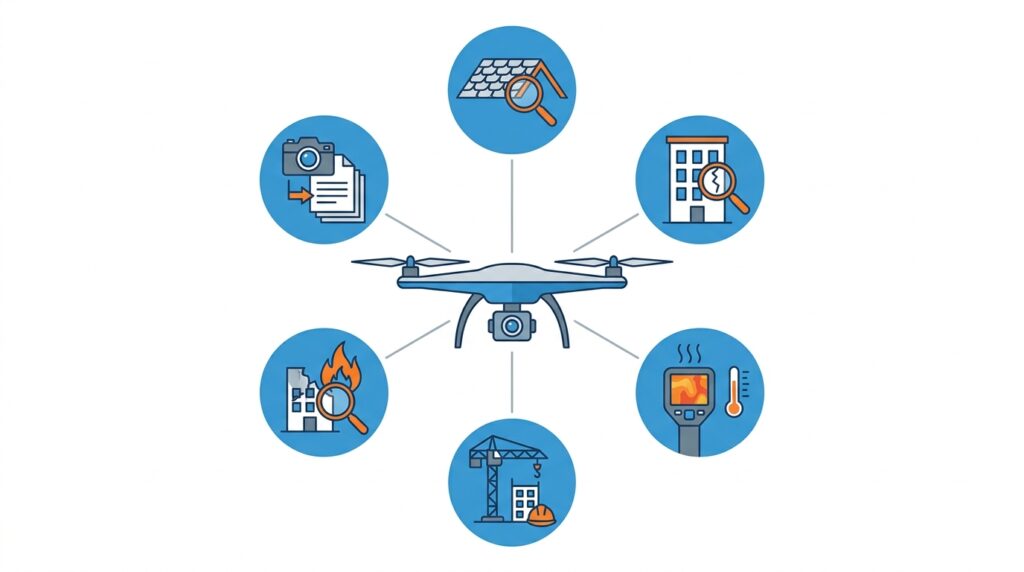
Building owners and facility managers use drones for inspection, monitoring, and documentation.
A. Roof Inspection
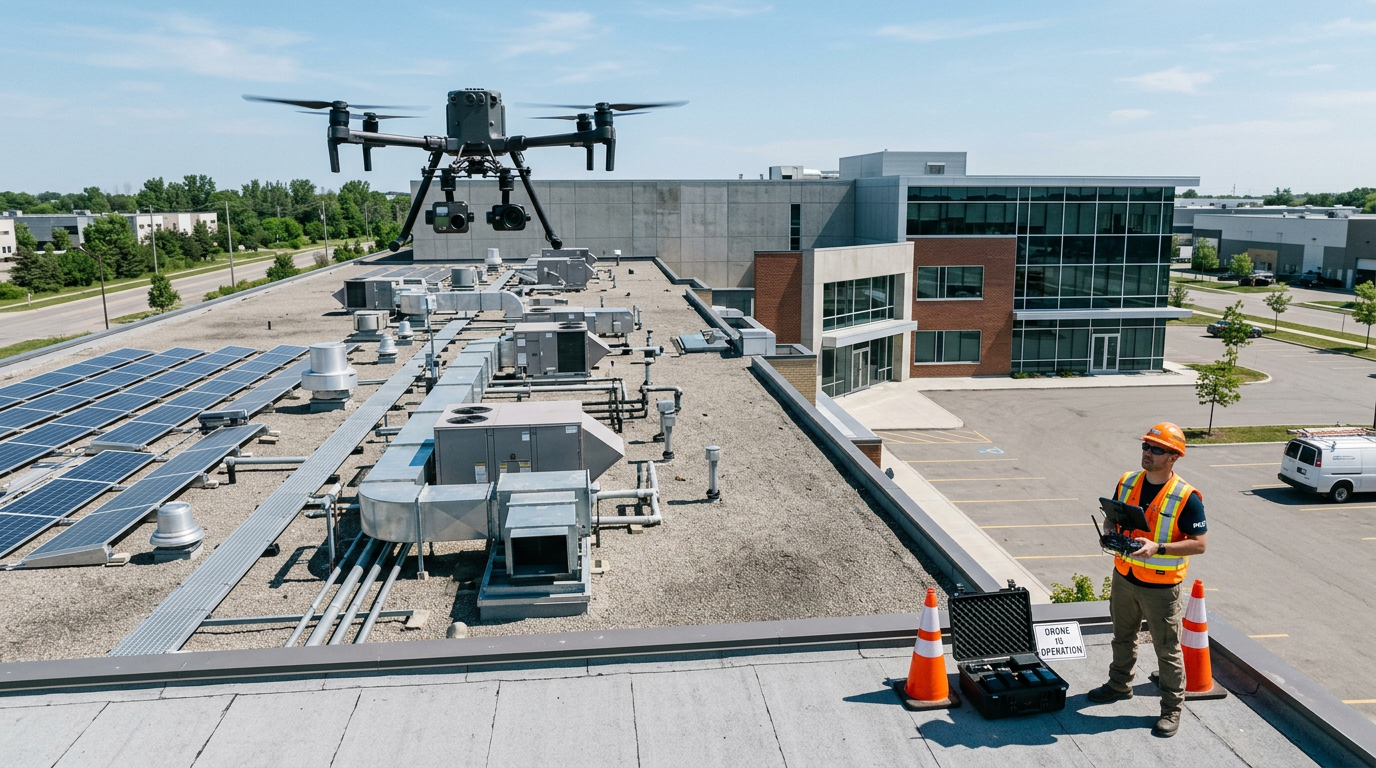
Roof inspection is the most common drone application for building owners. A drone can:
- Inspect roof condition without roof access
- Identify damaged or missing roofing, ponding, and penetrations
- Inspect rooftop equipment (HVAC, solar arrays, vents)
- Document roof conditions for insurance and maintenance
B. Facade Inspection
Periodic facade inspection is required in some jurisdictions (for example, New York City’s Local Law 11/FISP). A drone can screen a facade for cracks, spalling, displaced panels, and loose materials, and can document conditions over time. However, many facade programs require close-up, hands-on examination by a qualified professional at specified locations, so a drone survey usually supplements that work rather than replacing it. Confirm with the jurisdiction how drone data may be used for compliance.
C. Thermal Imaging
A drone-mounted thermal camera can help identify:
- Hot spots in rooftop and exterior electrical equipment
- Insulation deficiencies and air leakage
- Moisture intrusion in roofing
Thermal results depend on camera quality, emissivity, weather, and operator skill. Findings are screening indicators and should be confirmed by a qualified thermographer; for electrical equipment, follow NFPA 70B practice.
D. Indoor and Large-Space Inspection
Small indoor drones and ground robots can inspect high-bay warehouses, atriums, and above-ceiling or crawl spaces. They can document storage arrangements, check clearances, and view hard-to-reach piping and equipment. Indoor operations raise their own issues: no GPS, obstacle collision, interaction with sprinkler heads and detectors, and the need to notify occupants and the monitoring company when operating near fire protection devices.
E. Construction Monitoring
During construction, a drone can monitor progress, document conditions, and inspect areas that are difficult to access, supporting fire safety inspections (Article 144).
F. Post-Fire Assessment
After a fire, a drone can assess structural damage, identify hot spots, document conditions for insurance and investigation, and support reconstruction planning.
Key point: Drones give building owners a safer, faster, and often cheaper way to inspect and document building conditions, but they do not replace code-required hands-on inspection, testing, and maintenance.
Pro Tip: Use a consistent flight pattern, altitude, and image naming convention. The images become a historical record that can be compared year over year.
◆ Section 3: Drone Applications for Fire Departments
Fire departments use drones for emergency response, pre-incident planning, and investigation.
A. Emergency Response
| Application | Use |
|---|---|
| Aerial overview | Situational awareness of the incident scene |
| Thermal imaging | Hot spot identification; search and rescue |
| Size-up | Assessment of fire conditions and extension |
| Access | Identification of access routes and obstacles |
| Hazard identification | Location of hazardous materials, collapse zones, and exposures |
| Payloads | Searchlight, loudspeaker, and rope or flotation delivery |
| Tethered drones | Persistent overwatch and communications relay for long incidents |
B. Drone as First Responder (DFR)
Some agencies launch drones from stations or rooftop docks in response to 911 calls, so a drone arrives before the first engine and gives command a view of the scene. DFR programs typically require approvals for operations beyond the visual line of sight, so they depend on FAA waivers and a mature program. They also raise policy questions on privacy, data retention, and public communication.
C. Wildfire and Wildland-Urban Interface
Drones map fire perimeters, detect hot spots and spot fires, and assess structure damage in the wildland-urban interface. Unauthorized drones near a wildfire can ground firefighting aircraft, so agencies and the public must follow temporary flight restrictions.
D. Pre-Incident Planning
Drones can capture building geometry, roof access points, rooftop hazards (solar arrays, skylights, equipment), hazardous materials locations, water supply locations, and access routes.
E. Post-Incident Investigation
Drones can document the scene, support origin-and-cause work, assess structural stability from a distance, and support reconstruction planning.
F. Airspace Deconfliction at Incidents
At an active incident, drones share airspace with helicopters and other aircraft. Command should designate who may launch, assign a drone coordinator, and establish deconfliction procedures with air operations. Drones that are not part of the response must be kept out.
Key point: Fire departments use drones for response, pre-incident planning, and investigation. NFPA 2400 and the FAA framework govern these operations.
Pro Tip: Coordinate drone operations with the AHJ, neighboring agencies, and the FAA. Non-compliance can ground the program.
Key Article: Article 69 — How to Design Firefighter Access and Building Features for Rescue Operations
◆ Section 4: Robotics Applications
Robots are used in fire safety where the environment is too dangerous or too difficult for people.
A. Firefighting Robots
Remotely operated ground vehicles can enter burning or smoke-filled buildings, carry a monitor to deliver water or foam, provide video and thermal imaging, and operate in high-heat, high-smoke environments. They are especially useful in industrial, tunnel, warehouse, and high-hazard settings.
B. Confined Space Robots
These robots inspect tanks, vaults, and tunnels, detect gases, and provide video without human entry.
C. Inspection and Patrol Robots
Crawler, snake, and legged robots can inspect piping internals, ductwork, and crawl spaces. Autonomous patrol robots and docked drones can make routine rounds in large facilities, detect smoke, heat, or open doors, and report anomalies. They may supplement scheduled rounds but should not replace fire watches or inspections required by code or by an impairment plan unless the AHJ agrees (see NFPA 25 and IFC impairment requirements).
D. Hazardous Locations
A robot operating in a location that may contain flammable gas, vapor, or dust can itself be an ignition source. Equipment must be suitably rated or listed for the classified area (for example, NEC hazardous location classifications), and the facility’s hot work, permit, and gas-testing procedures still apply.
E. The Regulatory Gap
Firefighting robots are not governed by a dedicated NFPA standard. Their use is covered by general occupational safety requirements (NFPA 1500, OSHA) and by the requirements for the facility and location. Verify the manufacturer’s rated limits (heat, water exposure, runtime, communication range) and require training and written procedures.
Key point: Robots serve applications that are too dangerous for people, but the regulatory framework is less developed than for drones, so program owners must set their own safeguards.
Pro Tip: For any robot deployment, verify that the robot is rated for the intended environment and that the operators are trained and drilled.
◆ Section 5: The Regulatory Framework
Drones and robots are governed by a combination of aviation, safety, privacy, and operational rules.
A. FAA Regulations (United States)
| Regulation | Scope |
|---|---|
| 14 CFR Part 107 | Commercial sUAS operations: remote pilot certificate, aircraft registration, visual line of sight, altitude, and operating limits |
| Public aircraft operations / Certificate of Waiver or Authorization (COA) | Government agencies operating as public aircraft operators, including many fire departments |
| Remote ID | Broadcast identification of drones in flight; verify current compliance and any public safety exceptions |
| Airspace authorization (for example, LAANC) | Operations in controlled airspace |
| Waivers and temporary flight restrictions | Operations over people, beyond visual line of sight, and flights near wildfires or other restricted areas |
Part 107 allows night operations and operations over people under defined conditions, and the FAA has proposed rules to make operations beyond the visual line of sight more routine. Rules continue to change, so check current FAA guidance before each program or mission type.
B. NFPA Standards
| Standard | Scope |
|---|---|
| NFPA 2400 | sUAS for public safety operations: program management, personnel, operations, maintenance, documentation |
| NFPA 1500 | Fire department occupational safety and health |
| NFPA 70B | Electrical equipment maintenance, including infrared thermography |
C. Other Regulations and Considerations
| Item | Scope |
|---|---|
| OSHA | Workplace safety, including working at height and confined spaces |
| Local and state laws | Drone launch, landing, and operation restrictions; state privacy and public records laws |
| Privacy and search law | Imaging of people and property; warrant and policy issues for government operators |
| Equipment and cybersecurity rules | Restrictions on certain foreign-made drones, especially for government-funded programs; data security and storage |
D. The International Perspective
Other countries have equivalent regulators (for example, EASA in Europe, the CAA in the UK, and Transport Canada). Requirements vary by country.
Key point: Drone and robot programs must satisfy aviation, safety, privacy, and procurement requirements. The framework varies by jurisdiction and is evolving.
Pro Tip: Consult legal counsel and the relevant regulator before deployment, and schedule a regular regulatory review.
◆ Section 6: Practical Considerations for Building Owners
A. Selecting a Service Provider
| Consideration | Detail |
|---|---|
| Certification | FAA Part 107 remote pilot certificate (or the local equivalent) |
| Insurance | Liability insurance for drone operations |
| Experience | Experience in building inspection and in your building type |
| Equipment | Appropriate drone and sensors, including a radiometric thermal camera if needed |
| Data delivery | Format, quality, timeline, and data ownership |
| Reporting | Report format, content, and who interprets findings |
B. Data Management
Drone inspection generates large amounts of data. It must be stored securely, organized consistently, accessible to the right people, and retained per policy.
C. Privacy Considerations
Drone imaging may capture people, neighboring properties, or sensitive areas. The operator should notify occupants if required, avoid capturing unnecessary imagery, comply with privacy laws, and store data securely.
D. Site Coordination
Before a flight, coordinate with building security, tenants, the fire alarm monitoring company (for indoor flights), nearby airports or heliports if applicable, and the owner’s insurer. Define takeoff and landing areas, public protection measures, and an emergency landing plan.
E. Integration with Existing Programs
Drone inspection should connect to the maintenance program, the fire safety plan, the insurance program, and the digital twin (Article 158).
Key point: Building owners should select qualified providers, manage the data, protect privacy, and integrate drone inspection into existing programs.
Pro Tip: Require the provider to deliver images in a consistent format and naming convention so the data remains usable over time.
◆ Section 7: Practical Considerations for Fire Departments
A. Program Development
| Element | Detail |
|---|---|
| Program manager | Named individual responsible for the program |
| Personnel | Trained, qualified remote pilots and visual observers |
| Equipment | Drones, sensors, batteries, chargers, and spare parts |
| Policies | Authorized uses, privacy, data retention, public records, and community notification |
| Maintenance | Scheduled maintenance and record-keeping |
| Documentation | Flight logs, maintenance records, training records |
| Coordination | FAA, AHJ, mutual aid partners, air operations |
B. NFPA 2400 Compliance
NFPA 2400 sets requirements for program management, personnel qualifications, flight operations, maintenance, and documentation. Use it as the backbone of the department’s program and policies, and confirm which edition your AHJ has adopted or expects.
C. Operational Considerations
| Consideration | Detail |
|---|---|
| Airspace | Coordination with FAA, air operations, and other airspace users |
| Weather | Wind, rain, temperature, and visibility limits |
| Battery life | Flight time, spare batteries, and charging |
| Communication | Data link, video feed, and interference near fire scenes |
| Integration | Role within the incident command system |
| Training | Initial qualification, recurrent training, and incident drills |
D. The Cost
Programs require investment in equipment, training, maintenance, insurance, and personnel time. Grants may help fund startup costs.
Key point: Fire department drone programs need structured development, NFPA 2400 compliance, written policies, and coordination with the FAA and other agencies.
Pro Tip: Start small, with one drone and a few trained pilots, and expand as experience and resources allow.
◆ Section 8: Safe Operation of Drones and Robots
Unmanned systems create their own hazards and must be operated with a safety management approach.
- Risk assessment. Assess each mission or recurring operation: people on the ground, roof edges, wind, obstacles, radio interference, airspace, and emergency options. NFPA 2400 expects a risk-based approach.
- Roles. Use a remote pilot in command, and add a visual observer and a payload or sensor operator for complex missions.
- Checklists. Use preflight, postflight, and lost-link or emergency checklists.
- Battery safety. Lithium-ion batteries can fail and ignite during charging, storage, and transport. Use charging bags or cabinets, avoid unattended charging, store at proper charge levels away from combustibles, and apply the facility’s lithium-ion battery safety measures.
- Weather and environment. Set wind, precipitation, temperature, and visibility limits, and plan contingencies.
- Hazardous settings. Keep drones and robots out of areas where they could create ignition or interfere with fire protection systems unless the operation is approved.
- Reporting. Investigate crashes, near misses, and equipment failures, and report as required.
Key point: A drone or robot program needs the same safety discipline as any other operational program: risk assessment, defined roles, procedures, and learning from incidents.
Pro Tip: Treat battery handling as a fire safety issue in its own right, not only an equipment issue.
◆ Section 9: Integrating Drones and Robots into Fire Safety Programs
Drones and robots should be part of the building’s fire safety program, not standalone tools.
A. Integration Points
| Program Element | Integration |
|---|---|
| Fire safety plan | Include drone inspection procedures |
| Inspection, testing, and maintenance | Add drone inspection to the ITM schedule as a supplement |
| Pre-incident planning | Use drone imagery for pre-incident plans |
| Digital twin | Feed drone data into the digital twin |
| Emergency response | Coordinate drone operations with the fire department |
| Training | Train staff to use drone data |
B. The Data Feedback Loop
Inspection findings inform maintenance, thermal imaging informs fire prevention, pre-incident imagery informs response planning, and post-incident imagery informs investigation. Analytics and artificial intelligence are beginning to help flag changes and anomalies automatically (see planned Article 160), but results must still be reviewed by qualified people.
C. The Limitations
Drones and robots cannot make decisions, cannot replace inspection and testing by qualified personnel, have limited flight time and payload, and are subject to weather, interference, and airspace restrictions.
Key point: Integrate drones and robots into the fire safety program and make sure the data they generate feeds back into it.
Pro Tip: Include a drone survey in the building’s annual fire safety inspection. It provides a view that is difficult to get any other way.
◆ Section 10: Common Challenges and Mistakes
| Issue | Why It Happens | Solution |
|---|---|---|
| Unqualified operators | Cost-driven selection | Verify certification, experience, and insurance |
| Regulatory uncertainty or non-compliance | Rules evolve; programs are not reviewed | Consult legal counsel and the regulator; review regularly |
| Privacy concerns | Imaging captures people and neighbors | Notify occupants; limit imagery; write a privacy policy |
| Poor data management | Large data volume | Consistent naming, secure storage, retention policy |
| Not integrating with programs | Drones treated as standalone tools | Tie data to the fire safety plan, ITM, and digital twin |
| Overstating what drones can do | Assuming they replace hands-on work | Confirm what the code or AHJ accepts |
| Poor coordination with the fire department | Separate programs | Coordinate pre-incident planning and response roles |
| Cost and ongoing support | Equipment, training, and maintenance underestimated | Start small; demonstrate value |
| Weather and airspace limits | Drones cannot fly in all conditions | Plan contingencies; coordinate with the FAA |
| Battery fires and equipment failure | Poor charging and storage practices | Follow battery safety procedures; maintain equipment |
| Missing documentation | Flights and maintenance not logged | Keep flight logs and maintenance records |
| Public perception | Noise and privacy concerns | Communicate benefits and address concerns |
Key point: Most drone and robot challenges are regulatory, operational, and organizational rather than technical.
Pro Tip: Be transparent with occupants, neighbors, and the public about what the program does and does not do. Transparency reduces concern.
◆ Section 11: Design Checklist
| Item | Status | Notes |
|---|---|---|
| Application identified | ☐ | Roof inspection, thermal, response |
| Regulatory requirements confirmed | ☐ | FAA, NFPA 2400, local, privacy |
| Service provider selected (owner) | ☐ | Certified, insured, experienced |
| Program developed (fire department) | ☐ | NFPA 2400 aligned, written policies |
| Personnel trained | ☐ | Remote pilots, observers, data users |
| Equipment selected | ☐ | Drone, sensors, batteries; rated for environment |
| Risk assessment and checklists | ☐ | Per mission type |
| Battery handling plan | ☐ | Charging, storage, transport |
| Maintenance plan | ☐ | Scheduled maintenance |
| Documentation system | ☐ | Flight logs, inspection records |
| Data management plan | ☐ | Storage, naming, access, retention |
| Privacy considerations | ☐ | Notification, data handling, policy |
| Integration with fire safety plan | ☐ | Inspection, pre-incident |
| Digital twin integration | ☐ | If applicable |
| Fire department coordination | ☐ | Pre-incident planning, airspace |
| Insurance | ☐ | Liability coverage |
| Legal review | ☐ | Privacy, regulatory, procurement |
◆ Section 12: Conclusion
Drones and robots offer safer, faster, and often cheaper ways to inspect buildings, monitor conditions, and respond to incidents. But they are tools, not replacements for human judgment, and they are subject to regulatory, operational, and public perception considerations.
The critical elements are:
- Application: the specific use case that addresses a real challenge
- Regulation: FAA, NFPA 2400, local, and privacy requirements
- Qualification: trained and certified operators
- Safe operation: risk assessment, procedures, and battery safety
- Data management: consistent, secure, accessible
- Integration: with the fire safety program
- Coordination: with the fire department and the AHJ
- Documentation: flight logs and maintenance records
The most common failure is treating drones and robots as standalone tools rather than integrated elements of the fire safety program. The data they generate is valuable only if it is used.
Key Takeaways:
- Drones and robots address access, safety, speed, and data.
- Building owners use drones for roof, facade, and thermal inspection, as a supplement to hands-on work.
- Fire departments use drones for response, pre-incident planning, and investigation, and some use drone-as-first-responder programs.
- Robots serve environments too dangerous for people and must be rated for the hazard.
- NFPA 2400 guides public safety sUAS programs; FAA Part 107 (or public aircraft operation) governs flights in the United States.
- Privacy, data management, and battery safety need active attention.
- Integration into the fire safety program is what makes the data useful.
Take Action Today:
- Identify the application that addresses your biggest challenge.
- Confirm the regulatory requirements (FAA, NFPA 2400, local, privacy).
- Select a qualified service provider (owner) or develop a program (fire department).
- Verify certification and insurance.
- Develop a risk assessment, data management plan, and battery safety procedure.
- Address privacy considerations.
- Integrate drone inspection with the fire safety plan, pre-incident planning, and the digital twin.
- Train staff, document flights and maintenance, and review regulations regularly.
Continue Reading from Our Series:
- Related guide: Article 158 — Digital Twins for Fire Safety Management
- Related guide: Article 157 — Fire Safety in Smart Buildings and IoT Integration
- Read more: Article 160 — AI and Machine Learning in Fire Risk Prediction (planned)
About This Guide: This article is part of a series on commercial building fire safety, written for facility managers, architects, and code officials. It references model codes and standards for educational purposes. Always consult your local AHJ, your aviation regulator, and your legal counsel for project-specific requirements.