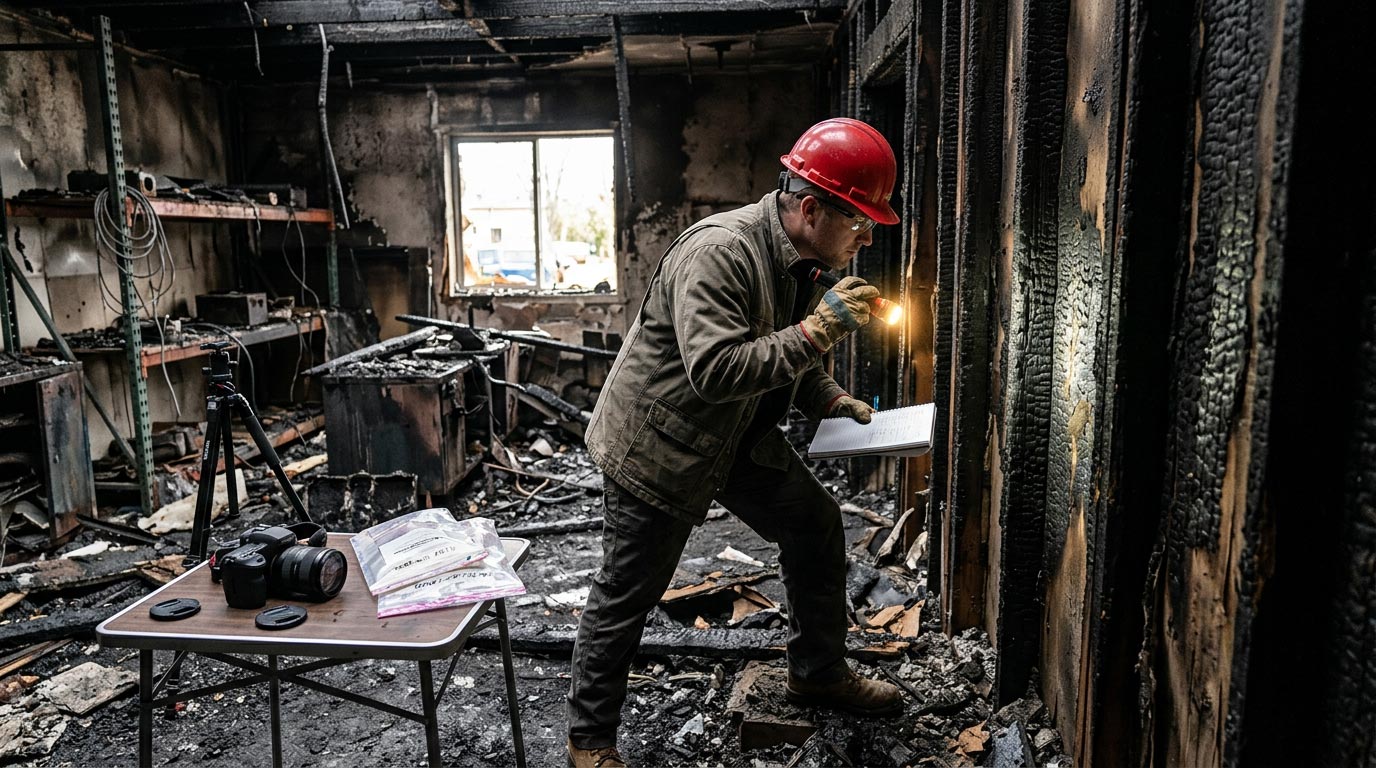
IMPORTANT DISCLAIMER: This guide references NFPA 921, Guide for Fire and Explosion Investigations; NFPA 1033, Standard for Professional Qualifications for Fire Investigator; NFPA 1, Fire Code; NFPA 101, Life Safety Code; the International Fire Code (IFC); ASTM E1188, E1492, E860, E1459, E1618, and E1385; and the requirements of the Authority Having Jurisdiction (AHJ). NFPA 921 is a guide, not a mandatory standard; it establishes a systematic, science-based approach but does not prescribe a single method or a fixed checklist. Fire investigation is a specialized discipline that requires training, experience, and adherence to the scientific method. Edition numbers, section references, and legal requirements vary by jurisdiction and may differ from what is cited here. This guide is educational and is not legal advice. Always verify the requirements applicable to your project with your AHJ, your legal counsel, and a qualified fire investigator.
Fire investigation is the process of determining the origin, cause, and development of a fire, and the factors that contributed to its spread and consequences. It combines fire science, engineering, and investigative technique. The result of an investigation can determine liability, insurance coverage, criminal prosecution, and future fire safety design.
NFPA 921 is the foundational reference for fire and explosion investigation in the United States. It describes a systematic approach based on the scientific method. It has been widely cited in court cases and training programs, and its emphasis on empirical data and testable hypotheses has reduced the incidence of incorrect conclusions based on myths and “rules of thumb.”
This article covers the scientific method, the investigation process, scene safety and legal authority, origin determination and fire patterns, cause determination, fire dynamics and modeling, evidence collection, reporting, investigator qualifications, and what owners, facility managers, and design professionals should do before investigators arrive.
◆ Section 1: The Scientific Method in Fire Investigation
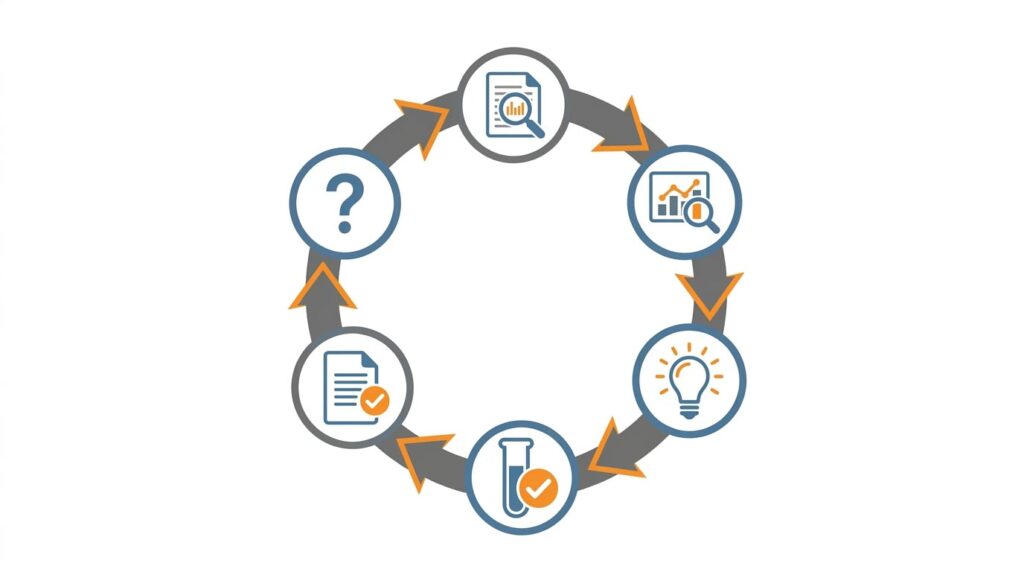
NFPA 921 applies the scientific method, a systematic approach to inquiry that relies on empirical evidence and reasoned analysis rather than opinion or experience alone.
A. The Scientific Method Steps
| Step | Activity |
|---|---|
| 1. Recognize the need | Determine that an investigation is required |
| 2. Define the problem | Decide what must be determined (origin, cause, spread, system performance) |
| 3. Collect data | Gather evidence through observation, measurement, testing, and documentation |
| 4. Analyze the data | Examine the data using inductive reasoning and fire science principles |
| 5. Develop a hypothesis | Propose an explanation based on the analyzed data |
| 6. Test the hypothesis | Challenge the hypothesis using deductive reasoning against all known facts |
| 7. Select the final hypothesis | Retain the hypothesis that survives testing; if none does, the cause is undetermined |
The process is iterative. New data can send the investigator back to earlier steps.
B. Bias and Improper Methods
The most damaging failures in fire investigation are failures of method, not of equipment. NFPA 921 specifically warns against:
- Expectation bias: forming a conclusion before the data is collected, then looking only for supporting evidence.
- Confirmation bias: giving weight to evidence that supports a favored hypothesis and discounting evidence that does not.
- Negative corpus: concluding that a fire was incendiary simply because no accidental cause was found. A cause must be supported by positive evidence, not by the elimination of alternatives. Where the evidence does not support a cause, the correct classification is undetermined.
- Speculation: a hypothesis that is not based on facts that can be tested.
- Reliance on myths: for example, treating crazed glass, alligatored char, or spalling as proof of an accelerant (see Section 4).
Key point: The scientific method is a discipline, not a formality. Every conclusion must be supported by data and must survive testing against all of the known facts.
Key Article: Article 72 — How to Conduct a Post-Fire Investigation and Lessons Learned
Pro Tip: Keep competing hypotheses alive as long as the evidence allows. The investigator who can explain why alternative hypotheses were eliminated has a far more defensible report.
◆ Section 2: The Fire Investigation Process
The process varies by agency and case, but it generally follows this sequence.
| Step | Activity |
|---|---|
| 1. Notification and assignment | The investigator is notified, assigned, and receives initial information |
| 2. Legal authority | Confirm the authority to be on the scene (consent, warrant, or statutory authority) |
| 3. Scene safety assessment | Identify structural, utility, and hazardous material hazards |
| 4. Scene security | Control access and preserve the scene |
| 5. Initial survey and documentation | Photograph, video, sketch, and measure before disturbing anything |
| 6. Witness and first-responder interviews | Obtain information on discovery, fire behavior, and conditions |
| 7. Scene examination | Examine exterior, then interior, working from least damaged to most damaged areas |
| 8. Origin determination | Identify the area and point of origin |
| 9. Cause determination | Identify the ignition sequence and the circumstances |
| 10. Evidence collection and analysis | Collect, preserve, and analyze physical evidence and records |
| 11. Hypothesis testing | Test the hypotheses against the data, including with fire models |
| 12. Report and testimony | Prepare the written report and testify if required |
A. Scene Documentation
Documentation is made before the scene is altered and includes:
- Photographs and video (overall, mid-range, and close-up, with scale)
- Diagrams and measured sketches
- Field notes with times, weather, and conditions
- Photogrammetry, 3D laser scanning, or drone imagery where appropriate
- Records of the building’s fire protection systems, utilities, and contents
B. Types of Evidence
- Physical evidence: debris, samples, appliances, electrical components
- Digital evidence: photographs, video, security and surveillance footage, alarm and building-management logs, smart-device data
- Documentary evidence: permits, plans, inspection and maintenance records, insurance records, 911 and dispatch records
- Testimonial evidence: witness and first-responder statements
Key point: Documentation is the evidence that the investigation was thorough and objective. If it was not documented, it is difficult to prove it was done.
Pro Tip: Fire department suppression and overhaul actions alter the scene. Interview the first-arriving companies early, and document what was moved, opened, or removed.
◆ Section 3: Scene Safety, Legal Authority, and Scene Security
A. Scene Safety
A fire scene is a hazardous environment. Before examination, the investigator evaluates:
- Structural stability, including damaged roofs, floors, and walls
- Energized or damaged utilities (electrical, gas, water)
- Hazardous materials, including asbestos and combustion by-products
- Hot spots and rekindle potential
- Confined spaces, falls, and sharp debris
Appropriate personal protective equipment, respiratory protection, and a safety plan are required. Do not enter a structure that has not been declared safe.
B. Legal Authority and Searches
Fire investigators generally have statutory authority to investigate fires, but entering and examining a fire scene can raise constitutional issues. In the United States, the Supreme Court cases Michigan v. Tyler and Michigan v. Clifford address the extent to which fire scenes may be entered and searched without a warrant, and how long the authority to remain on the scene continues. In practice:
- Obtain consent from the owner or occupant, or obtain an administrative or criminal warrant, as the circumstances require.
- Document the basis for entry and any consent given.
- Treat a scene that shifts from a cause-and-origin investigation toward a criminal investigation with additional care, and involve legal counsel.
Legal requirements vary by jurisdiction. Consult counsel before relying on any general statement.
C. Scene Security
The scene should be secured and access logged. Unauthorized entry can contaminate the scene and create arguments that evidence was planted, altered, or lost.
Key point: A safe, lawful, and secured scene is the foundation of every defensible investigation.
Pro Tip: Keep an entry log of every person who enters the scene, with time and purpose.
◆ Section 4: Origin Determination and Fire Patterns
Origin determination is the process of identifying where the fire started. It is based on the analysis of fire patterns, fire dynamics, witness information, and physical evidence.
A. The Origin Determination Process
The investigator proceeds from the general to the specific:
- Exterior examination: look for fire spread from outside and external ignition sources.
- Interior examination: identify the most heavily damaged areas and the path of fire spread.
- Area of origin: identify the room or area where the fire began.
- Point of origin: identify the specific location (and, if possible, the first fuel ignited).
The scene is examined from the least damaged areas toward the most damaged areas. In heavily damaged scenes, investigators use fire scene layering (stratigraphy) to remove debris in the reverse order of deposition, which helps establish the sequence of events.
B. Fire Patterns
Fire patterns are the visible or measurable physical changes and marks that result from a fire. They show where and how the fire burned, but they do not by themselves prove the cause.
| Pattern | Description and Caution |
|---|---|
| V-pattern | A V-shaped pattern on a vertical surface produced by the fire plume; the apex points toward the lower area of heat source, but ventilation and fuel can distort it |
| U-pattern | A U-shaped pattern that is typically a wider, rounded version of the V-pattern, often affected by ventilation or fuel arrangement |
| Inverted cone | A cone-shaped pattern produced by a plume from a localized fuel package |
| Char and depth of char | Can indicate the relative duration of burning in similar materials, but is affected by material, moisture, ventilation, and suppression |
| Clean burn | Areas where soot has been burned away, indicating direct flame or high heat |
| Protected areas | Areas shielded from fire or heat by an object that was later moved or consumed; can help locate the original position of items |
| Smoke deposits | Show the direction of smoke movement and the sequence of events, but not the origin on their own |
| Calcination and spalling | Calcination of gypsum board and spalling of concrete show exposure to heat; spalling has multiple causes and does not indicate an accelerant |
| Melting and oxidation | Indicate exposure to temperatures, not necessarily the origin |
| Arc damage on conductors | Beads and melting caused by electrical arcing; used with arc mapping |
C. Misleading Patterns and Myths
Over several decades, many “indicators” were once believed to prove arson. They are now recognized as unreliable:
- Crazed glass is caused by rapid cooling (such as water application), not by accelerants.
- Alligatoring of char (large shiny blisters) does not indicate a rapid, intense, or accelerated fire.
- Spalling of concrete can result from heat and moisture and does not prove an ignitable liquid.
- Low burn patterns and burns on the floor can be created by fully developed or post-flashover fires, falling burning debris, and ventilation; they are not proof of a poured liquid.
- Burn patterns in a post-flashover room are often so widespread that the origin cannot be determined from patterns alone.
D. Methods of Origin Analysis
An origin determination can use:
- The convergence of fire patterns
- Fire dynamics (how the fire grew and spread)
- Witness statements, including the time and location of first observation
- Electrical analysis, including arc mapping, which uses the location of arc sites on circuits to help locate the area of origin
- Fire protection system data (alarm and sprinkler activation times and device locations)
- Video and digital timelines
- Fire modeling and testing
The lowest point of damage or the most heavily burned area is not automatically the origin. A fire can burn longest and hardest where the fuel load or ventilation was greatest, not where it started.
Key point: Origin determination relies on the analysis of all of the data, not on any single pattern. If the origin cannot be determined, the cause usually cannot be reliably determined.
Key Article: Article 163 — Fire Modeling and Egress Modeling Software Overview
Pro Tip: Be cautious with the “most damage equals origin” assumption. Ask where the fire began, not where it ended.
◆ Section 5: Cause Determination
Cause determination is the process of identifying the ignition sequence: the source of heat, the first fuel ignited, and the circumstances that brought them together. It requires an origin that is supported by the evidence.
A. The Ignition Sequence
The investigator must identify:
- A competent ignition source with sufficient energy and temperature to ignite the first fuel under the circumstances
- The first fuel ignited and its ignition properties
- The oxidizer (usually air) and any ventilation effects
- The ignition factor (the circumstances or actions that allowed the heat source and fuel to interact)
If the investigator cannot show that a heat source was competent to ignite the first fuel at the area of origin, the cause is not established.
B. Cause Classifications
| Classification | Definition |
|---|---|
| Accidental | The fire cause does not involve a deliberate human act to ignite or spread the fire in an area where it should not be |
| Natural | The fire was caused by a natural event, such as lightning, earthquake, or spontaneous heating from natural processes |
| Incendiary | The fire was deliberately set under circumstances where the person knows it should not be set |
| Undetermined | The cause cannot be determined to a reasonable degree of certainty from the evidence |
The terms and classifications used in an agency’s reports may follow state statutes and agency policy.
C. Common Accidental Causes
| Cause | Examples |
|---|---|
| Electrical | Wiring faults, loose connections, overloaded circuits, damaged cords, equipment failure |
| Heating | Furnaces, space heaters, chimneys, flues |
| Cooking | Unattended cooking, grease, appliance failure |
| Smoking materials | Cigarettes, matches, lighters |
| Hot work | Welding, cutting, grinding, torch-applied roofing |
| Appliances and equipment | Dryers, water heaters, battery chargers |
| Lithium-ion batteries | Thermal runaway in devices, e-bikes, and energy storage systems |
| Open flame | Candles and fireplaces |
| Children playing | Matches and lighters |
| Spontaneous heating | Oily rags, hay, compost |
D. Incendiary Fires
Incendiary fires involve deliberate ignition and often involve ignitable liquids, multiple points of origin, trailers, or incendiary devices. Because an incendiary determination can lead to criminal charges, it must be supported by positive evidence. Laboratory analysis of ignitable liquid residue alone does not prove arson; the context (for example, a legitimate presence of a liquid or a flooring adhesive) must be considered.
E. Undetermined Fires
An undetermined classification is not a failure. It is an honest conclusion when the evidence does not support a specific cause. NFPA 921 also recognizes that the origin may be known while the cause remains undetermined.
Key point: A cause must be supported by the data and must be consistent with the origin, fire patterns, fire dynamics, physical evidence, and witness information.
Pro Tip: “Undetermined” is a valid, defensible classification. An incorrect cause is far more damaging than an undetermined one.
◆ Section 6: Fire Dynamics and Fire Modeling
Fire dynamics is the study of how fires ignite, grow, spread, and decay. It underpins the interpretation of fire patterns and the testing of hypotheses.
A. Key Fire Dynamics Concepts
| Concept | Description |
|---|---|
| Fire growth | Fire grows from ignition through a growth stage, typically controlled by fuel (fuel-controlled) or ventilation (ventilation-controlled) |
| Heat transfer | Fire spreads by conduction, convection, and radiation |
| Ventilation | Openings, doors, and HVAC significantly alter fire behavior and patterns |
| Flashover | The transition from a growing fire to full room involvement |
| Fully developed fire | Fire burning at its maximum rate, often ventilation-controlled |
| Smoke movement | Driven by buoyancy, stack effect, wind, and building systems |
| Fire plume | The rising column of hot gases and flames that produces many fire patterns |
B. Fire Modeling and Testing
Fire models can be used to test hypotheses:
- Hand calculations and correlations (for example, estimating heat release rate, flashover potential, and detector activation)
- Zone models such as CFAST
- Field (CFD) models such as FDS
- Full-scale or small-scale testing and reconstruction of the room or the item
Models can help test origin hypotheses, fire spread, smoke movement, and timelines, including the activation times of detectors and sprinklers.
C. Limitations
Fire models are approximations. Their results depend on the quality of the inputs, the assumptions, and the validation of the model. A model that matches the observed damage does not prove the hypothesis, and a model result is one input to the analysis, not the answer.
D. Specialized Fire and Explosion Investigations
NFPA 921 includes guidance on topics that need special expertise, including:
- Explosions and fuel gas incidents
- Vehicle and marine fires
- Wildfires
- Fire-related fatalities and injuries
- Appliance, electrical, and battery-related failures
- Evaluating the performance of fire protection systems and human behavior
Key point: Fire dynamics and fire modeling are tools for testing hypotheses against the evidence. They do not replace the examination of the scene.
Pro Tip: Fire models are tools, not answers. The investigator must interpret the results and disclose the assumptions.
◆ Section 7: Evidence Collection and Preservation
Evidence collection is a critical part of the investigation. The evidence must be collected, preserved, and documented in a way that supports analysis and admissibility.
A. Collection Methods
| Method | Application |
|---|---|
| Photography and video | Document the item in place before it is disturbed |
| Sketching and measurement | Record the location and relationship of items |
| Sampling | Collect debris samples for laboratory analysis |
| Packaging | Package evidence to prevent contamination and loss (for example, clean, new, unlined metal cans for ignitable liquid samples, per ASTM E1412 and related practices) |
| Labeling | Identify each item with a unique identifier, date, time, location, and collector |
| Comparison samples | Collect control or substrate comparison samples where appropriate |
| Chain of custody | Document every person who handles the evidence from collection to disposition |
B. Preservation
Evidence must be protected from contamination, loss, damage, and alteration, and must be stored securely. Preservation guidance and recognized practices are provided in ASTM E1188 and ASTM E860.
C. Laboratory Analysis
Laboratory analysis can include:
- Ignitable liquid residue analysis (for example, gas chromatography–mass spectrometry, per ASTM E1618)
- Material and metallurgical analysis
- Electrical examination of conductors, appliances, and devices
- Examination of batteries and electronic devices
- Fire testing
Trained canine teams can help identify sample locations, but a canine alert must be confirmed by laboratory analysis.
D. Spoliation and Notification of Interested Parties
If evidence is destroyed, altered, or lost, parties can claim spoliation, which can lead to sanctions or exclusion of evidence in litigation. When a loss may lead to a claim, the investigator should:
- Notify potentially interested parties (owners, insurers, manufacturers, contractors, and others) before evidence is moved or altered
- Give interested parties a reasonable opportunity to examine the scene and the evidence
- Follow a written protocol for joint examination and destructive testing
- Retain the evidence until the parties agree or a court permits release
Key point: The chain of custody and a notification protocol protect the admissibility and credibility of the evidence.
Pro Tip: Never release a scene to demolition or clean-up until the investigators, insurers, and counsel have confirmed in writing that evidence collection is complete.
◆ Section 8: The Fire Investigation Report
The report is the final product of the investigation. It documents the process, the evidence, and the conclusions.
A. Report Contents
| Section | Content |
|---|---|
| Summary | Overview of the investigation and conclusions |
| Background | The building, occupancy, the fire, and the assignment |
| Methodology | The process and standards used (for example, NFPA 921) |
| Scene examination | Observations, documentation, and photographs |
| Evidence | The evidence collected and the laboratory results |
| Analysis | The analysis, hypotheses considered, and why alternatives were eliminated |
| Origin | The origin determination and its basis |
| Cause | The cause determination, ignition sequence, and classification |
| Conclusions and limitations | The final conclusions and the limits of the investigation |
| Appendices | Supporting documentation, diagrams, and photographs |
B. Report Standards
The report should be clear, objective, evidence-based, complete, and defensible. It should distinguish facts from opinions and state the basis for each opinion.
C. Report Review
The report should be reviewed by a peer or supervisor. In litigation, counsel may direct the review process.
D. Report Retention
Retain the report, the case file, and the evidence in accordance with the agency’s records retention schedule, applicable law, and any litigation hold. Many cases can be reopened or litigated years after the fire.
E. Courtroom Admissibility
In U.S. courts, expert fire investigation testimony is evaluated under standards such as Daubert, Kumho Tire, and Federal Rule of Evidence 702, or the corresponding state standards. Courts commonly look at whether the opinion is based on reliable methods, such as the scientific method described in NFPA 921, and whether the investigator applied the method reliably. Opinions based on myths, negative corpus, or unsupported assumptions have been excluded or have contributed to wrongful convictions.
Key point: The report must be written so that a reader who was not at the scene can understand and evaluate the conclusions.
Pro Tip: State what was not examined or could not be determined. Acknowledged limits strengthen credibility.
◆ Section 9: NFPA 1033 and Investigator Qualifications
NFPA 1033 establishes the job performance requirements (JPRs) for fire investigators. It covers the knowledge and skills needed to conduct a competent investigation, including scene examination, documentation, evidence collection and preservation, interviews, analysis of origin and cause, and presentation of findings.
A. Knowledge Areas
- Fire science and fire dynamics
- Building construction and building systems
- Fire protection systems
- Electrical, gas, and heating systems
- Fire investigation techniques and the scientific method
- Evidence handling and legal issues
B. Education, Training, and Certification
Qualifications are typically demonstrated through education, formal training, experience, and certification. Recognized organizations include:
| Organization | Role |
|---|---|
| International Association of Arson Investigators (IAAI) | Certification (for example, Certified Fire Investigator) and training |
| National Association of Fire Investigators (NAFI) | Certification (for example, Certified Fire and Explosion Investigator) and training |
| National Fire Protection Association (NFPA) | Development of NFPA 921 and NFPA 1033 |
| Professional engineering licensing boards | Licensure for engineers who perform fire investigations or fire protection engineering analysis |
Continuing education is needed to stay current with the evolving edition of NFPA 921 and with research on fire behavior, new fuels, and new technologies such as lithium-ion batteries.
C. Public-Sector and Private-Sector Investigators
Public-sector investigators (fire marshals, fire departments, and law enforcement) generally investigate for public safety and criminal purposes. Private investigators and engineers are often retained by insurers, owners, attorneys, or manufacturers. Each may have a different role, access, and obligations, and their findings can be subject to cross-examination.
D. The Expert Witness
A fire investigator who testifies as an expert should have appropriate qualifications, follow recognized methods, base opinions on the data, and testify objectively.
Key point: NFPA 1033 helps ensure that the investigator has the knowledge, training, and experience to conduct a competent investigation.
Pro Tip: Verify the investigator’s qualifications and experience with similar occupancies before engaging them. Ask for certifications, relevant training, and examples of the methodology used.
◆ Section 10: What Owners, Facility Managers, and Design Professionals Should Do
Owners, facility managers, architects, and contractors are often the first people on the scene after the fire department leaves. Their actions can help or harm the investigation.
A. Immediately After a Fire
- Do not enter the damaged area until it is declared safe.
- Do not move, clean, repair, or discard anything in the fire area.
- Do not power up or reset damaged electrical equipment, panels, or appliances.
- Notify the insurer promptly and ask whether a cause-and-origin investigator will be assigned.
- Notify legal counsel if there are injuries, fatalities, or potential claims.
- Do not authorize demolition, shoring, or clean-up until investigators release the scene.
B. Preserve Records and Data
- Issue a litigation hold for relevant records.
- Preserve security video, building automation system logs, and fire alarm panel event history before they are overwritten.
- Gather as-built drawings, permits, inspection, testing, and maintenance records, including records for fire alarm, sprinkler, and suppression systems.
- Preserve contractor records, work permits (including hot work permits), and tenant information.
C. Support Emergency Stabilization Safely
Emergency measures such as securing openings, controlling water, or shoring may be needed. Where possible, coordinate with the investigator, photograph the conditions before and after, and keep a record of what was changed and why.
D. Learn From the Findings
The investigation’s findings can inform repairs, code upgrades, and updates to fire protection, maintenance programs, and the design of replacement construction.
Key point: The first hours after a fire can determine whether the evidence needed for a reliable investigation survives.
Pro Tip: Include a post-fire scene preservation procedure in your emergency response plan so that staff know what not to touch.
◆ Section 11: Common Challenges and Solutions
| Challenge | Why It Happens | Solution |
|---|---|---|
| Scene contamination | Scene not secured, or suppression and overhaul altered it | Secure the scene; document before disturbance; interview first responders |
| Evidence loss | Scene released or cleaned up too early | Coordinate with insurers and counsel; obtain written release |
| Incorrect origin | Reliance on a single pattern or on “most damage” | Analyze all data; consider ventilation and fuel effects |
| Incorrect cause | Negative corpus or unsupported assumptions | Identify a competent ignition source and the first fuel; use positive evidence |
| Bias | Early conclusion or outside pressure | Apply the scientific method; consider all hypotheses; seek peer review |
| Reliance on myths | Outdated training | Use the current edition of NFPA 921 and continuing education |
| Poor documentation | Time pressure | Document everything before disturbing the scene |
| Broken chain of custody | Informal handling | Use labeled, logged, and secured evidence handling |
| Spoliation claims | Interested parties not notified | Notify early; follow a joint examination protocol |
| Legal entry issues | Consent or warrant not obtained | Confirm authority; consult counsel |
| Report not defensible | Conclusions not tied to data | Write an evidence-based report; have it peer reviewed |
Key point: Most fire investigation failures are failures of process, documentation, and bias control, not failures of technology.
Pro Tip: Following the scientific method is the best defense against incorrect conclusions.
◆ Section 12: Investigation Checklist
| Item | Status | Notes |
|---|---|---|
| Investigator qualified | ☐ | NFPA 1033; relevant certification and experience |
| Legal authority confirmed | ☐ | Consent, warrant, or statutory authority |
| Scene safety assessed | ☐ | Structure, utilities, hazardous materials |
| Scene secured | ☐ | Access controlled and logged |
| Interested parties notified | ☐ | Insurers, owners, manufacturers, counsel |
| Scene documented | ☐ | Photos, video, notes, measured sketches |
| First responders and witnesses interviewed | ☐ | Statements documented |
| Fire patterns and dynamics analyzed | ☐ | Including ventilation effects |
| Origin determined | ☐ | Based on all data, not a single pattern |
| Ignition sequence and cause determined | ☐ | Competent ignition source and first fuel |
| Evidence collected and labeled | ☐ | Proper packaging and chain of custody |
| Hypotheses tested | ☐ | Alternatives considered and eliminated; models used as needed |
| Report prepared | ☐ | Clear, objective, evidence-based |
| Report peer reviewed | ☐ | Review documented |
| Records and evidence retained | ☐ | Per retention schedule and litigation hold |
◆ Section 13: Common Mistakes and How to Avoid Them
| Mistake | Why It’s a Problem | How to Fix |
|---|---|---|
| Not securing the scene | Evidence contaminated | Secure and log access |
| Not documenting before disturbing | Evidence lost | Photograph, sketch, and measure first |
| Relying on myths (crazed glass, alligatoring, spalling) | False indicators of arson | Use current NFPA 921 and validated science |
| Using negative corpus | Unsupported incendiary conclusions | Require positive evidence; classify as undetermined if needed |
| Ignoring ventilation effects | Misread patterns | Analyze fire dynamics |
| Not maintaining the chain of custody | Evidence inadmissible | Log every transfer |
| Failing to notify interested parties | Spoliation claims | Notify early and share protocols |
| Considering only one hypothesis | Incorrect conclusions | Consider and test all reasonable hypotheses |
| Overstating certainty | Report and testimony challenged | State limits and the level of confidence |
| Not verifying qualifications | Unreliable investigation | Verify certification and experience |
◆ Section 14: Conclusion
Fire investigation is a specialized discipline that combines fire science, engineering, and investigative technique. NFPA 921 provides a systematic approach based on the scientific method, and NFPA 1033 establishes the qualifications for investigators.
The critical elements are:
- Scientific method: the foundation of NFPA 921, including avoidance of bias and negative corpus
- Scene safety and legal authority: a lawful, safe, and secured scene
- Origin determination: based on all of the data, not a single pattern
- Cause determination: a competent ignition source, a first fuel, and the circumstances
- Fire dynamics and modeling: tools to test hypotheses
- Evidence collection and preservation: chain of custody and spoliation protection
- Reporting: clear, defensible, and peer reviewed
- Qualifications: knowledge, training, and experience under NFPA 1033
The most common failure is not following the scientific method. The investigator who follows the method, documents the work, and acknowledges the limits of the evidence is most likely to reach a correct conclusion and to produce a defensible report.
Key Takeaways:
- NFPA 921 is a guide that describes a systematic, science-based approach to fire and explosion investigation.
- The scientific method requires data collection, analysis, hypothesis development, and hypothesis testing.
- Expectation bias, confirmation bias, and negative corpus are leading causes of incorrect conclusions.
- Fire patterns show how a fire burned but are not proof of cause; many once-popular indicators are now recognized as myths.
- Origin determination should be based on all of the data, and the most damaged area is not necessarily the origin.
- Cause determination requires a competent ignition source, the first fuel, and the circumstances.
- “Undetermined” is a valid and defensible classification.
- Evidence must be collected, labeled, preserved, and tracked with a chain of custody, and interested parties should be notified to avoid spoliation claims.
- Legal authority to enter and examine a scene must be confirmed.
- NFPA 1033 establishes the qualifications for fire investigators.
- Owners and facility managers can protect the investigation by preserving the scene and the records.
Take Action Today:
- Verify the investigator’s qualifications (NFPA 1033).
- Confirm legal authority before entering the scene.
- Secure the scene and control access.
- Document the scene thoroughly before disturbing it.
- Notify insurers and other interested parties.
- Collect, label, and preserve evidence with a chain of custody.
- Preserve video, alarm panel, and building automation records.
- Apply the scientific method and consider all hypotheses.
- Prepare a clear, evidence-based report and have it peer reviewed.
- Retain the report and evidence according to the retention schedule and any litigation hold.
Continue Reading from Our Series:
- Related guide: Article 168 — Insurance Underwriting and Fire Risk Assessment
- Related guide: Article 72 — How to Conduct a Post-Fire Investigation and Lessons Learned
- Related guide: Article 163 — Fire Modeling and Egress Modeling Software Overview
- Read more: Article 170 — Post-Fire Reconstruction and Code Upgrades (planned)
About This Guide: This article is part of a series on commercial building fire safety, written for facility managers, architects, and code officials. It references model codes and standards for educational purposes and is not legal advice. Always consult your local AHJ, legal counsel, and a qualified fire investigator for project-specific requirements.