IMPORTANT DISCLAIMER: This guide references the International Fire Code (IFC); the International Building Code (IBC); NFPA 1, Fire Code; NFPA 101, Life Safety Code; NFPA 5000, Building Construction and Safety Code; the International Existing Building Code (IEBC); the International Code Council (ICC) and National Fire Protection Association (NFPA) code development processes; and state and local adoption statutes. Adoption processes vary by state and by local jurisdiction. The specific editions, amendments, statutes, and examples cited here are illustrative and may not reflect the current status in your jurisdiction. Local amendments can significantly change the requirements of the model code, and the adopted edition may lag behind the current model code. This guide is a starting point only. Always verify the adopted code, the applicable edition, and any local amendments with your Authority Having Jurisdiction (AHJ) and your legal counsel.
A model code is not law. It becomes law only when a jurisdiction adopts it. The adoption process determines which code applies, which edition applies, and which amendments modify the model code. For an owner, architect, or code official, this matters because the code that governs a project is not the model code. It is the adopted code.
Fire code adoption and local amendments is the discipline of understanding how model codes become law, how local amendments change them, and how to track the requirements that apply to a specific building. It is not glamorous, but it is foundational. A design that complies with the model code but not with the local amendments is non-compliant.
This article explains how model codes are developed and adopted, how local amendments work, how multiple codes and authorities interact, how existing buildings are treated, and how to track the requirements that apply to your project.
◆ Section 1: The Model Codes
Model codes are developed by standards organizations and made available for adoption. They carry no legal force until a jurisdiction adopts them.
A. The Major Model Codes
| Code | Organization | Scope |
|---|---|---|
| International Building Code (IBC) | International Code Council (ICC) | Building construction |
| International Fire Code (IFC) | ICC | Fire prevention and protection |
| International Existing Building Code (IEBC) | ICC | Alteration, repair, and change of use of existing buildings |
| International Residential Code (IRC) | ICC | One- and two-family dwellings and townhouses |
| NFPA 1, Fire Code | National Fire Protection Association (NFPA) | Fire prevention and protection |
| NFPA 101, Life Safety Code | NFPA | Life safety in new and existing buildings |
| NFPA 5000, Building Construction and Safety Code | NFPA | Building construction (limited adoption in practice) |
B. The Development Process
| Organization | Process |
|---|---|
| ICC | Code change proposals, committee action hearings, public comment hearings, and a final online governmental consensus vote. New editions are published on a three-year cycle. |
| NFPA | ANSI-accredited consensus process: public input, technical committee first draft, public comment, second draft, and Standards Council issuance. Editions follow a regular revision cycle. |
C. Referenced Standards
Model codes incorporate other standards by reference, such as NFPA 13 for sprinklers and NFPA 72 for fire alarms. Each model code edition names specific editions of those standards. Adopting the code adopts those editions as they are referenced, which may differ from the newest edition of the standard.
Key point: A model code is not law until adopted. The adopted code, with its referenced standards, is what applies.
Pro Tip: Do not design to the model code. Design to the adopted code. The difference can be significant.
Key Article: Article 161 — NFPA 101 vs. IBC: Key Differences Explained
◆ Section 2: The Adoption Process
A. The Adoption Sequence
The process varies by state and locality, but it typically follows the same steps at either level.
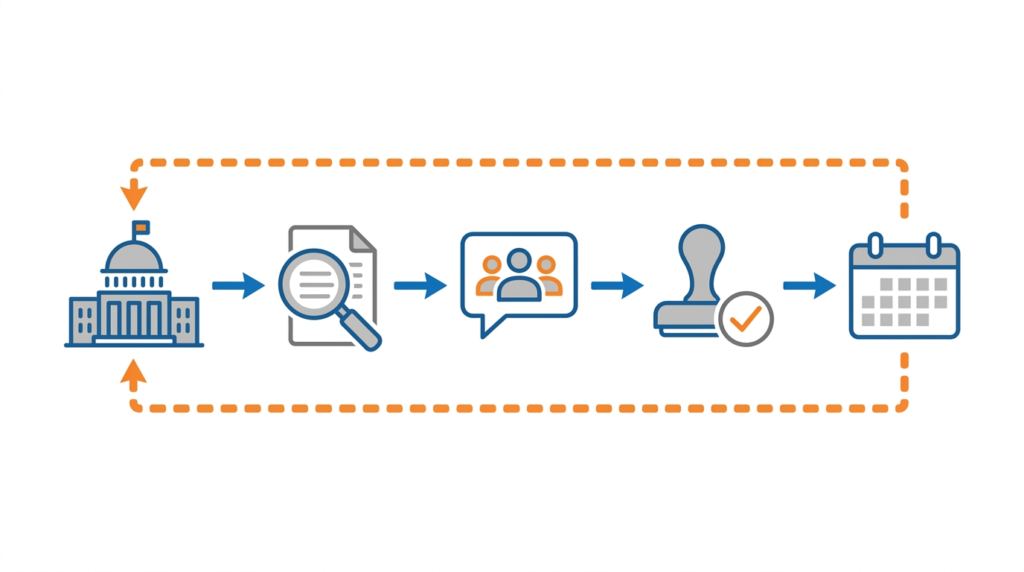
| Step | Activity |
|---|---|
| 1. Authorization | Legislation or enabling authority permits the adoption of a model code |
| 2. Agency review | The responsible agency reviews the model code and proposes amendments |
| 3. Public comment | Stakeholders comment on the proposed code and amendments |
| 4. Adoption | The state or local government adopts the code and amendments by statute, regulation, or ordinance |
| 5. Effective date | The code takes effect on a specified date |
B. The Adoption Models
| Model | Description |
|---|---|
| Statewide adoption | The state adopts the code; local jurisdictions may amend |
| Mandatory statewide | The state mandates a code with limited or no local amendment |
| Local adoption | Each local jurisdiction adopts its own code |
| Home rule | Local jurisdictions have broad authority to adopt and amend |
Some states use more than one model. For example, one state code may apply to certain building types while local codes govern the rest.
C. What the Adoption Ordinance Actually Does
Jurisdictions typically adopt a model code by reference, then list their changes. The adopting ordinance usually does the following:
- Names the edition. Most jurisdictions adopt a specific edition. A “latest edition” clause is generally disfavored because it delegates lawmaking to a private organization.
- Replaces the administrative provisions. Chapter 1 of the ICC codes covers scope, permits, fees, inspections, violations, and appeals. Jurisdictions usually customize it.
- Fills in the blanks. The model code leaves items such as the jurisdiction name, penalties, and the appeals board for the adopter to complete.
- Selects appendices. Appendices are not enforceable unless the ordinance adopts them. Examples include IFC appendices on fire-flow, hydrant spacing, and fire apparatus access roads.
D. The Effective Date and Vesting
The effective date is when the code takes effect. Most jurisdictions tie the applicable edition to the date a complete permit application is submitted, not the date of construction. Transition provisions may allow projects already in the pipeline to use the previous edition.
Key point: The adoption ordinance, not the model code, defines the requirements. The effective date and transition provisions determine which projects are subject to a new edition.
Pro Tip: Confirm the edition, the adopted appendices, and the transition rules before submitting a permit application. Submission timing can change which code applies.
◆ Section 3: Local Amendments
Local amendments modify the model code to address local conditions, priorities, or experience. They can significantly change the requirements.
A. Why Local Amendments Are Made
| Reason | Example |
|---|---|
| Local hazards | Wildfire, seismic, flood, hurricane |
| Local climate | Snow loads, wind loads, temperature extremes |
| Local fire department capability | Response times, apparatus reach, water supply |
| Local experience | Past fires or building failures |
| Local industry | Specific occupancies or processes |
| Local policy priorities | Historic preservation, sustainability, affordability |
B. Types of Amendments
| Type | Example |
|---|---|
| Additions | Requiring sprinklers in a building type the model code exempts |
| Deletions | Removing a model code requirement |
| Modifications | Lowering an area threshold for fire alarm or sprinkler requirements |
| Clarifications | Stating how the jurisdiction applies a provision |
C. The Impact of Amendments
Amendments can increase requirements, decrease them, change the scope of the code, or change the compliance process. Common fire-related examples are lower sprinkler thresholds, added fire alarm or radio coverage requirements, expanded fire apparatus access and water supply rules, and wildland-urban interface provisions.
D. Limits on Local Amendment Authority
Local authority to amend is not unlimited.
- State preemption. Some states prohibit or restrict local amendments to the state code.
- Findings requirements. Some states require formal findings, such as climatic, geological, or topographical conditions, before a local amendment more restrictive than the state code takes effect. California is a well-known example.
- Approval or filing steps. Local amendments may need to be filed with or approved by a state agency before they are enforceable.
E. Where Amendments Are Documented
- The adopting ordinance
- The local amendments document or municipal code
- The AHJ’s website
- State or local registers and municipal code publishers
Key point: Amendments can add, remove, or change requirements, and they must be identified and applied. Whether they are valid depends on state law.
Pro Tip: Obtain the local amendments document before design starts. Read the administrative amendments as well as the technical ones, since they affect permits, fees, inspections, and appeals.
◆ Section 4: Multiple Codes and Multiple Authorities
Many projects are governed by more than one code and more than one authority.
A. Code Interplay
- IBC and IFC. These are designed to work together, but jurisdictions may adopt different editions of each. Edition mismatches create gaps and conflicts, particularly for referenced standards.
- NFPA 101 and the building code. Some states adopt NFPA 101 alongside, or instead of, the IBC for certain occupancies. Florida, for example, adopts NFPA 1 and NFPA 101 through its Fire Prevention Code in addition to its Building Code. Where two codes apply, the more restrictive requirement generally governs unless the jurisdiction states otherwise.
- Specialty codes. Mechanical, plumbing, electrical, energy, and accessibility requirements add further layers.
B. Multiple AHJs
A single building can answer to several authorities.
| Authority | Typical role |
|---|---|
| Building official | Plan review and inspection of construction |
| Local fire marshal | Fire code plan review, permits, and operational inspections |
| State fire marshal | Statewide fire code, certain occupancies, state-owned buildings |
| State agencies | Healthcare, schools, childcare, and similar facilities |
| Other regulators | Health department, environmental agencies, utility providers |
C. Overlays That Apply Regardless of Local Adoption
- Federal programs. CMS requirements for healthcare facilities reference specific editions of NFPA 101. HUD, VA, and military facilities have their own requirements.
- Accessibility law. The ADA and the Fair Housing Act apply independently of local building code adoption.
- Insurers and lenders. Insurance carriers and property insurers such as FM Global may impose requirements beyond the adopted code.
- Occupational safety rules. OSHA requirements apply to workplaces regardless of local adoption.
Key point: Compliance means satisfying every code and authority that applies, not just the local building code.
Pro Tip: Early in design, list every code, edition, and authority that applies. A one-page matrix prevents missed requirements.
◆ Section 5: The AHJ’s Authority
The AHJ is the organization, office, or individual responsible for enforcing the code.
A. Who the AHJ Is
| Type | Example |
|---|---|
| Fire marshal | Enforces the fire code |
| Building official | Enforces the building code |
| Fire chief | May hold fire safety authority |
| Plan reviewer / inspector | Reviews plans and inspects for compliance |
B. What the AHJ Can Do
The AHJ typically has authority to interpret the code, issue permits, conduct inspections, enforce compliance, and approve modifications or alternate methods under the code’s own provisions. See Article 164 for how equivalency and alternate methods work.
C. The Limits of AHJ Authority
The AHJ has real discretion, but not unlimited discretion.
- The AHJ cannot waive the code. Relief comes through the code’s modification and alternate-method provisions, which typically require a demonstration of equivalent performance or practical difficulty.
- Interpretations should be consistent and based on the adopted code and its stated intent.
- Authority comes from statute and ordinance and is bounded by them.
D. The Appeal Process
Most jurisdictions have a board of appeals. Appeals typically involve a written application filed within a short, fixed window after the AHJ’s decision, a hearing, and a written decision. Boards usually review interpretation disputes and alternate-method questions, but they cannot waive code requirements. Further appeal to the courts may be available.
Key point: The AHJ’s interpretation carries great weight in practice, but it is bounded by the adopted code and subject to appeal.
Pro Tip: Engage the AHJ early and get significant interpretations in writing. A verbal agreement does not protect you at inspection.
◆ Section 6: Existing Buildings and Retroactivity
Retroactivity is the most commonly misunderstood part of code adoption. The answer depends on which type of code applies.
| Code type | Typical treatment of existing buildings |
|---|---|
| Building code (IBC, NFPA 5000) | Generally not retroactive. Buildings are judged against the code in force when they were permitted. |
| Fire code (IFC, NFPA 1) | Applies to existing buildings for maintenance, operations, and inspection. Some provisions apply retroactively. |
| NFPA 101 | Separate chapters for new and existing occupancies. Existing buildings must meet the existing-occupancy requirements. |
| Existing building code (IEBC) | Governs alterations, repairs, additions, and changes of occupancy and sets what must be upgraded. |
Retroactive requirements arise in several ways:
- Fire code existing-building provisions. Examples include fire alarm and sprinkler retrofits for certain occupancies, such as high-rises and some residential or care occupancies.
- Local retrofit ordinances. A jurisdiction may require retrofits by a deadline, often after a major fire.
- Triggers. A renovation, an addition, or a change of occupancy can require upgrades to the altered area or the whole building.
- Operational requirements. Maintenance of fire protection systems, egress, and housekeeping applies to all buildings.
Key point: “Not retroactive” applies to construction requirements, not to fire code maintenance and operational rules, and not to local retrofit ordinances.
Pro Tip: For any existing building, ask what the fire code, NFPA 101, and local ordinances require today, and what the planned work will trigger.
Related guide: Article 166 — Retrofit Ordinances and Existing Building Codes (planned)
◆ Section 7: Tracking Code Requirements
Tracking requirements is an ongoing task from pre-design through construction.
A. Information Sources
| Source | Content |
|---|---|
| Adopting ordinance and municipal code | The code as adopted, with amendments |
| AHJ website | Interpretations, policies, forms |
| State agency or state fire marshal | Statewide code information |
| ICC and NFPA | Model code text and adoption maps (verify against official sources) |
| Professional associations | Updates and training |
B. The Process
| Phase | Steps |
|---|---|
| Pre-design | Identify the jurisdiction and all AHJs; confirm the adopted codes, editions, and appendices; obtain the amendments; meet the AHJ; document the code basis |
| Design | Design to the adopted code, apply amendments and AHJ interpretations, and record the compliance analysis |
| Construction | Re-verify that codes, amendments, and interpretations have not changed; update the design if needed |
C. The Update Cycle
ICC codes are updated every three years, and NFPA codes follow their own revision cycles. Local adoption lags behind, and local amendments change on their own schedule. The tracking task never ends while a project is active.
D. Compliance Documentation
The project record should include the adopted codes and editions, the local amendments, the AHJ interpretations, the design basis, and the compliance analysis.
Key point: The code can change while a project is underway. Vesting rules decide whether the change affects you, and you can only apply them if you have tracked it.
Pro Tip: Assign responsibility for code tracking by name. An unassigned task is an undone task.
◆ Section 8: Common Challenges and Mistakes
| Problem | Why It Happens | Solution |
|---|---|---|
| Designing to the model code | The adopted code differs | Confirm the adopted code and edition |
| Ignoring local amendments | Not requested or not read | Obtain and apply them, including administrative ones |
| Missing appendices or fill-ins | Assumed the model code applies as published | Check which appendices were adopted |
| Edition mismatches between codes | IBC, IFC, and NFPA adopted on different cycles | Map editions for every code in use |
| Adoption lag | Jurisdiction on an older edition | Design to the adopted edition; discuss newer approaches as alternates |
| Missing other authorities or overlays | Only the local building official was consulted | List every AHJ and overlay |
| Inconsistent interpretations | Different AHJs or reviewers | Get written interpretations and document the basis |
| Assuming codes are not retroactive | Confusing building and fire codes | Check fire code, NFPA 101, and local ordinances |
| Missing transition or vesting rules | Not understood | Confirm with the AHJ before submitting |
| Code changes during design | Not tracked | Monitor changes and assign responsibility |
| Weak documentation | Seen as optional | Record the code basis and compliance analysis |
| No code review budget | Underestimated | Budget time and fees for code research |
Key point: Most adoption problems are communication and documentation problems, not technical ones.
Pro Tip: Build a working relationship with the AHJ. It makes every other step easier.
◆ Section 9: Design Checklist
| Item | Status | Notes |
|---|---|---|
| Jurisdiction and all AHJs identified | ☐ | Building, fire, state, other |
| Adopted codes and editions confirmed | ☐ | IBC, IFC, NFPA 101, specialty codes |
| Adopted appendices confirmed | ☐ | Fire-flow, access, other |
| Referenced standard editions confirmed | ☐ | NFPA 13, NFPA 72, others |
| Local amendments obtained | ☐ | Technical and administrative |
| AHJ interpretations obtained | ☐ | Written where possible |
| Effective date and vesting confirmed | ☐ | Permit submission timing |
| Federal and other overlays identified | ☐ | CMS, ADA, insurer, others |
| Retroactivity and triggers confirmed | ☐ | For existing buildings and renovations |
| Pre-design meeting held | ☐ | With AHJ |
| Code basis and compliance analysis documented | ☐ | In the project record |
| Code changes monitored | ☐ | During design and construction |
◆ Section 10: Conclusion
Fire code adoption and local amendments determine which code applies to a building. The model code is not law until a jurisdiction adopts it, and the adopted code may include local amendments that significantly change the requirements.
The critical elements are:
- Jurisdiction and AHJs: which authorities have jurisdiction
- Adopted code and edition: including adopted appendices and referenced standards
- Local amendments: technical and administrative
- AHJ interpretations: the authority’s guidance and policies
- Effective date and vesting: which projects are subject to which edition
- Retroactivity: how existing buildings and renovations are affected
- Overlays: federal, accessibility, insurer, and other requirements
- Documentation: the evidence of the code basis
The most common failure is designing to the model code rather than the adopted code.
Key Takeaways:
- A model code is not law until a jurisdiction adopts it.
- The adopting ordinance defines the edition, appendices, administrative provisions, and amendments.
- Local amendments can significantly change requirements, within limits set by state law.
- Multiple codes and multiple authorities often apply to one project.
- The AHJ interprets and enforces the code but cannot waive it, and decisions are subject to appeal.
- Vesting and transition rules decide which edition applies to a project.
- Building codes are generally not retroactive, but fire codes, NFPA 101, and local retrofit ordinances can reach existing buildings.
- Tracking code requirements is ongoing, and documentation is the evidence of the code basis.
Take Action Today:
- Identify the jurisdiction and every authority involved.
- Confirm the adopted codes, editions, appendices, and referenced standards.
- Obtain the local amendments, including administrative changes.
- Confirm the effective date, vesting, and transition provisions.
- Confirm retroactivity and renovation triggers for existing buildings.
- Hold a pre-design meeting with the AHJ and get key interpretations in writing.
- Document the code basis and compliance analysis.
- Assign responsibility for monitoring code changes.
Continue Reading from Our Series:
- Related guide: Article 164 — Equivalency and Alternate Methods of Compliance
- Related guide: Article 161 — NFPA 101 vs. IBC: Key Differences Explained
- Read more: Article 166 — Retrofit Ordinances and Existing Building Codes (planned)
About This Guide: This article is part of a series on commercial building fire safety, written for facility managers, architects, and code officials. It references model codes and standards for educational purposes. Always consult your local AHJ and your legal counsel for project-specific requirements.