IMPORTANT DISCLAIMER: This guide references NFPA 101, Life Safety Code, including Chapters 4 and 5 (Goals and Objectives; Performance-Based Option); NFPA 5000, Building Construction and Safety Code; the International Building Code (IBC), including Section 104.11 (Alternative Materials, Design and Methods of Construction and Equipment); the ICC Performance Code for Buildings and Facilities; the International Fire Code (IFC); NFPA 1, Fire Code; NFPA 72 (National Fire Alarm and Signaling Code); NFPA 13 (sprinkler systems); NFPA 92 (smoke control systems); NFPA 101A (Guide on Alternative Approaches to Life Safety); the SFPE Engineering Guide to Performance-Based Fire Protection; the SFPE Handbook of Fire Protection Engineering; ASTM E1355, E1472, and E1591; and ISO 16730 (Fire Safety Engineering: Assessment, Verification and Validation of Calculation Methods). Performance-based design is a specialized engineering discipline that requires qualified fire protection engineers, AHJ approval, and usually independent peer review. Acceptance criteria, design fire scenarios, and modeling methods cited here follow the model codes and standards and may differ in your adopted edition. Local amendments and the edition adopted by your Authority Having Jurisdiction (AHJ) always control. This guide is a starting point only. Always verify the requirements applicable to your project with your AHJ and a qualified fire protection engineer.
Performance-based design is the alternative to prescriptive codes. Instead of following a set of rules (this many exits, this travel distance, this fire-resistance rating), the designer demonstrates that the building achieves a stated level of safety through analysis, modeling, and engineering judgment. The prescriptive code is the default. Performance-based design is the alternative path, used when the prescriptive code cannot accommodate the design intent or when a more efficient solution is possible.
NFPA 101 Chapter 5 establishes the performance-based option for the Life Safety Code. It requires the designer to establish performance criteria, analyze a set of design fire scenarios using fire and egress models, apply safety factors, and document the results. The approach is powerful, but demanding. It requires specialized expertise, rigorous analysis, thorough documentation, and AHJ approval.
The IBC does not contain a performance-based chapter. It permits performance-based solutions through Section 104.11, which allows alternative materials, design, and methods of construction when the AHJ approves them as equivalent to the prescriptive requirement in quality, strength, effectiveness, fire resistance, durability, and safety. The ICC Performance Code provides a companion framework for jurisdictions that use it.
This article covers what performance-based design is, how it differs from prescriptive design, the NFPA 101 Chapter 5 process, the design fire scenarios, the acceptance criteria, fire and egress modeling, uncertainty and safety factors, documentation and peer review, the ongoing operating obligations that come with the design, and the practical considerations for a project.
◆ Section 1: What Performance-Based Design Is, and Is Not
Performance-based design demonstrates that a building achieves a stated level of safety by analysis rather than by adherence to prescriptive rules.
A. The Prescriptive Approach
The code specifies the number of exits, the travel distance, the fire-resistance rating, and the sprinkler and fire alarm requirements. If the building complies with the rules, it is deemed compliant.
B. The Performance-Based Approach
The performance-based approach specifies:
- The goals and objectives (what the building must achieve)
- The performance criteria (the measurable limits that define success)
- The design fire scenarios (the fires the building must withstand)
- The analysis methods (the models and calculations used)
The designer demonstrates by analysis that the building meets the criteria under the design fire scenarios.
C. What Performance-Based Design Is Not
It is not a way to avoid safety requirements, a substitute for engineering judgment, a guarantee of safety, a simple analysis, or a routine exercise.
D. Performance-Based Design vs. Equivalency
Performance-based design is different from an equivalency or alternate method request. An equivalency asks the AHJ to accept a specific alternative to a specific prescriptive requirement, often supported by a limited justification. A performance-based design replaces the prescriptive path for the building (or a defined portion of it) with a complete analysis. NFPA 101A offers a structured, non-modeling alternative approach (the Fire Safety Evaluation System). Equivalency is covered in a planned article of this series.
E. When Performance-Based Design Is Used
- The prescriptive code cannot accommodate the design intent (atriums, large open spaces, complex geometry, arenas, airports, transit stations)
- The prescriptive code imposes requirements that are disproportionate to the risk
- Historic buildings or existing buildings where prescriptive compliance is impractical
- A more efficient solution is possible
- The AHJ requires or encourages it
Key point: Performance-based design is the alternative to prescriptive codes. It is not a way to avoid safety requirements. It is a way to demonstrate, by analysis, that the building achieves the required level of safety.
Key Article: Article 161, NFPA 101 vs. IBC: Key Differences Explained
Pro Tip: Performance-based design is not for every project. The cost and time can exceed the prescriptive approach, so confirm early that the benefit justifies it.
◆ Section 2: The NFPA 101 Chapter 5 Process
A. Goals, Objectives, and Performance Criteria
NFPA 101 Chapter 4 sets the goals of the Code, such as providing an environment for occupants that is reasonably safe from fire and protecting occupants not intimate with the initial fire development for the time needed to evacuate, relocate, or defend in place. Chapter 5 builds on these by requiring performance criteria, design fire scenarios, assumptions, and an evaluation of the proposed design. Chapter 5 also identifies retained prescriptive requirements: certain provisions that still apply even when the performance-based option is used. Confirm which apply in your edition.
B. The Process Steps
| Step | Activity |
|---|---|
| 1. Define the project scope | Identify the building, occupancy, and design intent |
| 2. Confirm goals and objectives | Life safety, and any property protection or continuity objectives |
| 3. Prepare a design brief | Agree on scope, criteria, scenarios, methods, and assumptions with the AHJ before analysis |
| 4. Identify design fire scenarios | The fires the building must withstand |
| 5. Establish performance criteria | The measurable conditions that define success |
| 6. Analyze the building’s performance | Using fire and egress models and calculations |
| 7. Apply safety factors and evaluate | Account for uncertainty; compare results to criteria |
| 8. Document the design | The performance-based design report and the operations and maintenance manual |
| 9. Peer review | Independent review by a qualified third party |
| 10. AHJ approval | The AHJ reviews and approves |
C. The Performance Objectives
| Objective | Description |
|---|---|
| Life safety | Occupants can evacuate safely or be protected in place |
| Property protection | The building and contents are protected |
| Mission continuity | The building’s function is maintained |
| Environmental protection | The environment is protected |
The most common objective under NFPA 101 is life safety.
D. The Stakeholders
| Stakeholder | Role |
|---|---|
| Building owner | Defines objectives; accepts the design and the operating obligations |
| Fire protection engineer | Performs the analysis; documents the design |
| Architect | Integrates the design into the building |
| AHJ | Reviews and approves |
| Peer reviewer | Independent review |
| Insurer | Reviews for property protection |
Key point: The Chapter 5 process is structured: define objectives, agree on the design brief, identify scenarios, establish criteria, analyze, document, review, and obtain approval.
Pro Tip: Start with the objectives and the design brief. Without clear objectives and an agreed brief, the analysis has no anchor.
◆ Section 3: Design Fire Scenarios
The design fire scenarios are the fires the building must withstand. They are the basis of the analysis.
A. What a Design Fire Scenario Is
A design fire scenario describes the ignition source, the fuel package, the location, the growth rate, the peak heat release rate, the duration, the ventilation conditions, the occupant locations and characteristics, and the fire protection systems in operation.
B. The NFPA 101 Design Scenarios
NFPA 101 Chapter 5 specifies a set of design fire scenarios that the designer must evaluate. The scenarios are summarized below; confirm the exact wording and any additional scenarios in your adopted edition.
| Scenario | Description |
|---|---|
| 1. Occupancy-specific fire | A typical fire representative of the occupancy |
| 2. Ultrafast fire in the primary means of egress | Fire in the main egress route, with interior doors open at the start |
| 3. Fire in an unoccupied room | Starts in a normally unoccupied room and spreads into the major occupied area |
| 4. Concealed-space fire | Originates in a concealed wall or ceiling space next to a large occupied room |
| 5. Shielded slow-growing fire | A slow-growing fire shielded from fire protection systems, close to a high-occupancy area |
| 6. Most severe fire | The most severe fire from the largest credible fuel load of normal operations |
| 7. Exposure fire | A fire outside the building that exposes it |
| 8. System-failure fire | A fire in ordinary combustibles with each passive or active fire protection system independently rendered ineffective |
The designer may add project-specific scenarios, such as smoke migration through atriums, or fires involving specific hazards.
C. Scenario Selection
Select scenarios based on the occupancy and fuel load, the building geometry, the fire protection systems, historical fire experience, and professional judgment. Document why each scenario was included or excluded.
D. The Design Fire Curve
The design fire curve describes heat release rate over time:
- Growth phase: often modeled as a t-squared fire (slow, medium, fast, ultrafast)
- Steady phase: the fire peaks, limited by fuel or ventilation
- Decay phase: the fire declines as fuel is consumed
The growth rate is a key parameter. NFPA 92, NFPA 72 (Annex), and the SFPE Handbook provide typical growth rates and heat release data. Sprinkler or suppression intervention should be reflected in the curve only where the analysis justifies it.
Key point: Scenarios should represent the fires the building could really experience, not the easiest fires to analyze.
Key Article: Article 163, Fire Modeling and Egress Modeling Software Overview (planned)
Pro Tip: Select scenarios that challenge the design. An easy scenario produces a result that does not demonstrate safety.
◆ Section 4: Performance Criteria and Acceptance Criteria
The criteria are the measurable conditions that define success.
A. The Life Safety Criteria
NFPA 101 sets the principle (occupants not exposed to instantaneous or cumulative untenable conditions) but leaves most numeric thresholds to the designer and the AHJ. Typical values drawn from SFPE guidance are shown below. They vary by project and must be agreed with the AHJ.
| Criterion | Typical Threshold |
|---|---|
| Smoke layer height | Above occupant head height (e.g., 6 ft / 1.8 m above the floor) |
| Temperature | Below about 60°C (140°F) at head height |
| Visibility | About 10 m (33 ft) in large spaces; about 5 m (16 ft) in small rooms |
| Toxicity | Below incapacitation thresholds, often assessed with a Fractional Effective Dose (FED) |
| Radiant heat | Below about 2.5 kW/m² at occupant locations |
| Egress time | RSET less than ASET with a margin of safety |
Refer to ISO 13571 and the SFPE guidance for the methods behind toxicity and tenability limits.
B. The ASET/RSET Concept
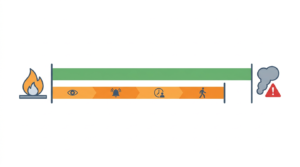
The core concept of life safety performance-based design is ASET/RSET:
- ASET (Available Safe Egress Time): the time from ignition until conditions become untenable
- RSET (Required Safe Egress Time): the time occupants need to reach safety
RSET is the sum of its parts: detection time + alarm/notification time + pre-movement time (recognition and response) + travel (movement) time. The design is acceptable if ASET exceeds RSET with an adequate margin of safety.
C. The Margin of Safety
The margin of safety accounts for uncertainty in the analysis. It is expressed as a factor or a time buffer, and the value should be justified and agreed with the AHJ. NFPA 101 also requires safety factors to be addressed in the evaluation.
D. Criteria for Other Objectives
Where the objectives include property protection or continuity, add criteria such as limits on damage, structural stability, or exposure to adjacent buildings. Structural performance in fire, where relevant, is evaluated using the SFPE guidance on fire exposures to structural elements.
E. Criteria Selection
Base the criteria on the occupancy and occupant characteristics, the performance objectives, accepted engineering practice, and AHJ requirements.
Key point: Acceptance criteria must be measurable, defensible, and agreed with the AHJ.
Pro Tip: Agree on the criteria with the AHJ before the analysis. Disagreements after the analysis are hard to resolve.
◆ Section 5: Fire Modeling
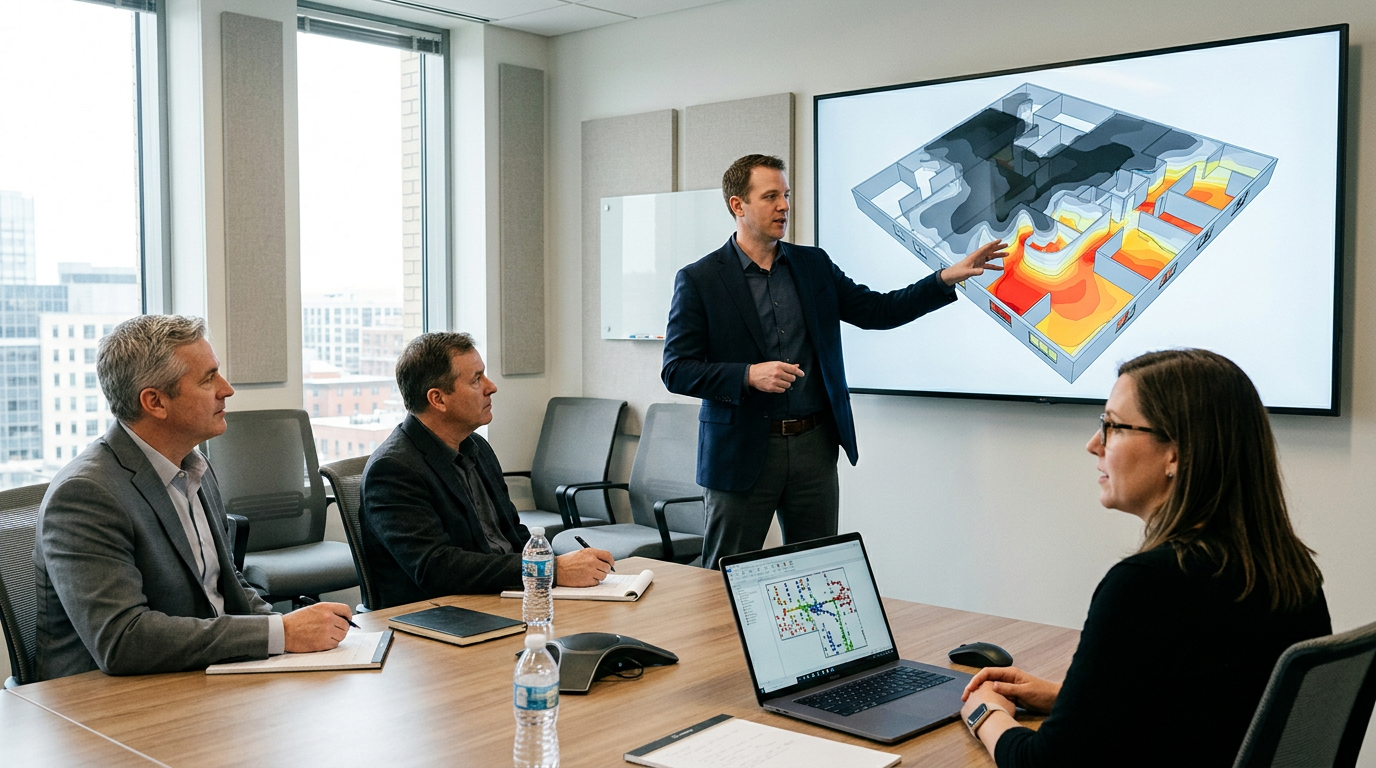
Fire modeling uses computational tools to predict fire growth, smoke movement, temperature, and toxicity.
A. Types of Fire Models
| Model Type | Description | Examples |
|---|---|---|
| Hand calculations | Empirical correlations | NFPA 92 plume and smoke-filling equations; SFPE Handbook correlations |
| Zone models | Divide the space into upper and lower layers | CFAST |
| Field models (CFD) | Divide the space into small computational cells | FDS, Fluent |
B. Model Selection
Selection depends on the complexity of the space, the required accuracy, the available data, and the analyst’s expertise. Zone models and hand calculations suit simple compartments. CFD suits atriums, complex geometry, and cases where smoke movement is driven by detailed geometry or ventilation.
C. Model Validation and Verification
Models must be shown to be appropriate for the conditions being analyzed.
| Standard | Scope |
|---|---|
| ASTM E1355 | Evaluating the predictive capability of deterministic fire models |
| ASTM E1472 | Documenting computer software for fire models |
| ASTM E1591 | Obtaining data for deterministic fire models |
| ISO 16730 | Assessment, verification, and validation of calculation methods |
D. Inputs, Mesh, and Sensitivity
For CFD models, document the mesh resolution and show that results are not mesh-dependent. For all models, document the input data and test the sensitivity of the results to the most uncertain inputs (see Section 7).
E. Limitations
Fire models are approximations of reality. They depend on input data that may be uncertain, may not capture every physical phenomenon, and require expert interpretation.
Key point: Fire modeling is a tool, not an answer. A qualified fire protection engineer must interpret the results.
Key Article: Article 163, Fire Modeling and Egress Modeling Software Overview (planned)
Pro Tip: Use the simplest model that adequately addresses the problem. A complex model with uncertain inputs can be less reliable than a simple model with well-characterized inputs.
◆ Section 6: Egress Modeling
Egress modeling predicts occupant movement, exit usage, and evacuation time.
A. Types of Egress Models
| Model Type | Description | Examples |
|---|---|---|
| Hand calculations | Flow and travel-time correlations | SFPE Handbook egress calculations |
| Hydraulic (flow) models | Treat occupants as a flow through egress elements | Pathfinder (SFPE mode), EVACNET4 |
| Agent-based models | Simulate individual occupant behavior | Pathfinder (steering mode), STEPS, buildingEXODUS, MassMotion |
B. The Model Inputs
| Input | Description |
|---|---|
| Occupant load | Number of occupants and their distribution |
| Occupant characteristics | Age, mobility, alertness, familiarity with the building |
| Pre-movement time | Time before occupants begin to move |
| Walking speed | Speed of occupant movement, including reductions for crowding and stairs |
| Exit selection | How occupants choose exits (familiar route vs. nearest exit) |
| Egress elements | Doors, stairs, corridors, and their capacities |
C. Pre-Movement Time
Pre-movement time is often a large, and sometimes dominant, component of RSET. It consists of recognition time and response time. It depends on the occupancy, the alarm type (voice alarm or bell), the building management procedures, and occupant characteristics. Sleeping and assembly occupancies often have long and widely distributed pre-movement times.
D. Accessible Egress and Non-Ambulatory Occupants
Models should account for occupants who need assistance, who use areas of refuge, or who use evacuation elevators, and for the staff procedures that support them.
E. Model Validation
Egress models should be benchmarked against experimental or reference data, and their behavioral assumptions documented.
Key point: Egress modeling predicts evacuation time. Pre-movement time is often the largest and most uncertain component.
Pro Tip: Use conservative pre-movement times and test the sensitivity of RSET to them.
◆ Section 7: Uncertainty, Sensitivity, and Safety Factors
Every performance-based analysis rests on uncertain inputs. NFPA 101 requires the designer to address this explicitly.
A. Sources of Uncertainty
- Fire growth and heat release rate
- Fuel load and arrangement
- Occupant behavior and pre-movement time
- Model limitations
- Reliability of fire protection systems
B. Sensitivity Analysis
Vary the key inputs (growth rate, pre-movement time, door positions, ventilation) and show that the conclusions hold across a reasonable range.
C. System Reliability
Performance-based designs often rely on active systems such as sprinklers, detection, and smoke control. The analysis should address how reliable these systems are, what happens if they fail (Scenario 8), and what redundancy or supervision supports them.
D. Safety Factors
Apply safety factors or time margins to the results, and justify them. Do not stack arbitrary conservatism in some inputs while ignoring larger uncertainties elsewhere.
Key point: A result without a sensitivity analysis and a justified margin is not defensible.
Pro Tip: Show the AHJ which inputs matter most. It builds confidence and focuses the review.
◆ Section 8: Documentation and Peer Review
A. The Performance-Based Design Report
Many projects use a staged approach: a design brief up front, then the analysis, then the final report.
| Section | Content |
|---|---|
| Executive summary | Overview of the design and findings |
| Performance objectives | What the building must achieve |
| Design fire scenarios | The fires analyzed and why |
| Performance/acceptance criteria | The measurable conditions for success |
| Analysis methods | The models, calculations, and validation |
| Analysis results | The predicted conditions |
| Sensitivity and safety factors | Uncertainty treatment and margins |
| Evaluation | Comparison of results to criteria |
| Conclusions | Whether the design meets the objectives |
| Assumptions and limitations | The assumptions and uncertainties |
| Required design features and operating limits | Systems and conditions the design depends on |
| References | The standards, models, and data used |
B. The Peer Review
The AHJ may require an independent third-party review, typically at the owner’s expense. The reviewer should be independent of the design team, qualified in fire protection engineering, experienced in performance-based design, and familiar with the applicable codes. The review should address the objectives, scenarios, criteria, analysis methods, interpretation of results, and conclusions.
C. The AHJ Review
The AHJ reviews the report and the peer review. The AHJ may accept the design, require modifications, require additional analysis, or reject the design.
Key point: The report is the evidence. The peer review is the assurance.
Pro Tip: Engage the peer reviewer early. A review that finds issues late is expensive to address.
◆ Section 9: Operating and Maintenance Obligations
A performance-based design is valid only for the conditions it analyzed. The building must be operated and maintained to match those assumptions for its whole life.
A. The Operations and Maintenance Manual
NFPA 101 expects the design features and assumptions to be documented so the building can be maintained as designed. The manual should list:
- The fire protection systems and features the design depends on
- Required inspection, testing, and maintenance (NFPA 25, NFPA 72, and others)
- Limits on fuel load, occupant load, and use of space
- Staff training and emergency procedures that the egress analysis assumed
B. Changes After Approval
Changes to the occupancy, occupant load, layout, contents, or fire protection systems can invalidate the analysis. Require re-evaluation and AHJ notification before such changes are made.
C. Records
Keep the report, the model files, the input data, the peer review, and the O&M manual for the life of the building, and make sure the owner and facility staff understand what the design depends on.
Key point: The analysis does not end at occupancy. If the building is not operated as designed, the design no longer applies.
Pro Tip: Give the owner a one-page summary of “what this building depends on” and the changes that trigger re-evaluation.
◆ Section 10: Practical Considerations
A. Cost
Performance-based design usually costs more up front: fire protection engineer fees, modeling, peer review, and AHJ review time. The cost may be offset by reduced construction cost (fewer exits, less fire-resistance-rated construction), more usable space, and in some jurisdictions faster permitting.
B. Time
The analysis, peer review, and AHJ review all add time to the schedule.
C. Risk
The AHJ may reject the design, the peer reviewer may identify issues, the analysis may not support the design intent, and the building may not perform as predicted.
D. Expertise
The team needs a fire protection engineer with performance-based experience, a fire modeler (FDS or CFAST), an egress modeler (Pathfinder, STEPS, or similar), and a peer reviewer with comparable experience.
Key point: Performance-based design has cost, time, risk, and expertise implications, and the project team must be prepared for them.
Pro Tip: Engage the fire protection engineer and the peer reviewer early.
◆ Section 11: Common Challenges and Mistakes
| Challenge or Mistake | Why It Happens or Why It Matters | Solution |
|---|---|---|
| Using performance-based design to avoid safety requirements | The design may not be safe | Focus on objectives, not shortcuts |
| AHJ unfamiliar with performance-based design | Not common in the jurisdiction | Pre-submittal meeting and education |
| Criteria not agreed | Different expectations | Agree in the design brief before analysis |
| Scenarios not representative | Selected for ease | Select challenging scenarios and justify them |
| Model validation not documented | Results look unreliable | Document validation and mesh studies |
| No sensitivity analysis | Results cannot be defended | Test key inputs and justify margins |
| Optimistic pre-movement times | RSET is underestimated | Use conservative, supported values |
| Assumptions not documented | Results cannot be defended | Record every assumption |
| Peer reviewer engaged late | Late-stage issues | Engage early |
| Cost and time underestimated | Overruns | Budget and schedule for it |
| Operating features not addressed | Design is not maintained | Include O&M manual and limits |
| Changes after approval not controlled | Analysis no longer applies | Require re-evaluation |
| Documentation not retained | Cannot demonstrate compliance | Retain for the life of the building |
Key point: Most performance-based design problems are communication, planning, and expertise problems, not technical ones.
Pro Tip: Hold a pre-submittal meeting with the AHJ to discuss the approach, the criteria, and the peer review process.
◆ Section 12: Design Checklist
| Item | Status | Notes |
|---|---|---|
| Performance-based approach justified | ☐ | Why prescriptive is not feasible |
| Fire protection engineer engaged | ☐ | With performance-based experience |
| Goals and objectives defined | ☐ | Life safety, property, continuity |
| Retained prescriptive requirements identified | ☐ | Per NFPA 101 Chapter 5 |
| Design brief agreed with AHJ | ☐ | Scope, criteria, scenarios, methods |
| Design fire scenarios identified | ☐ | Including all NFPA 101 scenarios |
| Acceptance criteria established | ☐ | Agreed with AHJ |
| Fire model selected | ☐ | Appropriate to the problem |
| Egress model selected | ☐ | Appropriate to the problem |
| Model validation documented | ☐ | Per ASTM/ISO |
| ASET/RSET analysis | ☐ | With margin of safety |
| Sensitivity and reliability analysis | ☐ | Inputs and system failure |
| Peer reviewer engaged | ☐ | Independent, qualified |
| Performance-based design report | ☐ | Complete and documented |
| AHJ pre-submittal meeting | ☐ | Discuss approach |
| AHJ review and approval | ☐ | Required |
| O&M manual and operating limits | ☐ | Maintenance, training, use limits |
| Change-control process established | ☐ | Re-evaluation triggers |
| Documentation retained | ☐ | Life of building |
◆ Section 13: Conclusion
Performance-based design is the alternative to prescriptive codes. It lets the designer demonstrate, by analysis, that a building achieves a stated level of safety. NFPA 101 Chapter 5 establishes the process, and the IBC permits it through Section 104.11.
The critical elements are:
- Performance objectives and criteria: what the building must achieve
- Design fire scenarios: the fires the building must withstand
- Fire modeling: predicting fire behavior
- Egress modeling: predicting evacuation
- ASET/RSET analysis: comparing available and required egress time
- Uncertainty and safety factors: making the result defensible
- Documentation and peer review: the evidence and the assurance
- AHJ approval: the final authority
- Operations and maintenance: keeping the building as designed
The most common failure is treating performance-based design as an easier path than prescriptive design. It is not. It is a more demanding path that requires specialized expertise, rigorous analysis, and thorough documentation.
Key Takeaways
- Performance-based design demonstrates safety by analysis, not by adherence to rules.
- NFPA 101 Chapter 5 establishes the process; the IBC permits it through Section 104.11.
- NFPA 101 specifies a set of design fire scenarios, including egress-path, concealed-space, and system-failure fires.
- Acceptance criteria must be measurable, defensible, and agreed with the AHJ before the analysis.
- ASET/RSET is the core of life safety performance-based design, and RSET includes detection, alarm, pre-movement, and travel time.
- Model validation, sensitivity analysis, and justified safety factors make results defensible.
- Independent peer review is commonly required by the AHJ.
- The design is valid only if the building is operated and maintained as analyzed.
- The most common failure is treating performance-based design as an easier path.
Take Action Today
- Determine whether performance-based design is justified for the project.
- Engage a fire protection engineer with performance-based experience.
- Define the objectives and prepare a design brief.
- Identify the design fire scenarios, including the NFPA 101 scenarios.
- Establish the acceptance criteria and agree on them with the AHJ.
- Select the fire and egress models and document their validation.
- Perform the ASET/RSET analysis with sensitivity checks and a justified margin.
- Engage the peer reviewer early.
- Prepare the performance-based design report and the O&M manual.
- Hold a pre-submittal meeting with the AHJ and obtain approval.
- Put change control in place for the life of the building.
- Retain the documentation for the life of the building.
Continue Reading from Our Series:
- Related guide: Article 161, NFPA 101 vs. IBC: Key Differences Explained
- Related guide: Article 163, Fire Modeling and Egress Modeling Software Overview (planned)
- Read more: Article 164, Equivalency and Alternate Methods of Compliance (planned)
About This Guide: This article is part of a series on commercial building fire safety, written for facility managers, architects, and code officials. It references model codes and standards for educational purposes. Always consult your local AHJ and a qualified fire protection engineer for project-specific requirements.