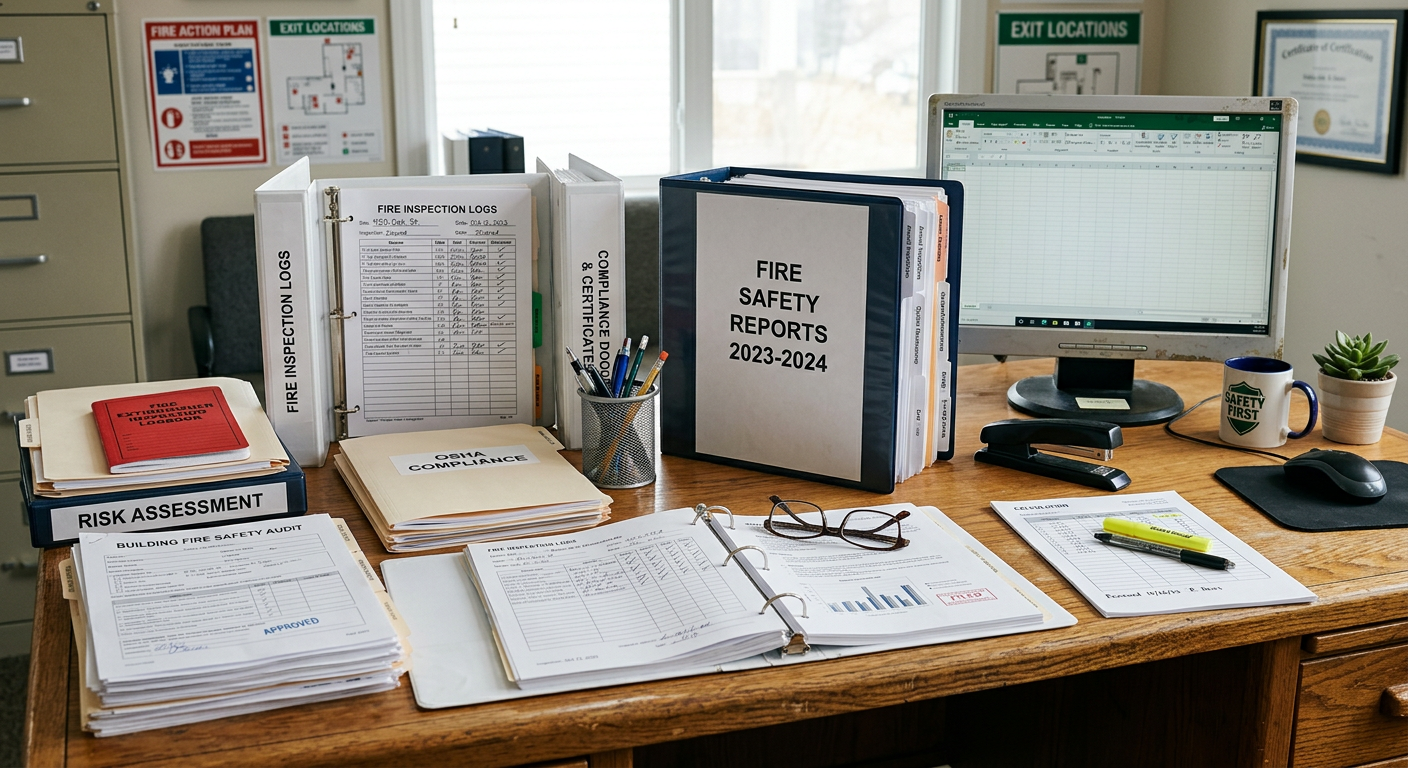
Fire safety documentation is not just a regulatory requirement—it is a critical tool for managing risk, demonstrating compliance, and protecting your organization. Clear, well-organized documentation can save time during inspections, reduce liability, and provide a clear record of your safety efforts.
This guide covers the essential elements of fire safety documentation, including:
- Inspection reports.
- Fire safety plans.
- Compliance records.
- Maintenance logs.
- Training and drill records.
Section 1: Why Documentation Matters
Documentation serves multiple critical functions in fire safety management.
| Reason | Why It Matters |
|---|---|
| Demonstrates Compliance | Provides evidence of compliance with codes and standards. |
| Reduces Liability | Shows that you have taken reasonable steps to ensure safety. |
| Supports Inspections | Enables quick access to required records during inspections. |
| Identifies Trends | Helps identify recurring issues that need attention. |
| Improves Accountability | Assigns clear responsibility for safety tasks. |
| Facilitates Training | Provides reference materials for employee training. |
| Supports Insurance Claims | Documentation can support claims and demonstrate proactive risk management. |
Pro Tip: The quality of your documentation can be as important as the quality of your safety systems. Clear, well-organized records inspire confidence during inspections.
Section 2: Required Documentation
The following documents are typically required for fire safety compliance.
| Document | Description | Code Reference |
|---|---|---|
| Fire Safety Plan | Document outlining emergency procedures. | NFPA 101 [1] |
| Inspection Logs | Records of routine inspections (fire extinguishers, sprinklers, alarms). | NFPA 10, NFPA 13, NFPA 72 |
| Testing and Maintenance Reports | Reports from annual testing of fire protection systems. | NFPA 13, NFPA 72, NFPA 25 |
| Training Records | Records of employee training and fire drills. | NFPA 101, OSHA 1910.157 [2] |
| Fire Drill Records | Documentation of fire drills, including date, time, and duration. | NFPA 101 [1] |
| Equipment Certificates | Certificates for fire extinguishers, sprinkler systems, and other equipment. | NFPA 10, NFPA 13 |
Section 3: Writing Effective Inspection Reports
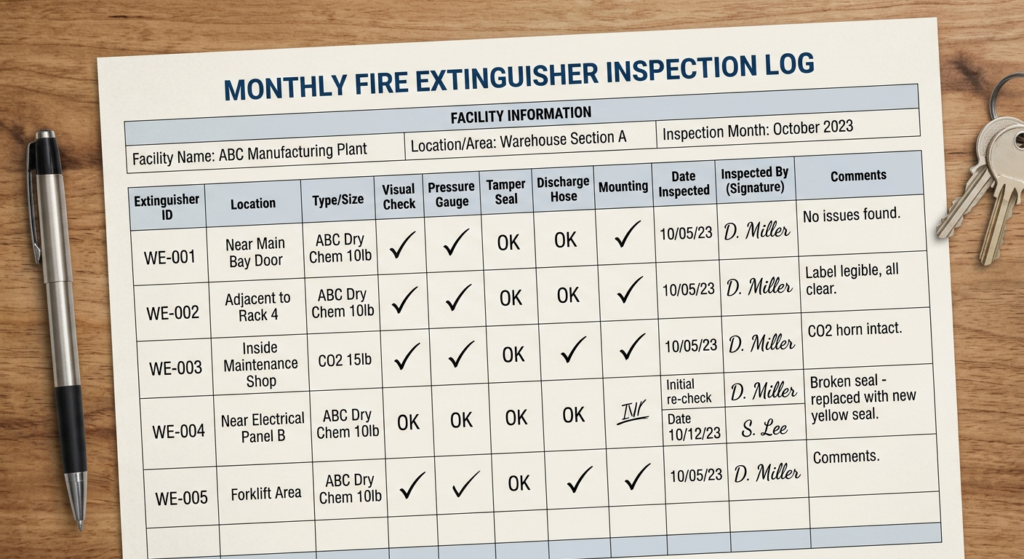
An inspection report should provide a clear, accurate, and actionable record of what was inspected, what was found, and what needs to be done.
Key Elements of an Inspection Report:
| Element | Description | Example |
|---|---|---|
| Header | Title, location, date, and inspector’s name. | “Fire Extinguisher Inspection Report – Building A” |
| Scope | What was inspected and why. | “Monthly inspection of all fire extinguishers per NFPA 10.” |
| Observations | What was found during the inspection. | “Extinguisher #12 is missing; #15 is blocked by storage.” |
| Findings | What needs to be addressed. | “Replace #12; clear obstruction around #15.” |
| Priority | How urgent the finding is. | High (critical), Medium (needs attention), Low (minor). |
| Action Plan | Who is responsible for fixing the issue and by when. | “John Smith to replace #12 by [target date].” |
| Attachments | Photos, diagrams, or supporting documents. | “Photo of obstructed extinguisher attached.” |
Structure for a Simple Inspection Report:
| Section | Description |
|---|---|
| 1. Introduction | Purpose and scope of the inspection. |
| 2. Observations | List of observations with photos. |
| 3. Non-Compliances | List of non-compliances with code references. |
| 4. Corrective Actions | Recommended actions and timelines. |
| 5. Attachments | Photos, drawings, and supporting documents. |
| 6. Signatures | Inspector’s signature and date. |
Pro Tip: Use a standard template to ensure consistency and save time.
Section 4: Developing a Fire Safety Plan
A fire safety plan is the cornerstone of your documentation. It outlines the procedures to be followed in a fire emergency.
Key Elements of a Fire Safety Plan:
| Element | Description |
|---|---|
| Building Information | Address, description, and occupancy type. |
| Fire Protection Systems | Description of sprinklers, alarms, extinguishers, and other systems. |
| Evacuation Procedures | Routes, assembly points, and procedures for evacuating occupants. |
| Roles and Responsibilities | Assignments for fire safety director, floor wardens, and evacuation coordinators. |
| Emergency Communication | How occupants will be notified and how emergency services will be contacted. |
| Training and Drills | Schedule and procedures for training and fire drills. |
| Maintenance and Testing | Schedule for inspecting and testing fire protection systems. |
Example Fire Safety Plan Outline:
1.0 INTRODUCTION
  1.1 Purpose
  1.2 Scope
  1.3 Building Description

2.0 FIRE PROTECTION SYSTEMS
  2.1 Fire Sprinkler System
  2.2 Fire Alarm System
  2.3 Fire Extinguishers
  2.4 Standpipe System

3.0 EMERGENCY PROCEDURES
  3.1 Detection and Reporting
  3.2 Evacuation Procedures
  3.3 Assembly Points

4.0 ROLES AND RESPONSIBILITIES
  4.1 Fire Safety Director
  4.2 Floor Wardens
  4.3 Evacuation Coordinators

5.0 TRAINING AND DRILLS
  5.1 Training Schedule
  5.2 Drill Schedule

6.0 MAINTENANCE AND TESTING
  6.1 Fire Sprinkler System
  6.2 Fire Alarm System
  6.3 Fire Extinguishers

7.0 APPENDICES
  7.1 Floor Plans
  7.2 Inspection Checklists
Pro Tip: The fire safety plan should be reviewed and updated annually, or whenever significant changes occur to the building or occupancy.
Section 5: Training and Drill Records
Training and drill records document that occupants are prepared for a fire emergency.
Key Elements of Training Records:
| Element | Description |
|---|---|
| Date | Date of the training session. |
| Participants | Names of employees who attended. |
| Topics Covered | Description of what was covered. |
| Instructor | Name of the person delivering the training. |
| Duration | Length of the training session. |
| Certificates | Any certificates issued. |
Key Elements of Drill Records:
| Element | Description |
|---|---|
| Date | Date of the fire drill. |
| Time | Start and end times. |
| Participants | Number and names of participants. |
| Evacuation Time | Time taken to evacuate. |
| Issues Encountered | Any problems or observations. |
| Debrief | Summary of the debrief session. |
Section 6: Maintenance and Testing Logs
Maintenance and testing logs document that fire protection systems are in working order.
Key Elements of Maintenance Logs:
| Element | Description |
|---|---|
| System | System being maintained (sprinklers, alarms, extinguishers). |
| Date | Date of the maintenance activity. |
| Description | What was done (e.g., “Inspected and recharged extinguisher #12”). |
| Performed By | Name of the technician or staff member. |
| Next Maintenance Date | Scheduled date for the next maintenance. |
Pro Tip: Use a digital system to track maintenance activities and set reminders for upcoming due dates.
Section 7: Best Practices for Documentation
| Best Practice | Why It Matters |
|---|---|
| Use Standard Templates | Ensures consistency and completeness. |
| Keep Records Current | Outdated records can undermine credibility. |
| Store Records Securely | Protect records from loss, damage, or unauthorized access. |
| Retain Records for Required Period | Typically at least 3 years (check your local requirements). |
| Use Clear, Concise Language | Ensure records are understandable to all readers. |
| Include Photos and Drawings | Visual evidence can support written records. |
| Regularly Review and Update | Ensure documentation reflects current conditions. |
Section 8: Common Mistakes and How to Avoid Them
| Mistake | Why It’s a Problem | How to Fix |
|---|---|---|
| Incomplete Records | Missing information; cannot demonstrate compliance. | Use a checklist to ensure all required information is included. |
| Outdated Documentation | Reflects old conditions; may not be valid. | Schedule regular reviews and updates. |
| Poor Organization | Difficult to find required information during an inspection. | Organize records logically and use a consistent filing system. |
| Illegible Handwriting | Records are unreadable. | Use typed records or a digital system. |
| No Backup | Records can be lost in a fire or other disaster. | Keep digital backups offsite or in the cloud. |
Section 9: Digital Documentation Systems
Consider using a digital system to manage your fire safety documentation.
| Benefit | Description |
|---|---|
| Centralized Storage | All records in one place, accessible from anywhere. |
| Automated Reminders | Set reminders for maintenance, inspections, and training due dates. |
| Easy Search and Retrieval | Quickly find specific records. |
| Version Control | Track changes and updates to documents. |
| Secure Backup | Protect against loss due to fire or other disaster. |
| Audit Trail | Track who made changes and when. |
Pro Tip: Many digital documentation systems are available as software-as-a-service (SaaS) solutions, making them affordable and easy to implement.
Section 10: Design Checklist
Use this checklist to ensure your fire safety documentation is complete and effective:
| Item | Status | Notes |
|---|---|---|
| Fire Safety Plan | ☐ | Reviewed and updated annually. |
| Inspection Logs | ☐ | Completed and stored for all systems. |
| Testing and Maintenance Reports | ☐ | Completed and stored for all systems. |
| Training Records | ☐ | Completed and stored for all employees. |
| Fire Drill Records | ☐ | Completed and stored for all drills. |
| Equipment Certificates | ☐ | Current and accessible. |
| Digital Backup | ☐ | Records backed up offsite. |
| Review Schedule | ☐ | Schedule for regular reviews. |
Conclusion
Effective fire safety documentation is essential for managing risk, demonstrating compliance, and protecting your organization. By understanding the required documents, following best practices, and using a consistent system, you can ensure that your documentation is clear, accurate, and actionable.
Take Action Today:
- Review your current fire safety documentation against the requirements in this guide.
- Identify any gaps and develop a plan to address them.
- Implement standard templates for inspection reports, training records, and other documents.
- Schedule regular reviews to keep documentation current.
- Consider a digital documentation system for improved organization and backup.
References & Notes
[1] NFPA 101, Life Safety Code — fire safety and evacuation plan requirements. Note: the original article cited a specific section number (“4.8”) for this requirement, which could not be confirmed against current sources; fire safety/evacuation plan requirements in NFPA 101 are set primarily within the individual occupancy chapters (e.g., Chapters 11–43) rather than a single universal Chapter 4 section. Verify the applicable section for your specific occupancy and adopted edition before citing a section number in a published document.
[2] OSHA, 29 CFR 1910.157(g) — Portable Fire Extinguishers, Training and Education, requiring documented training upon initial employment and annually thereafter for designated employees.
Note: this article is general documentation-practice guidance rather than a citation-heavy compliance reference. The system-specific standards named in Section 2 (NFPA 10 for extinguishers, NFPA 13 for sprinklers, NFPA 72 for alarms, NFPA 25 for water-based system inspection/testing/maintenance) are correctly matched to their systems but are cited here at the standard level, not to specific sections, since this article doesn’t quote specific numeric requirements from them the way other guides in this series do.
Continue Reading from Our Series:
- Read more about: How to Design and Implement a Fire Safety Training Program
- Learn more: How to Conduct a Fire Risk Assessment
- Related guide: Commercial Building Fire Safety Plan: Development and Implementation