IMPORTANT DISCLAIMER: This guide references the International Existing Building Code (IEBC), including its provisions for repairs, classification of work, alterations (Levels 1–3), change of occupancy, additions, and historic buildings; the International Building Code (IBC); the International Fire Code (IFC); NFPA 101, Life Safety Code, including Chapter 43 (Building Rehabilitation); NFPA 1, Fire Code; local building, fire, zoning, and floodplain regulations; and insurance policy provisions, including ordinance or law coverage. IEBC chapter and section numbering differs between editions, so this guide describes requirements by topic. Code requirements depend on the scope of damage, the scope of work, and local amendments. Insurance coverage depends on the specific policy and endorsements. The edition adopted by your Authority Having Jurisdiction (AHJ) and the language of your policy always control. This guide is a starting point only. Verify the requirements applicable to your project with your AHJ, your insurer, and your legal counsel.
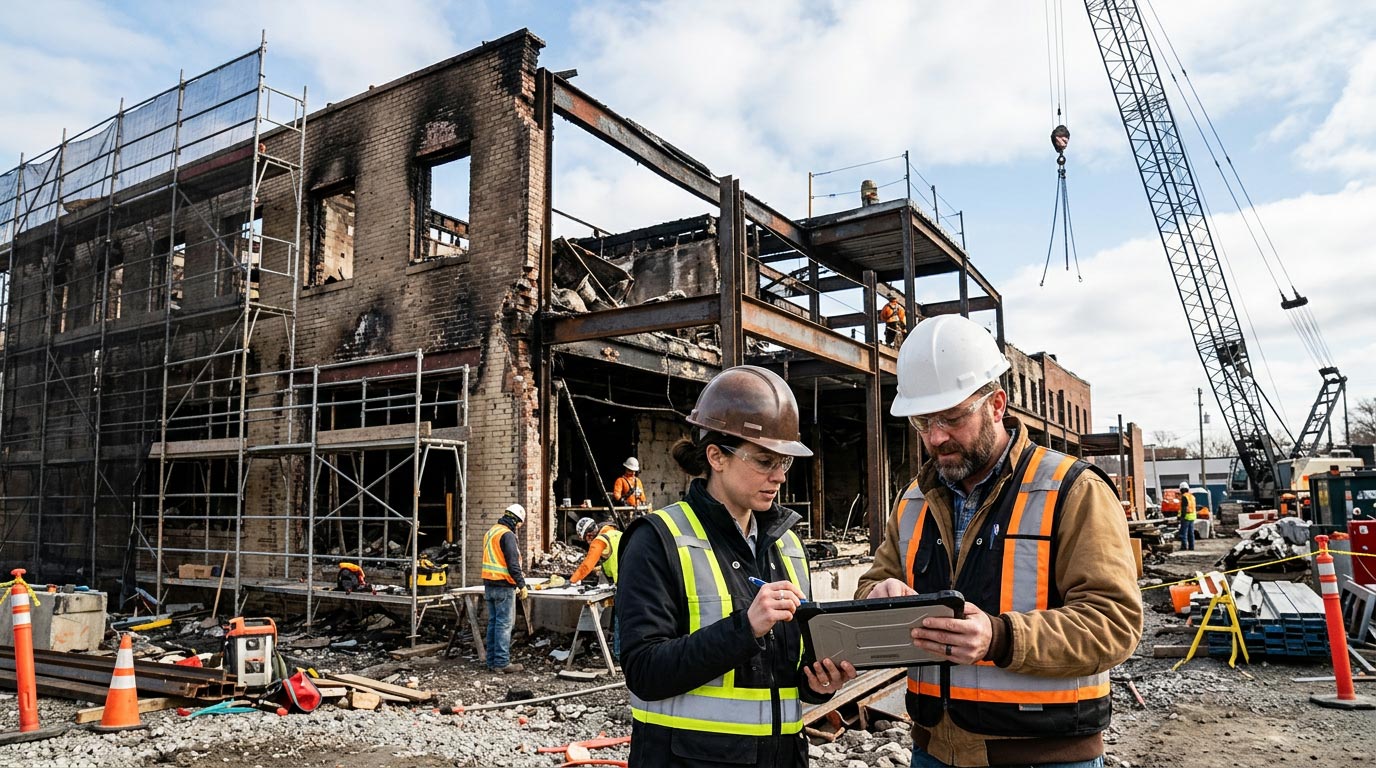
A fire damages more than a building. It damages the business, the occupants, the community, and the owner’s financial position. The reconstruction that follows is a complex process involving insurance claims, code compliance, design, construction, and the emotional and operational strain of rebuilding.
Post-fire reconstruction is not simply restoring the building to its pre-fire condition. Depending on the extent of damage and the scope of rebuilding, the work may trigger code upgrades that never applied to the original building, and the insurance policy may or may not pay for them.
The key question is: what code applies, and who pays for it? The answer depends on:
- The extent and type of damage (including structural damage)
- The scope of work (repair, alteration, addition, change of occupancy)
- Local ordinances, including zoning, floodplain, and retrofit requirements
- The insurance policy’s ordinance or law coverage
This article covers the first days after a fire, the insurance dimension, the code dimension, damage assessment, design, construction, claim management, and occupant continuity, so you can plan a reconstruction that complies with current codes and is supported by insurance.
◆ Section 1: The First Days After a Fire
Decisions made in the first days affect the claim, the investigation, and the safety of everyone on site.
A. Make the Site Safe
- Confirm the building is safe to enter. Fire-damaged buildings may have compromised structure, unstable walls, contaminated air, and live utilities. The building or fire official may post the building as unsafe or restrict entry.
- Secure the site. Board openings, install fencing, and control access. Vacant and damaged buildings are targets for theft, vandalism, and arson, and the IFC contains requirements for securing vacant premises.
- Control utilities. Shut off or isolate damaged electrical, gas, and water systems, and keep temporary power and lighting in safe condition.
- Protect against further damage. Temporary roofing, tarps, and water extraction limit secondary damage. Most policies require the insured to take reasonable steps to protect the property.
- Manage fire protection impairments. If sprinklers, standpipes, or alarms are damaged or shut off, follow an impairment program and provide a fire watch or temporary protection until systems are restored (see NFPA 25 and IFC Section 901.7).
B. Preserve the Fire Scene
Do not demolish, clean up, or discard anything until the insurer and the fire investigator have released the scene. Altering the scene can compromise the cause-and-origin investigation and can be treated as spoliation of evidence, which can jeopardize the claim and any subrogation against a responsible party. Photograph and document conditions before anything is moved.
C. Notify the Right People
Notify the insurer and broker promptly, the lender (the mortgagee is usually a named payee), the AHJ, and the design team. Many policies have notice and proof-of-loss deadlines, so ask for the dates in writing.
D. Identify Hazardous Materials
Fire, firefighting water, and demolition can release or spread hazardous materials. Before demolition or heavy repair, test for asbestos and lead paint, and assess soot and char contamination, mold from water damage, damaged tanks or chemicals, and firefighting runoff. Regulations on asbestos and hazardous waste often require surveys, notifications, and licensed contractors.
Key point: The first days determine safety, evidence, and the integrity of the insurance claim.
Pro Tip: Document everything before you clean anything. Photographs, video, and a dated log are the foundation of both the claim and the reconstruction scope.
Key Article: Article 169 — Fire Investigation Standards (NFPA 921)
◆ Section 2: The Insurance Dimension
The policy determines what is covered and what the owner must pay out of pocket. Review it early, because its terms shape the scope of the reconstruction.
A. Typical Coverages
| Coverage | What It Covers |
|---|---|
| Building coverage | Cost to repair or replace the building |
| Contents coverage | Cost to repair or replace the contents |
| Business interruption | Lost income during the period of restoration |
| Extra expense | Additional costs of operating during restoration |
| Ordinance or law coverage | Costs related to enforcing building codes |
| Debris removal | Cost of removing debris (often with a limit) |
B. Ordinance or Law Coverage
Ordinance or law coverage is the key coverage for code upgrades. Without it, the owner may bear the cost of code-required work that the base building coverage does not pay for. In common forms, it is divided into three parts:
| Coverage | What It Covers |
|---|---|
| Coverage A | Loss in value of the undamaged portion of the building when code requires it to be demolished |
| Coverage B | Cost of demolishing the undamaged portion and clearing the site |
| Coverage C | Increased cost of construction to comply with code when rebuilding or repairing |
Base policies often provide only a small additional amount for increased cost of construction, and Coverages B and C are frequently optional endorsements with their own limits. Ordinance or law coverage generally responds only to laws in force at the time of loss, and it typically does not pay to correct violations that existed before the fire and were ignored. Check the exact wording.
C. Valuation, Limits, and Conditions
- Replacement cost vs. actual cash value. Replacement cost is often paid only after the work is actually completed, with actual cash value paid first. Ask what is held back and what deadlines apply to completing repairs.
- Policy limits and coinsurance. If the cost exceeds the limits, or the building was underinsured, the owner pays the difference, and a coinsurance penalty can reduce payment.
- Business interruption. The period of restoration generally runs only for the time needed to repair with reasonable speed. Delays caused by code compliance or permitting may not be covered unless the policy extends the period for ordinance or law.
- Flood and substantial damage. If the building is in a flood hazard area and the damage is substantial, increased cost of compliance may be a separate coverage question.
D. The Claim Process
Notification, investigation, adjustment, payment, and close-out. Supplemental claims are common when hidden damage or code-required work is discovered during construction.
Key point: Insurance defines the financial boundaries of the reconstruction. Know what is covered before designing.
Pro Tip: Meet with the insurer and broker right after the fire to review the policy, the deadlines, and ordinance or law coverage. The coverage often decides how much of the reconstruction scope the owner can fund.
Key Article: Article 168 — Insurance Underwriting and Fire Risk Assessment
◆ Section 3: The Code Dimension
The adopted code and local regulations determine what must be upgraded. The answer depends on how the work is classified, not only on how bad the fire was.
A. How Existing Building Codes Classify the Work
| Classification | General Approach |
|---|---|
| Repair | Restore damaged elements to their pre-damage condition, with some required improvements |
| Alteration, Level 1 | Removal and replacement or covering of existing materials; limited upgrades |
| Alteration, Level 2 | Reconfiguration of space, new or relocated doors and windows, extension of systems; more upgrades in the work area |
| Alteration, Level 3 | Work area exceeds 50 percent of the aggregate building area; the most extensive upgrades |
| Addition | New construction attached to the building; the addition must comply with new construction requirements |
| Change of occupancy | The building must meet the requirements of the new occupancy |
A fire rebuild is often a mix of these. A heavily burned floor may be treated as a Level 3 alteration, while undamaged floors are untouched.
B. Compliance Methods
The IEBC offers three compliance methods: prescriptive, work area, and performance. The design team selects the method, and the AHJ must accept it. A performance-based approach can help where prescriptive upgrades are impractical in an existing structure.
C. Structural Damage Triggers
Structural damage can trigger upgrades beyond the damaged area. Under the IEBC:
- Dangerous conditions must be repaired or removed right away.
- Less than substantial structural damage can generally be repaired back to its pre-damage condition.
- Substantial structural damage requires evaluation of the building and rehabilitation to meet current requirements for wind and seismic loads, generally to a reduced level for seismic forces. Substantial structural damage is defined by loss of lateral-load capacity in a story (more than 33 percent) or loss of capacity in gravity-load components supporting a large share of the floor or roof area.
Every repair of structural elements needs an engineer’s evaluation, not an assumption.
D. Flood Hazard Areas
In mapped flood hazard areas, repairs to a building where the cost of restoration equals or exceeds 50 percent of the market value before the damage are treated as substantial damage. The building must then be brought into compliance with local floodplain requirements. This applies to fire damage as well as flood damage.
E. NFPA 101 and Local Fire Code Requirements
Where NFPA 101 is adopted, Chapter 43 (Building Rehabilitation) classifies work as repair, renovation, modification, reconstruction, change of use or occupancy, and addition, with escalating requirements for egress, fire protection, and interior finish. Local fire code amendments may add requirements, such as sprinklers or fire alarm upgrades.
F. Zoning, Accessibility, Energy, and Historic Buildings
- Zoning and nonconforming rights. A building that was legally nonconforming (use, height, setbacks, parking) may lose that status if the damage exceeds a threshold set by the local ordinance. Some jurisdictions have right-to-rebuild provisions. Confirm this early.
- Accessibility. Alterations typically trigger accessibility requirements in the altered area and on the path of travel to it, subject to limits on cost disproportionality under the ADA and the adopted code.
- Energy code. Replaced envelope, lighting, and mechanical systems usually must meet the current energy code.
- Historic buildings. Historic provisions may allow some flexibility, and may add review requirements from a historic commission.
G. Retrofit Ordinances
Local ordinances may require upgrades, such as sprinkler retrofit, soft-story retrofit, façade inspection, or fire escape repair, and a major reconstruction can accelerate their timelines.
H. The AHJ’s Role
The AHJ interprets the code, accepts alternative methods, and approves the scope. Early engagement is not optional on a fire rebuild.
Key point: The classification of work, structural damage, location, and local ordinances determine what must be upgraded.
Pro Tip: Request a pre-design meeting with the building official, fire official, and zoning staff. Get decisions on compliance method, structural triggers, and nonconforming status in writing.
Key Article: Article 166 — Retrofit Ordinances and Existing Building Codes
◆ Section 4: Common Code Upgrade Triggers

| Upgrade | Typical Trigger |
|---|---|
| Structural (wind, seismic) | Substantial structural damage; retrofit ordinance; Level 3 alteration |
| Automatic sprinklers | Level 3 alteration or large work areas in some occupancies; change of occupancy; retrofit ordinance; local amendment |
| Fire alarm and detection | Alterations in the work area; change of occupancy; local amendment |
| Egress | Alterations affecting exits, reconfiguration, change of occupancy |
| Fire resistance and compartmentation | Reconstructed assemblies; change of occupancy |
| Accessibility | Alterations; change of occupancy; additions |
| Energy | Replacement of envelope, lighting, or mechanical systems |
| Flood-resistant construction | Substantial damage in a flood hazard area |
Trade-Offs and Alternative Methods
Codes sometimes allow trade-offs where a feature is added elsewhere, for example, sprinklers permitting greater travel distance, or an approved system offsetting a limitation of an existing feature. Trade-offs must be expressly permitted by the adopted code or approved by the AHJ as an alternative method or equivalency, supported by an engineering analysis where needed. Do not assume a trade-off.
Key point: Upgrades are triggered by the type and scope of work and by local rules, so list the triggers early.
◆ Section 5: Damage Assessment
Assessment determines what can be saved, and a poor assessment is expensive in either direction.
- Structural evaluation. Fire can reduce the strength of steel, concrete, masonry, and wood. Evaluate with visual surveys, deformation and alignment checks, and testing as needed, such as concrete cores, steel testing, and char-depth measurement. A structural engineer should decide what is retained.
- Fire protection systems. Evaluate sprinklers, piping, alarm devices, panels, and wiring, because heat and water can damage components that look intact.
- Building envelope and finishes. Smoke, soot, and water spread well beyond the burn area.
- Mechanical, electrical, and plumbing systems. Heat, smoke, and water exposure often make replacement necessary.
- Indoor air quality and contamination. Soot, smoke odor, and mold can make rooms unusable even when the structure is sound.
The decision between repair and demolition is both technical and financial. Compare repair cost against replacement cost, including code upgrades and the effect on schedule and insurance.
Pro Tip: Share the assessment with the insurer and the AHJ. A consistent factual record reduces disputes over scope.
◆ Section 6: Reconstruction Planning and Design
A. The Process
| Step | Activity |
|---|---|
| 1 | Make the site safe and preserve evidence |
| 2 | Notify the insurer, lender, and AHJ |
| 3 | Assess damage and hazardous materials |
| 4 | Engage the design team |
| 5 | Determine code requirements and compliance method |
| 6 | Develop options, schedule, and budget |
| 7 | Obtain permits |
| 8 | Construct |
| 9 | Inspect, test, and commission |
| 10 | Obtain a certificate of occupancy and reoccupy |
B. The Design Team
Architect, structural engineer, fire protection engineer, mechanical, electrical, and plumbing engineers, code consultant, and, when appropriate, an environmental consultant, a cost estimator, and an owner’s representative or construction manager. Insurance adjusters and public adjusters work alongside the team but are not part of it.
C. Design Objectives
Meet current code, align the scope with insurance coverage, stay within the budget, minimize downtime, restore the building’s function, and improve resilience.
D. Design Options and Trade-Offs
Develop at least two options and compare them on cost, schedule, code risk, and insurance coverage. Typical trade-offs are cost vs. resilience, code compliance vs. insurance recovery, speed vs. quality, and function vs. future flexibility.
E. Build Back Better
A reconstruction is an opportunity to improve fire performance and resilience: noncombustible or more fire-resistant materials where practical, better compartmentation, sprinkler coverage, improved detection, wildfire or flood resilience where relevant, and a digital as-built record. Some improvements will not be covered by insurance, so decide which are worth the owner’s own funding.
F. Permits
Expect demolition, building, fire protection (sprinkler and alarm), electrical, mechanical, plumbing, and possibly zoning, floodplain, and environmental permits. Fire protection systems usually need separate submittals by a licensed contractor.
Key point: Design is where code, cost, and coverage meet. Engage the full team before locking the scope.
Pro Tip: Phase the permits if needed (for example, demolition and structural stabilization first) to keep the schedule moving while the final design is reviewed.
◆ Section 7: Construction
A. Contractor Selection
Select a contractor who is qualified, experienced in fire restoration, licensed, insured, and bonded, and who can handle hazardous material abatement or manage specialist subcontractors. Competitive bidding, negotiation, and design-build are all used, and the choice should be coordinated with the insurer’s requirements.
B. Fire Safety During Construction
A damaged and rebuilt building is vulnerable to a second fire. Construction fire safety requirements apply, including NFPA 241 and IFC Chapter 33, with hot work controls (NFPA 51B), site security, temporary protection, and access for the fire department. Keep fire protection systems in service in any occupied part of the building, and restore sprinklers and standpipes as the work progresses.
C. Construction Management
Manage the schedule, budget, quality, safety, and changes. Hidden damage and code discoveries are normal in this type of work, so keep a contingency and a clear change order process that is tied to the insurance claim.
D. Inspection, Testing, and Commissioning
The building and fire officials will inspect at required stages. Fire protection systems require acceptance testing, and integrated testing of interconnected life safety systems should be performed before occupancy (see NFPA 3 and NFPA 4). Keep test reports, listings, and as-built drawings.
E. Occupancy
A certificate of occupancy, or a temporary certificate for phased reoccupancy, is the end of the code process. Do not reoccupy before it is issued.
Key point: Construction must be managed for safety, quality, schedule, and budget, with hidden conditions expected.
Pro Tip: Engage an owner’s representative or construction manager. Restoration projects are usually unfamiliar to owners, and the representative protects the owner’s interests.
◆ Section 8: Managing the Insurance Claim During Reconstruction
A. Documentation
Keep photos and video of the damage, an inventory of damaged property, receipts and records of the pre-loss condition, reconstruction estimates, invoices, payment records, and correspondence. Link code upgrade costs to the specific code requirement or AHJ directive that caused them, since ordinance or law claims depend on that evidence.
B. The Adjuster and the Public Adjuster
The insurer’s adjuster investigates, evaluates, and negotiates the settlement. A public adjuster is licensed to represent the insured, and typically charges a percentage of the recovery. Consider one for a large or complex loss, and check licensing and fee terms. A coverage attorney may be needed for denials or disputes.
C. Disputes and Deadlines
Policies set deadlines for proof of loss, completing repairs to receive replacement cost, and bringing suit. Appraisal provisions may resolve disagreements about the amount of loss. Track every deadline.
D. Supplemental Claims
Hidden damage and code-required work often emerge during demolition and construction. Notify the insurer promptly and document the discovery before covering it up.
Key point: A well-documented claim is the best protection against disputes and shortfalls.
Pro Tip: Ask the AHJ to put code-required upgrades in writing, such as correction notices or plan review comments, so the insurer can verify the cost was caused by an enforced requirement.
◆ Section 9: Occupants, Business Continuity, and Communication
Occupants and tenants are affected as much as the building.
- Relocation plan. Identify temporary space for occupants, operations, and records.
- Business interruption. Keep records of lost income and extra expenses from the first day.
- Tenants and leases. Review the lease provisions on casualty, rent abatement, and termination rights, and the obligations of the landlord and tenants to rebuild.
- Communication. Keep occupants, employees, tenants, the lender, and neighbors informed of the schedule and any hazards.
- Return to occupancy. Plan cleaning, inspections, and training on the restored building’s systems, such as the new alarm and egress arrangements.
Pro Tip: Appoint a single point of contact for communication. Inconsistent information damages trust and can create legal exposure.
◆ Section 10: Common Challenges and Mistakes
| Challenge or Mistake | Why It Happens | Solution |
|---|---|---|
| Code upgrades not covered | No or inadequate ordinance or law coverage | Review and add coverage before a loss |
| Underinsurance | Limits or valuation out of date | Review limits and valuation annually |
| Code requirements unclear | AHJ interpretation not confirmed | Engage the AHJ early and get decisions in writing |
| Evidence destroyed or scene altered | Cleanup begins before release | Wait for the insurer and investigator release |
| Hazardous materials missed | No survey before demolition | Test early and use licensed abatement |
| Structural damage underestimated | No engineering evaluation | Retain a structural engineer immediately |
| Loss of nonconforming status | Damage threshold not checked | Review zoning provisions at the start |
| Claim disputes | Poor documentation | Document everything and link upgrades to code requirements |
| Missed policy deadlines | Dates not tracked | Calendar every deadline |
| Schedule delays and cost overruns | Unrealistic planning, hidden conditions | Realistic schedule, contingency, and early permitting |
| Fire protection left impaired | No impairment program | Implement impairment management and fire watch |
| Occupant displacement | No relocation plan | Plan relocation and communication early |
Key point: Most post-fire reconstruction problems are planning, documentation, and communication problems, not technical ones.
◆ Section 11: Reconstruction Checklist
| Item | Status | Notes |
|---|---|---|
| Site made safe and secured | ☐ | Utilities, openings, access control |
| Fire scene released | ☐ | Insurer and investigator release |
| Fire protection impairments managed | ☐ | Fire watch, temporary protection |
| Hazardous materials surveyed | ☐ | Asbestos, lead, soot, mold |
| Insurer, lender, and AHJ notified | ☐ | Written notice, deadlines recorded |
| Policy reviewed | ☐ | Limits, valuation, endorsements |
| Ordinance or law coverage confirmed | ☐ | Coverages A, B, and C |
| Damage assessed | ☐ | Structural, systems, envelope |
| Design team engaged | ☐ | Architect, engineers, code consultant |
| Code requirements determined | ☐ | Compliance method, structural and flood triggers |
| Zoning and nonconforming status confirmed | ☐ | Rebuild rights |
| Retrofit ordinances reviewed | ☐ | Local requirements |
| Plan, schedule, and budget developed | ☐ | With contingency |
| Permits obtained | ☐ | Building, fire, other |
| Contractor selected | ☐ | Qualified, licensed, insured |
| Construction fire safety in place | ☐ | NFPA 241, hot work, site security |
| Inspections and acceptance tests completed | ☐ | Fire protection, integrated testing |
| Certificate of occupancy issued | ☐ | Temporary or final |
| Claim documented and supplements filed | ☐ | Code upgrades linked to requirements |
| Occupant relocation and return planned | ☐ | Communication plan |
◆ Section 12: Conclusion
Post-fire reconstruction is a complex process that combines safety, evidence preservation, insurance, code compliance, design, construction, and the human impact on occupants. The key question is what code applies and who pays for it.
The critical elements are:
- Safety and evidence: secure the site and preserve the fire scene
- Insurance: the policy defines what is covered, and ordinance or law coverage defines code upgrade funding
- Code requirements: the classification of work, structural damage, flood, and local ordinances
- Design and construction: early team engagement and managed construction
- The claim: thorough documentation tied to code requirements
- People: a plan for occupants and communication
The most common failure is not planning before the fire. A plan makes the process smoother and reduces financial loss.
Key Takeaways:
- Secure the site and preserve the fire scene before demolition or cleanup.
- Insurance is the first financial consideration, and ordinance or law coverage is the key coverage for code upgrades.
- The scope of work, structural damage, and local rules determine the code upgrades, not the fire alone.
- Substantial structural damage and substantial damage in flood hazard areas can trigger major upgrades.
- Zoning may limit the right to rebuild a nonconforming building.
- The AHJ determines code requirements, so engage early and get decisions in writing.
- Test for hazardous materials before demolition.
- Maintain fire protection and construction fire safety during rebuilding.
- Document the claim thoroughly and link code costs to enforced requirements.
Take Action Today:
- Review your insurance policy for ordinance or law coverage, limits, and valuation.
- Pre-qualify a design team and a restoration contractor.
- Develop a basic reconstruction and relocation plan.
- Confirm zoning status, floodplain status, and local retrofit ordinances.
- Keep current drawings, photos, and equipment records off-site.
- Know who to call at your AHJ and insurer.
Continue Reading from Our Series:
- Related guide: Article 169 — Fire Investigation Standards (NFPA 921)
- Related guide: Article 168 — Insurance Underwriting and Fire Risk Assessment
- Related guide: Article 166 — Retrofit Ordinances and Existing Building Codes
- Read more: Article 171 — Fire Safety for Schools and Universities (planned)
About This Guide: This article is part of a series on commercial building fire safety, written for facility managers, architects, and code officials. It references model codes and standards for educational purposes. Always consult your local AHJ, your insurer, and your legal counsel for project-specific requirements.