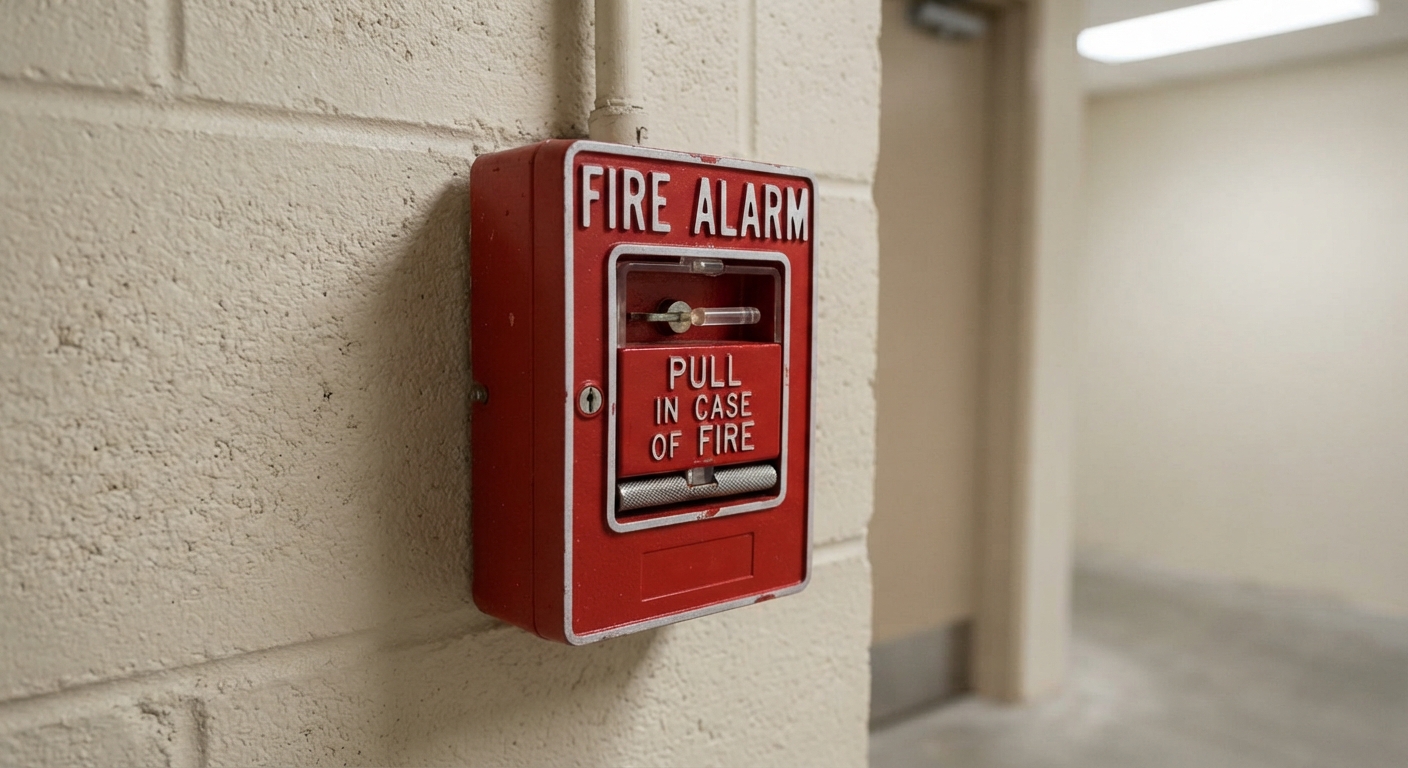
Manual call points—also known as pull stations or manual fire alarm boxes—are a critical component of any commercial building’s fire alarm system. They empower occupants to take immediate action, providing a reliable backup to automatic detection systems [1].
This guide covers the essential requirements for manual call points under NFPA 101 and NFPA 72, including:
-
When they are required.
-
Where to place them.
-
How to install them.
-
Height and spacing requirements.
Section 1: Why Are Manual Call Points Required?
Manual call points serve several critical functions in a building’s fire safety strategy:
| Function | Why It Matters |
|---|---|
| Human-Initiated Activation | A person may spot flames or smoke before automatic sensors activate, allowing for faster evacuation [1]. |
| Redundancy and Fail-Safe | Provides backup if automatic systems malfunction, experience power issues, or have poor sensor coverage [1]. |
| Code Compliance | NFPA 72 and NFPA 101 require manual stations to ensure occupant notification even when automatic circuits are out of service [1][4]. |
| Reliability | They operate mechanically, completing a circuit when pulled, and can function independently of power or complex electronics [1]. |
The Single Required Manual Box:
Even in buildings that rely on automatic detection or sprinkler waterflow for alarm initiation, NFPA 101 generally requires at least one manual fire alarm box in the building. This box is intended to initiate the alarm if the automatic initiation circuit is out of service for testing, maintenance, or repair [4].

Section 2: Location and Placement Requirements
NFPA 72, Section 17.15, provides the specific requirements for the installation of manual stations [3]. The key location requirements are:
| Requirement | Details |
|---|---|
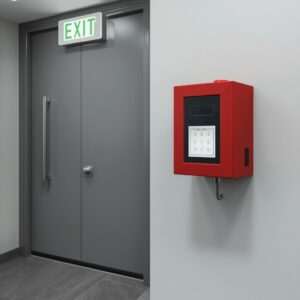
| Near Exit Doors | Manual stations must be located within 5 feet (1.5 m) of each exit doorway on each floor [3][8][10][11]. |
| Zoned Systems | In zoned fire alarm systems, manual stations must be located at the entrance to each exit enclosure and at the main exit [2][7]. |
| Multiple Tenant Buildings | When a fire alarm system is required in a multiple-tenant building, a manual station and approved occupant notification must be located at each required or marked exit for each tenant exiting directly to the exterior [2][7]. |
| Grouped Openings | Manual stations must be mounted on both sides of grouped openings over 40 feet (12.2 m) in width, within 5 feet (1.5 m) of each side of the grouped opening [10]. |
| Conspicuous and Accessible | Manual stations must be installed so they are conspicuous, unobstructed, and accessible [10]. |
Pro Tip: A good rule of thumb is to always install manual stations at a location where they are immediately visible to anyone approaching an exit.
Section 3: Mounting Height Requirements
NFPA 72 specifies the exact height for mounting manual stations. The operable part of the device must be installed at a height that is accessible to all occupants.
| Requirement | Details |
|---|---|
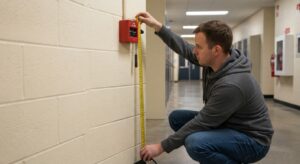
| Height Range | The operable part of a manually actuated alarm-initiating device shall be not less than 42 inches (1.07 m) and not more than 48 inches (1.22 m) from the finished floor [3][5][10][11]. |
| Best Practice | A good rule of thumb is to install manual stations at 48 inches (1.22 m) to the top of the device. This way, regardless of where the handle is, it will always comply with NFPA 72[3]. |
| Contrasting Background | Manual stations should be mounted on a background of contrasting color to make them easily visible [10]. |
| Color | Unless installed in an environment that precludes the use of red paint or red plastic, manual fire alarm boxes shall be red in color [10]. |
Section 4: Spacing and Travel Distance
In addition to placement near exits, manual stations must be distributed throughout the building so that they are within a reasonable distance from any point.
| Requirement | Details |
|---|---|
| Maximum Travel Distance | Additional manual stations shall be provided so that the travel distance to the nearest manual fire alarm box will not exceed 200 feet (61 m), measured horizontally on the same floor [8][10]. |
| Purpose | This ensures that a person can reach a manual station quickly, regardless of where they are in the building. |
Pro Tip: For buildings with large floor plates, ensure that manual stations are distributed evenly to minimize travel distance.
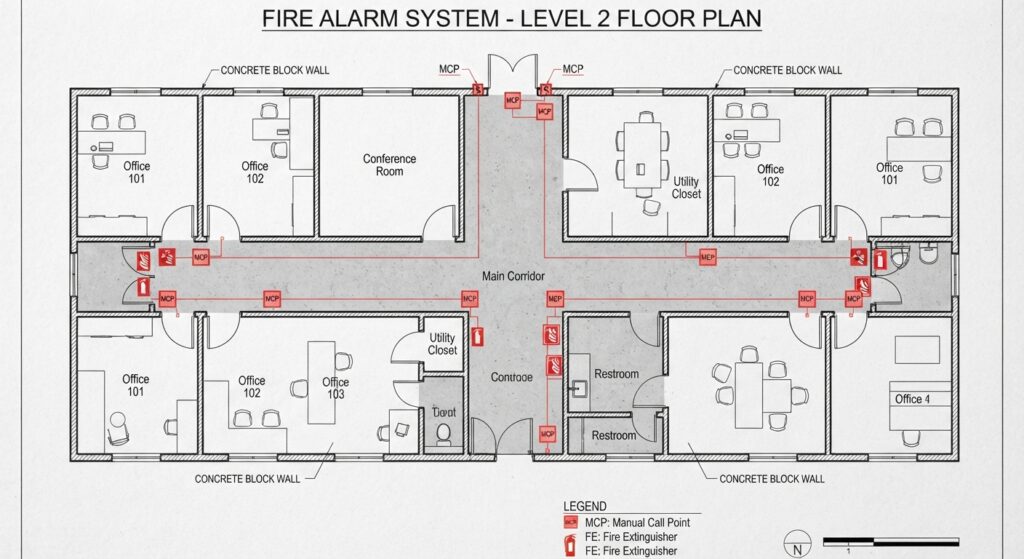
Section 5: Installation Best Practices
| Best Practice | Details |
|---|---|
| Single or Double Action | Manual stations can be single-action or double-action. Single-action requires only one motion; double-action requires two motions (e.g., lift a cover then pull) [10]. |
| Protective Covers | Listed protective covers may be installed over manual stations to prevent accidental activation [10]. |
| Secure Mounting | Manual stations must be securely mounted [10]. |
| Differentiation | Manually actuated devices used for initiating signals other than fire alarms shall be differentiated from manual fire alarm boxes by a color other than red and proper labeling [10]. |
Pro Tip: For high-traffic areas or locations where accidental activation is a concern, consider installing double-action manual stations or using protective covers.
Section 6: Common Mistakes and How to Avoid Them
| Mistake | Why It’s a Problem | How to Fix |
|---|---|---|
| Mounting at the wrong height | May be inaccessible to some occupants. | Install between 42″ and 48″ (1.07 m – 1.22 m). |
| Placing too far from exits | May delay alarm activation. | Install within 5 feet (1.5 m) of each exit doorway. |
| Exceeding travel distance | Some areas may be too far from a station. | Ensure no point is more than 200 feet (61 m) from a station. |
| Obstructed stations | Occupants cannot access the station. | Keep the area clear and unobstructed. |
| Using the wrong color | May confuse occupants. | Manual stations should be red. |
Conclusion
Manual call points are a critical component of a commercial building’s fire alarm system. By understanding the requirements for placement, height, and spacing, you can ensure that your building is compliant and that occupants can quickly initiate an alarm in an emergency.
Take Action Today:
-
Verify the location of all manual call points against the requirements.
-
Check the mounting height of each station (42″–48″ / 1.07 m – 1.22 m).
-
Confirm maximum travel distance (200 ft / 61 m).
-
Ensure stations are red, unobstructed, and on contrasting backgrounds.
-
Verify with your local AHJ for any amendments.
Continue Reading from Our Series:
-
Read more about: How to Prepare for a Fire Department Inspection
-
Learn more: How to Conduct a Fire Safety Audit
-
Related guide: Fire Alarm System Requirements by Occupancy
References & Notes:
[1] NFPA 72, National Fire Alarm and Signaling Code, 2019 Edition.
[2] NFPA 72, Section 17.15.1.2.1 (Zoned Systems).
[3] NFPA 72, Section 17.15.1.2.2 (Multiple Tenant Buildings).
[4] NFPA 101, Life Safety Code, 2012 Edition (General Manual Box Requirement).
[5] NFPA 101, 9.6.2.1 (Manual Initiation).
[6] NFPA 101, 9.6.2.2 (Manual Box Location – Travel Distance).
[7] NFPA 101, 9.6.2.3 (Manual Box Location – Exits).