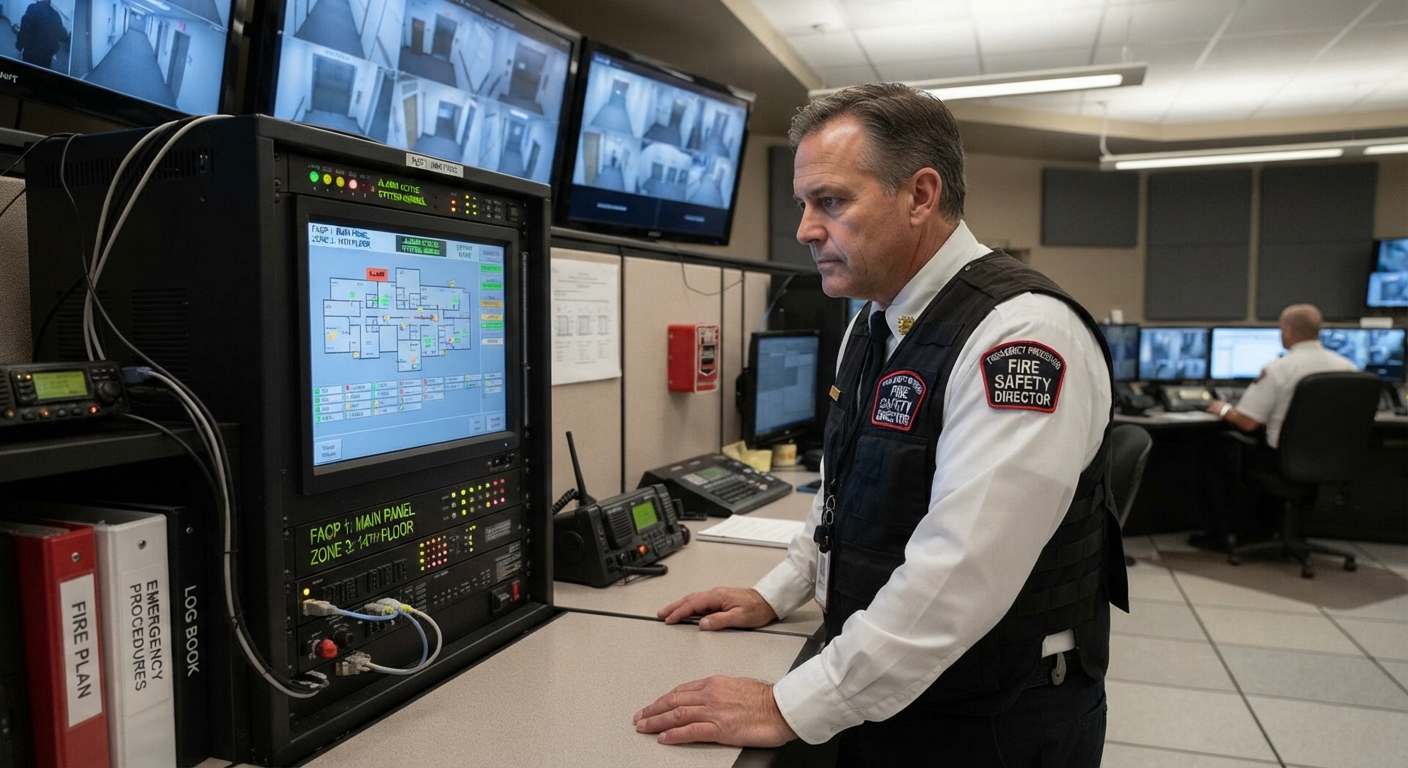
The Fire Safety Director (FSD) is a critical role in any commercial building’s life safety program. This individual is the primary point of contact for fire emergencies, responsible for implementing the building’s fire safety plan, managing emergency response teams, and ensuring compliance with fire codes [1][2].
This guide covers the essential duties, responsibilities, and qualifications of a Fire Safety Director.
Section 1: What Is a Fire Safety Director?
A Fire Safety Director is a designated individual responsible for developing, implementing, and supervising fire safety and emergency response programs within a commercial building or facility [3][7]. The primary mission is to protect life and property through the implementation of the building’s fire safety plan, including the management of the Fire Command Station and supervision of the fire brigade, floor wardens, and building evacuation supervisors [2].
Key Definition:
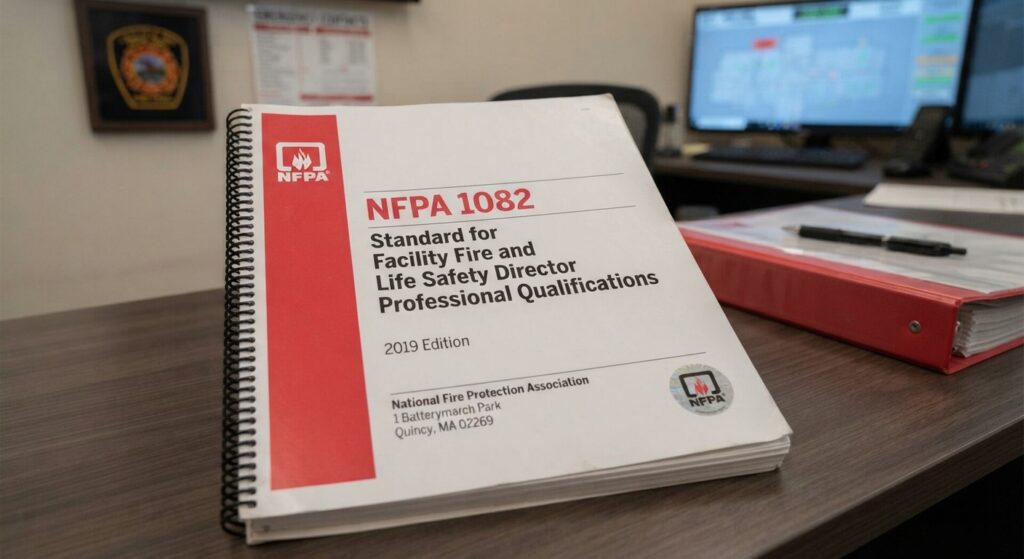
The NFPA defines the role through NFPA 1082, Standard for Facilities Fire and Life Safety Director Professional Qualifications. This standard establishes the minimum knowledge and skill competencies centered on five core areas: administration, planning, training, response, and recovery activities developed as part of an emergency action plan [4].
Section 2: Core Responsibilities
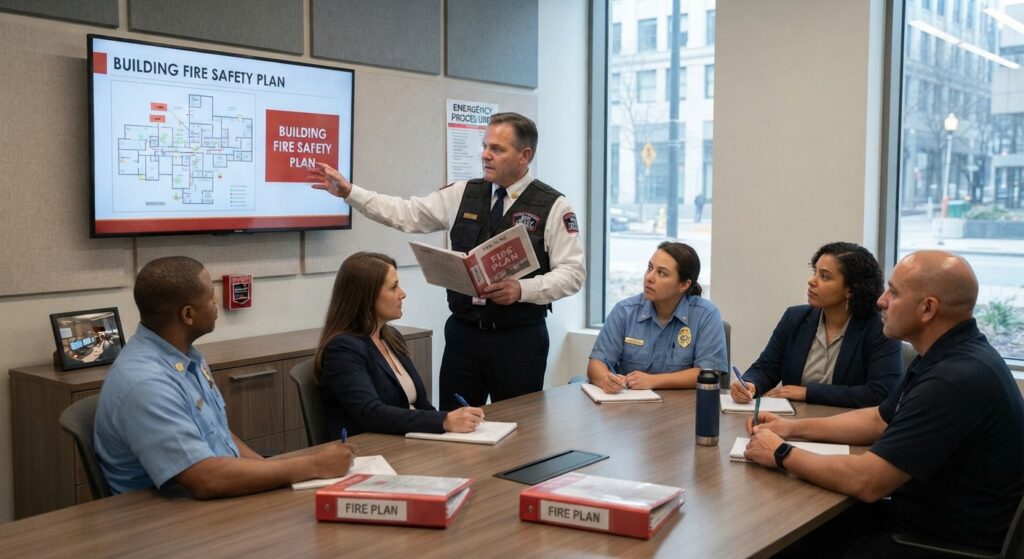
The Fire Safety Director’s role encompasses a wide range of duties. Based on the NFPA 1082 standard, job listings, and industry practice, these responsibilities are organized into four core areas [4][5][8][10]:
A. System Oversight and Monitoring
| Responsibility | Details |
|---|---|
| Fire Alarm Monitoring | Monitor and operate the fire alarm system panel and elevator system panels [1][10]. |
| System Functionality | Ensure that all life safety systems and related equipment are fully functional [2][5][8]. |
| Inspection and Testing | Perform facility safety inspections and testing including monthly fire extinguisher and elevator fire service [1][3][5]. |
| Vendor Coordination | Coordinate with contracted vendors for fire alarm, sprinkler-standpipe, preaction, and FM200 system testing [10]. |
| System Bypass Management | Review work tickets to ensure proper notification of fire systems are bypassed to reduce unwarranted fire alarm activations [10]. |
B. Emergency Response and Incident Management
| Responsibility | Details |
|---|---|
| Primary Contact for First Responders | Serve as the primary point of contact for Fire Department, Police, and other emergency agencies during incidents [1][2][8][10]. |
| Emergency Leadership | Act decisively in emergencies, providing calm and effective leadership [5][10]. |
| Public Address Announcements | Make clear and articulate public-address announcements as required [1][5]. |
| Incident Reporting | Prepare incident reports and escalate serious issues to management [1][3]. |
C. Training and Drills
| Responsibility | Details |
|---|---|
| Fire Drills | Plan, conduct, and document fire and non-fire drills as per code [1][2][3][5][8]. |
| Staff Training | Train members of the emergency response team and floor warden organization [2][5][7]. |
| Warden Program Maintenance | Update floor warden and brigade teams as needed [1][2]. |
| Team Supervision | Supervise Fire Safety Directors, security staff, and building evacuation supervisors [8][10]. |
D. Documentation and Compliance
| Responsibility | Details |
|---|---|
| Regulatory Compliance | Ensure compliance with fire codes (NFPA 101, NFPA 72, local codes) [1][5][8][10]. |
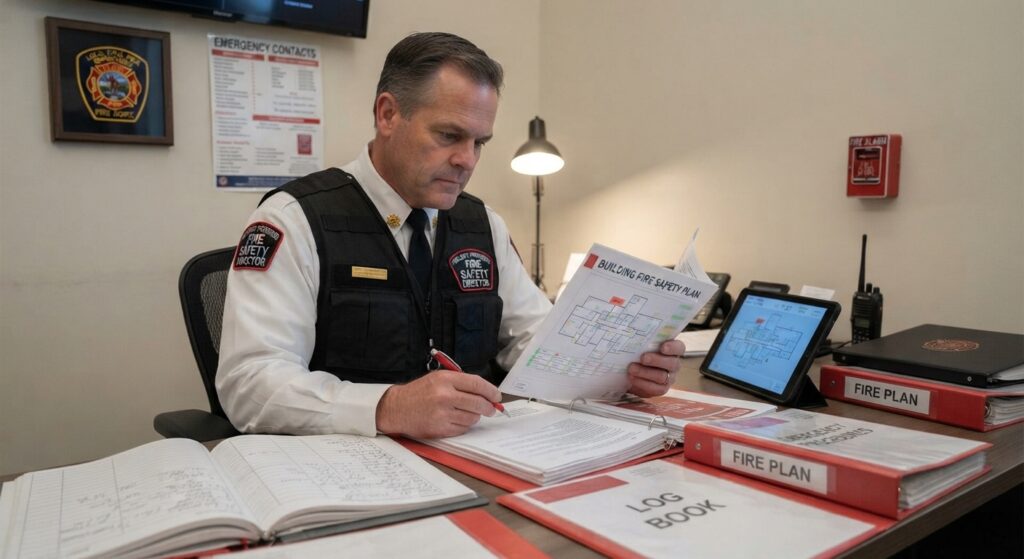
| Record Keeping | Maintain detailed logs of safety activities, drills, and incident reports [5][8]. |
| Plan Development | Develop, implement, and continuously refine fire safety and emergency response plans [5][8][10]. |
Section 3: Qualifications and Certifications
The Fire Safety Director role requires a specific set of qualifications and certifications. While requirements vary by jurisdiction, the following are common across the industry [2][3][5][8][10]:
| Qualification | Details |
|---|---|
| Certification | F-89 Certification (in NYC) or equivalent local certification [3][5][8]. |
| Security License | Valid Security Guard License [3][5]. |
| Experience | Typically 2+ years as a Fire Safety Director in commercial property [5][8]. |
| Knowledge | Proficiency in NFPA codes (101, 72, 13, 25), OSHA standards, and local fire codes [1][3][10]. |
| Soft Skills | Strong leadership, communication, and decision-making abilities [1][2][5]. |
| CPR/AED | Basic Life Support (BLS), CPR, and AED certification preferred [2][8]. |
Pro Tip: The NFPA offers certifications that align with this role. The Certified Fire Protection Specialist (CFPS) is a recognized credential that can enhance career progression [3].
Section 4: NFPA 1082 – Professional Qualifications
NFPA 1082, “Standard for Facilities Fire and Life Safety Director Professional Qualifications,” provides a benchmark for evaluating the competencies of personnel responsible for safeguarding facilities, contents, and occupants [4].
The standard covers the minimum Job Performance Requirements (JPRs) across five key areas:
| Area | Description |
|---|---|
| 4.2 Administration | Managing the fire safety program, including documentation and compliance [4]. |
| 4.3 Planning | Developing and maintaining emergency action plans [4]. |
| 4.4 Training | Training staff, floor wardens, and brigade members [4]. |
| 4.5 Response | Leading emergency response and coordinating with first responders [4]. |
| 4.6 Recovery | Managing post-incident recovery and documentation [4]. |
Section 5: The Fire Command Center
The Fire Command Center is the operational hub for the Fire Safety Director [2][8]. It is where emergency response is coordinated and the fire alarm panel is monitored.
Key Features:
| Feature | Purpose |
|---|---|
| Fire Alarm Panel | Central monitoring and control of the building’s fire alarm system [1][2]. |
| Elevator Panel | Monitoring and control of elevator operations during emergencies [1][2]. |
| Communication Systems | Public address system, two-way communication, and radio systems [1]. |
| Monitoring Systems | Access control systems, turnstiles, and CCTV cameras [1]. |
| Documentation | Fire safety plans, inspection logs, and emergency procedures [8][10]. |
Pro Tip: The Fire Command Center should be maintained as a clean, organized, and fully functional space, with all documentation readily accessible [8][10].
Section 6: Emergency Response Leadership
The Fire Safety Director is responsible for leading the building’s response during emergencies [5][8][10].
Key Actions During an Emergency:
| Phase | Action |
|---|---|
| Detection | Acknowledge the alarm, assess the situation, and initiate response [1][2]. |
| Communication | Notify occupants via public address system [1][5]. |
| Coordination | Liaise with first responders (Fire Department, Police) [2][10]. |
| Evacuation | Direct floor wardens and evacuation supervisors [2][8]. |
| Documentation | Record all actions and prepare incident reports [1][8]. |
Pro Tip: Regular drills and training ensure that the Fire Safety Director and the entire emergency response team are prepared to act decisively.
Section 7: Career Path and Progression
A career as a Fire Safety Director can lead to senior leadership roles [3][8].
| Role | Description |
|---|---|
| Fire Safety Director | Entry-level to mid-level role managing a single property [2][5]. |
| Director, Fire Life Safety | Senior role overseeing multiple properties and staff [8][10]. |
| Chief Fire Marshal | Leadership role in fire code enforcement. |
| Director of Emergency Management | Senior role managing all emergency response functions. |
| Fire Safety Consultant | Provides expert advice to building owners and organizations [3]. |
Conclusion
The Fire Safety Director is an essential role in any commercial building’s life safety program. By overseeing system monitoring, emergency response, training, and compliance, the Fire Safety Director ensures that occupants and property are protected.
Take Action Today:
-
If you are a building owner: Ensure your property has a qualified Fire Safety Director.
-
If you are a Fire Safety Director: Review your responsibilities against NFPA 1082 standards [4].
-
Verify certifications are current and valid.
-
Conduct regular drills and training sessions.
-
Maintain thorough documentation of all safety activities.
Continue Reading from Our Series:
-
Read more about: Manual Call Point Requirements
-
Learn more: How to Prepare for a Fire Department Inspection
-
Related guide: Commercial Building Fire Safety Plan: Development and Implementation
References & Notes:
[1] Quality Building Services, Fire Life Safety Director Job Description, 2026.
[2] Allied Universal, Fire Life Safety Director Job Description, 2024.
[3] Security USA Inc, Fire Safety Director Job Description, 2025.
[4] NFPA 1082, Standard for Facilities Fire and Life Safety Director Professional Qualifications.
[5] Alliance Building Services, Fire & Life Safety Director Job Description, 2026.
[6] ZipRecruiter, Fire Safety Director Career Overview.
[7] City College of San Francisco, Fire Safety Director Course Outline, 2026.
[8] Tishman Speyer, Director, Fire Life Safety Job Description, 2026.
[9] Films Media Group, Fire Safety Director Career Q&A.
[10] CBRE, Director of Fire Life Safety Job Description, 2025.