
IMPORTANT DISCLAIMER: This guide is general committee-management and meeting-facilitation guidance rather than a code-compliance reference. The recommendations (committee size, meeting frequency, agenda structure, minute-taking format) reflect common organizational best practice rather than a specific legal or code requirement. Always verify fire safety management requirements against the codes and regulations adopted by your Authority Having Jurisdiction (AHJ).
A fire safety committee is a dedicated group responsible for overseeing and enhancing the fire safety of a building or organization. It ensures that fire safety is not an afterthought but a continuous, strategic priority. Effective committees bring together diverse expertise, foster a culture of safety, and ensure compliance with codes and standards.
This guide covers the essential steps for establishing and running an effective fire safety committee.
◆ Section 1: Purpose of a Fire Safety Committee
The committee plays a crucial role in the organization’s overall fire safety management program. Its primary responsibilities include:
| Responsibility | Description |
|---|---|
| Developing and Implementing Fire Safety Policy | Creating, reviewing, and maintaining the organization’s fire safety policy. |
| Coordinating Fire Safety Activities | Ensuring all fire safety measures are properly coordinated and implemented. |
| Conducting Fire Risk Assessments | Leading or coordinating fire risk assessments. |
| Reviewing Incident Reports | Investigating fire incidents and near misses, and making recommendations to prevent recurrence. |
| Providing Fire Safety Advice | Acting as a resource for employees and management on fire safety matters. |
| Ensuring Fire Safety Training | Overseeing fire safety training programs. |
| Reviewing Fire Safety Performance | Monitoring fire safety performance, setting targets, and ensuring continuous improvement. |
| Ensuring Compliance | Ensuring compliance with relevant fire safety legislation and standards. |
◆ Section 2: Committee Structure and Membership
| Role | Description | Typical Members |
|---|---|---|
| Chairperson | Leads meetings, sets the agenda, and ensures action items are completed. | Senior manager, fire safety director, or building manager. |
| Secretary | Records minutes, distributes documents, and tracks action items. | Administrative staff or committee member. |
| Fire Safety Advisor | Provides expert advice on fire safety matters. | Fire safety professional, consultant, or engineer. |
| Management Representative | Ensures senior management support and resources. | Senior manager, operations manager. |
| Employee Representatives | Represent the interests and concerns of employees. | Employee representatives from different departments. |
| Facilities Management | Responsible for building systems, maintenance, and repairs. | Facilities manager, maintenance staff. |
| Health and Safety Representative | Represents the broader health and safety function. | Health and safety officer. |
Pro Tip: Committees should typically include between six and twelve members to ensure effective decision-making and representation.
◆ Section 3: Meeting Frequency
| Meeting Type | Frequency | Purpose |
|---|---|---|
| Regular Meetings | Monthly or Quarterly | Routine review of fire safety activities, performance, and issues. |
| Special Meetings | As needed | To address urgent issues, incidents, or significant changes. |
| Annual General Meeting | Annually | Review the year’s performance, set targets, and plan for the next year. |
Pro Tip: Regular monthly or quarterly meetings are recommended for most organizations. Some organizations choose a bi-monthly cadence (every two months) as a middle ground between the two—but the key is consistency, not the specific interval.
◆ Section 4: Preparing the Agenda
A well-prepared agenda ensures the meeting stays on track and addresses the most important issues.
Sample Meeting Agenda (Full — ~120 minutes):
| Item | Description | Time |
|---|---|---|
| 1. Call to Order | Review quorum (at least half the committee members must be present). | 5 mins |
| 2. Approval of Minutes | Review and approve minutes from the previous meeting. | 5 mins |
| 3. Fire Safety Performance Review | Review fire safety performance since the last meeting, including incident statistics. | 15 mins |
| 4. Review of Action Items | Review action items from the previous meeting. | 10 mins |
| 5. Fire Risk Assessment Review | Review any new or updated fire risk assessments. | 15 mins |
| 6. Training and Drills | Review training schedules and fire drill performance. | 10 mins |
| 7. System Inspections and Maintenance | Review inspection and maintenance records for fire protection systems. | 10 mins |
| 8. Compliance and Regulatory Updates | Review changes to fire safety legislation or codes. | 10 mins |
| 9. Incident Reviews | Review any fire incidents or near misses. | 15 mins |
| 10. New Business | Discuss any new issues or initiatives. | 10 mins |
| 11. Action Items | Identify and assign action items. | 10 mins |
| 12. Adjournment | Close the meeting. | 5 mins |
Note on agenda length: The full agenda above totals approximately 120 minutes (2 hours). For routine monthly or quarterly sessions, that may be longer than necessary. If a tighter meeting is preferred, consider trimming items 5–8 (Risk Assessment, Training, Inspections, and Compliance Updates) to brief verbal updates of 5 minutes each—bringing the total to roughly 90 minutes.
Sample 60-Minute Core Agenda:
| Item | Time |
|---|---|
| 1. Call to Order & Quorum | 5 mins |
| 2. Approval of Previous Minutes | 5 mins |
| 3. Performance Review & Action Items | 15 mins |
| 4. Incident / Near-Miss Review | 10 mins |
| 5. Training & Drill Status | 5 mins |
| 6. New Business | 10 mins |
| 7. Action Items & Adjournment | 10 mins |
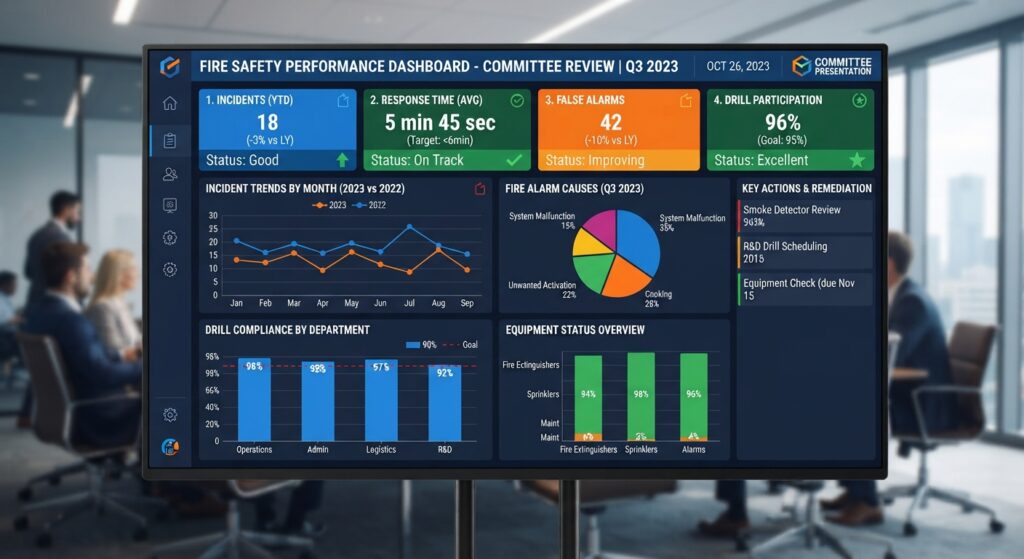
◆ Section 5: Fire Safety Performance Metrics
| Metric | Description | Target |
|---|---|---|
| Number of Fire Incidents | Total number of fires. | Zero. |
| Number of Near Misses | Reported near misses. | Report and investigate all. |
| False Alarms | Number of false alarms. | Minimize. |
| Fire Drill Performance | Evacuation times. | Continuous improvement. |
| Training Completion | Percentage of employees trained. | 100%. |
| Inspection Completion | Percentage of inspections completed. | 100%. |
| Hazard Reports | Number of hazards reported. | Increase reporting. |
◆ Section 6: Reviewing Fire Risk Assessments
The committee should periodically review completed fire risk assessments to ensure they remain current and that all identified actions have been addressed.
| Review Question | Action |
|---|---|
| Is the assessment current? | Update if there have been changes to the building, occupancy, or activities. |
| Have all actions been completed? | Follow up on outstanding actions. |
| Are controls still effective? | Verify that controls are still in place and working. |
◆ Section 7: Incident Reviews
When a fire or near-miss occurs, the committee should conduct a thorough review.
| Review Question | Action |
|---|---|
| What happened? | Describe the incident. |
| Why did it happen? | Identify the root causes. |
| What can be done to prevent recurrence? | Develop and implement corrective actions. |
| Were there any failures in fire protection systems? | Identify system failures and address them. |
| Were evacuation procedures effective? | Review drill performance and identify improvements. |
◆ Section 8: Minute-Taking Best Practices
The secretary is responsible for taking and distributing minutes. Accurate minutes are essential for tracking action items and demonstrating compliance.
| Best Practice | Why It Matters |
|---|---|
| Record Key Decisions | Document what was decided and by whom. |
| List Action Items | Clearly state each action item, who is responsible, and the deadline. |
| Include Discussion Points | Briefly summarize key discussion points. |
| Distribute Promptly | Send minutes to members and relevant stakeholders. |
| Maintain a Record | Keep minutes for reference and compliance. |
Sample Minutes Format:
| Item | Description |
|---|---|
| Date | Date of meeting. |
| Attendees | List of attendees. |
| Apologies | Apologies received. |
| Previous Minutes | Approval status. |
| Matters Arising | Updates on previous action items. |
| Discussion | Summary of key discussion points. |
| Action Items | List of action items, responsible person, and deadlines. |
| Next Meeting Date | Date of the next meeting. |
◆ Section 9: Committee Effectiveness Checklist
Use this checklist to evaluate the effectiveness of your committee:
| Item | Status |
|---|---|
| Clear Terms of Reference | ☐ |
| Appropriate Membership | ☐ |
| Regular Meetings | ☐ |
| Agendas Circulated in Advance | ☐ |
| Minutes Taken and Distributed | ☐ |
| Action Items Tracked | ☐ |
| Performance Metrics Monitored | ☐ |
| Risk Assessments Reviewed | ☐ |
| Incidents Reviewed | ☐ |
| Training and Drills Reviewed | ☐ |
◆ Section 10: Common Mistakes and How to Avoid Them
| Mistake | Why It’s a Problem | How to Fix |
|---|---|---|
| Irregular Meetings | Loss of momentum. | Schedule meetings in advance and stick to the schedule. |
| Lack of Senior Representation | Committee lacks authority. | Ensure a senior manager is a member or attends regularly. |
| Too Many Members | Inefficient decision-making. | Aim for 6–12 members. |
| No Agenda | Meetings lack focus. | Prepare and distribute agendas in advance. |
| No Action Item Tracking | Items are not completed. | Track action items and follow up. |
| Ignoring Minutes | Decisions are forgotten. | Review minutes at the start of each meeting. |
◆ Section 11: Design Checklist
Use this checklist to establish or improve your fire safety committee:
| Item | Status | Notes |
|---|---|---|
| Terms of Reference | ☐ | Define the committee’s purpose, responsibilities, and membership. |
| Membership | ☐ | Recruit members from key areas. |
| Meeting Schedule | ☐ | Set a regular schedule. |
| Agenda Template | ☐ | Create a standard agenda template. |
| Minutes Template | ☐ | Create a standard minutes template. |
| Action Item Tracker | ☐ | Implement a system for tracking action items. |
| Performance Metrics | ☐ | Define and monitor fire safety performance metrics. |
◆ Section 12: Conclusion
A fire safety committee is a powerful tool for building a strong safety culture. By bringing together diverse expertise, setting clear goals, and monitoring performance, the committee can drive continuous improvement in fire safety and ensure the protection of occupants and property.
Take Action Today:
-
Establish a fire safety committee if you don’t already have one.
-
Define clear terms of reference.
-
Schedule regular meetings.
-
Prepare agendas and take minutes.
-
Track action items and monitor performance.
-
Review performance metrics and risk assessments at every meeting.
Continue Reading from Our Series:
- Read more about: How to Design a Fire Safety Awareness Campaign
- Learn more: How to Conduct a Post-Fire Investigation
- Related guide: How to Design and Implement a Fire Safety Training Program