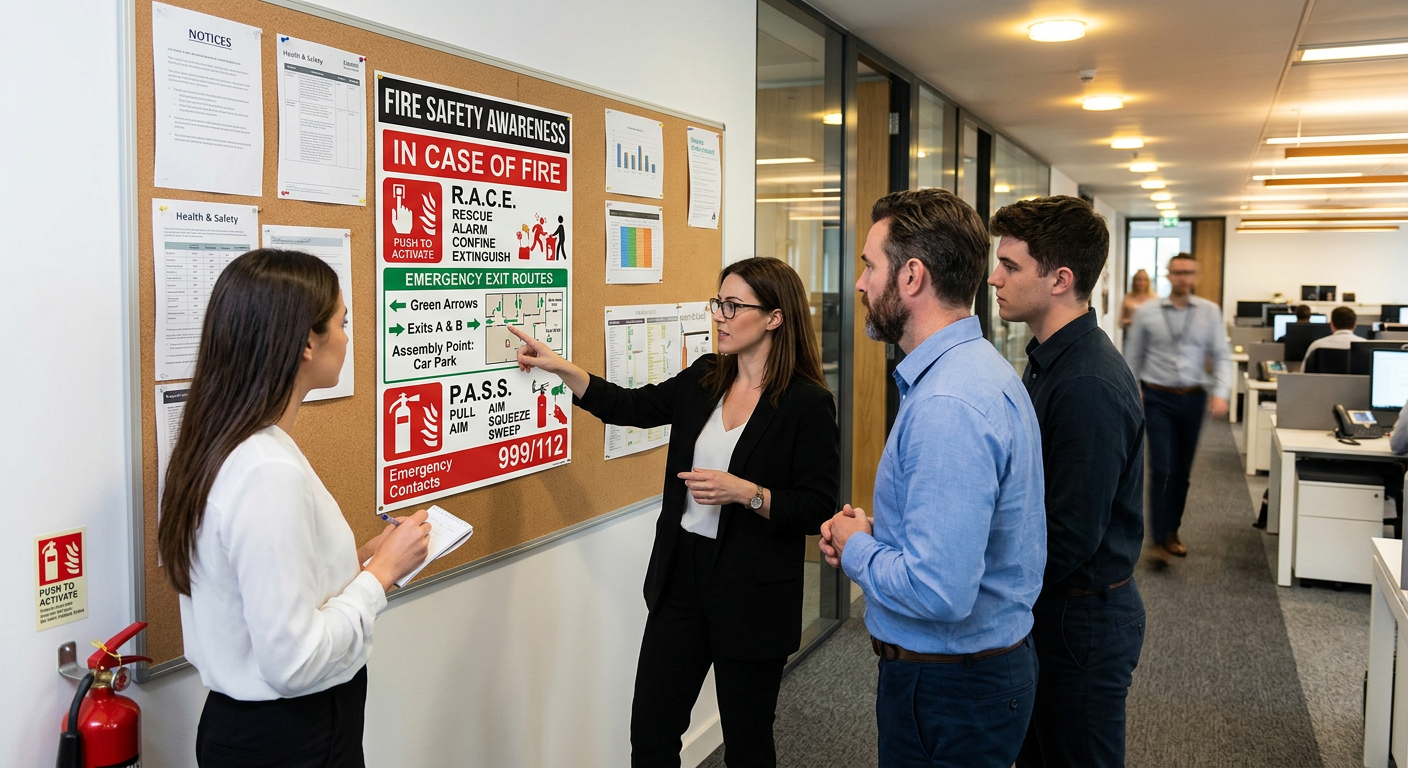
Fire safety awareness is the foundation of any effective safety program. Employees who understand the risks, recognize hazards, and know what to do in an emergency are far less likely to cause fires and far more likely to respond effectively if one occurs.
Awareness campaigns bridge the gap between policies and practice, turning written procedures into shared habits. This guide provides a step-by-step framework for designing and implementing a fire safety awareness campaign.
Section 1: Why Awareness Matters
| Reason | Why It Matters |
|---|---|
| Prevention | Employees who understand fire hazards are less likely to create them. |
| Early Detection | Awareness means occupants notice and report fires earlier, reducing damage and injury. |
| Effective Response | Occupants who know procedures evacuate faster and more safely. |
| Culture of Safety | A strong safety culture means employees look out for themselves and others. |
| Regulatory Compliance | Many codes require occupant training and awareness programs. |
Pro Tip: Awareness campaigns are not a one-time event—they must be ongoing to be effective.
Section 2: Understanding Your Audience
Effective campaigns start with understanding your audience’s existing knowledge, attitudes, and behaviours.
| Audience Factor | Questions to Ask |
|---|---|
| Knowledge Level | How much do occupants already know about fire safety? |
| Attitudes | Do they view fire safety as important or a burden? |
| Behaviours | Are they following existing fire safety procedures? |
| Communication Preferences | Do they prefer emails, posters, meetings, or digital tools? |
| Diversity | Are there language or accessibility barriers to consider? |
Pro Tip: Conduct a brief survey to understand your audience’s baseline knowledge and attitudes before designing the campaign.
Section 3: Key Campaign Messages
Your campaign should focus on the most critical fire safety messages.
| Message Category | Key Messages |
|---|---|
| Prevention | Recognising and reporting fire hazards. |
| Evacuation | Knowing escape routes, exits, and assembly points. |
| Alarm Activation | Knowing how and when to pull a fire alarm. |
| Extinguisher Use | Understanding when and how to use a fire extinguisher (PASS technique). |
| Reporting | How to report a fire hazard or safety concern. |
| Emergency Numbers | Know how to contact emergency services. |
Pro Tip: Prioritize messages based on risk—what behaviours are most likely to prevent fires in your building?
Section 4: Campaign Delivery Methods
| Method | Description | Best For |
|---|---|---|
| Posters | Visual reminders placed in high-traffic areas. | Reinforcing key messages. |
| Email Campaigns | Regular email updates with safety tips. | Remote workers, office-based employees. |
| Digital Signage | Screens displaying rotating safety messages. | Common areas, lobbies, corridors. |
| Safety Bulletins | Short, focused newsletters. | Detailed safety information. |
| Intranet / App | Dedicated safety page or app. | Easy access to information. |
| Toolbox Talks | Short, focused safety talks. | Engaging employees in conversation. |
| Competitions | Quizzes, safety-related competitions. | Increasing engagement. |
| Events | Safety fairs, demonstrations. | High visibility and engagement. |
| Social Media | Internal social media posts. | Reaching a broad audience. |
Pro Tip: Use multiple channels to reinforce messages—people learn best through repetition and variety.
Section 5: Campaign Calendar
A campaign calendar helps ensure consistent messaging over time.
| Month | Theme | Key Messages | Activities |
|---|---|---|---|
| January | Fire Safety Basics | Recognizing hazards, reporting. | Posters, email blast. |
| February | Evacuation Procedures | Escape routes, assembly points. | Fire drill, signage review. |
| March | Fire Extinguishers | PASS technique, when to use. | Extinguisher training. |
| April | Electrical Safety | Overloading sockets, damaged cords. | Safety inspection, tips. |
| May | Kitchen Safety | Cooking hazards, fire blankets. | Kitchen safety demonstration. |
| June | Fire Drills | Practice evacuation. | Fire drill, debrief. |
| July | Smoke Detectors | Testing, maintenance. | Detector inspection. |
| August | First Response | Fire brigade, emergency contacts. | Emergency plan review. |
| September | Fire Doors | Keep closed, don’t prop open. | Fire door inspection. |
| October | Fire Safety Month | All topics. | Safety fair, demonstrations. |
| November | Winter Safety | Heating, holiday hazards. | Seasonal safety tips. |
| December | Review and Plan | Review progress, plan next year. | Campaign review. |
Pro Tip: Align your campaign with national fire safety events, such as Fire Prevention Week — the NFPA-sponsored U.S. observance held every year during the Sunday-to-Saturday week containing October 9, commemorating the Great Chicago Fire [1].
Section 6: Engaging Campaign Elements
| Element | Description | Example |
|---|---|---|
| Visuals | Strong, memorable images. | Photos of fire hazards, evacuation routes. |
| Slogans | Catchy phrases. | “Stop, Drop, and Roll”; “Be Alert – Don’t Get Hurt.” |
| Stories | Real-life examples. | “Fire that started from an overloaded socket.” |
| Quizzes | Test knowledge. | “Do you know the PASS technique?” |
| Challenges | Encourage safe behaviours. | “Walk to the nearest exit and find the fire extinguisher.” |
| Recognition | Reward safe behaviours. | “Safety Champion of the Month.” |
Section 7: Social Media and Digital Communication
| Platform | Content Ideas |
|---|---|
| Internal Social Media | Safety tips, quizzes, employee stories, photos from drills. |
| Email Newsletters | Monthly safety updates, hazard alerts, new information. |
| Intranet/App | Safety resources, training materials, emergency plans, contacts. |
Pro Tip: Use internal social media to share positive stories and recognise employees who demonstrate safe behaviours.
Section 8: Evaluating Your Campaign
| Evaluation Method | What to Assess |
|---|---|
| Surveys | Knowledge, attitudes, and behaviours. |
| Drill Performance | Evacuation times, behaviour during drills. |
| Hazard Reports | Are employees reporting hazards? |
| Incident Rates | Are fires decreasing? |
| Engagement | How many people are participating in activities? |
Pro Tip: Use evaluation data to refine and improve your campaign over time.
Section 9: Design Checklist
Use this checklist to plan your fire safety awareness campaign:
| Item | Status | Notes |
|---|---|---|
| Audience Assessment | ☐ | Understand your audience. |
| Campaign Goals | ☐ | Define what you want to achieve. |
| Key Messages | ☐ | Identify the most important messages. |
| Delivery Methods | ☐ | Choose appropriate channels. |
| Campaign Calendar | ☐ | Plan a schedule. |
| Engaging Elements | ☐ | Plan visuals, slogans, and activities. |
| Evaluation Plan | ☐ | Define how you will measure success. |
| Budget and Resources | ☐ | Identify what you need. |
Section 10: Common Mistakes and How to Avoid Them
| Mistake | Why It’s a Problem | How to Fix |
|---|---|---|
| One-Time Campaign | Messages are quickly forgotten. | Run ongoing campaigns. |
| Ignoring Audience Needs | Messages are not relevant. | Understand your audience. |
| Too Much Information | Overload reduces effectiveness. | Focus on key messages. |
| Passive Communication | Low engagement. | Use interactive and engaging methods. |
| No Evaluation | Cannot measure success or improve. | Evaluate and adjust. |
Section 11: The Power of Behavioural Change
Ultimately, a successful awareness campaign changes behaviour. Use insights from behavioural science to increase effectiveness:
| Technique | Application |
|---|---|
| Social Norms | Show that most people are following safety rules. |
| Commitment | Ask people to commit to safe behaviours. |
| Habit Formation | Encourage repetition to form habits. |
| Incentives | Reward safe behaviours. |
| Nudges | Make the safe choice the easy choice. |
Conclusion
A well-designed fire safety awareness campaign is a powerful tool for preventing fires and protecting occupants. By understanding your audience, delivering clear messages through multiple channels, and engaging employees in a variety of ways, you can promote a culture of safety in your building.
Take Action Today:
- Assess your audience—what do they know and need?
- Define your key messages—what do you want them to know?
- Choose your methods—posters, emails, meetings, digital?
- Plan your calendar—spread messages throughout the year.
- Measure and improve—evaluate and refine your campaign.
References & Notes
[1] National Fire Protection Association (NFPA), Fire Prevention Week — an annual U.S. observance held during the Sunday-to-Saturday week containing October 9, commemorating the Great Chicago Fire of 1871. Sponsored by NFPA since 1922.
Note: this article is general campaign-planning and behavioural-science guidance rather than a code-compliance reference. It contains no statistics, regulatory citations, or named case studies beyond the Fire Prevention Week reference above, which has been verified. No other fact-checking was required.
Continue Reading from Our Series:
- Read more about: How to Conduct a Post-Fire Investigation
- Learn more: How to Write Effective Fire Safety Reports and Documentation
- Related guide: How to Design and Implement a Fire Safety Training Program