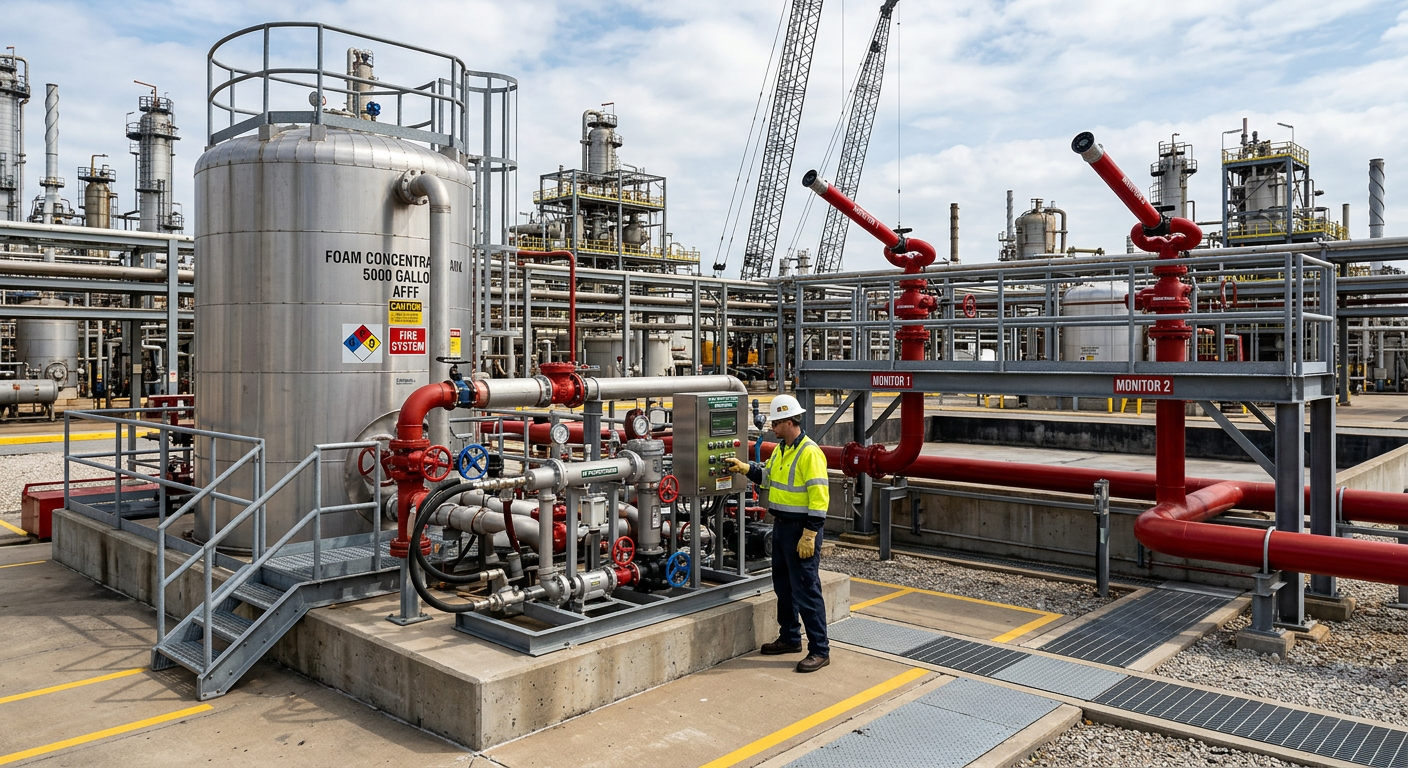
IMPORTANT DISCLAIMER: This guide references NFPA 11, Standard for Low-, Medium-, and High-Expansion Foam; NFPA 30, Flammable and Combustible Liquids Code; NFPA 409, Standard on Aircraft Hangars; NFPA 25, Standard for the Inspection, Testing, and Maintenance of Water-Based Fire Protection Systems; and the International Fire Code (IFC). These codes vary significantly by edition and are frequently amended by state and local jurisdictions. NFPA 11 editions include 2016, 2021, and 2024. The most recent published edition is NFPA 11 (2024), but AHJ-adopted editions commonly lag behind by one or more cycles. NFPA 16 (Foam-Water Sprinkler and Foam-Water Spray Systems) was withdrawn in 2020, with its material incorporated into NFPA 11. Local amendments and the edition adopted by your Authority Having Jurisdiction (AHJ) always control. This guide is a starting point only—always verify the specific requirements applicable to your project with your local AHJ.
Foam suppression is a primary protection method for flammable liquid hazards. Most hydrocarbons are lighter than water, so water sinks beneath the burning fuel and can spread it. Foam works by forming a blanket over the fuel surface, separating the fuel from oxygen and cooling the surface. For polar solvents (alcohols, ketones), which destroy ordinary foam, alcohol-resistant formulations form a polymeric membrane that protects the foam blanket from destruction.
NFPA 11 governs the design, installation, operation, testing, and maintenance of low-, medium-, and high-expansion foam systems. The standard does not itself mandate where foam protection is required—that comes from NFPA 30, NFPA 409, and other occupancy-specific standards. NFPA 11 tells you how to design the system once it is required.
This guide covers the fundamentals of foam suppression under NFPA 11, with a focus on foam types, concentrates, application rates, and the distinction between hydrocarbon and polar solvent fires.
◆ Section 1: Why Foam Suppression Is Different
Foam systems operate on principles that differ from both water-based suppression and clean agents.
| Factor | Challenge |
|---|---|
| Fuel type | Hydrocarbon vs. polar solvent determines foam selection |
| Foam blanket | Must form and maintain a seal over the fuel surface |
| Application rate | Too low = foam never covers the fire; too high = wasted agent |
| Proportioning | Foam concentrate must be mixed with water at the correct percentage |
| Expansion ratio | Low, medium, and high expansion serve different applications |
| Drainage time | How long the foam blanket retains water affects burnback resistance |
Key point: Foam is not a “spray and forget” agent. The foam blanket must form, spread, and seal the fuel surface. If the application rate is insufficient, the foam never establishes control.
Key Article: Article 109 — Fire Safety for Airports and Transportation Hubs (hangar foam systems)
Pro Tip: The foam concentrate and the discharge device must be listed for use together. Mixing a listed concentrate with an unlisted nozzle voids the listing and may prevent the system from working.
◆ Section 2: Foam Types — Low, Medium, and High Expansion
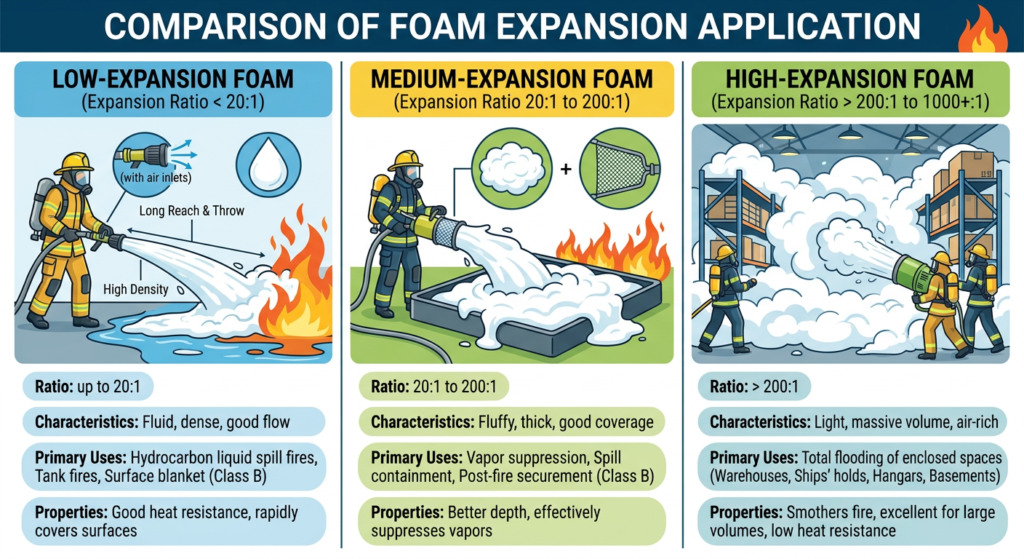
NFPA 11 classifies foam by expansion ratio—the ratio of expanded foam volume to the original foam solution volume.
| Foam Type | Expansion Ratio | Typical Applications |
|---|---|---|
| Low-expansion | 1:1 to 20:1 | Storage tanks, loading racks, spill areas, aircraft hangars |
| Medium-expansion | 20:1 to 200:1 | Ordinary combustibles, flammable liquid hazards |
| High-expansion | 200:1 to 1000:1 | LNG operations, total flooding of enclosures, ordinary combustibles |
A. Low-Expansion Foam
Low-expansion foam is the most common for flammable liquid hazards. It forms a dense, water-retaining blanket that seals the fuel surface. Normal expansion is typically under 20:1. It is used for:
-
Outdoor storage tanks
-
Interior flammable liquid hazards
-
Loading racks
-
Diked and undiked spill areas
B. Medium-Expansion Foam
Medium-expansion foam (20:1 to 200:1) is used for ordinary combustible and flammable liquid hazards where a thicker blanket is beneficial. It is typically delivered through medium-expansion generators.
C. High-Expansion Foam
High-expansion foam generators typically deliver expansion ratios between 200:1 and 1000:1. High-expansion foam is capable of totally flooding large rooms and enclosures, carrying foam to the source of the fire.
Key point: High-expansion foam is effective for LNG fires by blocking heat feedback from the flames to the LNG, reducing the vaporization rate. It requires an adequate permanent enclosure around the hazard.
Pro Tip: The minimum application rate for high-expansion foam depends on hazard classification, building construction, and whether sprinklers are present. Verify against the applicable high-expansion table in your adopted NFPA 11 edition.
◆ Section 3: Foam Concentrates
The foam concentrate is the chemical agent that, when mixed with water and aerated, produces foam. NFPA 11 recognizes several concentrate types.
A. AFFF (Aqueous Film-Forming Foam)
AFFF concentrates combine fluoro- and hydrocarbon-surfactant technologies to provide fire and vapor suppression for Class B hydrocarbon fuel fires. The aqueous film at the fuel/air interface provides an oxygen barrier, while the foam blanket cools the fuel and adjacent heat sources.
B. AR-AFFF (Alcohol-Resistant Aqueous Film-Forming Foam)
AR-AFFF concentrates add a water-soluble polymer (polysaccharide) to AFFF technology. This polymer forms a polymeric membrane on polar solvent fires, protecting the foam from destruction by the fuel.
C. FFFP (Film-Forming Fluoroprotein)
FFFP combines fluorochemical surfactants with protein-based foam to form an aqueous film on the fuel surface while retaining the heat resistance of protein foam. It is used for hydrocarbon fuels.
D. Protein and Fluoroprotein Foams
Protein foam uses hydrolyzed protein with stabilizers for Class B hydrocarbon fires. Fluoroprotein combines hydrolyzed protein with fluorochemical surfactants for enhanced vapor suppression.
E. Alcohol-Resistant Formulations
Alcohol-resistant formulations are not limited to AR-AFFF. They also include:
-
AR-FFFP (alcohol-resistant film-forming fluoroprotein)
-
AR-fluoroprotein
-
AR-SFFF (alcohol-resistant synthetic fluorine-free foam)
F. Non-Fluorinated Foam (NFF) / Synthetic Fluorine-Free Foam (SFFF)
Industry is developing NFF/SFFF concentrates that contain no intentionally added PFAS. Several are now listed under UL 162. Application rates and design criteria for NFF differ from AFFF.
PFAS regulatory note: Many jurisdictions restrict or ban PFAS-containing foam concentrates. The 2024 IFC (Section 904.7.2.1) requires that when foam concentrate fails the annual quality assurance test, the code official is notified, and the resolution—whether replacement, transition to a new concentrate, or another approach—must be approved by the fire code official and fire chief . Readers should check state and local rules, as requirements vary.
G. Selecting Foam for Polar Solvents
For polar solvent fires, an alcohol-resistant concentrate listed for the specific polar solvent is required. This includes AR-AFFF, AR-FFFP, AR-fluoroprotein, and AR-SFFF. Standard AFFF will be destroyed by alcohols and ketones.
Key point: The 2024 IFC requires foam systems complying with NFPA 30 and NFPA 11 and prohibits intentionally added PFAS in foam concentrate where adopted.
Pro Tip: Verify that the foam concentrate is listed for the specific fuel and discharge device. A concentrate listed for hydrocarbons may not be listed for polar solvents.
◆ Section 4: Hydrocarbon vs. Polar Solvent Fires
The fuel type determines the foam concentrate and application rate.
| Fuel Type | Examples | Foam Requirement |
|---|---|---|
| Hydrocarbon | Crude oil, gasoline, diesel, aviation fuel | AFFF, FFFP, protein, fluoroprotein, or AR concentrate |
| Polar Solvent | Methyl/ethyl alcohol, acetone, MEK | Alcohol-resistant concentrate listed for the specific solvent |
Key point: Polar solvents destroy ordinary foam. An alcohol-resistant concentrate listed for the specific solvent is required.
Pro Tip: For polar solvent fires, AR foam is applied gently—forceful application can disrupt the polymeric membrane.
◆ Section 5: Proportioning Methods
Proportioning is the process of mixing foam concentrate with water at the correct percentage. NFPA 11 recognizes several methods.
A. Bladder Tank (Pressure Proportioning Tank)
A bladder tank system uses a bladder inside a tank filled with foam concentrate. Water pressure on the outside of the bladder forces concentrate out through a metering valve into the water stream. As water flow rate changes, foam concentrate flow adjusts automatically.
B. Balanced-Pressure Proportioning
A balanced-pressure proportioning system uses a pump to deliver concentrate. A pressure-balancing valve senses water pressure and regulates concentrate pressure to match. The concentrate then flows to a ratio controller or venturi where it is introduced into the water stream.
C. Electronic Proportioning
An electronic proportioning system uses flow meters to measure water flow. A microprocessor commands a pump to deliver concentrate at the desired mix ratio. This method provides accurate proportioning across a wide flow range.
D. Around-the-Pump Proportioning
Around-the-pump proportioning uses a bypass loop at the pump. A portion of the water flow is diverted through a foam concentrate tank, picking up concentrate, and then returns to the pump suction.
E. Venturi / Line Proportioners
Venturi (line) proportioners use the pressure drop through a venturi to draw concentrate directly into the water stream. They are simple and reliable but require adequate water pressure and flow for proper operation.
Key point: The proportioner must be listed for the foam concentrate and the system flow rate. A proportioner that delivers the wrong percentage will produce foam that does not work.
Pro Tip: Provide a test connection to verify proportioner performance periodically. Samples of foam concentrate should be sent to the manufacturer annually to check condition.
◆ Section 6: Application Rates and Duration
Application rates are the flow of foam solution per unit area of fire. They are specified by NFPA 11 and by the foam concentrate manufacturer.
A. Hydrocarbon Application Rates
| Application | Rate | Source |
|---|---|---|
| Fixed-roof storage tank (Type I/II discharge outlets) | 4.1 L/min/m² (0.10 gpm/ft²) | NFPA 11 / manufacturer listing |
| Floating roof tank (annular ring) | 12.2 L/min/m² (0.30 gpm/ft²) | NFPA 11 |
| Spill fire (AFFF, FFFP, AR foams) | 4.1 L/min/m² (0.10 gpm/ft²) | NFPA 11 |
| Spill fire (protein, fluoroprotein) | 6.5 L/min/m² (0.16 gpm/ft²) | NFPA 11 |
Important qualifiers:
-
Tanks larger than approximately 150 ft (45 m) in diameter require different rates and system approaches. Consult the manufacturer’s listing and NFPA 11 for large-tank applications.
-
Certain liquids—low-boiling-point or oxygenated fuels—may require higher application rates or longer durations than the baseline. Verify against the foam concentrate listing and NFPA 11.
B. Polar Solvent Application Rates
| Application | Rate | Note |
|---|---|---|
| Polar solvent (typical listed value) | 6.5 L/min/m² (0.16 gpm/ft²) | Example of a listed value — not a code requirement |
| Ketones (typical listed value) | 6.9 L/min/m² (0.17 gpm/ft²) | Example of a listed value — not a code requirement |
Key point: Polar solvent application rates come from the concentrate’s listing for the specific solvent, not from a single NFPA 11 number. The values above are examples of typical listed values.
C. Duration
Foam system duration depends on the fuel and discharge type:
| Application | Typical Duration |
|---|---|
| Tank storage | 30 to 65 minutes |
| Aircraft hangars (NFPA 409) | 10 minutes (Group I/II low-expansion); 12 minutes (Group IV high-expansion); 20 minutes (hand hose) |
Note: NFPA 409 durations depend on hangar group and system type. Verify against the NFPA 409 table for your hangar group and system type.
Key Article: Article 109 — Fire Safety for Airports and Transportation Hubs
Pro Tip: The application rate is not a suggestion. If the rate is too low, the foam layer will never cover the surface in flames and will not control or extinguish the fire.
◆ Section 7: Fixed, Semi-Fixed, and Portable Systems
NFPA 11 addresses fixed, semi-fixed, and portable foam systems.
| System Type | Description | Application |
|---|---|---|
| Fixed | Permanently installed foam concentrate supply, proportioning, and discharge devices | Storage tanks, hangars, high-hazard processes |
| Semi-fixed | Fixed piping and discharge devices; foam supplied by fire department or mobile equipment | Where permanent concentrate storage is impractical |
| Portable | Foam concentrate and proportioning equipment that can be moved to the hazard | Supplement to fixed systems; spill response |
Key point: Mobile foam apparatus (fire trucks) is covered by NFPA 1900 (which consolidated NFPA 1901, 1906, 414, and 1917 effective January 1, 2024), not NFPA 11. NFPA 11 covers fixed, semi-fixed, and portable systems.
Pro Tip: For fixed systems, verify that the foam concentrate storage is adequate for the required duration and that the proportioning equipment is listed for the concentrate.
◆ Section 8: Design Checklist for Foam Suppression Systems
| Item | Status | Notes |
|---|---|---|
| Fuel type identified | ☐ | Hydrocarbon or polar solvent |
| Foam type selected | ☐ | Low, medium, or high expansion |
| Concentrate selected | ☐ | AFFF, AR-AFFF, FFFP, protein, fluoroprotein, AR-FFFP, AR-fluoroprotein, AR-SFFF, NFF/SFFF |
| Concentrate listed for fuel | ☐ | Verify manufacturer listing |
| Discharge devices listed with concentrate | ☐ | Do not mix brands |
| Application rate verified | ☐ | Per NFPA 11 and manufacturer data |
| Proportioning method selected | ☐ | Bladder tank, balanced-pressure, electronic, around-the-pump, or venturi |
| Proportioner listed for flow range | ☐ | Verify design flow |
| Duration determined | ☐ | 30–65 min for tanks; 10–20 min for hangars |
| Foam concentrate quantity calculated | ☐ | Flow × Duration × Concentration |
| Concentrate sampling scheduled | ☐ | Annually to manufacturer per NFPA 25 |
| Proportioner test connection provided | ☐ | Periodic performance verification |
| System type determined | ☐ | Fixed, semi-fixed, or portable |
| Air supply for high-expansion | ☐ | Outside air unless specific data allows inside air |
| PFAS regulatory status checked | ☐ | Many jurisdictions restrict PFAS foam |
◆ Section 9: Common Mistakes and How to Avoid Them
| Mistake | Why It’s a Problem | How to Fix |
|---|---|---|
| Using standard AFFF on polar solvent fire | Foam destroyed by fuel | Use an alcohol-resistant concentrate listed for the specific solvent |
| Mixing unlisted concentrate and nozzle | Voided listing; foam may not form | Verify listing compatibility |
| Application rate too low | Foam never covers fire | Verify rate per NFPA 11 and manufacturer |
| Proportioner not listed for flow range | Wrong mix percentage | Verify proportioner listing |
| No concentrate sampling | Degraded concentrate fails | Sample annually per NFPA 25 |
| No proportioner test connection | Cannot verify performance | Provide test connection |
| High-expansion using inside air without data | Combustion products degrade foam | Use outside air unless specific data allows |
| Assuming NFPA 16 applies | NFPA 16 withdrawn in 2020 | Use NFPA 11 |
◆ Section 10: Conclusion
Foam suppression is a primary protection method for flammable liquid hazards. It works by forming a blanket over the fuel surface—or, for polar solvents, a polymeric membrane that protects the foam from destruction. The foam type, concentrate, and application rate must all match the fuel and the hazard.
Key Takeaways:
-
NFPA 11 governs foam systems — it covers low-, medium-, and high-expansion foam.
-
NFPA 16 was withdrawn in 2020; its contents were incorporated into NFPA 11.
-
Low-expansion foam (1:1 to 20:1) is used for storage tanks, loading racks, and spill areas.
-
High-expansion foam (200:1 to 1000:1) can totally flood enclosures and is used for LNG and ordinary combustibles.
-
AFFF is for hydrocarbons; an alcohol-resistant concentrate listed for the specific polar solvent is required for polar solvents (AR-AFFF, AR-FFFP, AR-fluoroprotein, AR-SFFF).
-
Hydrocarbon application rate for fixed-roof storage tanks is 4.1 L/min/m² (0.10 gpm/ft²).
-
Polar solvent application rates come from the concentrate’s listing—6.5 L/min/m² is an example, not a code requirement.
-
Proportioning methods include bladder tank, balanced-pressure, electronic, around-the-pump, and venturi.
-
Foam concentrate and discharge devices must be listed together.
-
Sample foam concentrate annually per NFPA 25 and provide a proportioner test connection.
-
PFAS regulations vary — many jurisdictions restrict PFAS-containing foam, and the 2024 IFC requires AHJ approval of the resolution when concentrate fails quality testing.
Take Action Today:
-
Identify the fuel type (hydrocarbon or polar solvent) for each hazard.
-
Select the foam concentrate listed for that fuel.
-
Verify the discharge device is listed with the concentrate.
-
Confirm the application rate against NFPA 11 and manufacturer data.
-
Verify the proportioner is listed for the design flow range.
-
Calculate foam concentrate quantity for the required duration.
-
Provide a proportioner test connection.
-
Schedule annual concentrate sampling per NFPA 25.
-
Verify high-expansion air supply and application rates where applicable.
-
Check PFAS regulatory status in your jurisdiction.
Continue Reading from Our Series:
-
Related guide: Fire Safety for Airports and Transportation Hubs (Article 109)
-
Learn more: Hazard Classification (Low, Ordinary, High) and Hazardous Areas (NFPA 101) (Article 46)
-
Read more: How to Design Fire Safety for Storage Occupancies (Article 92)