IMPORTANT DISCLAIMER: This guide references NFPA 25, Standard for the Inspection, Testing, and Maintenance of Water-Based Fire Protection Systems, including Chapter 15 (Impairments); NFPA 72, National Fire Alarm and Signaling Code, including the impairment provisions in Chapter 10 (§10.21 in recent editions); NFPA 101, Life Safety Code, including §9.6.1.6 (fire alarm out of service) and §9.7.6 (sprinkler out of service); NFPA 1, Fire Code; NFPA 51B, Standard for Fire Prevention During Welding, Cutting, and Other Hot Work; NFPA 601, Standard for Security Services in Fire Loss Prevention; the International Fire Code (IFC), including §901.7 (Systems Out of Service); and 42 CFR 482.41(b) and 42 CFR 483.70(a) for healthcare facilities subject to CMS certification. NFPA 25 is the primary reference for water-based system impairments; NFPA 72 governs fire alarm system impairments; IFC §901.7 is the code-enforceable version in IFC jurisdictions. Time thresholds, fire watch durations, and section numbers vary by edition, by system type, and by occupancy (healthcare facilities subject to CMS have different thresholds). Local amendments and the edition adopted by your Authority Having Jurisdiction (AHJ) always control. This guide is a starting point only. Always verify the requirements applicable to your project with your AHJ.
A fire protection system that is out of service is not a fire protection system. It is a collection of pipes, valves, and devices that will not perform when needed. The building is more vulnerable during an impairment than at any other time in its life, and an impairment is often when the building is occupied, work is underway, and ignition sources are present.
Impairment management is the discipline of recognizing when a system is out of service, controlling the increased risk, and restoring the system as quickly and safely as possible. The fire watch is the compensating measure when the system cannot be restored quickly. Together, they form a continuous process that begins when the impairment is identified and ends when the system is verified back in service.
NFPA 25 Chapter 15 establishes the impairment process for water-based systems. NFPA 72 governs fire alarm impairments. IFC §901.7 is the code-enforceable version in jurisdictions that adopt the IFC. The requirements overlap but differ in detail: time thresholds, notification lists, and fire watch durations vary.
This article covers what an impairment is, preplanned and emergency impairments, the impairment coordinator role, the 10-hour rule and its alternatives, notification and tagging, fire watch qualifications and procedures, fire alarm impairments, system-specific considerations, long-term impairments, restoration and verification, healthcare facilities, insurer requirements, records, and how to build a program that functions when the system does not.
◆ Section 1: What an Impairment Is, and What It Is Not
NFPA 25 treats “deficiency” as the umbrella term for any condition that reduces fire protection below what the standard requires. It then divides deficiencies into three classes: noncritical deficiency, critical deficiency, and impairment. The classification determines urgency and response.
| Condition | Definition | Effect on Fire Performance | Response |
|---|---|---|---|
| Noncritical deficiency | Does not have a material effect on the system’s ability to control or extinguish a fire | System remains functional | Correct to meet NFPA 25; no impairment process required |
| Critical deficiency | If not corrected, can have a material effect on the system’s ability to function as intended | System may be compromised | Correct promptly; the impairment process applies if the system is taken out of service |
| Impairment | System or portion thereof is out of order, and the condition can result in the system not functioning in a fire | System will not function as designed | Impairment process applies; fire watch or other measures may be required |
Key point: An impairment is the most severe class of deficiency. The impairment process applies only to impairments, but classification is a judgment call, and the AHJ may disagree with the owner’s classification.
Common examples of impairments
- A closed sprinkler control valve
- A shut-down fire pump
- A drained or frozen system
- A ruptured pipe
- An interrupted water supply
- Sprinkler heads removed for construction
- A fire alarm control unit or signaling circuit that is down
- Detectors covered or disabled in a work area
Key Article: Article 141, Fire Safety Management Systems and ISO 31000 Alignment
Pro Tip: When in doubt, treat the condition as an impairment and start the process. The cost of an unnecessary fire watch is far lower than the cost of an unmanaged impairment.
◆ Section 2: Preplanned vs. Emergency Impairments
NFPA 25 distinguishes between preplanned impairments (scheduled work) and emergency impairments (unplanned failures).
A. Preplanned Impairments
Preplanned impairments occur when the owner or a contractor knows in advance that a system will be taken out of service, for example during renovation, sprinkler relocation, valve repair, or system modification. The impairment coordinator must authorize the impairment and verify that the required procedures are in place before the system is taken out of service.
B. Emergency Impairments
Emergency impairments occur without warning. NFPA 25 lists system leakage, interruption of water supply, frozen or ruptured piping, and equipment failure as examples. The coordinator implements the same procedures as for a preplanned impairment, but the process is compressed because the impairment has already occurred.
C. The Practical Difference
| Aspect | Preplanned | Emergency |
|---|---|---|
| Timing | Work is scheduled; impairment is anticipated | Impairment occurs without warning |
| Authorization | Coordinator authorizes before work begins | Coordinator responds to the impairment |
| Fire watch | Can be arranged in advance | Must be arranged immediately |
| Notification | Coordinated in advance with the fire department | Fire department notified immediately |
| Documentation | Prepared in advance | Completed as soon as the emergency response allows |
Key point: The process is the same for both types, but the timing differs. Preplanned impairments can be managed carefully; emergency impairments demand immediate action and prompt documentation.
Pro Tip: For preplanned impairments, do all possible work in advance (prefabrication, material staging, crew scheduling) to minimize the length of the outage. Where possible, use temporary feed lines or phase the work so that only part of the system is out of service at a time.
◆ Section 3: The Impairment Coordinator
The impairment coordinator is the central figure in the process. NFPA 25 requires the owner to assign an impairment coordinator. If no one is designated, the owner is considered the coordinator.
A. Who Should Be the Impairment Coordinator
The coordinator should be:
- Designated in writing by the building owner
- Familiar with the building’s fire protection systems
- Trained on the impairment process
- Available to authorize impairments and verify procedures, with a designated backup
- Authorized to make decisions about fire watch, evacuation, and temporary measures
In practice, this is often the facility manager, fire safety director, or a maintenance supervisor.
B. Pre-Impairment Responsibilities
Before authorizing a preplanned impairment (or on discovering an emergency impairment), the coordinator must verify that the following have been completed:
| Step | Requirement |
|---|---|
| 1 | The extent and expected duration of the impairment have been determined |
| 2 | The areas involved have been inspected and increased risks determined |
| 3 | Recommendations to mitigate risks have been submitted to management or the owner |
| 4 | The fire department has been notified |
| 5 | The insurance carrier, alarm company, building owner/manager, and other AHJs have been notified |
| 6 | Supervisors in affected areas have been notified |
| 7 | A tag impairment system has been implemented |
| 8 | Necessary tools and materials have been assembled on site |
Key point: The coordinator is not a figurehead. The coordinator must verify each step, not merely be aware that someone else is supposed to do it. If a step cannot be confirmed, the impairment is not properly authorized.
Pro Tip: Create a pre-impairment checklist that mirrors NFPA 25’s requirements. The coordinator signs it before the system is taken out of service, and it becomes part of the impairment record.
◆ Section 4: The 10-Hour Rule and Its Alternatives
A. The NFPA 25 Requirement
Where a required fire protection system is out of service for more than 10 hours in a 24-hour period, the impairment coordinator must arrange for one of the following:
| Option | Description |
|---|---|
| Evacuation | Evacuate the building or the affected portion |
| Fire watch | Provide an approved fire watch |
| Temporary water supply | Establish a temporary water supply |
| Ignition/fuel control program | Establish and implement an approved program to eliminate potential ignition sources and limit the fuel available to a fire |
B. NFPA 101 and IFC Differences
- NFPA 101 §9.7.6: Where a required sprinkler system is out of service for more than 10 hours in a 24-hour period, the AHJ must be notified, and the building must be evacuated or an approved fire watch provided. NFPA 101 does not list temporary water supply or ignition control as alternatives, so where NFPA 101 is enforced, the AHJ’s approval is needed to use them.
- IFC §901.7: The fire department and fire code official must be notified immediately when a required system is out of service. Where required by the fire code official, the building must be evacuated or an approved fire watch provided. The IFC does not wait for a 10-hour threshold.
C. How the 10 Hours Are Counted
The threshold is cumulative within a 24-hour period. Several short outages of the same system can add up to more than 10 hours. Track total out-of-service time, not just individual events.
D. Choosing the Option
| Situation | Likely Option |
|---|---|
| Healthcare, assembly, high-occupancy, sleeping occupancies | Evacuation or fire watch |
| Business occupancy, small area | Fire watch or ignition control |
| Short duration, isolated, low-hazard area | Ignition control program |
| System can be partially restored | Temporary water supply |
Key point: The 10-hour threshold is a trigger, not a deadline. Many AHJs and insurers require compensating measures from the start of the impairment, especially for high-hazard areas or hot work.
Pro Tip: For impairments expected to exceed 10 hours, arrange the fire watch or other measure before the threshold is reached. Starting at hour 10 leaves the building unprotected for the first 10 hours.
◆ Section 5: Notification Requirements
Notification is broader than many building owners assume.
A. Who Must Be Notified
| Party | When | Source |
|---|---|---|
| Fire department | Before a preplanned impairment; immediately for emergency | IFC §901.7; NFPA 25 |
| Fire code official / AHJ | As required by local code and the thresholds above | IFC §901.7; NFPA 101 |
| Insurance carrier | Before a preplanned impairment; promptly for emergency | NFPA 25; insurer requirements |
| Alarm / monitoring company | Before the impairment, to prevent false dispatches and confirm monitoring | NFPA 25; NFPA 72 |
| Building owner/manager | Before a preplanned impairment | NFPA 25 |
| Supervisors in affected areas | Before the impairment | NFPA 25 |
| Occupants and tenants | As required by occupancy and AHJ | IFC; building procedure |
| Water utility (if the water supply is involved) | When the supply is shut off or restored | Good practice |
B. Notification Content
- The system affected and the extent of the impairment
- The expected duration
- The compensating measures in place
- The expected restoration time
- Contact information for the impairment coordinator
C. Utility and Municipal Outages
Impairments are not always caused by the owner. A municipal water main shutdown, a hydrant outage, or a utility power loss can impair a building’s fire protection without any action by the owner. Arrange with the water utility to be notified of planned shutdowns, and treat an unannounced loss of supply as an emergency impairment.
Key point: Notification is a requirement, not a courtesy. The fire department needs to know that the building is unprotected, and the alarm company needs to know that signals may be abnormal.
Pro Tip: Keep a notification log for every impairment, recording the date, time, person notified, and method. The log is the evidence that notification occurred.
◆ Section 6: Tagging Requirements
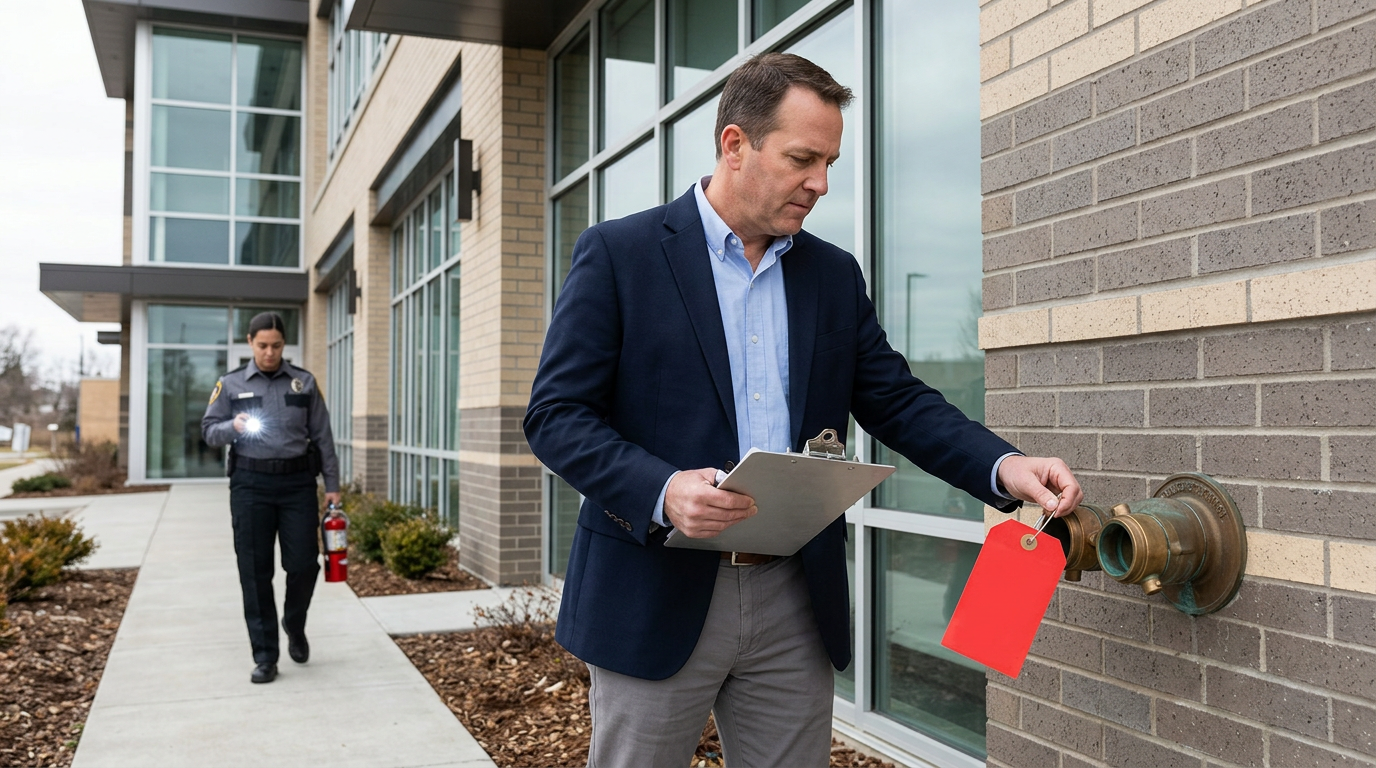
The impairment tag is the visible evidence that a system is out of service.
A. Tag Placement
Under IFC §901.7, the tag is posted at:
- Each fire department connection (FDC)
- The system control valve
- The fire alarm control unit (where the alarm system is impaired)
- The fire alarm annunciator
- The fire command center (where applicable)
B. Tag Content
The tag should identify:
- Which system or portion is impaired
- The date and time the impairment began
- The person responsible
- The expected duration (where known)
C. Tag Characteristics
The tag should be weather-resistant, plainly visible, and large enough to be read quickly. Use a standardized tag design throughout the facility.
D. Tag Color Coding
NFPA 25’s annex provides guidance on system status tagging:
| Color | Meaning |
|---|---|
| Green | No deficiencies or impairments |
| Yellow | Noncritical deficiencies found |
| Orange | Critical deficiencies found |
| Red | Impairment found |
Key point: The tag alerts responding firefighters that the system is out of service. A tag that is not at the FDC may not be seen until the fire department is already committed to a plan that relies on the system.
Pro Tip: Place the tag at the FDC even if the riser room is locked. Firefighters often reach the FDC before they gain access to the building interior.
◆ Section 7: Compensating Measures in Detail
A. Fire Watch
The fire watch is the most common compensating measure and the most frequently performed inadequately.
NFPA 25 Annex material describes a fire watch as trained personnel who continuously patrol the affected area, with ready access to fire extinguishers and the ability to promptly notify the fire department. The fire watch should not only look for fire but also confirm that other fire protection features, such as egress routes and alarms, remain available and functioning. NFPA 601 provides additional guidance on fire watch services.
Fire Watch Qualifications
| Requirement | Detail |
|---|---|
| Training | Trained in fire prevention, extinguisher use, alarm activation, evacuation, and fire department notification |
| Dedication | No other duties during the watch |
| Availability | Continuous patrol of the affected area |
| Communication | Radio or phone to notify the fire department and occupants |
| Equipment | Suitable extinguisher, flashlight, patrol log, and a copy of the building’s emergency contacts |
| Familiarity | Knows the building layout, exits, alarm panel location, and system shutoffs |
Fire Watch Frequency
Frequency is set by the AHJ. Common requirements include continuous patrol, checking all portions of the affected area at least every 30 minutes, or hourly checks. Confirm the requirement before the watch begins.
Fire Watch Scope
The watch covers the area unprotected by the impairment. For a sprinkler impairment, that is the zone served by the impaired section. For a fire alarm impairment, it may be the entire building.
Fire Watch Emergency Actions
If a fire is discovered, the fire watch must:
- Activate the alarm (or alert occupants verbally if the alarm is impaired).
- Call the fire department.
- Assist with evacuation.
- Fight the fire with an extinguisher only if it is small, the exit is behind them, and they are trained.
Fire Watch Duration and Fatigue
The fire watch continues until the system is restored and verified. Do not end it merely because repairs are finished. For long impairments, rotate personnel; a fatigued fire watch is not a functioning one.
B. Evacuation
Evacuation is the most conservative option and is sometimes required in sleeping or high-hazard occupancies. It carries significant operational cost, so it is rare for short impairments in healthy occupancies, but it must be considered whenever the fire watch cannot be reliably staffed.
C. Temporary Water Supply
Options include temporary connections to a hydrant or alternate main, a temporary pump, or a fire department pumper staged and connected at the FDC. Coordinate with the fire department before relying on this measure.
D. Ignition and Fuel Control Program
This option is listed in NFPA 25 but rarely described. A credible program includes:
- Prohibiting hot work and other ignition sources in the affected area
- Prohibiting smoking and open flames
- Controlling temporary heaters and electrical equipment
- Removing or limiting combustible storage
- Housekeeping (waste removal, dust control)
- Daily inspections by the coordinator or designee
Key point: A fire watch is not a security guard walking past occasionally. It is a dedicated, trained individual whose sole duty is to watch for fire and respond. If the fire watch has other duties, it is not a fire watch.
Pro Tip: Equip the fire watch with a written log (patrol times, areas checked, observations, signature). The log is the evidence that the watch was performed.
◆ Section 8: Fire Alarm Impairments
Fire alarm impairments are governed by NFPA 72 and NFPA 101, not NFPA 25. The thresholds and requirements differ.
A. The NFPA 101 Threshold
NFPA 101 §9.6.1.6 requires that where a required fire alarm system is out of service for more than 4 hours in a 24-hour period, the AHJ must be notified, and the building must be evacuated or an approved fire watch provided. NFPA 72’s impairment provisions require similar notification and compensating measures.
B. What “Out of Service” Means
NFPA 101 Annex A clarifies that “out of service” implies a significant portion of the system is not functioning, such as an entire initiating device circuit, signaling circuit, or notification appliance circuit, not just a single device.
C. Detector Covers and Construction Impairments
Dust covers on smoke detectors during construction are one of the most common and most overlooked fire alarm impairments. Covered or disabled detectors are an impairment. Manage them as such:
- Record each covered detector (location, date, responsible person).
- Limit the number of detectors disabled to the work area.
- Consider temporary detection or a fire watch for the affected area.
- Remove the covers at the end of each work shift where practical, or at the end of the project, and verify by test that the detectors are operational.
D. Purpose of the Fire Watch
The fire watch for an alarm impairment differs from one for a sprinkler impairment. The fire watch must:
- Patrol the affected area and watch for fire
- Notify occupants if fire is found (since the alarm may not function)
- Notify the fire department
Key point: The 4-hour threshold for fire alarm impairments is shorter than the 10-hour threshold for sprinkler impairments. The alarm is the building’s early warning system, and its absence is more immediately critical.
Pro Tip: If both the alarm and the sprinklers are impaired, the compensating measures compound. The fire watch must cover both the absence of detection and the absence of suppression.
◆ Section 9: System-Specific Considerations
| System | Impairment Concern | Practical Response |
|---|---|---|
| Sprinkler systems | Loss of automatic suppression in the affected zone | Isolate by zone where possible; keep the rest of the system in service |
| Standpipes | Firefighters lose their hose water source, which is critical in high-rises | Notify the fire department specifically; consider temporary standpipe measures |
| Fire pumps | Loss of pressure and flow to the system | Notify the fire department and insurer; verify the backup pump or alternate supply |
| Water supply / tanks / private mains | Loss of supply to all dependent systems | Treat as a building-wide impairment |
| Special hazard systems (clean agent, CO₂, foam, dry chemical) | System may not discharge, or may discharge unexpectedly during work | Lock out or disable actuation during work; provide hazard control and restoration testing |
| Fire alarm | Loss of detection and notification | See Section 8 |
| Freeze-prone systems | Cold-weather outages can freeze and rupture pipes | Plan heat and drain-down; avoid winter impairments where possible |
Short-duration valve closures: For very short work, a common practice is to station a person at the closed valve with the means to reopen it immediately if a fire starts. This does not replace the impairment process for longer outages.
Key point: The impairment process is the same, but the consequences differ by system. A standpipe impairment in a high-rise affects the fire department’s ability to fight the fire, not just the building’s.
Pro Tip: Maintain a one-page impairment response sheet per system type, listing who to notify, what compensating measure applies, and what testing is needed on restoration.
◆ Section 10: Long-Term and Extended Impairments
A fire watch is a short-term measure. It is not a sustainable substitute for a system that will be out of service for weeks or months.
For extended impairments (major renovations, phased shutdowns, system replacements):
- Obtain AHJ approval of a written plan.
- Phase the work so that only part of the system is out of service at a time.
- Install temporary systems (temporary detection, temporary standpipes, temporary sprinkler coverage).
- Provide interim life safety measures (see Section 12).
- Review the plan at regular intervals and whenever conditions change.
- Consider permanent alternatives if the outage will be prolonged.
Key point: The longer the impairment, the weaker a fire watch alone becomes. Fatigue, turnover, and complacency increase with time.
Pro Tip: For any impairment expected to exceed a few days, hold a weekly review with the coordinator, contractor, and AHJ (or insurer) to confirm the measures remain adequate.
◆ Section 11: Restoration and Verification
The process does not end when the repair is complete. It ends when the system is restored, tested, and verified operational.
A. Restoration Requirements
When impaired equipment is restored, the coordinator must verify that:
| Step | Requirement |
|---|---|
| 1 | Necessary inspections and tests have been conducted to verify the affected systems are operational |
| 2 | Supervisors have been advised that protection is restored |
| 3 | The fire department has been advised that protection is restored |
| 4 | The owner/manager, insurance carrier, alarm company, and other involved parties have been advised that protection is restored |
| 5 | The impairment tag has been removed |
B. Testing Before Restoration
Required tests depend on the system and the work performed. For sprinkler systems, typical verification includes:
- Valve position verification (open and supervised)
- Main drain test after a control valve has been closed and reopened
- Waterflow alarm and supervisory signal tests
- Hydrostatic testing of any new or modified piping, as required by NFPA 13
- Confirmation that sprinklers, covers, and caps removed during work have been replaced
- For dry and preaction systems, confirmation that air or nitrogen pressure and trip components have been restored
For fire alarm systems, test the affected circuits and devices, and confirm that signals are being received at the monitoring station.
C. Fire Watch Continuation
The fire watch continues until the system is verified operational. If the system is restored but not yet tested, the fire watch stays in place.
Key point: Restoration is not the same as repair. The system must be tested to confirm it will function in a fire, not merely that the pipe no longer leaks or the valve is open.
Pro Tip: Require the contractor to provide a written restoration verification before the tag is removed, stating what was tested, how, and the results.
◆ Section 12: Healthcare Facilities and Interim Life Safety Measures
Healthcare facilities face stricter expectations than most occupancies.
- Shorter thresholds: Healthcare facilities regulated under CMS and accredited by bodies such as The Joint Commission are often held to a 4-hour threshold for both alarm and sprinkler impairments, rather than 10 hours for sprinklers. Verify the exact requirement for your facility.
- Interim Life Safety Measures (ILSM): NFPA 101 requires ILSM when life safety features are deficient or construction compromises protection. ILSM can include additional fire watches, extra exit inspections, temporary alarms, staff training, and restrictions on combustibles.
- Notification: Healthcare facilities typically need to notify the fire department, state or accreditation authorities, and internal infection control and safety committees.
- Defend-in-place: In hospitals and nursing homes, evacuation is difficult. The compensating measure should be conservative and in place immediately.
Key point: In a healthcare facility, the impairment process and the ILSM program are linked. An impairment should trigger an ILSM assessment.
Pro Tip: Include the impairment process in the facility’s ILSM policy so that both are activated together.
◆ Section 13: Coordination with Hot Work
Hot work and impairments frequently occur together. Hot work often requires impairing sprinklers or detection in the work area, and the combination compounds the risk.
A. The Link
The hot work permit and the impairment record should reference each other. NFPA 51B expects sprinklers and detection to remain in service where they exist; where they are impaired, additional precautions are needed.
B. The Fire Watch Overlap
The hot work fire watch and the impairment fire watch may be the same person or different people, but the requirements differ:
- Hot work fire watch: watches the work area during hot work and for a period afterward (NFPA 51B requires a minimum period after the work ends, with additional monitoring in recent editions).
- Impairment fire watch: patrols the area affected by the impairment until the system is restored and verified.
Where both are required, the fire watch must satisfy both sets of requirements.
Key point: Hot work during an impairment is a high-risk combination. The building is unprotected and an ignition source is present.
Key Article: Article 142, Hot Work Permit Programs and Procedures
Pro Tip: Do not close the hot work permit until the system is restored and verified.
◆ Section 14: Insurer Requirements
Insurers often impose stricter impairment requirements than the code.
- Many insurers operate their own impairment programs (for example, FM Global’s Red Tag Permit System). These typically require notifying the insurer before a planned impairment and following the insurer’s procedures even for short outages.
- Insurer requirements often apply to any sprinkler impairment, not only those exceeding 10 hours.
- Failure to follow the insurer’s impairment procedures can affect coverage after a loss.
Key point: Where the insurer’s requirement is stricter than the code, follow the stricter one.
Pro Tip: Obtain the insurer’s impairment procedures in writing and incorporate them into the facility’s pre-impairment checklist.
◆ Section 15: Impairment Records and Documentation
A. Records to Maintain
| Record | Content |
|---|---|
| Impairment authorization | Coordinator’s authorization, with the pre-impairment checklist |
| Notification log | Who was notified, when, and how |
| Tag record | Tag number, placement, and removal date |
| Fire watch log | Patrol times, areas checked, observations, and signature |
| Restoration verification | Testing performed, results, and sign-off |
| Impairment report | Summary, duration, cause, and lessons learned |
B. Retention Period
Retention requirements vary. As a practical standard:
- Retain impairment records for at least 3 years, which matches the IFC §901.6.3 retention period for inspection, testing, and maintenance records. Confirm what your AHJ and insurer require.
- Retain records tied to a fire, incident, claim, or litigation until the matter is fully resolved.
- Keep records on site or readily accessible for the AHJ and insurer.
C. Program Metrics
Track impairment data to improve the program:
- Number of impairments per year, by system
- Average and maximum duration
- Percentage with complete documentation
- Percentage exceeding the 10-hour (or 4-hour) threshold
- Recurring causes (for example, repeated frozen pipes or contractor-caused outages)
Key point: The impairment record is the owner’s defense if a fire occurs during or after an impairment. It shows the impairment was recognized, managed, and restored properly.
Pro Tip: Include the impairment record in the building’s fire safety documentation file, and review the metrics annually as part of the fire safety management system (see Article 141).
◆ Section 16: Common Challenges and Mistakes
| Challenge or Mistake | Why It Happens | Solution |
|---|---|---|
| Impairment not recognized | Deficiency misclassified as noncritical | Train staff on NFPA 25 definitions; when in doubt, treat as an impairment |
| Deficiency treated as an impairment | Over-caution without a classification process | Train on definitions; document the classification |
| Coordinator not designated or unavailable | No written assignment or backup | Designate in writing, with a backup; update when personnel change |
| Notification skipped for “short” impairments | Assumption that short outages do not matter | Notify for all impairments and log it |
| Tag not placed | Forgotten or considered unnecessary | Tag at the FDC and control valve; include in the checklist |
| Fire watch not dedicated or trained | Assigned to someone with other duties, or a security guard assumed to qualify | Train and dedicate fire watch personnel |
| Fire watch not documented | No log or record | Fire watch log with patrol times and signature |
| Fire watch ends when repair ends | System not yet tested | Continue until verified operational |
| 10-hour (or 4-hour) threshold missed | Duration not tracked; short outages not added up | Track cumulative duration from the moment of impairment |
| Tag removed before testing | False sense of protection | Remove the tag only after restoration verification |
| Detector covers left in place | Construction impairments not tracked | Track covers; test devices at completion |
| Hot work and impairment not coordinated | Separate processes | Link the permit and impairment record |
| Insurer or AHJ not notified of restoration | Notification overlooked | Include restoration notification in the checklist |
| Records not retained | No retention policy | Retain per Section 15 |
Key point: The most common impairment failure is treating the process as paperwork. The coordinator signs the form and the tag is placed, but the fire watch is not dedicated, the notification is not made, or the restoration is not verified.
Pro Tip: Walk the building during an impairment. Confirm that the tag is in place, the fire watch is present and dedicated, and the affected area is being patrolled.
◆ Section 17: Program Checklist
| Item | Status | Notes |
|---|---|---|
| Impairment coordinator and backup designated in writing | ☐ | Named individuals |
| Impairment procedures documented | ☐ | Preplanned and emergency |
| Pre-impairment checklist developed | ☐ | Mirrors NFPA 25 requirements |
| Notification list established | ☐ | Fire department, insurer, alarm company, AHJ, water utility |
| Tag system implemented | ☐ | Tags available; placement defined |
| Fire watch procedure documented | ☐ | Qualifications, frequency, emergency actions, log |
| Fire watch personnel identified and trained | ☐ | Dedicated; rotation for long outages |
| Cumulative duration tracking | ☐ | 10-hour (sprinkler) and 4-hour (alarm) thresholds |
| Alternatives to fire watch identified | ☐ | Evacuation, temporary water, ignition control |
| Detector cover tracking | ☐ | For construction impairments |
| System-specific response sheets | ☐ | Standpipe, fire pump, special hazard |
| Long-term impairment plan process | ☐ | AHJ approval; phasing; temporary systems |
| Restoration verification procedure | ☐ | Testing before tag removal |
| Insurer procedures incorporated | ☐ | In writing |
| Healthcare ILSM linkage (if applicable) | ☐ | Trigger on impairment |
| Hot work coordination procedure | ☐ | Link permit and impairment record |
| Records retention defined | ☐ | 3 years minimum recommended |
| Program metrics reviewed | ☐ | Annual |
| Training for coordinators and fire watches | ☐ | Initial and refresher |
◆ Section 18: Conclusion
An impairment is the moment when a building’s fire protection system is not available. It is the moment of greatest vulnerability, and the moment when management matters most.
NFPA 25 Chapter 15 establishes the impairment process for water-based systems. NFPA 72 and NFPA 101 govern fire alarm impairments. IFC §901.7 is the code-enforceable version in IFC jurisdictions. Insurers and healthcare regulators may impose stricter requirements. The requirements overlap but differ in detail.
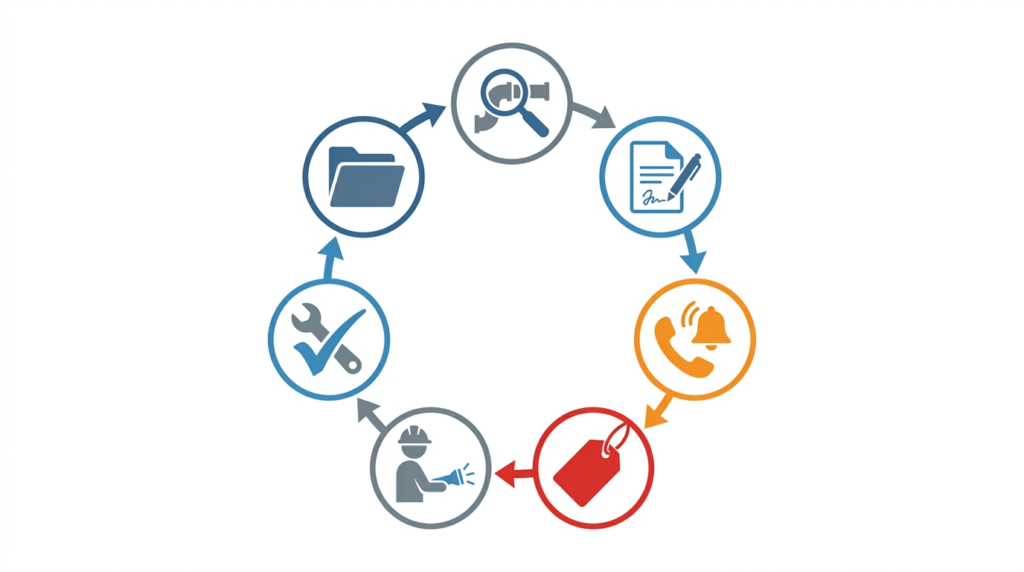
The impairment process has recognizable stages:
- Recognition: identify the impairment and classify it correctly
- Authorization: the coordinator verifies the required procedures
- Notification: fire department, insurer, alarm company, AHJ, utility, and occupants
- Tagging: visible evidence at the FDC and control valve
- Compensating measures: fire watch, evacuation, temporary water, or ignition control
- Restoration: test and verify before removing the tag
- Documentation: records that demonstrate the process was followed
The most common failure is treating the process as paperwork.
Key Takeaways
- An impairment is the most severe class of deficiency: a condition where the system will not function in a fire.
- NFPA 25 Chapter 15 governs water-based system impairments; NFPA 72 and NFPA 101 govern fire alarm impairments; IFC §901.7 is the code-enforceable version.
- The impairment coordinator is designated by the owner and must verify each step of the process.
- Preplanned impairments are authorized in advance; emergency impairments are managed immediately.
- NFPA 25’s 10-hour rule offers four options (evacuation, fire watch, temporary water supply, ignition control); NFPA 101 allows only evacuation or fire watch.
- Fire alarm impairments have a 4-hour threshold under NFPA 101; healthcare facilities are often held to 4 hours for sprinklers as well.
- Out-of-service time is cumulative within a 24-hour period.
- The impairment tag must be placed at the FDC and control valve (and alarm control unit for fire alarm impairments).
- The fire watch must be dedicated, trained, and equipped; frequency is set by the AHJ.
- Detector covers during construction are impairments and must be tracked and tested.
- Long-term impairments need an AHJ-approved plan, not a fire watch alone.
- Restoration requires testing and verification before the tag is removed and the fire watch ends.
- Hot work during an impairment requires coordination, and insurer requirements may be stricter than code.
- Records should be retained for at least 3 years.
Take Action Today
- Confirm an impairment coordinator and backup are designated in writing.
- Confirm impairment procedures are documented for preplanned and emergency impairments.
- Confirm the pre-impairment checklist mirrors NFPA 25 and your insurer’s requirements.
- Confirm the notification list includes the fire department, insurer, alarm company, AHJ, and water utility.
- Confirm tags are available and the placement locations are defined.
- Confirm fire watch personnel are trained, dedicated, and equipped with a log.
- Confirm cumulative out-of-service time is tracked against the applicable threshold.
- Confirm detector covers are tracked and tested before completion of construction.
- Confirm restoration testing and verification procedures are in place.
- Confirm hot work and impairment procedures are linked.
- Confirm records are retained for at least 3 years.
- Walk the building during an impairment to confirm the process is functioning.
- Review impairment metrics annually.
Continue Reading from Our Series:
-
Related guide: Article 142 — Hot Work Permit Programs and Procedures
-
Related guide: Article 141 — Fire Safety Management Systems and ISO 31000 Alignment
-
Read more: Article 25 — NFPA 25 Inspection, Testing, and Maintenance of Water-Based Systems (planned)
About This Guide: This article is part of a series on commercial building fire safety, written for facility managers, architects, and code officials. It references model codes and standards for educational purposes. Always consult your local AHJ for project-specific requirements.