IMPORTANT DISCLAIMER: This guide references NFPA 855, Standard for the Installation of Stationary Energy Storage Systems (2023 and 2026 editions); NFPA 1, Fire Code; NFPA 101, Life Safety Code; NFPA 13; NFPA 72; NFPA 69; NFPA 70 (National Electrical Code); the International Fire Code (IFC), including Section 320 (Lithium-Ion and Lithium Metal Battery Storage) and Section 1207 (Energy Storage Systems); the International Building Code (IBC); UL 9540; UL 9540A; UL 1973; UL 1642; UL 2054; UL 2271; and UL 2849. Battery chemistries, testing standards, code editions, and AHJ requirements vary significantly. Adoption of IFC Section 320 and NFPA 855 varies by jurisdiction, and the IFC may reference an earlier NFPA 855 edition than the newest one published. State of charge thresholds, separation distances, and protection requirements cited here follow the model codes and standards and may differ in your adopted edition. Local amendments and the edition adopted by your Authority Having Jurisdiction (AHJ) always control. This guide is a starting point only. Always verify the requirements applicable to your project with your AHJ and a qualified fire protection engineer.
Lithium-ion batteries are everywhere in the built environment: laptops, phones, power tools, e-bikes, scooters, electric vehicles, backup power systems, and grid-scale energy storage. They are also one of the fastest-growing fire hazards in commercial and residential buildings. A lithium-ion battery fire is not a conventional fire. It can generate its own heat, release flammable and toxic gases, reignite hours or days after being extinguished, and propagate from one cell to the next in a chain reaction that is difficult to stop.
The codes have struggled to keep up. Until the 2024 code cycle, the International Fire Code did not contain storage-specific requirements for lithium-ion batteries. NFPA 855 was first published in 2020 and has been revised twice since, with the 2026 edition bringing some of the most significant changes yet. The result is a regulatory landscape that is evolving rapidly, varies by jurisdiction, and requires careful coordination with the AHJ.
Lithium-ion battery fire safety is the discipline of understanding the unique hazards of these batteries, applying the applicable codes and standards, and designing protection that addresses thermal runaway, gas generation, propagation, and reignition. It cannot be solved with conventional fire protection assumptions.
This article covers how lithium-ion batteries fail, where the hazard shows up in buildings, the codes that govern it (NFPA 855, IFC Section 320, IFC Section 1207), state of charge, testing and hazard mitigation analysis, detection and system safeguards, suppression, explosion control and prevention, separation and installation arrangements, micromobility and charging, emergency response, commissioning and maintenance, and how to approach a project involving battery storage.
Section 1: Why Lithium-Ion Batteries Are Different
A lithium-ion battery fire is a thermal runaway event: an exothermic reaction within the cell that generates its own heat and, depending on chemistry, can sustain itself without outside oxygen. The electrolyte is flammable, and the cell vents gases that can ignite or accumulate.
| Factor | Conventional Fire | Lithium-Ion Battery Fire |
|---|---|---|
| Oxygen source | Ambient air | Ambient air plus oxygen released by some cathode materials inside the cell |
| Fuel | External combustible material | The cell itself (electrolyte, separators, cell materials) |
| Suppression | Water, foam, dry chemical | Sustained cooling is effective; smothering alone is not |
| Reignition | Possible but uncommon | Common; can occur hours or days later |
| Gas generation | Smoke | Flammable and toxic gases (hydrogen, CO, hydrocarbons, HF, electrolyte vapors) |
| Propagation | Fire spreads through fuel | Thermal runaway propagates cell to cell and module to module |
| Detection | Smoke and heat | Off-gas detection can provide earlier warning; smoke may come too late |
A. Thermal Runaway
Thermal runaway occurs when a cell’s internal temperature rises faster than it can be dissipated. Causes include:
- Internal short circuit (manufacturing defect, damage, degradation, lithium plating)
- Overcharging or over-discharging
- External heat exposure
- Mechanical damage (crush, penetration)
- Cell degradation over time
- Failure of the battery management system (BMS) or charging equipment
Once thermal runaway begins, the cell vents flammable and toxic gases, which can ignite and heat adjacent cells.
B. Propagation
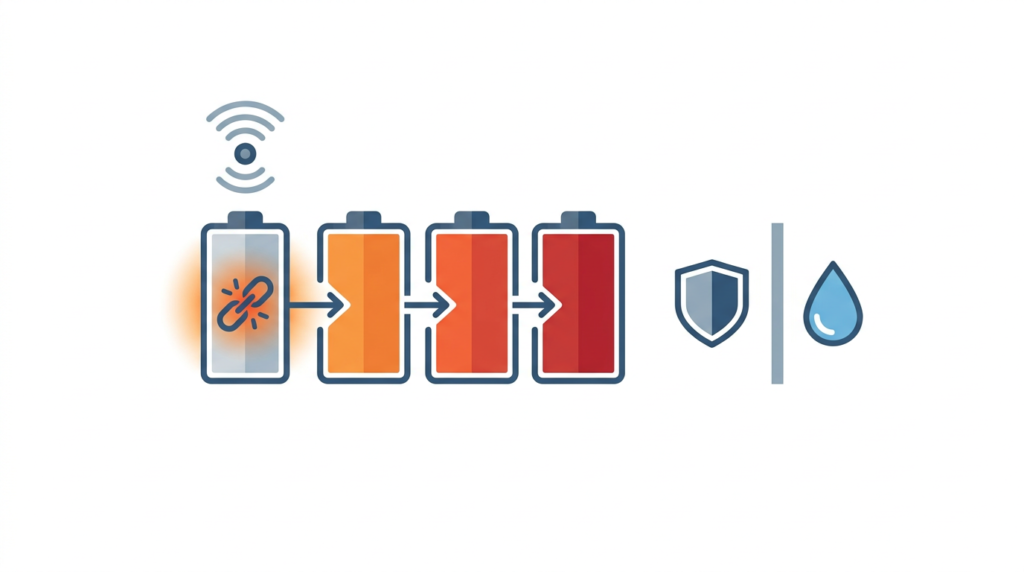
The defining risk of lithium-ion battery storage is propagation. One cell failing can heat adjacent cells, causing them to fail, which heat more cells. The result is a cascading event that can involve an entire module, rack, or installation. Testing such as UL 9540A is designed to characterize whether and how propagation occurs.
C. Chemistry Matters
Not all lithium-ion batteries behave alike. Common chemistries include lithium iron phosphate (LFP), nickel manganese cobalt (NMC), nickel cobalt aluminum (NCA), and lithium cobalt oxide (LCO). In general, NMC, NCA, and LCO cells release more energy and more oxygen during runaway, while LFP cells tend to be more thermally stable but still produce large volumes of flammable gas, including hydrogen, and can still be involved in deflagrations. Chemistry affects heat release, gas composition, and the protection strategy, so it should be identified early and tested data should be specific to the actual product.
Key point: Lithium-ion battery fire safety is not only about extinguishing a fire. It is about preventing thermal runaway, detecting it early, cooling the cells, managing flammable gas, and preventing propagation.
Pro Tip: Treat a lithium-ion battery fire as a hazardous materials event, not a conventional fire. The gases are toxic, the fire can reignite, and the water runoff may be contaminated.
Section 2: Where the Hazard Shows Up in Buildings
The applicable code path depends on what the batteries are and how they are used. Identify which of these applies before anything else.
| Category | Examples | Primary Reference |
|---|---|---|
| Stationary energy storage systems (ESS) | Battery rooms, outdoor BESS enclosures, rooftop and garage installations, residential wall units, UPS | NFPA 855, IFC Section 1207, UL 9540 |
| Battery storage (warehouse, retail, back-of-house) | Pallets of batteries, e-bike and tool stock, recycling collection | IFC Section 320 |
| Batteries in equipment and devices | Phones, laptops, power tools, e-bikes, scooters, mobility devices | Product listings (UL 2054, UL 2271, UL 2849); IFC and NFPA 1 for charging and storage areas |
| Vehicle charging with storage | EV chargers with integrated ESS | NFPA 855, NFPA 70, local requirements |
Many buildings contain more than one category. A distribution center may have forklift battery charging, stocked consumer batteries, and a rooftop BESS, each with a different code path.
Pro Tip: Build a battery inventory before design or inspection. List location, chemistry, kilowatt-hours, state of charge, and intended use for each battery area.
Section 3: The Codes — NFPA 855 and IFC Sections 320 and 1207
Two primary documents govern lithium-ion battery storage and energy storage systems: NFPA 855 and the IFC.
A. NFPA 855
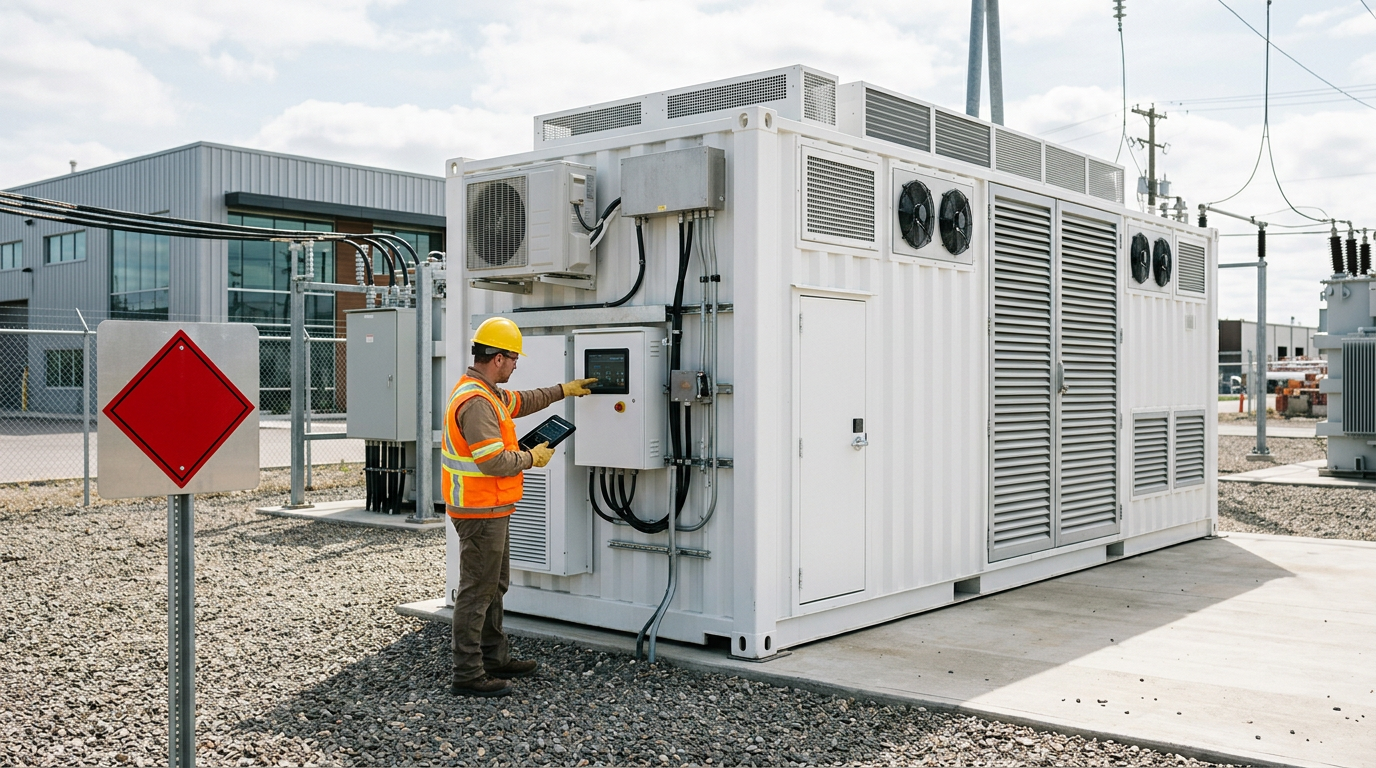
NFPA 855 establishes requirements for the design, installation, commissioning, operation, maintenance, and decommissioning of stationary ESS. It covers fire detection and suppression, explosion control, ventilation, gas detection, thermal runaway, separation distances, hazard mitigation analysis (HMA), signage, and emergency planning. It applies based on technology type and energy thresholds, and the 2026 edition expanded the number of technologies it addresses.
B. IFC Section 320
The 2024 IFC added Section 320, Lithium-Ion and Lithium Metal Battery Storage. It applies to storage of batteries in warehouses and other occupancies, and it establishes requirements based on the following factors (verify exact thresholds in your adopted edition):
| Factor | Typical Requirement |
|---|---|
| Operational permit | Required above a threshold quantity where adopted by the AHJ |
| Fire safety plan | Must address emergency response for battery incidents |
| State of charge (SoC) | Protection requirements tied to SoC; lower SoC (about 30% or less) reduces requirements |
| Technical opinion report | May be required to evaluate deflagration potential and establish the sprinkler design basis |
| Separation | Fire-resistance-rated separation may be required |
| Sprinklers | Automatic sprinklers required |
| Detection and alarm | Automatic detection and alarm required |
| Explosion control | May be required depending on SoC and quantity |
C. IFC Section 1207
IFC Section 1207 governs stationary energy storage systems and references NFPA 855 for most technical requirements. It is the path for installed battery energy storage systems rather than stored inventory.
D. Exceptions
IFC Section 320 has exceptions that typically include:
- Batteries installed in the equipment they power
- Batteries packed with equipment
- Retail packaging at or below stated size limits (for example, not more than 300 Wh for lithium-ion or 25 grams of lithium metal)
- Temporary storage during manufacturing
E. Other Related Documents
- NFPA 1 and NFPA 101: Fire code and life safety provisions that reference NFPA 855
- NFPA 70 (NEC): Electrical installation requirements, including Article 706 (energy storage systems) and Article 480 (storage batteries)
- NFPA 72: Detection and alarm; the 2026 edition of NFPA 855 aligns detection provisions more closely with NFPA 72
- UL 9540 and UL 1973: Product listing of the ESS and its batteries
Key point: The regulatory landscape is evolving. The 2024 IFC still references the 2023 edition of NFPA 855, while the 2026 edition of NFPA 855 has already been published. Confirm the adopted edition and local amendments before design.
Pro Tip: For any project involving more than incidental battery storage, engage a fire protection engineer with specific experience in NFPA 855 and IFC Section 320. The requirements are too complex and too new for a generalist approach.
Section 4: State of Charge — The Critical Variable for Storage
State of charge (SoC) is the single most important variable for stored batteries. A battery at 100% SoC holds more energy and is more hazardous than a battery at 30% SoC.
A. The SoC Threshold
IFC Section 320 recognizes that at roughly 30% SoC or lower, the hazard is significantly reduced. Typical differences:
| Requirement | SoC above 30% | SoC at or below 30% |
|---|---|---|
| Technical opinion report | May be required | Generally not required |
| Fire-resistance-rated separation | May be required | Generally not required |
| Explosion control | May be required | Generally not required |
| Automatic sprinklers | Required | Required |
| Fire alarm and detection | Required | Required |
The reduction is not a loophole. It reflects the physics: a battery at low SoC has less energy available for thermal runaway and propagation.
B. Managing SoC in Practice
For storage occupancies, SoC can be managed by:
- Storing batteries at the manufacturer’s shipping SoC (typically 30% or lower)
- Discharging batteries before storage
- Limiting charging in storage areas
- Separating charged and discharged batteries
- Verifying SoC at receiving
For operating ESS, SoC is a function of the system’s operational state and cannot be managed this way. Protection is designed for the system at full charge.
Key point: SoC is a design variable, not only an operational one. For stored batteries, the lower the SoC, the lower the hazard and the fewer the protection requirements.
Pro Tip: If the AHJ allows reduced requirements at low SoC, document the SoC management procedure in the fire safety plan and verify it periodically. The reduction is contingent on SoC being maintained.
Section 5: Testing and Analysis — UL 9540A, Large-Scale Fire Testing, and the HMA
A. UL 9540A
UL 9540A is the test method for evaluating thermal runaway fire propagation in battery energy storage systems. It is not a pass/fail standard. It is a data-generating test that informs installation design.
| Level | What Is Tested |
|---|---|
| Cell | Thermal runaway characteristics of a single cell, including gas generation |
| Module | Propagation from cell to cell within a module |
| Unit | Propagation from module to module within a unit |
| Installation | Propagation from unit to adjacent units under specific installation conditions |
The data helps determine whether propagation occurs, what separation is needed, what protection is required, and how much flammable gas may be generated.
B. Large-Scale Fire Testing
Modern codes increasingly rely on large-scale fire testing (LSFT), sometimes called fire and explosion testing, to justify exceptions to prescriptive requirements such as spacing, sprinkler design, and explosion control. Cell-, module-, and unit-level data from UL 9540A is often supplemented by installation-level testing that reflects the real configuration. The 2026 edition of NFPA 855 tightened what qualifies as acceptable large-scale testing, so confirm with the AHJ what level of testing it expects for your project.
C. Edition Questions
Check which edition of UL 9540A your adopted code references. Newer editions of test standards may be published before the codes adopt them. Equipment tested to the edition referenced by the adopted code is generally what the AHJ will review, but confirm with the AHJ.
D. Hazard Mitigation Analysis (HMA)
An HMA is a site-specific engineering analysis that evaluates the failure modes of the ESS and the effectiveness of the protection. It addresses fire and explosion hazards, deflagration potential, separation, fire protection adequacy, and emergency response considerations. Earlier editions of NFPA 855 required an HMA only in certain cases. The 2026 edition expands the role of the HMA, with a documented analysis expected from the design stage for more installations. Confirm requirements for your project and who is qualified to prepare it, since the 2026 edition emphasizes qualified design professionals.
Key point: UL 9540A data, large-scale testing where required, and the HMA are the technical basis for the protection design. Without them, the design rests on assumptions rather than tested performance.
Pro Tip: Require the test report for the specific equipment being installed. A report for a different product, configuration, or firmware may not be applicable.
Section 6: Detection and System Safeguards
Detection is the most important active layer because the event develops faster than conventional detection can respond.
A. Why Conventional Detection Alone Is Insufficient
Smoke detection may not activate until thermal runaway is well underway. Heat detection is slower still. For battery rooms and enclosures, earlier indicators are needed.
B. Off-Gas Detection
Lithium-ion cells vent flammable and toxic gases before they ignite. Off-gas detection (also called electrolyte vapor or gas detection) can identify a failing cell before thermal runaway is fully established.
| Detection Type | What It Detects | Response |
|---|---|---|
| Off-gas detection | Electrolyte vapor, CO, hydrogen, VOCs | Earliest warning |
| Smoke detection (including aspirating) | Smoke particles | Later |
| Heat detection | Temperature rise | Latest |
| Radiant energy / flame detection | Flame | At ignition |
C. Detection Requirements
IFC Section 320 requires automatic detection and alarm for indoor battery storage. NFPA 855 requires fire detection for ESS, and the 2026 edition aligns detection requirements more closely with NFPA 72. Gas detection requirements and the response to a gas alarm (for example, ventilation activation, shutdown, and notification) depend on the system and the HMA.
D. Battery Management System (BMS) and Electrical Safeguards
The BMS is part of the fire protection strategy. It monitors voltage, current, and temperature, and it can isolate a failing module, stop charging, or trigger alarms. Safeguards include:
- Overcharge, over-discharge, and overcurrent protection
- Temperature monitoring and thermal management
- Ground-fault and arc-fault protection where applicable
- Remote monitoring and alarm communication to a constantly attended location
- Emergency disconnects and clear shutdown procedures for responders
The BMS is not a substitute for fire protection. It reduces the likelihood of failure but does not eliminate it.
Key point: Detection is the first line of defense, and the BMS is the first layer of prevention. Off-gas detection gives the earliest warning of a failing cell.
Pro Tip: Do not rely on smoke detection alone for battery storage. By the time smoke is detected, the event may be beyond simple intervention.
Section 7: Suppression and Cooling
Suppression of lithium-ion battery fires is fundamentally about cooling, not smothering.
A. Water Is the Most Effective Agent
Water is generally the most effective agent because it absorbs heat and cools cells below the thermal runaway threshold. Smothering agents such as CO2 and clean agents may knock down flame but do not stop the thermal runaway reaction inside the cell and may allow reignition.
B. Sprinkler Design
For ESS rooms, NFPA 855 and IFC Section 1207 have commonly specified automatic sprinklers designed to at least 0.3 gpm/ft² over a 2,500 ft² area (or the room, whichever is less), unless the design is justified by large-scale fire testing or the HMA to be different. This exceeds a conventional ordinary hazard design and reflects the higher heat release rate. For storage occupancies under IFC Section 320, automatic sprinklers are required, and the design basis may be established through the technical opinion report. Verify the exact design basis in your adopted edition.
C. Specialized Suppression Systems
Some ESS installations use water mist, aerosol, clean agent, or proprietary systems, often in combination with off-gas detection. These must be listed or tested for the application and evaluated in the HMA. For outdoor containers and enclosures, suppression is often paired with exterior water supply and firefighter access to the enclosure.
D. Water Supply and Runoff
Cooling an ESS fire can require sustained water flow. Confirm available water supply and fire department connections, and plan for containment and treatment of contaminated runoff.
E. Reignition
Batteries can reignite hours or days after the initial fire appears out. The fire watch must continue until the battery is confirmed stable, which may require thermal imaging and extended monitoring.
Key point: Suppression is about cooling. Water is the most effective agent for most lithium-ion fires. Reignition is a real risk and requires extended monitoring.
Pro Tip: Plan for extended fire watch after any lithium-ion battery fire. The fire department may not consider the event resolved until the battery is cooled and stable.
Section 8: Explosion Control and Prevention
Lithium-ion batteries generate flammable gases during thermal runaway, including hydrogen, carbon monoxide, and hydrocarbons. In an enclosed space, these gases can accumulate and create a deflagration hazard. Several well-documented ESS incidents have involved explosions after gas accumulated in an enclosure.
A. Explosion Control and Prevention
NFPA 855 and IFC Section 320 require explosion control for certain installations, depending on SoC, quantity, enclosure characteristics, and ventilation. The 2026 edition of NFPA 855 shifted the language from explosion control to explosion control and prevention, with more emphasis on preventing flammable gas accumulation and on performance-based justification. Strategies include:
- Deflagration venting (explosion relief panels) designed per NFPA 68
- Explosion prevention systems designed per NFPA 69
- Gas detection tied to active ventilation or other mitigation
- Limiting enclosure volume and fuel loading
B. Ventilation
Ventilation serves two purposes:
- Normal operation: Maintaining temperature and removing minor off-gassing
- Emergency: Removing or diluting flammable gases during a thermal runaway event
The design must account for the worst-case gas generation scenario and must remain reliable under fire conditions. Note that ventilation alone is not necessarily sufficient for explosion prevention and should be evaluated in the HMA.
C. Responder Hazard
Explosion risk also affects emergency response. Firefighters should not open doors to a battery enclosure that has experienced thermal runaway without first understanding the gas conditions. The emergency response plan should address this (see Section 11).
Key point: Explosion control and prevention is a critical layer for enclosed lithium-ion installations. The gases generated during thermal runaway are flammable and can accumulate to dangerous concentrations.
Pro Tip: Coordinate explosion control with the HVAC design. The ventilation system may serve both normal cooling and emergency gas removal, but the emergency function must be reliable under fire conditions.
Section 9: Separation, Location, and Installation Arrangements
Separation and siting are passive strategies that limit propagation and protect people and neighboring property.
A. Indoor Storage
IFC Section 320 may require fire-resistance-rated separation for indoor battery storage depending on SoC and quantity. This limits the fire to the compartment of origin and protects adjacent areas.
B. Outdoor Storage
Outdoor storage requirements are based on separation distance, pile area, and storage height. IFC Section 320 generally requires outdoor storage to be separated from buildings, lot lines, and public ways by a minimum distance (commonly 20 feet in the model code). Verify the distance in your adopted edition.
C. Warehouse Storage
For warehouse storage, separation requirements depend on SoC, commodity classification, storage height, and sprinkler protection. The technical opinion report may establish alternative arrangements based on test data.
D. Stationary ESS Location and Spacing
NFPA 855 limits where ESS may be located and how large individual units and groups can be. Typical considerations include:
- Indoor rooms: Dedicated rooms with fire-resistance-rated separation, limited unit size and group size, and restrictions on locating ESS near exits and in occupied spaces
- Outdoor installations: Minimum spacing between arrays and from buildings, property lines, exposures, and combustible vegetation, which may be reduced where supported by testing
- Rooftops and parking structures: Additional structural, access, and exposure restrictions
- Residential installations: Limits on energy per unit and aggregate energy per dwelling, and restrictions on locations such as sleeping rooms and habitable spaces; garages and utility closets are common allowed locations
- Exposure protection: Protection of adjacent structures, vehicles, and egress paths
Specific thresholds in kilowatt-hours differ between editions and technologies, so confirm them in the edition your AHJ enforces.
E. Signage, Access, and Disconnects
Signs must identify the hazard, the chemistry, and the location of disconnects. Firefighter access, clear approach paths, and accessible emergency shutdown controls are part of the installation design.
Key point: Separation limits the consequences of a thermal runaway event and works best when combined with detection and suppression.
Pro Tip: Separation distances are based on the tested propagation characteristics of the specific system. Do not reduce them without a technical basis.
Section 10: Micromobility, Chargers, and Occupant-Owned Batteries
Some of the most frequent lithium-ion fires in buildings do not involve stationary ESS at all. E-bikes, e-scooters, mobility devices, and power tools are commonly charged indoors, in apartments, corridors, lobbies, and storage rooms, and fires from them have caused fatalities and injuries, particularly in residential occupancies.
A. Typical Risk Factors
- Damaged, modified, or counterfeit batteries
- Non-listed or mismatched chargers
- Charging unattended or while sleeping
- Charging in egress paths or near exits
- Storage of many units in one room, such as bike rooms, shops, and delivery hubs
B. Practical Controls
- Require products and chargers to be listed to applicable standards (for example UL 2849 for e-bike systems and UL 2271 for light electric vehicle batteries)
- Designate charging areas away from exits, corridors, and sleeping areas
- Limit the number of units charged at once and provide fire-rated or sprinklered rooms where needed
- Prohibit charging of damaged batteries and provide safe storage and disposal
- Provide smoke detection and sprinkler protection in charging and storage rooms
- Adopt tenant and employee rules, signage, and education
- Check whether local law or the AHJ has specific rules for e-bike charging or storage
C. EV Charging With Storage
EV charging systems that include integrated energy storage may fall under NFPA 855. Confirm the applicable code path with the AHJ, and coordinate with NFPA 70 for electrical requirements.
Key point: Occupant-owned batteries are often the more likely ignition source in a building. Policies, listed products, and designated charging areas matter as much as engineered protection.
Pro Tip: If a building allows e-bike charging, write a policy before an incident forces one.
Section 11: Emergency Response, Fire Watch, and Post-Incident Actions
A battery fire is one of the incidents where emergency response planning has the greatest effect on outcomes.
A. Emergency Response Plan (ERP)
The 2026 edition of NFPA 855 adds an emergency response plan requirement for covered ESS. The plan typically addresses mitigation, preparedness, response, and recovery, and it is reviewed periodically, with refresher training for responders and facility staff. Confirm the review frequency, notification requirements, and AHJ involvement in your adopted edition.
The plan should cover:
- Facility description, hazards, chemistry, and quantities
- Site and building layout, including access, utilities, and water supply
- Shutdown and isolation procedures, including DC disconnects
- Gas hazard, explosion risk, and re-entry precautions
- Evacuation and shelter-in-place considerations for nearby occupants
- Roles for facility personnel and the fire department
- Contact information for the system manufacturer and operator
B. Coordination With the Fire Department
Early coordination matters. Invite the fire department to tour the installation, provide site plans and safety data, and agree on what they will and will not do. In many incidents with large installations, the safe response is defensive: protect exposures, cool where safe, and allow the system to burn out under controlled conditions.
C. Fire Watch and Post-Incident Monitoring
After an event, the battery remains hazardous. Continue a fire watch until the system is confirmed stable, use thermal imaging to check for hot spots, and treat damaged batteries as unstable. Coordinate with the manufacturer on removal and handling.
D. Runoff, Air Quality, and Cleanup
Water runoff may contain contaminants, and smoke may contain toxic gases such as hydrogen fluoride. Plan for runoff containment, air monitoring where appropriate, and environmental notifications required by local rules.
E. Damaged, Defective, and Recalled Batteries
Have a written procedure for isolating damaged or recalled batteries, storing them in non-combustible containers or separated areas, and arranging safe disposal or recycling through authorized handlers.
Key point: Response planning is part of the design. The best protection systems still rely on informed responders and a plan for the hours and days after the event.
Pro Tip: Do not wait for an incident to learn where the disconnects are. Walk through the plan with the fire department.
Section 12: Commissioning, Inspection, Testing, and Maintenance
Protection that is not commissioned and maintained will not perform when needed.
A. Commissioning
NFPA 855 requires commissioning of ESS, and the 2026 edition strengthened these requirements. Commissioning should verify:
- Detection, alarm, and gas detection function and signal to a monitored location
- Ventilation and explosion control operate as designed
- Suppression systems are installed and tested per their standards
- BMS and safety functions operate, including shutdown and alarm responses
- Integrated sequence of operations works together
- Documentation, signage, and ERP are complete
A qualified party independent of the installer should witness or review commissioning where required by the AHJ.
B. Inspection, Testing, and Maintenance (ITM)
NFPA 855 requires ongoing operation and maintenance. Maintain the fire alarm per NFPA 72, sprinklers per NFPA 25, and the ESS per the manufacturer’s instructions and NFPA 855. Keep records of inspections, battery health, and alarms. Review the HMA and ERP when the system, quantity, chemistry, or use changes.
C. Management of Change
Replacing modules, adding capacity, changing firmware, or changing chemistry can invalidate test data. Review changes against the listing, the HMA, and the AHJ approval.
D. Decommissioning and Disposal
NFPA 855 addresses decommissioning. Plan for safe de-energizing, transportation of used batteries (damaged batteries have special shipping rules), and recycling or disposal through authorized handlers.
Key point: Commissioning proves the system works on day one. ITM keeps it working.
Pro Tip: Include battery protection systems in the building’s regular ITM program and impairment procedures.
Section 13: The 2026 NFPA 855 Changes at a Glance
The 2026 edition of NFPA 855 introduced significant revisions that affect ESS design, review, and operation. Verify the details against the published standard and your adopted edition.
| Topic | Change |
|---|---|
| Organization | Continued reorganization, with general requirements consolidated and technology-specific requirements separated |
| Scope | Expanded coverage of additional energy storage technologies |
| Hazard mitigation analysis | Broader use; more installations expected to have a documented HMA from the design stage |
| Large-scale fire testing | Clearer expectations for fire and explosion testing used to justify designs |
| Explosion control and prevention | Revised approach with more emphasis on preventing gas accumulation and performance-based justification |
| Detection | Alignment with NFPA 72 and allowance for other suitable smoke detection technologies |
| Emergency response plan | New or expanded requirement, with periodic review and responder training |
| Commissioning | Strengthened commissioning requirements |
| Emergency power | New provisions for emergency power supply systems and stored emergency power supply systems |
| Other technologies and use cases | New or expanded content on flow batteries, EV charging with storage, and other applications |
The IFC does not automatically follow NFPA 855 editions. The 2024 IFC references the 2023 edition of NFPA 855, so some jurisdictions will apply 2023 requirements while others amend to the 2026 edition.
Key point: The 2026 edition is a significant revision. Projects designed to earlier editions should be reviewed against the new requirements.
Pro Tip: Confirm which edition the AHJ has adopted, and ask whether the AHJ will accept design to the newer edition.
Section 14: Common Challenges and Mistakes
| Challenge or Mistake | Why It Happens | Solution |
|---|---|---|
| Treating lithium-ion as a conventional fire hazard | Familiar assumptions applied to a different hazard | Design for thermal runaway, gas, and propagation |
| Code adoption lag | IFC Section 320 and NFPA 855 are new and editions differ | Verify adopted edition; ask the AHJ about the newer edition |
| SoC management not documented | Treated as an operational detail | Document the procedure and verify in the fire safety plan |
| Test data not applicable | Report for a different configuration | Require product-specific data |
| Detection too late | Smoke detection only | Add off-gas or gas detection |
| Suppression inadequate | Conventional design density or smothering agent | Design to NFPA 855 or tested design; use water cooling |
| Explosion hazard overlooked | Gas hazard not recognized | Evaluate deflagration in the HMA; provide control and prevention |
| Separation reduced without basis | Space constraints | Require a technical basis for any reduction |
| Fire watch ended too early | Reignition not understood | Extended fire watch with thermal imaging |
| No commissioning or ITM | Project closed out without verification | Commission, then maintain |
| Occupant batteries ignored | Focus on engineered ESS only | Adopt charging and storage policies |
| AHJ or fire department unfamiliar | New codes and technology | Pre-submittal meeting; provide documentation and tour |
| Insurer requirements not met | Not aware of them | Obtain insurer requirements in writing early |
Key point: Most failures are not technical failures. They are failures to recognize that lithium-ion batteries are a different hazard requiring a different approach.
Pro Tip: Assume the AHJ will require more, not less, protection for lithium-ion battery storage. The codes are evolving toward stricter requirements.
Section 15: Design Checklist
| Item | Status | Notes |
|---|---|---|
| Adopted IFC edition confirmed | ☐ | 2024 or later for Section 320 |
| Adopted NFPA 855 edition confirmed | ☐ | 2023 or 2026 |
| Battery inventory completed | ☐ | Location, chemistry, kWh, use |
| Code path determined | ☐ | Stationary ESS, storage, devices, charging |
| State of charge determined | ☐ | About 30% or less reduces storage requirements |
| UL 9540A and large-scale test data obtained | ☐ | Product-specific |
| Hazard mitigation analysis (HMA) | ☐ | Qualified preparer |
| Technical opinion report | ☐ | Required by IFC 320 for certain storage |
| Fire and gas detection specified | ☐ | Off-gas preferred; smoke minimum |
| BMS and electrical safeguards verified | ☐ | Shutdown and alarm functions |
| Sprinkler design specified | ☐ | Per NFPA 855 or tested basis |
| Explosion control and prevention evaluated | ☐ | Venting, NFPA 69, ventilation |
| Separation and spacing determined | ☐ | Rated construction or approved alternative |
| Signage, access, and disconnects | ☐ | Responder-friendly |
| Fire safety plan updated | ☐ | Battery incidents |
| Emergency response plan | ☐ | Required by NFPA 855 2026 |
| Commissioning and ITM plan | ☐ | Integrated testing |
| E-bike and charger policy | ☐ | Where applicable |
| AHJ and fire department meeting | ☐ | Confirm requirements |
| Insurer requirements obtained | ☐ | In writing |
Section 16: Conclusion
Lithium-ion battery fire safety is a distinct discipline. The batteries are not conventional combustibles, and the fires they produce are not conventional fires. Thermal runaway, gas generation, propagation, and reignition are the defining hazards, and the protection must address them.
The regulatory framework is evolving. IFC Section 320 (2024), IFC Section 1207, and NFPA 855 (2023 and 2026) are the primary documents, supported by UL 9540A and large-scale fire testing, the hazard mitigation analysis, commissioning, and emergency response planning.
The critical elements are:
- Recognition: lithium-ion batteries are a different hazard
- Code path: stationary ESS, storage, or devices, and the adopted editions
- State of charge: the critical variable for stored batteries
- Testing and HMA: the technical basis for protection design
- Detection and BMS: early warning and prevention
- Suppression: water cooling, not smothering
- Explosion control and prevention: flammable gases can accumulate
- Separation and siting: passive protection against propagation
- Emergency response and fire watch: planning and extended monitoring
- Commissioning and maintenance: proof and persistence
- AHJ coordination: the codes are new; engage early
The most common failure is treating lithium-ion batteries as a conventional fire hazard. They are not. The protection must be designed for the specific hazard, using the specific standards and testing data.
Key Takeaways
- Lithium-ion battery fires are thermal runaway events, not conventional fires.
- Thermal runaway can generate heat, flammable gas, and toxic vapors, and reignition can occur hours or days later.
- Propagation is the defining risk; UL 9540A and large-scale testing evaluate it.
- Chemistry matters; verify the actual product.
- State of charge is critical for stored batteries; about 30% or less reduces requirements.
- IFC Section 320 governs battery storage; IFC Section 1207 and NFPA 855 govern stationary ESS.
- The 2026 NFPA 855 expanded HMA, explosion control and prevention, emergency response, and commissioning.
- Off-gas detection gives the earliest warning of a failing cell.
- Water cooling is the most effective suppression; smothering alone is not.
- Occupant-owned batteries such as e-bikes need policies and listed equipment.
- Commissioning, ITM, and an emergency response plan are part of the protection.
- Verify the adopted edition and engage the AHJ early.
Take Action Today
- Confirm the adopted IFC and NFPA 855 editions.
- Inventory the batteries in the building, with chemistry and quantity.
- Determine the state of charge and document SoC management.
- Obtain product-specific UL 9540A and fire test data.
- Determine whether an HMA or technical opinion report is required.
- Specify off-gas or gas detection for battery areas.
- Verify sprinkler design and water supply.
- Evaluate explosion control and prevention for enclosed installations.
- Verify separation distances or obtain a technical basis for alternatives.
- Establish an e-bike and charging policy where applicable.
- Prepare an emergency response plan and walk it through with the fire department.
- Plan commissioning and ongoing ITM.
- Obtain insurer requirements in writing.
Continue Reading From Our Series
- Related guide: Article 150 — NFPA 25 Inspection, Testing, and Maintenance of Water-Based Systems
- Related guide: Article 149 — Insurance Requirements and Fire Protection Credits
- Read more: Article 152 — Solar Panel and PV System Fire Safety (planned)
About This Guide: This article is part of a series on commercial building fire safety, written for facility managers, architects, and code officials. It references model codes and standards for educational purposes. Always consult your local AHJ and a qualified fire protection engineer for project-specific requirements.