IMPORTANT DISCLAIMER: This guide references the International Fire Code (IFC), including the solar photovoltaic power systems section (Section 1204 in the 2018 and 2021 editions, renumbered Section 1205 in the 2024 edition) and Section 1207 (Electrical Energy Storage Systems); the International Building Code (IBC), including Sections 1505.8 and 1505.9 (PV fire classification), 1510.7 (rooftop-mounted PV panels and modules) and Section 3111 (Solar Energy Systems); the National Electrical Code (NEC / NFPA 70), including Article 690 (Solar Photovoltaic Systems) and Section 690.12 (Rapid Shutdown); NFPA 1, Fire Code; NFPA 101, Life Safety Code; NFPA 70B (electrical equipment maintenance); NFPA 855 (energy storage systems); UL 61730 and UL 1703 (PV module safety); UL 1741 (inverters); UL 1699B (DC arc-fault protection); UL 2703 (mounting systems and PV system fire classification); and UL 3741 (Photovoltaic Hazard Control). PV requirements vary by jurisdiction, roof type, occupancy, and adopted code edition, and rapid shutdown and pathway requirements have changed between editions. Section numbers cited here follow the model codes and may differ in your adopted edition. Local amendments and the edition adopted by your Authority Having Jurisdiction (AHJ) always control. This guide is a starting point only. Always verify the requirements applicable to your project with your AHJ and a qualified fire protection engineer.
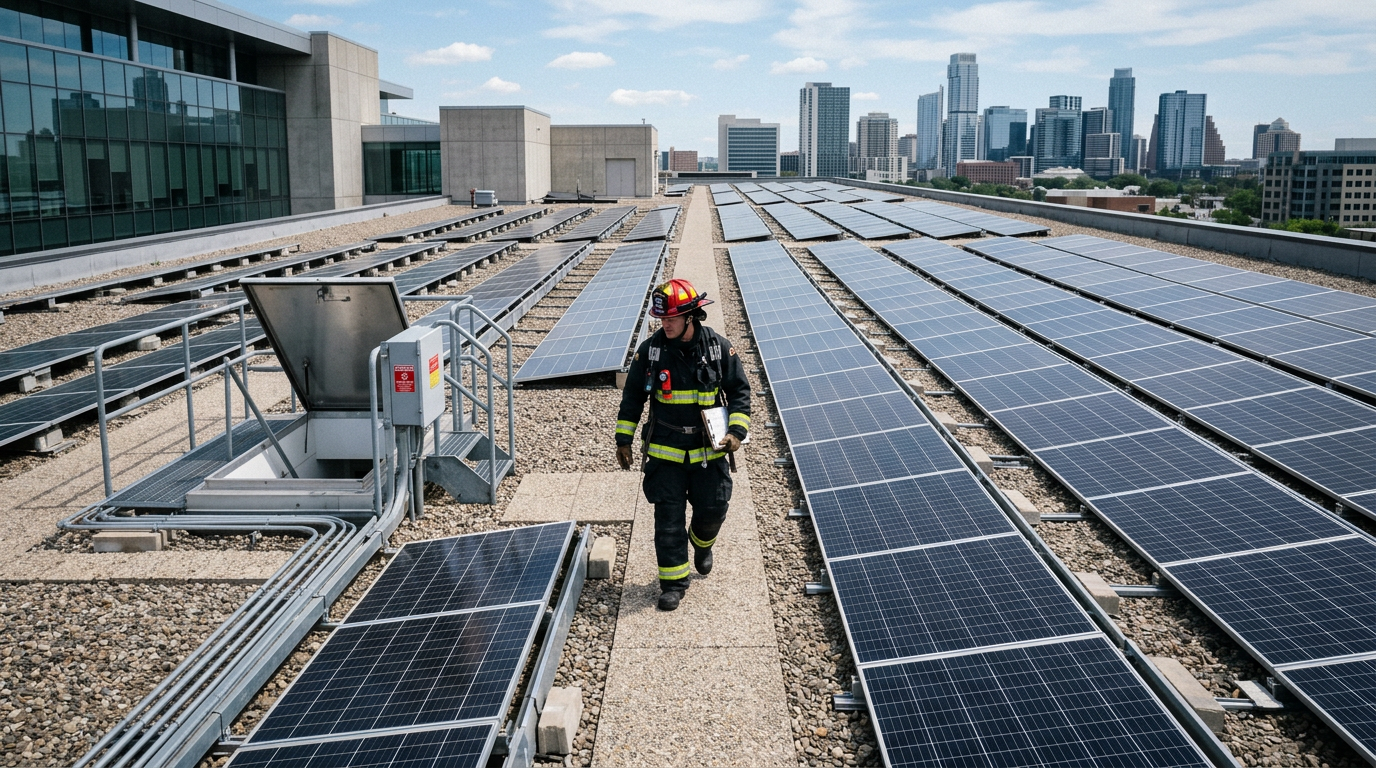
Rooftop solar is now a standard feature of commercial buildings. It reduces energy costs, supports sustainability goals, and is increasingly required by energy codes and incentive programs. But a rooftop PV array changes the fire safety profile of the building. It introduces a source of electrical energy that cannot be switched off at the panel during daylight, it occupies the roof surface that firefighters may need for access and ventilation, and it can complicate firefighting operations.
Solar PV fire safety is the discipline of understanding these hazards and applying the codes that address them. The most important concepts are rapid shutdown, which reduces conductor voltage to a level firefighters can manage, and firefighter access pathways, the clear areas on the roof that allow firefighters to move, ventilate, and fight fires. Both are governed by the IFC and NEC, and both have changed in recent code cycles.
This article covers how PV systems fail, the applicable codes, rapid shutdown, access pathways, roof classification, arc-fault and ground-fault protection, labeling, firefighting operations, carports and ground mounts, PV with energy storage, and how to commission and maintain a PV system that is safe for the building and for the firefighters who may need to operate around it.
◆ Section 1: Why PV Systems Are a Fire Safety Concern
A PV system is not a conventional electrical system. It generates electricity whenever light reaches the modules, regardless of whether the building is occupied, the main breaker is open, or the fire department has shut off power to the building. The DC conductors between the modules and the inverter remain energized while the array is illuminated.
| Factor | Conventional Electrical System | PV System |
|---|---|---|
| Power source | Can be disconnected at the main | Modules keep producing power while illuminated |
| DC hazard | Limited DC exposure | Extensive DC wiring on the roof |
| Firefighter access | Roof accessible | Roof partly occupied by panels and racking |
| Ventilation | Roof available for vertical ventilation | Panels obstruct ventilation openings |
| Arc hazard | AC arcs (zero-crossing helps extinguish) | DC arcs (sustained, difficult to extinguish) |
| Emergency shutdown | Main breaker | Rapid shutdown (NEC 690.12) |
A. The DC Arc Hazard
PV systems produce direct current. A DC arc has no zero-crossing point like an AC arc, so it can sustain itself and is difficult to extinguish. DC arcs can occur at connectors, junction boxes, and damaged conductors, and they can ignite surrounding materials.
B. The “Off at Night” and “Off with the Main” Misconceptions
Two misconceptions cause most of the danger to responders. The first is that opening the main breaker de-energizes the system. It does not: the array continues to produce power on the DC side, and conductors between the array and the inverter stay live. The second is that the array is harmless at night. Output drops to zero in full darkness, but modules can produce hazardous voltage under artificial light, including fire-scene lighting, and a system with energy storage can remain energized after dark.
Key point: A PV system cannot be fully de-energized by conventional means while the modules are illuminated. Rapid shutdown reduces the hazard to a level firefighters can manage. It does not eliminate it.
Key Article: Article 151 — Lithium-Ion Battery Fire Safety and Energy Storage Systems
Pro Tip: Never assume a PV system is “off” because building power is off. Treat all PV conductors as energized until rapid shutdown has been verified.
◆ Section 2: Codes and Standards Snapshot
PV fire safety is spread across several codes. Knowing which document governs which topic avoids gaps.
| Topic | Primary Reference |
|---|---|
| Rapid shutdown, arc-fault, grounding, wiring | NEC Article 690 (Section 690.12 for rapid shutdown) |
| Roof access, pathways, setbacks, marking | IFC solar section (1204 in 2018/2021; 1205 in 2024) |
| Roof fire classification | IBC 1505.8, 1505.9, 1510.7; UL 2703 |
| Structural loads, wind, rooftop installation | IBC Section 3111 and Chapter 16 |
| PV module safety and fire performance | UL 61730 (replacing UL 1703) |
| Mounting and racking, system fire class | UL 2703 |
| Inverters | UL 1741 |
| DC arc-fault protection equipment | UL 1699B |
| Hazard control systems | UL 3741 |
| Energy storage paired with PV | NFPA 855, IFC Section 1207, NEC Article 706 |
| Maintenance of electrical equipment | NFPA 70B |
Key point: The NEC governs how the system is wired and shut down. The IFC governs how it is arranged on the roof and marked for responders. The IBC governs roof classification and structure. All three must be satisfied.
Pro Tip: Confirm the adopted edition of each code at the start of design. The 2018, 2021, and 2024 IFC and the 2020, 2023, and 2026 NEC differ in ways that change layouts and equipment.
◆ Section 3: Rapid Shutdown (NEC Section 690.12)
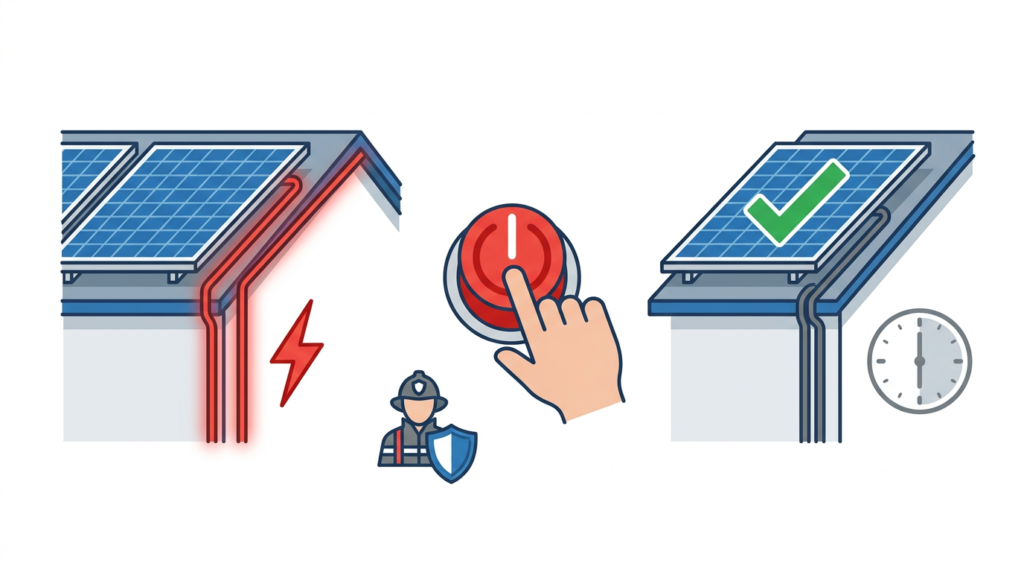
Rapid shutdown is the most important PV fire safety requirement. It requires that PV system conductors be reduced to a lower, safer voltage within a specified time after the shutdown initiator is operated. It applies to PV systems on or in buildings. Ground-mounted arrays that are not on buildings are generally outside its scope.
A. How the Requirement Evolved
| NEC Edition | Requirement |
|---|---|
| 2014 | Conductors more than 10 feet from the array, or more than 5 feet inside a building, reduced to 30 V within 10 seconds |
| 2017 | Array boundary defined (1 foot from the array). Conductors outside the boundary, or more than 3 feet inside a building, reduced to 30 V within 30 seconds. Conductors inside the boundary reduced to 80 V within 30 seconds (enforced from January 1, 2019), which in practice requires module-level power electronics |
| 2020 | Added the option of a listed PV Hazard Control System (UL 3741) inside the array boundary, a single initiation device for the PV system, and equipment requirements for rapid shutdown devices |
| 2023 | Retained the 30 V outside / 80 V or PV Hazard Control System inside structure, with refinements to initiation, equipment, and marking |
| 2026 | Reorganized the rapid shutdown provisions for clarity; voltage and time targets are unchanged |
In current editions, controlled conductors outside the array boundary must be at or below 30 V within 30 seconds of initiation. Inside the boundary, they must be at or below 80 V within 30 seconds, or the system must be a listed PV Hazard Control System.
B. The Initiation Device
The rapid shutdown initiation device must be:
- Clearly labeled
- Readily accessible to firefighters, typically at or near the service disconnect or at another approved location
- Capable of initiating rapid shutdown for the whole PV system
The building’s main disconnect often serves as the initiator, but not always. Some systems use a dedicated switch, so the label must say which device does the job.
C. UL 3741 and PV Hazard Control Systems
UL 3741 evaluates the array as a complete system: modules, racking, wiring, and shutdown equipment, installed exactly as listed. It provides an alternative to module-level shutdown inside the array boundary. Because the listing relies on protected wiring and a prescribed installation, some listed systems may allow higher voltages inside the array than the 80 V limit. Responders must therefore read the labels and not assume every array is at 80 V or less after shutdown.
D. The Practical Gap
Rapid shutdown controls the conductors. The modules themselves still produce voltage whenever they are illuminated, so a module, a module-level device, or the wiring within a module string remains a shock hazard. Rapid shutdown also does not stop a fire from starting at a connector or in an inverter, and it cannot work if the shutdown equipment has failed.
Key point: Rapid shutdown reduces the DC hazard to a level firefighters can manage. It does not eliminate it.
Pro Tip: Test the initiation device and confirm the voltage drop at commissioning and periodically after, and verify that the initiator is labeled and reachable without a ladder or key.
◆ Section 4: Firefighter Access Pathways (IFC Solar Section)
The IFC solar section (1204 in the 2018 and 2021 editions, 1205 in the 2024 edition) establishes roof access, pathway, setback, and smoke ventilation requirements. These allow firefighters to move across the roof, access ventilation points, and escape.
A. Typical Pathway Requirements
The requirements depend on occupancy and roof configuration. The following are representative of the IFC; confirm the exact dimensions in your adopted edition.
| Occupancy / Condition | Representative Requirement |
|---|---|
| Group R-3 (one- and two-family dwellings) | At least two 36-inch pathways on separate roof planes from the lowest roof edge to the ridge, plus ridge setbacks that vary by edition and by whether the building is sprinklered |
| Other than R-3 (commercial buildings) | Perimeter pathway to the roof edge: 6 feet wide where either roof axis exceeds 250 feet, or 4 feet where both axes are 250 feet or less |
| Interior pathways | 4-foot-wide pathways that divide large arrays into sections (arrays are commonly limited to 150 by 150 feet) and that lead to roof access points and hatches |
| Smoke ventilation | Provisions such as wider pathways or ventilation cut-outs so firefighters can vent without cutting through panels |
| Low-slope roofs | Commonly treated separately from steeper roofs, and many jurisdictions modify this section locally |
| Ground-level marking | Newer editions require roof pathways and access to be identified so responders can find them from the ground |
B. The Purpose of the Pathways
- Access: allow firefighters to move across the roof and reach stairs, hatches, and ladders
- Ventilation: provide clear areas for vertical ventilation
- Setback: keep panels away from roof edges, ridges, and valleys where firefighting operations occur
- Egress: give firefighters a clear route off the roof
C. The Edition Question and Exceptions
Pathway and setback requirements have changed between editions (for example, older editions required 3-foot ridge setbacks). Many jurisdictions allow exceptions where the fire code official determines that rooftop operations will not be employed, and many adopt local amendments. Some jurisdictions add requirements such as two roof access points or continuous maintenance of pathways and labels.
Key point: Firefighter access pathways are a life safety requirement for firefighters. They must be maintained. Storing equipment or materials in the pathways, or adding rooftop units, conduits, or panels later, defeats their purpose.
Key Article: Article 69 — How to Design Firefighter Access and Building Features for Rescue Operations
Pro Tip: Show the pathways on the roof plan submitted with the permit, and re-check them whenever rooftop equipment is added.
◆ Section 5: Roof Classification and Roof Interaction
A rooftop PV array changes the way the roof performs in a fire.
A. The Classification Requirement
IBC Section 1505.9 requires rooftop-mounted PV panel systems to be tested, listed, and identified with a fire classification in accordance with UL 2703 (with modules listed to UL 61730 or UL 1703). The fire classification must comply with IBC Table 1505.1 based on the construction type of the building. The 2012 and earlier approach, where the PV system simply matched the roof assembly’s classification, has been superseded.
B. The Nuance
The required PV classification comes from the building’s construction type. The PV system must be installed exactly according to its listing, so the listing must permit the roof slope, mounting height, and module type chosen. A listing for a different configuration may not apply.
C. Building-Integrated PV (BIPV)
BIPV products installed as the roof covering must be tested, listed, and labeled for fire classification like any other roof covering (IBC Section 1505.8).
D. How PV Interacts with the Roof
- Combustible roof materials: Heat or an arc beneath modules can ignite membranes, insulation, or debris, and the shaded, enclosed space under an array can hold heat and debris.
- Penetrations and conduit: Roof penetrations and conduit runs that cross the roof can carry fire into the building. Penetrations must be sealed and fire-stopped where they pass through rated assemblies.
- Ballasted and flush-mounted systems: Low-profile or ballasted systems leave little air gap, so heat and debris are harder to dissipate and detect.
- Structural load: Panels, racking, and ballast add dead load, and a fire-weakened roof can fail sooner under that added load.
Key point: The PV system has its own fire classification, separate from the roof assembly. Both must comply with their respective requirements.
Key Article: Article 137 — Roof Assemblies and Fire Classification
Pro Tip: Require the UL 2703 listing for the specific PV system and mounting configuration, and verify the roof type and slope are covered by it.
◆ Section 6: DC Arc-Fault and Ground-Fault Protection
A. DC Arc-Fault Protection
NEC Section 690.11 requires listed DC arc-fault circuit protection for PV systems on or in buildings with DC circuits operating at 80 volts or more. The protection must detect and interrupt series arcs in the DC conductors. Equipment is evaluated under UL 1699B, and inverters are listed under UL 1741.
DC arc-fault detection is more complex than AC detection because the DC arc has no zero-crossing point. Nuisance tripping has been an issue, and the technology has evolved over NEC editions.
B. Ground-Fault Protection
Ground faults in PV arrays are a recognized ignition source. A fault current path that is not detected can heat conductors or burn at a damaged point for a long time. Listed inverters include ground-fault detection and interruption, and this protection must be verified and kept enabled.
C. The Fire Risk
A DC arc or sustained ground fault can ignite roof materials, wiring insulation, and debris. Arc-fault and ground-fault protection are critical layers of PV fire safety.
Key point: Arc-fault and ground-fault protection are code requirements and critical fire safety layers. They should be verified at commissioning and kept active.
Pro Tip: Verify that the inverter or arc-fault device is listed for the application, that protection is enabled, and that any nuisance tripping is investigated and not simply disabled.
◆ Section 7: PV System Components and Failure Points
PV system fires often originate at specific components. Understanding the failure points focuses inspection and maintenance.
| Component | Failure Mode | Fire Risk |
|---|---|---|
| Modules | Hot spots, cell failure, cracked glass, bypass diode failure | Localized heating; potential ignition of the roof |
| Connectors | Loose connections, corrosion, incompatible mating | DC arc; ignition of connector and surrounding material |
| Junction boxes and combiners | Water ingress, loose terminals | DC arc; fire within the box |
| DC conductors | Damage, UV degradation, abrasion, rodent damage | Short circuit; arc; ground fault |
| Inverters | Component failure, overheating, blocked ventilation | Fire within inverter; propagation to surrounding materials |
| Rapid shutdown devices | Failure to operate | Loss of rapid shutdown function |
| Mounting system | Corrosion, loose hardware | Module displacement; conductor damage |
A. The Connector Problem
Connectors are one of the most common failure points. Loose connections, corrosion, poor crimps, and incompatible mating (mixing different manufacturers’ connectors) create resistance and heat, leading to arc faults and fire.
B. Environmental Damage
Rodents, birds nesting under arrays, falling debris, hail, and wind can damage conductors and modules and create short circuits and arc hazards. Conduit, cable management, and critter guards are important preventive measures.
C. Installation Quality
Many failures trace back to installation: wiring pinched under modules, conductors lying on the roof surface, incorrect torque, and damaged insulation.
Key point: PV fires often start at connectors, junction boxes, and inverters, not at the modules. Inspection and maintenance should focus on these components.
Pro Tip: Specify connectors from a single manufacturer, require proper crimping tools, and inspect cable routing at commissioning.
◆ Section 8: Marking, Labeling, and Information for Responders
A responder can only act on a system they can identify. Marking is therefore a core fire safety feature, and the labeling requirements come from both the NEC and the IFC.
A. Typical Marking Requirements
- Rapid shutdown label at the service equipment indicating that the building has a PV system with rapid shutdown and showing the type of shutdown
- Label at the rapid shutdown initiation device
- Labels on DC conduit, raceways, enclosures, and junction boxes warning of PV circuits
- Labels on disconnects, inverters, and combiners
- Marking of roof pathways and access points, where required by the adopted IFC
Labels must be durable, weather-resistant, and legible, and must be maintained for the life of the system.
B. Emergency Information
Provide responders with a site plan or placard showing the array layout, conductor routes, location of the initiation device, the inverter and disconnect locations, and the location of any battery system. Where batteries or multiple arrays exist, the plan should state which shutdown actions control which equipment.
Key point: Labels that are missing, faded, or incorrect are a failure of the safety system, not a cosmetic issue.
Pro Tip: Include a label audit in every annual inspection, and re-label after any alteration, reroof, or addition.
◆ Section 9: PV Systems and Firefighting Operations
Firefighters face specific challenges when a building has a rooftop PV array.
A. The Firefighter’s Perspective
| Challenge | Why It Matters |
|---|---|
| Live DC conductors | Cannot be fully de-energized while illuminated |
| Roof access | Panels obstruct movement and ventilation |
| Weight | Panels and ballast add load to a fire-exposed roof |
| Falling and trip hazards | Damaged panels, conduit, and racking |
| Smoke and visibility | Panels and smoke obscure the roof surface |
| Water on energized equipment | Risk of shock if water contacts live conductors |
| Delayed restart | Modules can re-energize when light returns |
B. Firefighter Safety Measures
- Locate the system and activate rapid shutdown before operations, but still treat conductors and modules as energized
- Avoid cutting, breaching, or walking on panels
- Follow the department’s guidance on water application and distance to energized equipment
- Do not rely on covering modules to stop them producing power, because light still reaches the cells
- Coordinate with the building owner or PV contractor for system information
C. After the Fire
A damaged array can remain hazardous after the fire is out. Damaged modules, wiring, and shutdown devices may still produce voltage, and the array can re-energize at sunrise. Overhaul, salvage, and demolition crews should treat the system as live until a qualified electrician has isolated it.
D. Pre-Incident Planning
The fire department should have pre-incident plans that identify the PV system location and extent, the rapid shutdown initiator location, DC conductor routes, inverter and disconnect locations, roof access points and pathways, and any battery system.
Key point: Firefighter safety depends on rapid shutdown, access pathways, labeling, and pre-incident planning. All four must be in place.
Pro Tip: Provide the fire department with a PV system diagram and walk the roof with the responding company before the system goes into service.
◆ Section 10: Carports, Ground Mounts, and Other PV Configurations
Not every PV system sits on a roof. Other configurations raise additional fire safety questions.
A. PV Carports and Canopies
Parking canopies put PV directly above vehicles, which are a significant fire source. A vehicle fire can damage the canopy and modules, and burning debris can fall. Key considerations include the classification of the canopy as a structure under the IBC, whether sprinkler or other protection is required under the adopted code, clearance for fire apparatus, rapid shutdown applicability (a canopy that functions as a building roof may trigger it), and the interaction with EV charging equipment.
B. Ground-Mounted Arrays
Ground-mounted arrays are generally outside the scope of rapid shutdown, but they still need defined access for responders, a clearly identified disconnect, and a perimeter of cleared vegetation. In wildfire-prone areas, vegetation management under and around the array is a primary fire control measure, and many jurisdictions regulate fencing, gates, and access roads.
C. Building-Integrated PV and Façades
BIPV roofs and façade-mounted PV act as the weather barrier and roof covering. They must meet the fire classification and, for façades, the exterior wall fire propagation requirements of the code. Rapid shutdown and marking still apply.
Key point: The same hazards apply to every configuration: energized conductors, arc and ground faults, and responder access. Only the rules and the access conditions change.
Key Article: Article 153 — Electric Vehicle Charging Station Fire Safety (planned)
Pro Tip: Treat a carport array as a building system, not just a canopy: coordinate the structural, fire protection, and electrical requirements with the AHJ early.
◆ Section 11: PV Systems and Energy Storage
PV systems are increasingly paired with battery energy storage systems (BESS). The combination introduces additional fire safety considerations.
A. The Interaction
A PV system paired with a BESS can generate and store energy. The BESS introduces the hazards described in Article 151: thermal runaway, propagation, and gas generation. The BESS can also keep a system energized after dark or when the grid is down.
B. Code Requirements
- NFPA 855 governs BESS installation
- IFC Section 1207 governs electrical energy storage systems
- NEC Article 706 governs energy storage systems, with interconnection requirements in Article 705 and Article 690
- PV rapid shutdown and BESS disconnection must be coordinated
C. The Fire Risk
A BESS fire is complicated by the PV system continuing to produce power. Rapid shutdown of the PV system and isolation of the BESS are both necessary for firefighting, and one does not substitute for the other.
Key point: PV and BESS are separate systems with separate hazards, but they interact. The fire safety design must address both.
Key Article: Article 151 — Lithium-Ion Battery Fire Safety and Energy Storage Systems
Pro Tip: Coordinate the PV rapid shutdown with the BESS emergency shutdown, and label so that firefighters see a single, clear shutdown procedure.
◆ Section 12: Commissioning, Inspection, and Maintenance
PV systems require commissioning and ongoing inspection, testing, and maintenance to remain safe.
A. Commissioning
- Verify rapid shutdown operation and voltage reduction
- Verify arc-fault and ground-fault protection are enabled
- Verify labeling and signage
- Verify firefighter access pathways and ground-level markings
- Verify connector compatibility and torque
- Verify grounding and bonding
- Verify UL 2703 and UL 3741 listings match what was installed
- Deliver the as-built diagram and emergency information to the owner and fire department
B. Maintenance and Inspection
- Visual inspection of modules, racking, and roof penetrations
- Inspection of connectors, junction boxes, and conductors for damage
- Infrared (thermographic) scanning of modules, connectors, and equipment for hot spots
- Inverter maintenance per the manufacturer and NFPA 70B
- Arc-fault and ground-fault protection testing
- Rapid shutdown testing
- Removal of debris, vegetation, and nests from under and around arrays
C. The Monitoring Opportunity
Many PV systems include monitoring that detects performance issues, such as a string producing less power than expected, ground-fault alarms, or inverter faults. Performance issues can indicate a failing component, which may be a fire risk, so alarms should trigger inspection and not be ignored.
D. Changes to the Building
Reroofing, rooftop equipment additions, and building alterations affect PV systems. The array may need to be removed and reinstalled, and the pathways, labels, and listings must be re-verified afterward.
Key point: PV systems are not maintenance-free. They require inspection, testing, and maintenance to remain safe.
Pro Tip: Include the PV system in the building’s annual fire safety inspection, and verify rapid shutdown, labeling, and access pathways each time.
◆ Section 13: Common Challenges and Mistakes
| Challenge / Mistake | Why It Happens | Solution |
|---|---|---|
| Assuming PV is off when building power is off | DC conductors stay live | Treat as energized; use rapid shutdown |
| Rapid shutdown not labeled or labels removed | Missed at commissioning or lost in later work | Verify labeling at commissioning; audit annually |
| Rapid shutdown not tested | No commissioning test or ITM program | Include in commissioning and ITM |
| Pathways obstructed | Equipment or materials stored on the roof | Include in roof inspections; enforce |
| Pathways reduced by later additions | New rooftop units or arrays added without review | Re-check pathways with any roof change |
| Connectors incompatible or poorly made | Mixed manufacturers; poor crimping | Specify matching connectors; inspect at commissioning |
| Arc-fault protection disabled | Nuisance tripping | Verify enabled; investigate the cause |
| PV not in fire safety plan | Not treated as a fire safety feature | Add to the fire safety plan and pre-incident plan |
| Fire department not informed | No pre-incident planning | Coordinate with the fire department |
| Roof classification not verified | Overlooked at permit | Verify UL 2703 listing against the roof |
| PV and BESS not coordinated | Separate designers | Coordinate shutdown procedures |
Key point: Most PV fire safety failures are not module failures. They are failures of the safety features (rapid shutdown, labeling, pathways, and arc-fault protection) that are installed but not maintained.
Pro Tip: Add the PV system to the building’s fire safety management system, with defined inspection, testing, and maintenance requirements.
◆ Section 14: Design Checklist
| Item | Status | Notes |
|---|---|---|
| Adopted IFC, IBC, and NEC editions confirmed | ☐ | Check local amendments |
| Rapid shutdown system specified | ☐ | NEC 690.12 compliant |
| Initiation device labeled and accessible | ☐ | At service disconnect or approved location |
| UL 3741 listing documented (if used) | ☐ | Installed exactly as listed |
| Firefighter access pathways specified | ☐ | IFC solar section for the adopted edition |
| PV system fire classification verified | ☐ | UL 2703 per IBC 1505.9 |
| Roof type and listing compatibility verified | ☐ | Slope, mounting height, module type |
| DC arc-fault and ground-fault protection specified | ☐ | NEC 690.11; UL 1699B |
| Connectors and cable management specified | ☐ | Compatible, same manufacturer |
| Labeling and signage specified | ☐ | Rapid shutdown, DC conductors, disconnects, pathways |
| Roof penetrations fire-stopped | ☐ | Where through rated assemblies |
| Carport, ground-mount, or BIPV requirements checked | ☐ | If applicable |
| Pre-incident plan and emergency diagram delivered | ☐ | With fire department |
| Fire safety plan updated | ☐ | Include PV system |
| Commissioning requirements specified | ☐ | Rapid shutdown, arc-fault, pathways |
| Maintenance requirements specified | ☐ | Annual inspection, IR scan |
| BESS coordination (if applicable) | ☐ | Shutdown procedures |
◆ Section 15: Conclusion
Rooftop PV systems are a standard feature of commercial buildings, and they introduce fire safety considerations that must be addressed. The DC conductors remain energized while the array is lit, the roof surface is occupied by panels, and firefighters face specific challenges in accessing and ventilating the roof.
The critical elements are:
- Rapid shutdown: reduces conductor voltage to a level firefighters can manage
- Firefighter access pathways: allow firefighters to move, ventilate, and escape
- Roof classification: the PV system has its own fire classification
- Arc-fault and ground-fault protection: detect and interrupt faults before they ignite
- Component quality: connectors and junction boxes are common failure points
- Marking and responder information: firefighters must be able to find and understand the system
- Commissioning and maintenance: verify that safety features are installed and keep working
The most common failure is not a module failure. It is a failure of the safety features that are installed but not maintained.
Key Takeaways:
- PV systems generate electricity whenever the modules are illuminated, regardless of building power status.
- Rapid shutdown (NEC 690.12) reduces conductors to 30 V or less outside the array boundary, and to 80 V or less inside it (or a listed UL 3741 system), within 30 seconds.
- The modules themselves stay energized after rapid shutdown.
- The IFC solar section (1204 in 2018/2021; 1205 in 2024) establishes roof pathways and marking.
- PV systems have their own fire classification per UL 2703 (IBC 1505.9).
- DC arc-fault (NEC 690.11) and ground-fault protection are required and must be kept enabled.
- Connectors, junction boxes, and inverters are common failure points.
- Labeling, emergency diagrams, and pre-incident planning are essential for responders.
- Carports, ground mounts, and BIPV have additional considerations.
- PV paired with BESS introduces additional hazards and requires coordinated shutdown.
- Commissioning and periodic inspection verify that safety features function.
Take Action Today:
- Confirm the adopted IFC, IBC, and NEC editions.
- Verify rapid shutdown is installed, labeled, and tested.
- Verify firefighter access pathways are clear and correctly marked.
- Verify PV system fire classification per UL 2703.
- Verify DC arc-fault and ground-fault protection is enabled.
- Verify connectors are compatible and conductors are properly routed.
- Add the PV system to the fire safety plan.
- Provide the fire department with an emergency diagram and coordinate pre-incident planning.
- Include PV inspection and infrared scanning in the annual inspection.
- Coordinate PV and BESS shutdown procedures.
Continue Reading from Our Series:
Related guide: Article 151 — Lithium-Ion Battery Fire Safety and Energy Storage Systems
Related guide: Article 137 — Roof Assemblies and Fire Classification
Related guide: Article 69 — How to Design Firefighter Access and Building Features for Rescue Operations
Read more: Article 153 — Electric Vehicle Charging Station Fire Safety (planned)
About This Guide: This article is part of a series on commercial building fire safety, written for facility managers, architects, and code officials. It references model codes and standards for educational purposes. Always consult your local AHJ and a qualified fire protection engineer for project-specific requirements.