The Americans with Disabilities Act (ADA) is not just a legal requirement—it is a fundamental aspect of inclusive design. Commercial properties that fail to meet ADA standards face hefty fines, lawsuits, and loss of tenant trust.
ADA compliance is also a business advantage. Accessible buildings attract a wider range of tenants, customers, and employees, and they demonstrate a commitment to equality and inclusion.
This comprehensive checklist covers the most critical ADA requirements for commercial entrances and restrooms.
Checklist Item #1: Accessible Route to the Entrance
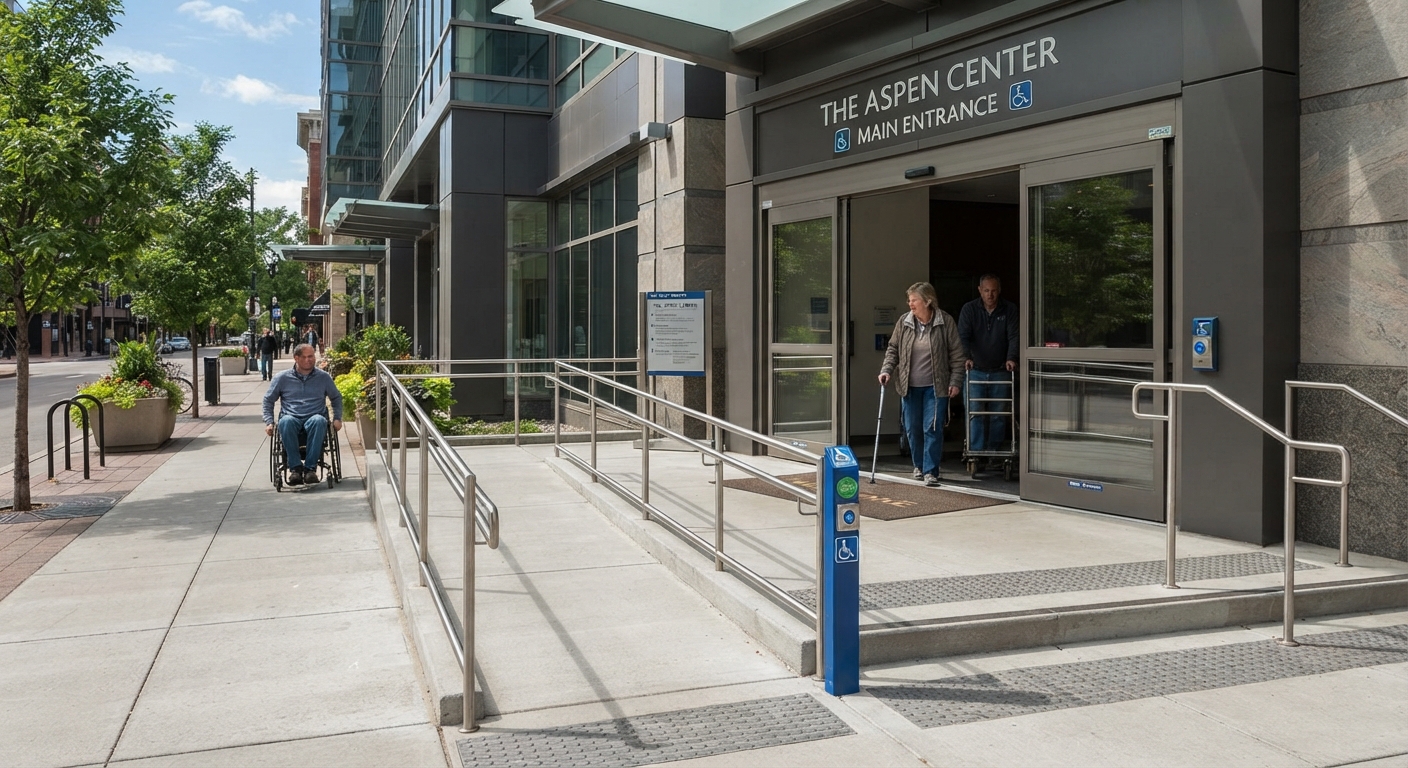
The ADA requires a clear, accessible path of travel from the public sidewalk or parking lot to the building entrance.
| Requirement | Details |
|---|---|
| Width | Minimum 36 inches clear width. |
| Surface | Stable, firm, and slip-resistant. |
| Slope | Maximum 1:12 (8.33%) for ramps [1]. |
| Obstructions | No protruding objects (e.g., signs, hydrants) in the path. |
Common Violation: Cracked or uneven sidewalks, steep ramps, or paths blocked by landscaping or furniture.
Checklist Item #2: Accessible Parking
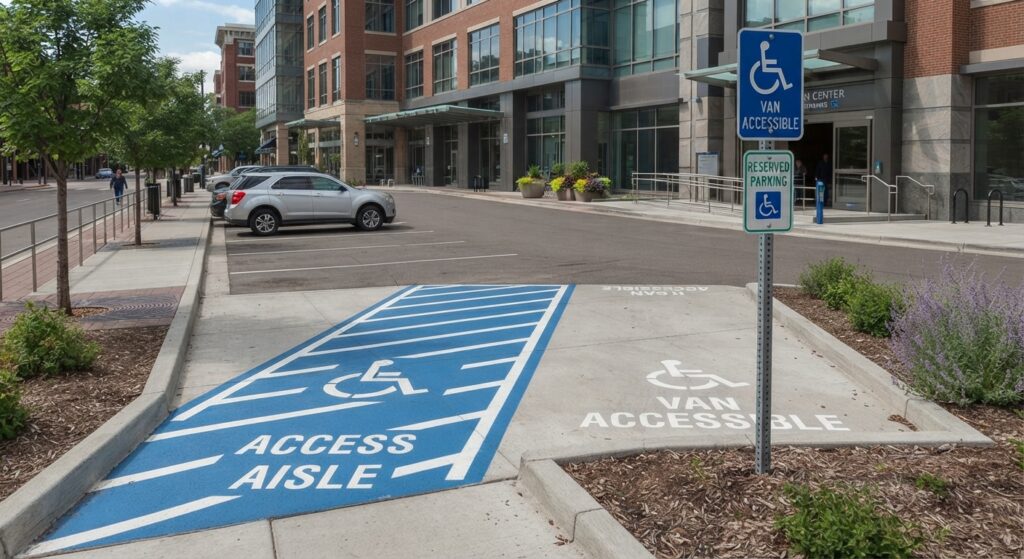
ADA parking requirements apply to both employee and visitor parking.
| Requirement | Details |
|---|---|
| Number of Spaces | 1 accessible space for every 25 total spaces [2]. |
| Van-Accessible Spaces | At least 1 van-accessible space (with 8 ft wide access aisle). |
| Signage | “Van Accessible” sign mounted 60–80 inches above the ground. |
| Surface | Level, stable, and slip-resistant. |
| Route | Direct accessible route to the entrance without crossing traffic lanes. |
Common Violation: Insufficient width of the access aisle, missing signage, or parking spaces not level.
Checklist Item #3: Accessible Entrance Doors
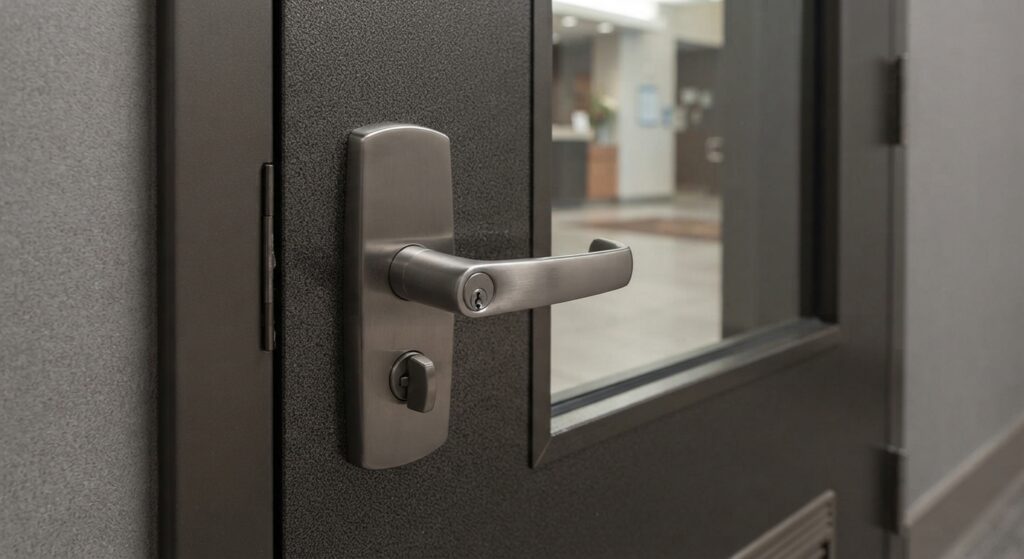
Doors are a common pain point for ADA compliance.
| Requirement | Details |
|---|---|
| Clear Width | Minimum 32 inches clear opening. |
| Threshold | Maximum 1/2 inch height (with beveled edges). |
| Opening Force | Maximum 5 lbs force to open (interior doors), 8.5 lbs for exterior doors. |
| Hardware | Lever-style handles (not round knobs) that operate with one hand. |
| Closing Speed | 5 seconds minimum to close from 90 degrees to 12 degrees [3]. |
Common Violation: Doors that require excessive force, thresholds over 1/2 inch, or round knobs.
Checklist Item #4: Accessible Restrooms
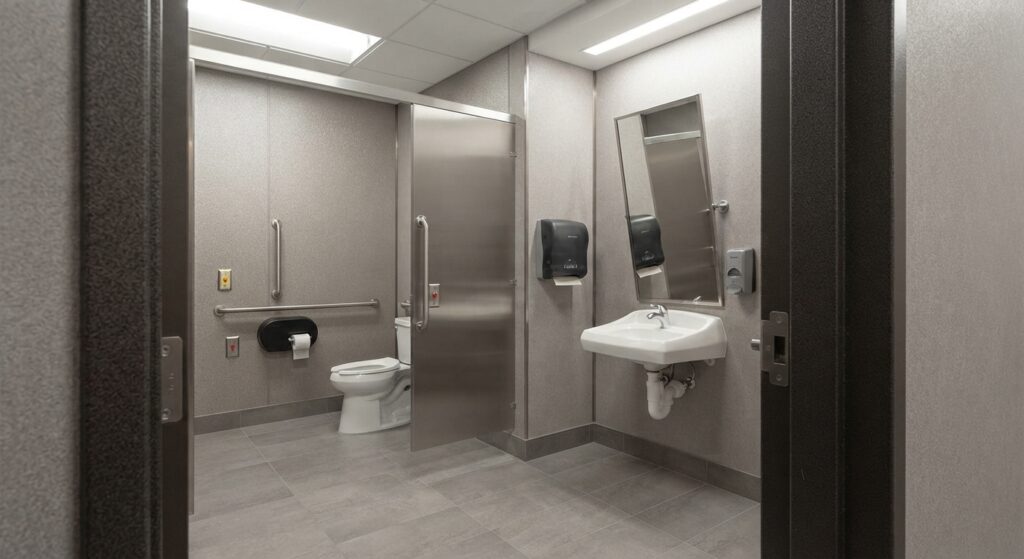
Restrooms are one of the most frequently cited ADA violations in commercial buildings.
| Requirement | Details |
|---|---|
| Single User Restroom | 60 inches x 60 inches minimum clear floor space for wheelchair turning. |
| Multiple User Restroom | At least one accessible stall: 60 inches wide by 56–59 inches deep. |
| Grab Bars | Must be installed on the back wall and side wall of accessible stalls. |
| Toilet Height | 17–19 inches from the floor to the top of the seat [4]. |
| Sink Height | Maximum 34 inches from the floor to the top of the rim. |
| Faucets | Lever, push-type, or motion-activated (not round knobs). |
| Clear Floor Space | Minimum 30 inches x 48 inches in front of sinks. |
| Paper Dispensers | Must be reachable from the seated position (within 48 inches height). |
Common Violation: Toilet paper dispensers mounted too high or too far, insufficient clear floor space, missing grab bars, or sink pipes not insulated (to prevent burns).
Checklist Item #5: Signage
ADA signage requirements ensure that all building occupants can navigate the space.
| Requirement | Details |
|---|---|
| Type | Raised characters and Braille on all permanent room signs [5]. |
| Height | Mounted 48–60 inches above the ground. |
| Contrast | Light characters on dark background (or vice versa). |
| Tactile | Raised characters must be at least 1/32 inch high. |
Common Violation: Signs mounted too high or too low, missing Braille, or insufficient contrast between characters and background.
Checklist Item #6: Common Areas
ADA compliance extends to common areas like hallways, lobbies, and waiting rooms.
| Requirement | Details |
|---|---|
| Clear Width | Minimum 36 inches in corridors. |
| Floor Surface | Stable, firm, and slip-resistant. |
| Protruding Objects | No objects protruding more than 4 inches into the path of travel [1]. |
| Drinking Fountains | One accessible unit per floor. |
| Fire Alarms | Audible and visual alarms (strobes) in public areas. |
Common Violation: Fire extinguishers or wall-mounted objects protruding into the hallway, narrow corridors, or missing visual fire alarms.
Conclusion
ADA compliance is not optional—it is a legal and ethical obligation. This checklist provides a comprehensive overview of the most frequently cited violations in commercial buildings.
Take Action Today:
- Walk your building with this checklist.
- Identify all non-compliant areas.
- Schedule repairs and upgrades.
- Document all changes for your records.
By ensuring your commercial property is fully ADA-compliant, you protect yourself from costly lawsuits, attract a wider range of tenants and customers, and create a more inclusive environment for everyone.
References & Notes
[1] 2010 ADA Standards for Accessible Design, Section 403 — Walking Surfaces, and Section 307 — Protruding Objects, U.S. Department of Justice.
[2] 2010 ADA Standards for Accessible Design, Section 208 — Parking Spaces.
[3] 2010 ADA Standards for Accessible Design, Section 404.2.8–404.2.9 — Doors, Doorways, and Gates.
[4] 2010 ADA Standards for Accessible Design, Section 604 — Water Closets and Toilet Compartments; ICC A117.1, Section 604.
[5] 2010 ADA Standards for Accessible Design, Section 703 — Signs.