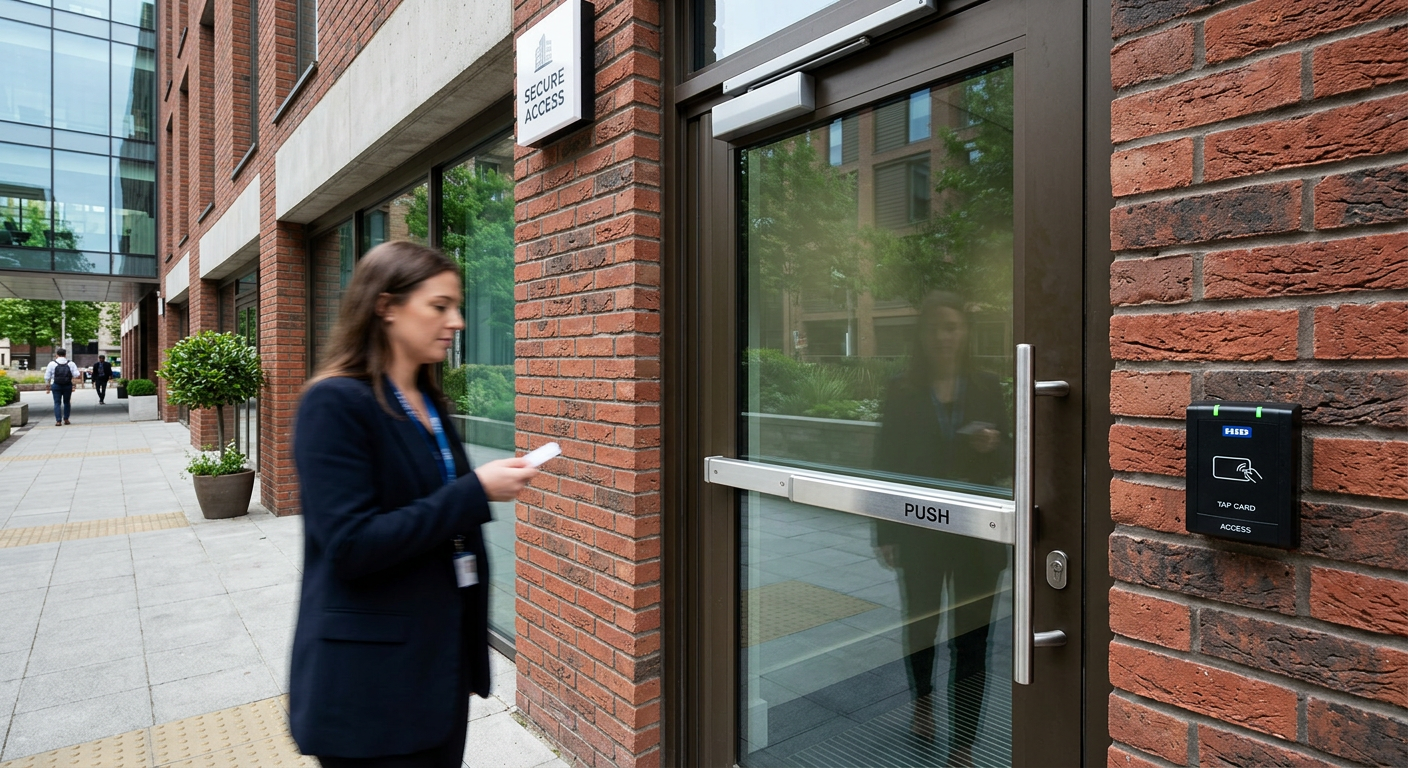
One of the most common questions in building design is: “Can I lock this door?”
The answer is not always. NFPA 101, the Life Safety Code, has strict rules about egress door locking. While most doors must be openable from the inside without a key, there are specific exceptions for:
-
Egress Door Locking (standard locks that require a key to exit).
-
Access-Controlled Egress (electronic locks that release upon a signal).
This guide explains the difference between these two concepts, when each is permitted, and how to comply with NFPA 101.
Section 1: The Golden Rule – Egress Door Locking (NFPA 101, 7.2.1.5.3)
The fundamental rule is that exit doors must be openable from the inside without the use of a key, tool, special knowledge, or effort (NFPA 101, 7.2.1.5.3).
Exceptions:
-
A keyed lock may be used on the main exit (if a single door or pair of doors) when the building is unoccupied.
-
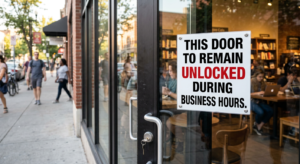
If the main exit is locked during business hours, a readily visible, durable sign must be posted stating: “THIS DOOR TO REMAIN UNLOCKED DURING BUSINESS HOURS.”
Prohibited Hardware:
-
Manually operated flush bolts (edge- or surface-mounted).
-
Sliding bolts or chains.
-
Any device that restricts the use of the exit during business hours.
Pro Tip: All exit doors must swing in the direction of exit travel when serving a hazardous area or when the occupant load is 50 or more.
Section 2: Access-Controlled Egress (NFPA 101, 7.2.1.6.2)
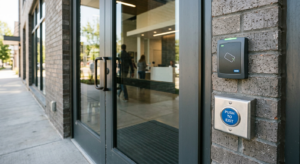
Access-Controlled Egress allows doors to be locked electronically, provided they unlock automatically under specific conditions.
Permitted Only Where Allowed by Occupancy Chapters:
Access-controlled egress is only permitted where specifically allowed by the occupancy chapters (12–42). The following occupancies permit access-controlled egress:
| Occupancy Type | Code Reference | Additional Requirements |
|---|---|---|
| Ambulatory | 20.2.2.2.5, 7.2.1.6.2 | — |
| Assembly | 12.2.2.2.5, 7.2.1.6.2 | Locking system disabled when building is occupied. |
| Business | 38.2.2.2.5, 7.2.1.6.2 | — |
| Educational | 14.2.2.2.3, 7.2.1.6 | Special locking arrangements. |
| Healthcare | 18.2.2.2.4(3), 7.2.1.6.2 | — |
| Hotels & Dormitories | 28.2.2.2.3, 7.2.1.6.2 | — |
| Apartments | 30.2.2.2.3, 7.2.1.6.2 | — |
| Mercantile | 36.2.2.2.5, 7.2.1.6.2 | Requires sprinkler or detection system. |
| Industrial | 40.2.2.2.3, 7.2.1.6.2 | — |
| Storage | 42.2.2.2.3, 7.2.1.6.2 | — |
Section 3: Requirements for Access-Controlled Egress (NFPA 101, 7.2.1.6.2)
Access-controlled egress doors must meet all of the following requirements:
| Requirement | Details |
|---|---|
| Sensor Detection | Doors shall unlock by an approved sensor that detects an approaching occupant on the egress side. |
| Loss of Power | Doors shall unlock on loss of power to the sensor or access control system. |
| Manual Release | A manual release button shall be located on the wall adjacent to the door, marked with a sign: “PUSH TO EXIT.” |
| Fire Alarm Activation | Doors shall unlock on activation of the building fire alarm system, smoke detection system, or sprinkler system. Doors shall remain unlocked until the system is reset. |
| Signage | A sign shall be posted on or adjacent to the door indicating that the door is access-controlled. |
Section 4: Delayed-Egress Locking (NFPA 101, 7.2.1.6.1)
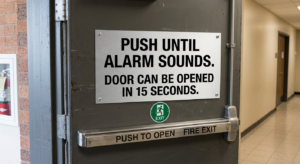
Delayed-Egress Locking allows doors to remain locked for a short period (up to 15 seconds) before unlocking.
Permitted Only Where Allowed by Occupancy Chapters:
| Occupancy Type | Code Reference | Additional Requirements |
|---|---|---|
| Assembly | 12.2.2.2.4, 7.2.1.6.1 | Not at main entrance doors. |
| Business | 38.2.2.2.4, 7.2.1.6.1 | — |
| Educational | 14.2.2.2.3, 7.2.1.6 | Special locking arrangements. |
| Healthcare | 18.2.2.2.4(2), 7.2.1.6.1 | Single delayed-egress lock permitted. |
| Hotels & Dormitories | 28.2.2.2.3, 7.2.1.6.1 | Single delayed-egress lock permitted. |
| Apartments | 30.2.2.2.2.2, 7.2.1.6.1 | Single delayed-egress lock permitted. |
| Mercantile | 36.2.2.2.4, 7.2.1.6.1 | — |
| Industrial | 40.2.2.2.2, 7.2.1.6.1 | — |
| Storage | 42.2.2.2.2, 7.2.1.6.1 | — |
Requirements for Delayed-Egress Locking:
| Requirement | Details |
|---|---|
| Time Delay | Maximum 15 seconds. |
| Activation Force | Not more than 15 lbf (67 N) applied for not more than 3 seconds. |
| Audible Signal | An audible signal must sound in the vicinity of the door during the delay. |
| Signage | A sign must be posted adjacent to the door stating: “PUSH UNTIL ALARM SOUNDS. DOOR CAN BE OPENED IN 15 SECONDS.” |
| Emergency Lighting | Emergency lighting is required at the locked door (NFPA 101, 7.9.1.1(4)). |
| Unlock on Alarm | The door must unlock on activation of the fire alarm system or sprinkler system. |
| Unlock on Power Loss | The door must unlock on loss of power. |
| Manual Reset | Once the door lock has been released, relocking shall be by manual means only. |
Section 5: Comparison Table – Egress Locking vs. Access-Controlled vs. Delayed-Egress
| Feature | Egress Locking | Access-Controlled | Delayed-Egress |
|---|---|---|---|
| Key Required? | Yes (to unlock) | No (unlocks automatically) | No (unlocks after delay) |
| Allowed During Occupancy? | No (must be unlocked) | Yes (under specific conditions) | Yes (under specific conditions) |
| Unlock on Fire Alarm? | N/A (must be unlocked anyway) | Yes | Yes |
| Unlock on Power Loss? | N/A | Yes | Yes |
| Time Delay | None | None | Maximum 15 seconds |
| Signage Required? | Yes (if locked during business hours) | Yes | Yes |
| Manual Release? | N/A | Yes (PUSH TO EXIT button) | Yes (push on door) |
Section 6: Common Mistakes and How to Avoid Them
| Mistake | Why It’s a Problem | How to Fix |
|---|---|---|
| Locking exit doors during business hours | Violates NFPA 101, 7.2.1.5.3. | Keep doors unlocked. Post sign if main exit is locked. |
| Using access-controlled egress without approval | Not permitted in all occupancies. | Verify the occupancy chapter permits it. |
| Missing signage | Occupants may not know how to exit. | Install required signs. |
| Not unlocking on fire alarm | Violates NFPA 101, 7.2.1.6.2(4). | Ensure doors unlock on fire alarm. |
| Not unlocking on power loss | Violates NFPA 101, 7.2.1.6.2(2). | Ensure doors unlock on power loss. |
| Using prohibited hardware | Flush bolts and sliding bolts are prohibited. | Remove prohibited hardware. |
Section 7: Special Note – Healthcare and Ambulatory Occupancies
In Healthcare (Chapter 18) and Ambulatory (Chapter 20) occupancies, doors can be locked to confine and protect building inhabitants (e.g., patients who may wander). This is permitted under NFPA 101, 20.1.1.1.7 and 18.1.1.1.7.
Conclusion
Understanding egress door locking, access-controlled egress, and delayed-egress systems is essential for compliant life safety design. By following the requirements and avoiding common mistakes, you can ensure that your building provides safe egress for all occupants.
Take Action Today:
-
Identify all exit doors in your building.
-
Verify the locking arrangement is compliant.
-
Install required signage where applicable.
-
Test access-controlled and delayed-egress systems regularly.
Continue Reading from Our NFPA 101 Series:
-
Read more about: Corridor, Door, and Stair Width Requirements
-
Learn more: Travel Distance Limits by Occupancy Type
-
Related guide: NFPA 101 Means of Exit Requirements