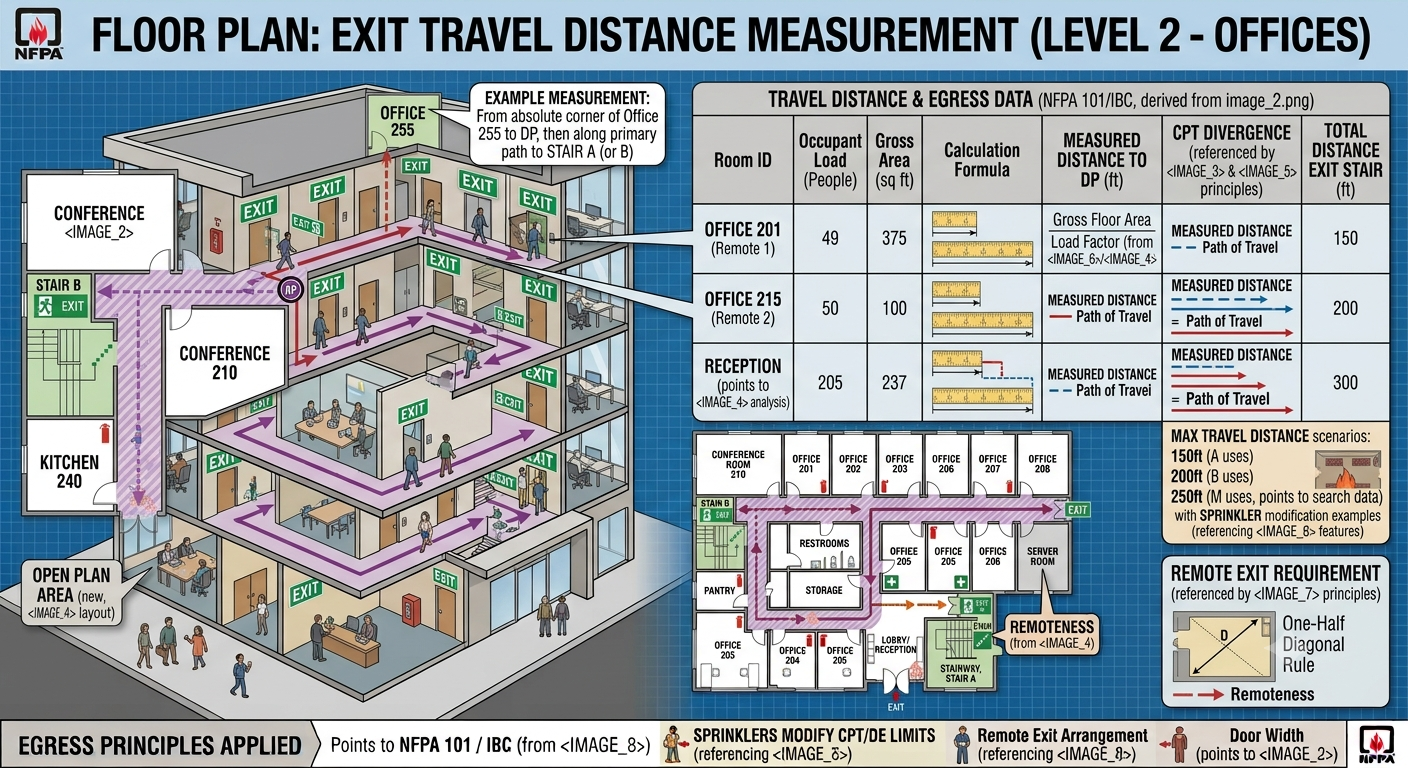
Travel distance is one of the most critical factors in life safety design. It determines how far occupants must walk to reach a safe exit. If the travel distance is too long, occupants may be exposed to fire and smoke for an extended period.
NFPA 101, the Life Safety Code, sets specific maximum travel distance limits for each occupancy type. These limits vary based on:
-
Occupancy type (e.g., Business, Assembly, Healthcare).
-
Whether the building is sprinklered (sprinklers allow longer travel distances).
-
The hazard level of the contents (Low, Ordinary, High).
This guide provides a complete overview of travel distance limits by occupancy type under NFPA 101.

Section 1: What Is Travel Distance?
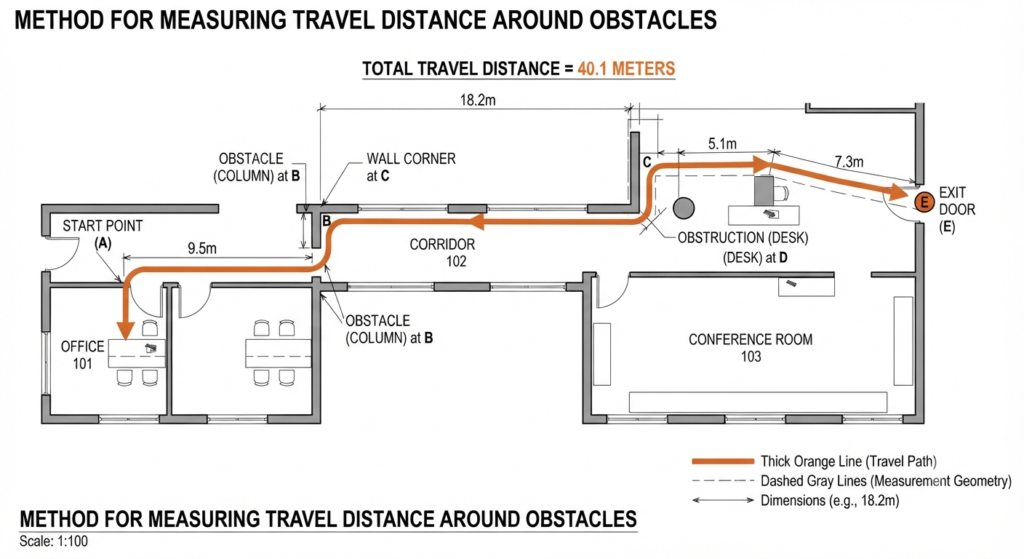
Travel distance is the total distance an occupant must travel from any point in a building to reach an exit. It is measured along the natural path of travel, considering walls, partitions, and fixed obstructions.
Key Definitions:
| Term | Definition |
|---|---|
| Travel Distance | The distance from any point to the nearest exit. |
| Common Path of Travel | The distance before two exits are available. |
| Dead-End Corridor | A corridor that does not lead to an exit. |
The Golden Rule: The travel distance must be measured along the actual path an occupant would take, not a straight line.
Section 2: Travel Distance Limits by Occupancy Type
NFPA 101 sets specific maximum travel distances for each occupancy type. The limits are based on the occupancy chapter (12–42) and Chapter 7 (Means of Egress).
| Occupancy Type | Sprinklered | Not Sprinklered | Code Reference |
|---|---|---|---|
| Ambulatory | 61 m | 46 m | 20.2.6.2.2, 20.2.6.2.1 |
| Assembly | 76 m | 61 m | 12.2.6.2(1), 12.2.6.2 |
| Business | 91 m | 61 m | 38.2.6.3, 38.2.6.2 |
| Educational | 61 m | 46 m | 14.2.6.3, 14.2.6.2 |
| Healthcare | 61 m (from any point) | 61 m | 18.2.6.2.1, 18.2.6.2.1 |
| Hotels & Dormitories | 61 m (corridor to exit) | 30 m (corridor to exit) | 28.2.6.3.2, 28.2.6.3.1 |
| Apartments | 61 m (corridor to exit) | 30 m (corridor to exit) | 30.2.6.3.2, 30.2.6.3.1 |
| Mercantile | 76 m | 46 m | 36.2.6.2, 36.2.6.1 |
| Storage | Varies (see Table 42.2.6) | Varies (see Table 42.2.6) | 42.2.6 |
| Industrial | Varies (see Table 40.2.6) | Varies (see Table 40.2.6) | 40.2.6 |
Section 3: Special Considerations
Healthcare (Patient Sleeping Rooms)
In healthcare occupancies, the travel distance within a sleeping room to the room door is limited to 15 m (NFPA 101, 18.2.6.2.3).
Hotels & Dormitories
Travel distance limits are divided into two parts:
-
Within the guest room to the corridor door: 23 m (non-sprinklered) / 38 m (sprinklered).
-
From the corridor door to the exit: 30 m (non-sprinklered) / 61 m (sprinklered).
Industrial & Storage
Travel distance limits for industrial and storage occupancies vary based on the hazard level (Low, Ordinary, High) and whether the building is sprinklered. Refer to NFPA 101 Tables 40.2.6 and 42.2.6 for complete details.
Section 4: How to Measure Travel Distance
| Step | Action |
|---|---|
| 1 | Identify the most remote point in the space. |
| 2 | Trace the natural path of travel (considering walls, partitions, and fixed obstructions). |
| 3 | Measure the path to the nearest exit. |
| 4 | Verify the distance against the applicable limit. |
| 5 | If exceeding the limit, add an exit or redesign the layout. |
Pro Tip: Use architectural software (e.g., AutoCAD, Revit) to measure travel distances accurately.
Section 5: Practical Examples
Example 1: Business Office (Sprinklered)
| Item | Value |
|---|---|
| Occupancy | Business |
| Sprinklered? | Yes |
| Travel Distance Limit | 91 m |
| Measured Distance | 65 m |
| Result | ✅ Compliant (65 m < 91 m) |
Example 2: Assembly Space (Non-Sprinklered)
| Item | Value |
|---|---|
| Occupancy | Assembly |
| Sprinklered? | No |
| Travel Distance Limit | 61 m |
| Measured Distance | 72 m |
| Result | ❌ Non-Compliant (72 m > 61 m) |
| Fix | Add an additional exit or install sprinklers. |
Section 6: Common Mistakes and How to Avoid Them
| Mistake | Why It’s a Problem | How to Fix |
|---|---|---|
| Measuring straight-line distance | Not the natural path of travel. | Always measure the path around walls and obstacles. |
| Ignoring sprinklered vs. non-sprinklered | Applies the wrong limit. | Always verify whether the building is sprinklered. |
| Not checking occupancy-specific limits | Different occupancies have different limits. | Always check the specific occupancy chapter. |
| Forgetting internal travel distances | Sleeping rooms have additional limits. | Include internal room distances where applicable. |
| Not verifying with AHJ | Local amendments may differ. | Always confirm with your local Authority Having Jurisdiction. |
Section 7: How to Reduce Travel Distance
| Strategy | How It Helps |
|---|---|
| Add additional exits | Reduces the distance to the nearest exit. |
| Install sprinklers | Allows for longer travel distances. |
| Reconfigure the floor plan | Shortens the natural path of travel. |
| Use smoke compartments | Can help subdivide spaces and reduce travel distances. |
| Provide horizontal exits | Allows occupants to move to a safer area without leaving the building. |
Conclusion
Travel distance is a critical factor in life safety design. By understanding the limits for each occupancy type and following the measurement guidelines, you can ensure that your building provides adequate egress for all occupants.
Take Action Today:
-
Identify the most remote point in each space.
-
Measure the natural path of travel to the nearest exit.
-
Compare the distance to the applicable limit.
-
Add exits or redesign where necessary.
Continue Reading from Our NFPA 101 Series:
-
Read more about: Common Path of Travel and Dead-End Corridors
-
Learn more: How to Know How Many Exits Are Required
-
Related guide: NFPA 101 Means of Exit Requirements