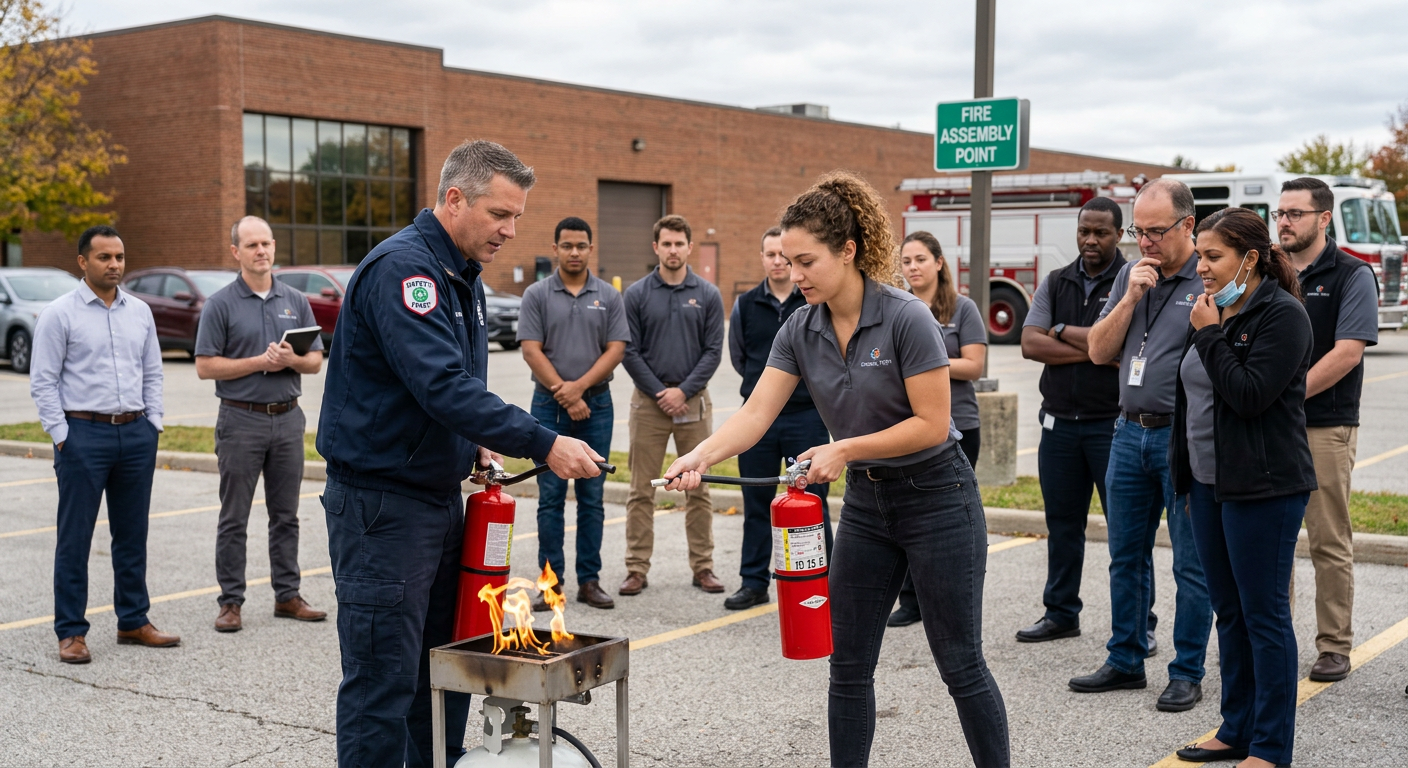
Your fire safety plan is only as good as the people who execute it. A well-trained workforce can mean the difference between a minor incident and a major catastrophe. Effective fire emergency training ensures that employees know what to do, where to go, and how to respond when every second counts[1].
This guide provides a step-by-step framework for training employees on fire emergencies, covering everything from initial awareness to hands-on extinguisher use.
Section 1: Why Employee Fire Training Matters
| Reason | Why It Matters |
|---|---|
| Life Safety | Trained employees can evacuate quickly and safely, reducing the risk of injury or death [1]. |
| Regulatory Compliance | NFPA 101 and OSHA require fire training and drills for most occupancies [2][4]. |
| Property Protection | Quick and correct use of extinguishers can extinguish small fires before they spread [3]. |
| Liability Reduction | Documented training demonstrates due diligence in the event of an incident [1]. |
Pro Tip: Training is not a one-time event—it must be ongoing and reinforced regularly.
Section 2: Core Training Components
An effective fire emergency training program should include the following components [1][2][3]:
A. Fire Prevention Awareness
| Topic | Key Points |
|---|---|
| Common Fire Causes | Electrical faults, unattended cooking, improper storage of combustibles [3]. |
| Housekeeping | Keep exits clear, store flammable materials safely, and maintain a clean workspace [3]. |
| Reporting Hazards | Employees should know how to report fire hazards to management [1]. |
| Smoking Policies | Designated smoking areas and proper disposal of smoking materials [3]. |
B. Evacuation Procedures
| Topic | Key Points |
|---|---|
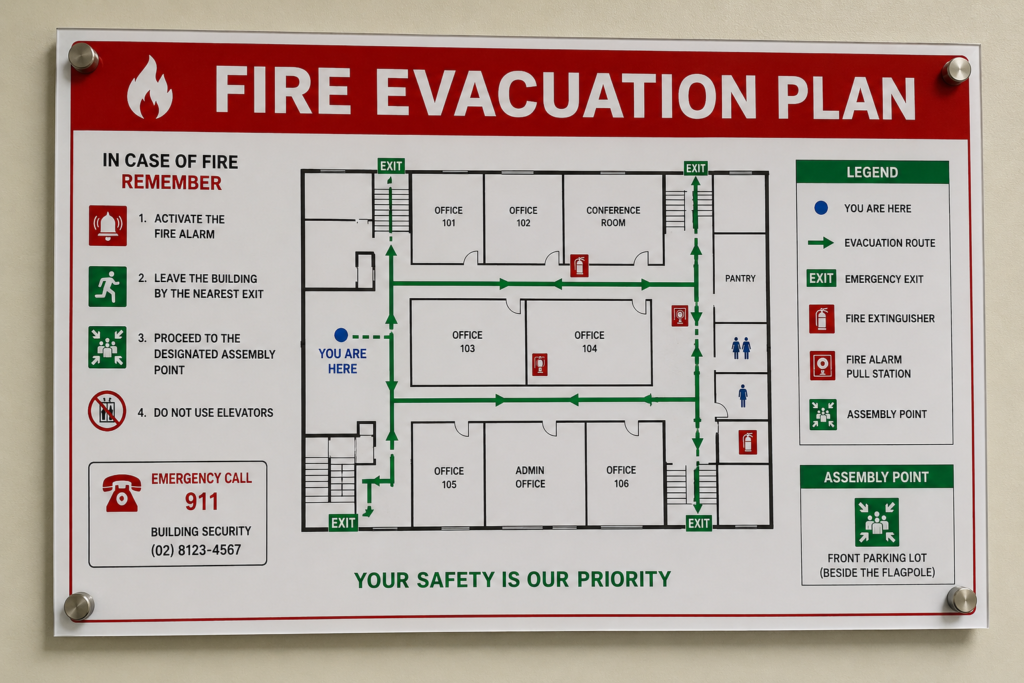
| Evacuation Routes | Employees must know the primary and secondary evacuation routes[2]. |
| Assembly Points | Designated safe areas outside the building for headcounts[2]. |
| Accounting for Occupants | Procedures for checking that all employees have evacuated[2]. |
| Assisting Others | How to assist individuals with disabilities or special needs[1]. |
C. Fire Extinguisher Training
| Topic | Key Points |
|---|---|
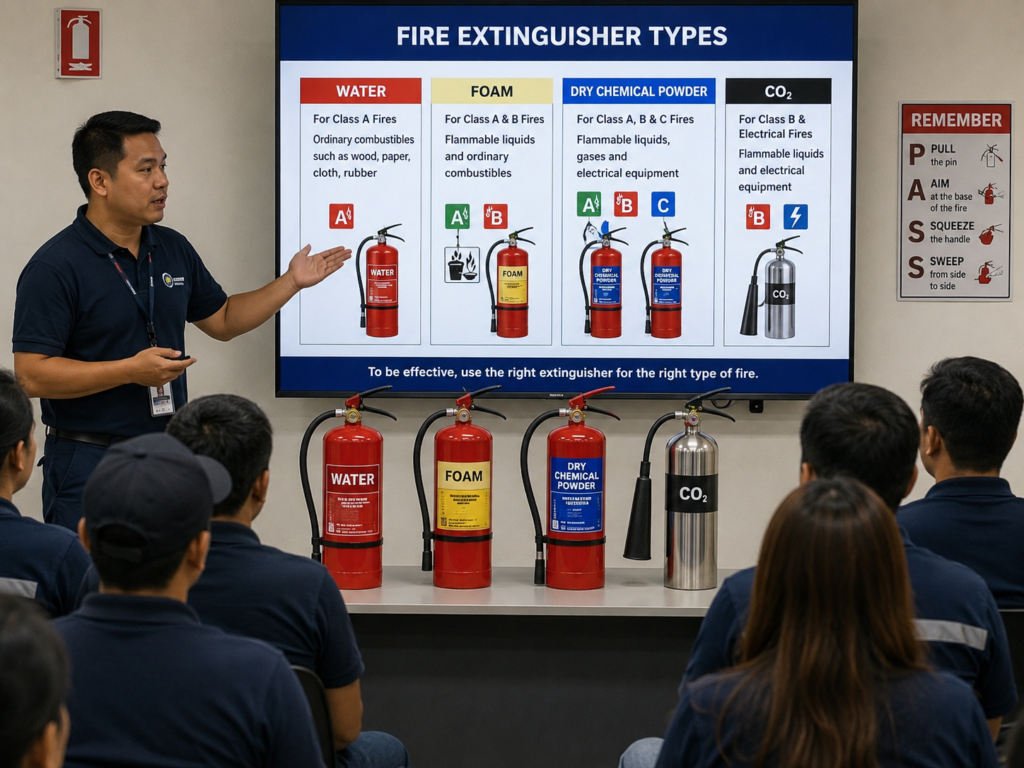
| Types of Extinguishers | Class A, B, C, D, and K—what each is used for [3]. |
| PASS Technique | Pull, Aim, Squeeze, Sweep—the correct way to use an extinguisher [3]. |
| When to Fight a Fire | Small, contained fires only—never fight a fire that is spreading or blocking your exit [3]. |
| When to Evacuate | If the fire is too large, the extinguisher is empty, or the smoke is thick, evacuate immediately [3]. |
D. Alarm and Notification
| Topic | Key Points |
|---|---|
| Alarm Signals | Employees should recognize the fire alarm sound [1]. |
| Manual Pull Stations | How to activate the alarm if they discover a fire [3]. |
| Communication | How to notify management and emergency services [1]. |
Section 3: The PASS Technique (Hands-On Training)
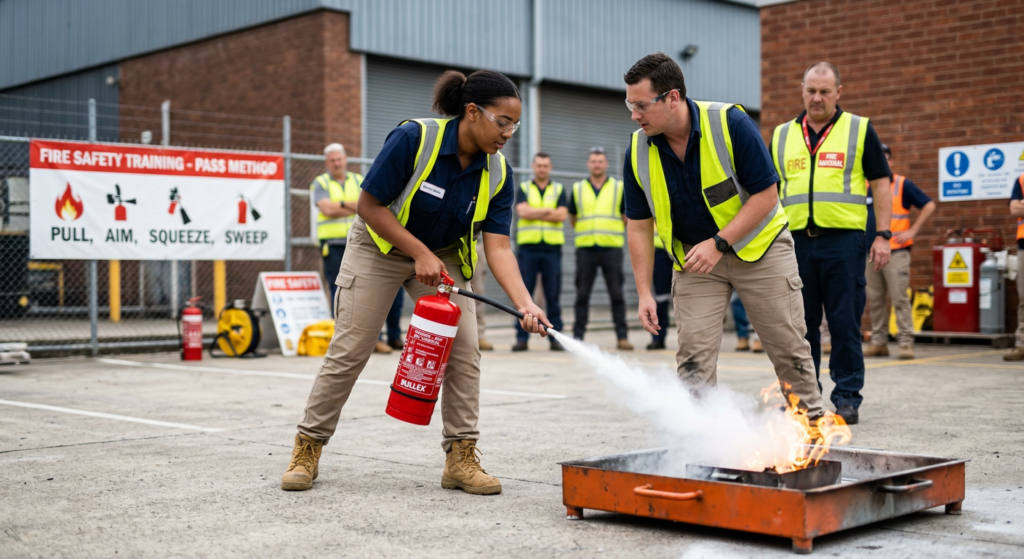
Every employee should be trained in the PASS technique for using a fire extinguisher [3]:
| Letter | Action | Description |
|---|---|---|
| P | Pull | Pull the pin at the top of the extinguisher, breaking the seal. |
| A | Aim | Aim the nozzle or hose at the base of the fire, not the flames. |
| S | Squeeze | Squeeze the handle to release the extinguishing agent. |
| S | Sweep | Sweep the nozzle from side to side at the base of the fire until it is out. |
Pro Tip: Provide hands-on training with a training extinguisher (water or digital simulator) so employees can practice the technique safely [3].
Section 4: Training Methods and Delivery
| Method | Description | Best For |
|---|---|---|
| Classroom Training | Instructor-led presentations covering theory and procedures [1]. | New hires, annual refresher training. |
| Hands-On Practice | Practical exercises using training extinguishers or simulators [3]. | Fire extinguisher training, evacuation drills. |
| Fire Drills | Simulated emergency evacuations [2]. | All employees, testing the entire plan. |
| Online Modules | Self-paced e-learning courses [3]. | Off-site employees, refresher training. |
| Video Demonstrations | Visual demonstrations of procedures [3]. | Supplement to other training methods. |
| Tabletop Exercises | Discussion-based scenarios [1]. | Management teams, emergency response teams. |
Pro Tip: Use a combination of methods to cater to different learning styles [1].

Section 5: Fire Drills: The Practical Test
Fire drills are the most critical component of employee training [1][2].
Fire Drill Checklist:
| Item | Requirement |
|---|---|
| Frequency | Annually at minimum, quarterly for high-occupancy buildings [2]. |
| Advance Notice | Notify employees in advance (to avoid panic) but occasionally conduct unannounced drills [1]. |
| Evacuation Time | Measure how long it takes to evacuate and account for all occupants [1]. |
| Scenario Variation | Practice different scenarios (e.g., blocked exits, power outage) [2]. |
| Documentation | Record the date, time, duration, and any issues encountered [1][2]. |
| Debrief | Review the drill with employees and management to identify areas for improvement [1]. |
Pro Tip: Conduct drills during different times of day and in different weather conditions to prepare for real emergencies [1].
Section 6: Training Frequency
| Training Type | Frequency | Description |
|---|---|---|
| New Hire Orientation | Upon hire | Basic fire safety training for all new employees[1]. |
| Annual Refresher | Annually | Review of procedures, updated information[1]. |
| Fire Drills | Annually (minimum) | Practical evacuation exercises[2]. |
| Extinguisher Training | Annually | Hands-on practice with fire extinguishers[3]. |
| Specialized Training | As needed | Training for emergency response teams, floor wardens, etc.[1]. |
Section 7: Documentation and Record Keeping
| Document | What to Record | Retention |
|---|---|---|
| Training Attendance | Employee names, date, topics covered[1]. | At least 3 years. |
| Drill Records | Date, time, duration, participants, issues[2]. | At least 3 years. |
| Extinguisher Training Records | Employee names, date, type of training[3]. | At least 3 years. |
| Certificates | Completion certificates for specialized training[1]. | As required. |
Pro Tip: Consider using a digital training management system to track and document employee training[1].
Section 8: Special Considerations
A. Individuals with Disabilities
| Consideration | Action |
|---|---|
| Evacuation Assistance | Assign “buddies” to assist individuals with mobility, hearing, or vision impairments [1]. |
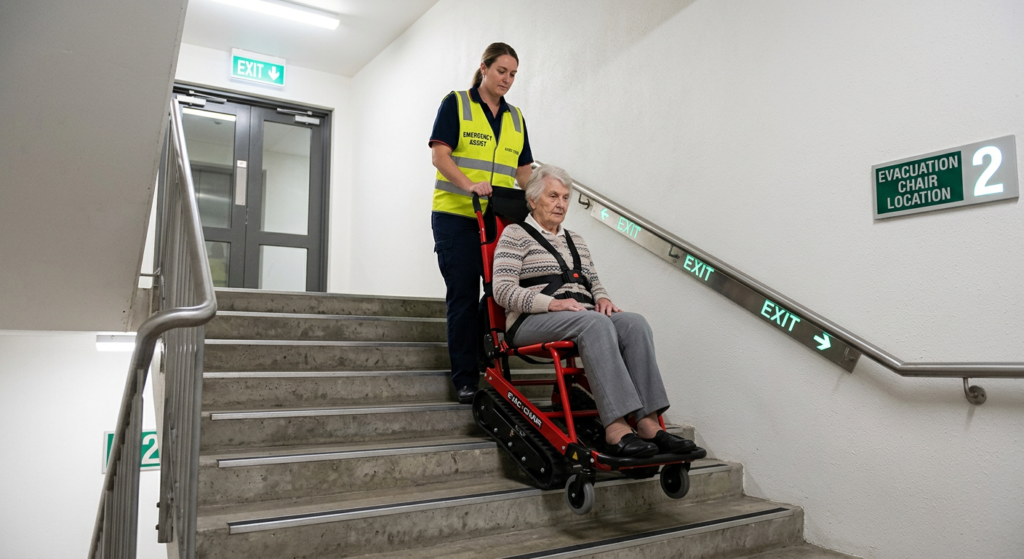
| Evacuation Devices | Provide evacuation chairs or sleds for stairwells[1]. |
| Notification | Provide strobe lights or vibrating pagers for individuals with hearing impairments[1]. |
| Practice | Include individuals with disabilities in drills to ensure procedures work[1]. |
B. Language and Literacy
| Consideration | Action |
|---|---|
| Multiple Languages | Provide training materials in languages spoken by employees[1]. |
| Visual Aids | Use pictograms, diagrams, and videos to supplement written materials[1]. |
| Simple Language | Use clear, simple language in written materials[1]. |
C. Night Shift and Remote Workers
| Consideration | Action |
|---|---|
| Night Shift Training | Ensure night shift employees receive the same training as day shift[1]. |
| Remote Workers | Provide online training and ensure they know evacuation procedures for their location[1]. |
Section 9: Common Mistakes and How to Avoid Them
| Mistake | Why It’s a Problem | How to Fix |
|---|---|---|
| One-time training only | Employees forget procedures over time[1]. | Provide annual refresher training[1]. |
| Not practicing with extinguishers | Employees freeze when they need to use one[3]. | Provide hands-on practice[3]. |
| No drills | Employees are unprepared for a real emergency[2]. | Conduct regular fire drills[2]. |
| Not documenting training | Cannot prove compliance[1]. | Maintain thorough records[1]. |
| Ignoring individuals with disabilities | May leave vulnerable employees behind[1]. | Include them in planning and drills[1]. |
Conclusion
Effective employee training is the cornerstone of fire safety in any commercial building. By providing comprehensive training, conducting regular drills, and maintaining thorough documentation, you can ensure that your employees are prepared to respond quickly and safely in an emergency.
Take Action Today:
-
Assess your current training program against the components listed in this guide.
-
Schedule annual refresher training for all employees.
-
Conduct fire drills and document them.
-
Provide hands-on fire extinguisher training using the PASS technique.
-
Update your training materials to include individuals with disabilities and language considerations.
Continue Reading from Our Series:
-
Read more about: How to Conduct a Fire Safety Audit
-
Learn more: How to Prepare for a Fire Department Inspection
-
Related guide: Commercial Building Fire Safety Plan: Development and Implementation
References & Notes:
[1] NFPA 101, Life Safety Code, 2012 Edition.
[2] NFPA 101, 4.8, 14.7, and 38.7 (Fire Safety Plans and Drills).
[3] NFPA 10, Standard for Portable Fire Extinguishers.
[4] OSHA 1910.157, Portable Fire Extinguishers (Training requirements).
[End of Article]