IMPORTANT DISCLAIMER: This guide references NFPA 13, Standard for the Installation of Sprinkler Systems (particularly Chapters 20–25 on storage); NFPA 1, Fire Code; NFPA 101, Life Safety Code; and the International Fire Code (IFC), Chapter 32 (High-Piled Combustible Storage). These codes vary significantly by edition and are frequently amended by state and local jurisdictions. NFPA 13 editions include 2019, 2022, and 2025. The most recent published edition is NFPA 13 (2025), but AHJ-adopted editions commonly lag behind by one or more cycles. Section numbers and table references in NFPA 13 have shifted between editions, particularly in the storage chapters. Local amendments and the edition adopted by your Authority Having Jurisdiction (AHJ) always control. This guide is a starting point only—always verify the specific requirements applicable to your project with your local AHJ.
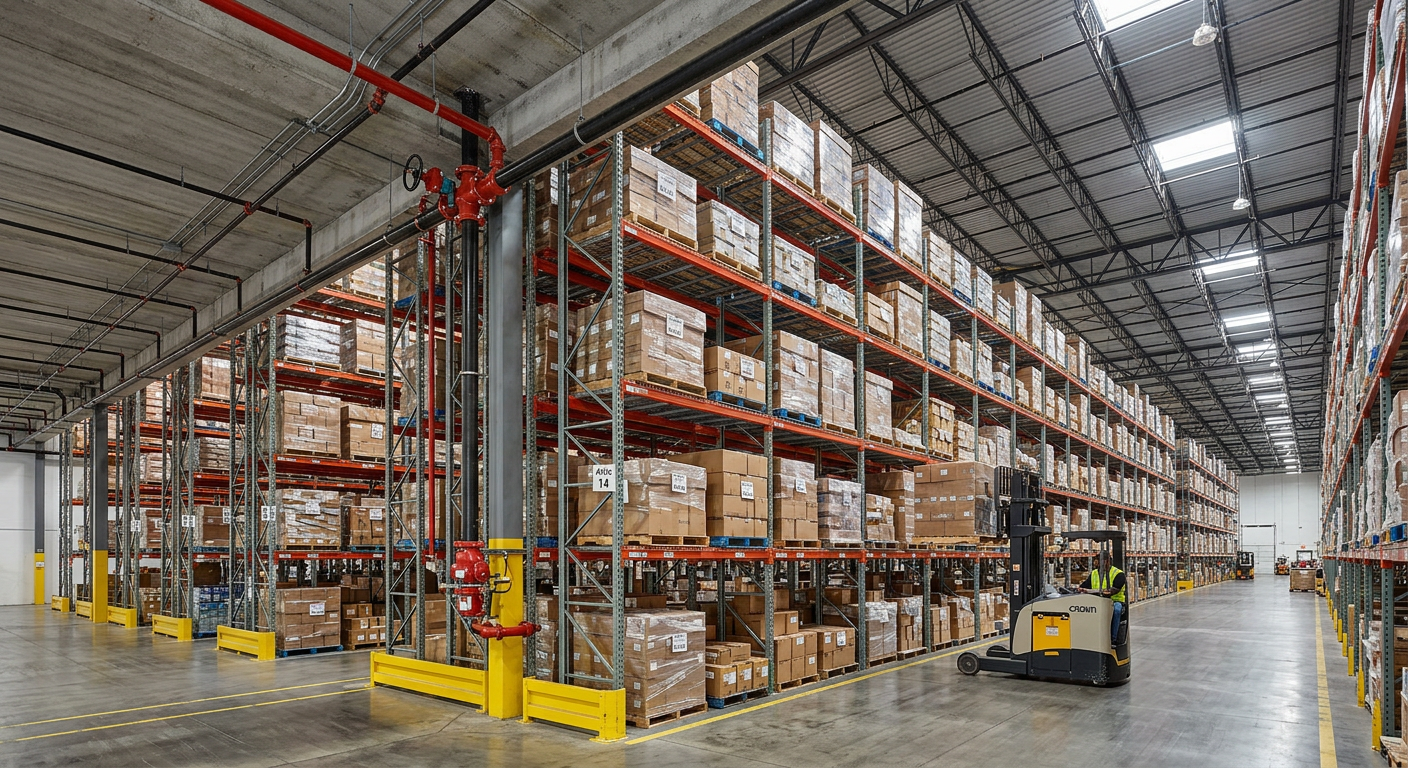
High-piled storage is one of the most technically demanding fire protection challenges in commercial construction. A warehouse storing paper products on wooden pallets in open racks is a fundamentally different fire hazard than one storing expanded Group A plastics on solid shelves. The commodity classification, storage arrangement, rack type, aisle width, and ceiling height all interact to determine whether a fire can be controlled—or whether it will overwhelm the sprinkler system before it can act.
NFPA 13 devotes more than five chapters to storage protection because the variables matter. The difference between a well-designed and poorly-designed high-piled storage system is not a matter of degree—it is the difference between suppression and total loss.
This guide covers the fundamentals of high-piled storage fire protection under NFPA 13 and the IFC, with a focus on the decisions that drive design.
◆ Section 1: What Counts as High-Piled Storage
The IFC defines high-piled combustible storage as storage of combustible materials in closely packed piles, on pallets, in racks, or on shelves where the top of storage is greater than 12 feet (3,658 mm) in height. Below that threshold, different provisions apply.
NFPA 13 does not use the term “high-piled storage” as a standalone definition. Instead, it addresses storage through a system of commodity classifications, storage arrangements, and height thresholds that determine which protection tables apply.
Key point: The 12-foot threshold in the IFC is a trigger for the code’s high-piled storage provisions. NFPA 13’s storage chapters apply based on the specific commodity, arrangement, and height—not a single threshold.
◆ Section 2: Commodity Classification — The Foundation
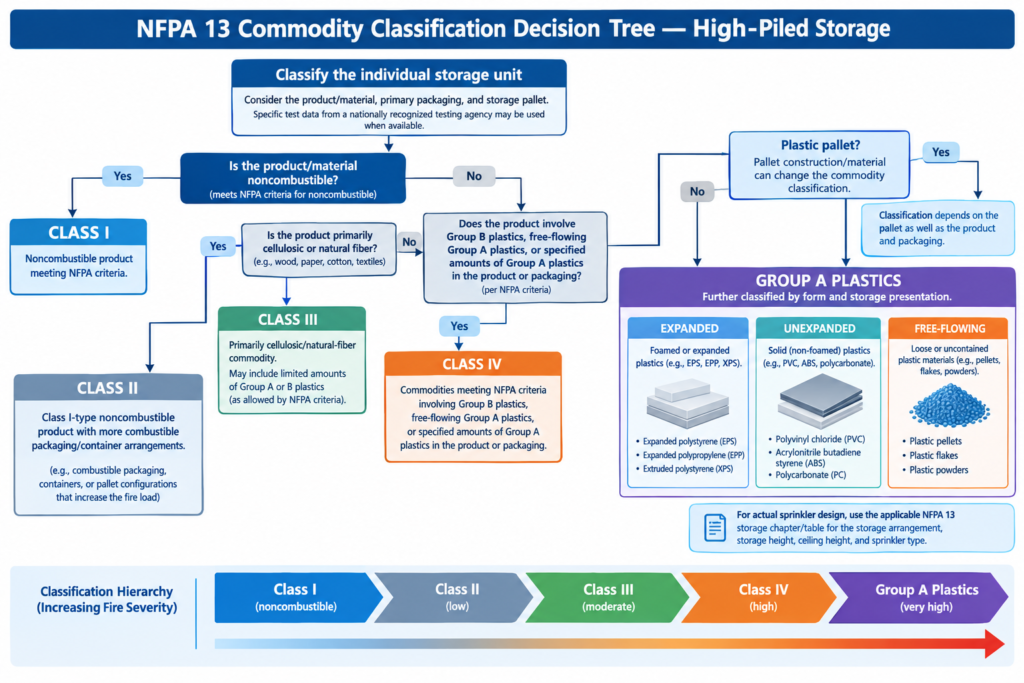
Everything in high-piled storage protection flows from commodity classification. The commodity is the combination of the product, its packaging, and its container—including pallets.
A. The Five Commodity Classes
NFPA 13 classifies commodities from least to most hazardous:
| Class | Description | Typical Examples |
|---|---|---|
| Class I | Essentially noncombustible products on pallets or in containers | Metal parts, glass bottles in cartons |
| Class II | Noncombustible products in combustible packaging | Canned goods in cardboard boxes |
| Class III | Ordinary combustibles with limited plastics | Paper products, wood furniture, natural fiber textiles |
| Class IV | Ordinary combustibles with more plastics, or free-flowing Group A plastics | Cartoned appliances with plastic components, plastic pellets |
| Group A Plastics | The most severe hazard; plastics that burn intensely | Expanded polystyrene, polyurethane foam, plastic pallets |
B. Plastics Drive Classification
Plastics are ranked into Groups A, B, and C based on heat of combustion and heat release rate. Group A plastics represent the most severe hazard—they can produce 1½ to 3 times as much heat per unit of weight as wood or paper.
A commodity containing more than 15% by weight of unexpanded Group A plastic, or more than 25% by volume of expanded Group A plastic, is classified as Group A plastic regardless of the other contents.
Pro Tip: The commodity classification is not a judgment call—it follows the flowchart in NFPA 13 Chapter 5 (and the annex figures). If you are unsure, the answer is almost always “higher than you think.” When in doubt, assume the more hazardous classification.
◆ Section 3: Storage Arrangements
The physical arrangement of storage has as much impact on fire behavior as the commodity itself.
| Arrangement | Description | Fire Behavior |
|---|---|---|
| Solid-piled | Materials stacked directly on each other | Moderate fire growth; limited air circulation |
| Palletized | Materials on pallets, stacked | Air passages through pallets accelerate fire |
| Shelf storage | Materials on shelves | Combustibles on multiple levels |
| Single-row rack | One rack deep | Accessible from both sides |
| Double-row rack | Two racks back-to-back | Common in warehouses |
| Multiple-row rack | Three or more racks deep | Highest shielding, most challenging for ceiling sprinklers |
A. Open vs. Solid Shelf Racking
NFPA 13 distinguishes between open racking and solid shelf racking. A rack qualifies as solid shelf if it has solid shelves larger than 20 ft² (1.9 m²), or if pallet loads within open racks do not have minimum 6-inch (150 mm) wide flues on all four sides.
Solid shelf racking requires in-rack sprinklers at every tier level because ceiling sprinklers cannot penetrate the shielding.
B. Multiple-Row Rack Complexity
The 2022 edition of NFPA 13 changed the definition of open racking for multiple-row racks. To qualify as open, a multiple-row rack must either have 6-inch flues around each pallet load, or have 6-inch transverse flues no more than 5 feet apart and be limited to 20 feet depth with minimum 3½-foot aisles.
Racks that do not meet these criteria are treated as solid shelf and require in-rack sprinklers at every tier—a requirement many stakeholders find onerous.
Pro Tip: If your warehouse uses deep multiple-row racks, verify whether they qualify as open racking under your adopted NFPA 13 edition. The definition changed in 2022, and racks that were previously acceptable may now require in-rack sprinklers.
◆ Section 4: Sprinkler Design Approaches
NFPA 13 provides three primary design approaches for high-piled storage, each with different hydraulic calculation methods and fire control objectives.
A. Control Mode Density/Area (CMDA)
CMDA sprinklers are designed to control a fire and limit its spread, not extinguish it. They are characterized by relatively high flow rates at relatively low pressures.
Hydraulic calculations use a density/area approach: a specified water density (gpm/ft²) over a specified design area (ft²).
B. Control Mode Specific Application (CMSA)
CMSA sprinklers are also designed to control a fire. They are similar to CMDA but use specific application criteria—typically higher pressures and specific sprinkler orientations—rather than density/area curves.
C. Early Suppression Fast Response (ESFR)
ESFR sprinklers are designed to suppress a fire—not just control it. They deliver high water density at high pressure with large droplets that penetrate the fire plume and attack the seat of the fire.
ESFR is the industry-preferred sprinkler type because of its ability to extinguish rather than control. The 2025 edition of NFPA 13 expanded ESFR clearance and density tables to cover ceiling heights up to 45 feet.
| Approach | Objective | Hydraulic Method | When to Use |
|---|---|---|---|
| CMDA | Control | Density over area | Class I–IV commodities; smaller storage areas |
| CMSA | Control | Specific pressure/orifice | Where ESFR is not suitable |
| ESFR | Suppress | Minimum pressure at heads | High-challenge fires; Group A plastics; distribution centers |
Pro Tip: ESFR is not always the answer. For very small, isolated storage areas or high-piled storage of Class I commodities, CMDA or CMSA may be more appropriate. The choice depends on commodity, height, ceiling geometry, and water supply.
◆ Section 5: In-Rack Sprinklers
In-rack sprinklers are installed within the rack structure to protect against fires that ceiling sprinklers cannot reach.
A. When In-Rack Sprinklers Are Required
In-rack sprinklers are required when:
-
Racks qualify as solid shelf (solid shelves >20 ft² or missing flues)
-
Multiple-row racks do not meet the open racking definition
-
Ceiling-only protection is inadequate for the commodity and height
B. Design Requirements
In-rack sprinklers are addressed in NFPA 13 Chapter 25. They are typically quick-response, with K-factors ranging from 5.6 to 16.8 gpm/psi½, and are fitted with wire cage guards to protect against damage during loading and unloading.
Key point: In-rack sprinklers are not a substitute for ceiling sprinklers. They work in coordination with the ceiling system to control fires that originate deep within the rack structure.
◆ Section 6: IFC High-Piled Storage Requirements
In jurisdictions that adopt the International Fire Code, Chapter 32 governs high-piled combustible storage.
A. When Sprinklers Are Required
The IFC’s sprinkler thresholds depend on both commodity type and whether the storage area is public-accessible. The base thresholds apply broadly; public-accessible areas trigger at lower areas.
Base thresholds (non-public-accessible storage):
| Commodity | Sprinkler Trigger |
|---|---|
| Class I–IV | High-piled storage area over 12,000 square feet |
| High-hazard commodities | High-piled storage area over 2,500 square feet |
Public-accessible storage (e.g., mercantile):
| Commodity | Sprinkler Trigger |
|---|---|
| Class I–IV | High-piled storage area over 2,500 square feet |
| High-hazard commodities | High-piled storage area over 500 square feet |
Key point: The public-accessible thresholds are lower than the base thresholds. This is because occupants in mercantile occupancies may be unfamiliar with the space and less able to evacuate quickly. The IFC stops differentiating between public and non-public at 12,000 square feet—above that, sprinklers are required regardless.
Verification note: The exact structure of IFC Table 3206.2 (or Table 2306.2 in older editions) — including whether the public/non-public split applies identically to the high-hazard row — should be confirmed against your AHJ-adopted IFC edition. Secondary sources describing the table are consistent with the values shown above, but table structure and footnotes have changed between code cycles. Always pull the actual table from your adopted edition.
B. Extent of Protection
Where high-piled storage areas have different protection requirements due to commodity, method, or height, the fire protection features must be based on the most restrictive design requirements.
Fire detection, smoke and heat removal, and automatic sprinkler design densities must extend the lesser of 15 feet beyond the high-piled storage area or to a permanent partition.
C. Separation of Mixed Commodities
Where mixed commodities are stored without separation, the fire code official may require an engineering analysis to confirm the sprinkler system can adequately protect the higher-hazard commodity.
Commodities can be separated using minimum 1-hour fire barriers to isolate higher-hazard commodities from less challenging ones.
Key Article: Article 44 — Subdivision of Building Spaces and Smoke Compartments (NFPA 101)
◆ Section 7: Idle Pallet Storage
Idle pallets are a fire hazard in their own right—at times greater than the commodities stored in the building.
A. Why Pallets Matter
Stacked pallets provide airflow spaces that optimize fire spread, while upper pallets shield lower ones, allowing concealed fire to develop rapidly.
B. NFPA 13 Requirements
The 2025 edition of NFPA 13 addresses idle pallet storage in Section 20.17.
| Pallet Type | Pile Height Limit | Separation Required |
|---|---|---|
| Wood | 6 ft (1.8 m) | 8 ft clear space or 25 ft stored commodity |
| Plastic | 4 ft (1.2 m) | 8 ft clear space or 25 ft stored commodity |
Key point: Plastic pallets are considered a higher fire hazard than wood. They can only be treated as equivalent if listed for such equivalency. Storage of idle pallets on solid-shelf racks is not permitted.
Pro Tip: Idle pallet storage is not limited to warehouses. It is a concern anywhere goods are received in bulk and broken down—including big-box stores, grocery stores, and even pharmacies.
◆ Section 8: Design Checklist for High-Piled Storage
| Item | Status | Notes |
|---|---|---|
| Commodity classification determined | ☐ | Class I–IV or Group A Plastic per NFPA 13 Chapter 5 |
| Storage arrangement identified | ☐ | Solid-piled, palletized, rack (single/double/multiple row) |
| Rack type verified as open or solid shelf | ☐ | Check flue spaces and shelf area per adopted edition |
| Storage height documented | ☐ | Above or below 12 ft IFC threshold |
| Sprinkler approach selected | ☐ | CMDA, CMSA, or ESFR based on commodity and height |
| In-rack sprinklers evaluated | ☐ | Required for solid shelf racks; K-factor 5.6–16.8 |
| Ceiling height and clearance verified | ☐ | ESFR clearance tables expanded to 45 ft in 2025 edition |
| Aisle width confirmed | ☐ | Minimum 8 ft for ESFR; verify per design |
| Idle pallet storage addressed | ☐ | Height limits; separation; solid-shelf rack prohibition |
| IFC thresholds reviewed | ☐ | Base: 12,000 / 2,500 sq ft; Public: 2,500 / 500 sq ft — verify table structure |
| Extent of protection confirmed | ☐ | 15 ft beyond storage or to permanent partition |
| Mixed commodity analysis | ☐ | Engineering analysis if required by AHJ |
| Water supply and duration | ☐ | Hose stream allowance: 250 gpm for 60 minutes (typical) |
◆ Section 9: Common Mistakes and How to Avoid Them
| Mistake | Why It’s a Problem | How to Fix |
|---|---|---|
| Underestimating commodity classification | Group A plastics treated as Class IV | Use NFPA 13 Chapter 5 flowchart; assume higher hazard |
| Assuming multiple-row racks are open | In-rack sprinklers omitted when required | Verify flue space and depth criteria per adopted edition |
| Reversing IFC public/non-public thresholds | Under-protecting public-accessible storage | Public thresholds are lower (2,500 / 500 sq ft) — verify table |
| Ignoring idle pallet storage | Pallets can be the primary fuel | Follow Section 20.17 limits and separation |
| Missing IFC area thresholds | Sprinklers not required when they should be | Check 12,000 sq ft / 2,500 sq ft base triggers |
| Inadequate design area | System cannot control fire | Verify minimum design area per tables |
| Assuming plastic pallets = wood pallets | Higher fire hazard unaddressed | Verify listing for equivalency |
| Neglecting hose stream demand | Fire department cannot supplement | Verify 250 gpm for 60 minutes |
◆ Section 10: Conclusion
High-piled storage protection is not a commodity design. It is a discipline built on commodity classification, storage arrangement, and sprinkler technology—all of which must be correct for the system to work.
Key Takeaways:
-
Commodity classification drives everything—from Class I to Group A Plastics.
-
Storage arrangement matters—solid-piled, palletized, and rack storage behave differently.
-
Multiple-row racks are the most challenging—the 2022 definition change made many racks solid shelf.
-
ESFR is preferred for high-challenge fires but is not always the answer.
-
In-rack sprinklers are required for solid shelf racks and non-conforming multiple-row racks; K-factors range from 5.6 to 16.8.
-
Idle pallets are a separate hazard with their own requirements.
-
The IFC sets different thresholds for public and non-public storage—public-accessible areas trigger at lower areas (2,500 / 500 sq ft) than non-public (12,000 / 2,500 sq ft). Verify the exact table structure against your adopted edition.
Take Action Today:
-
Verify your commodity classification using NFPA 13 Chapter 5.
-
Confirm your racks qualify as open racking under your adopted edition.
-
Evaluate whether ESFR, CMSA, or CMDA is appropriate for your commodity and height.
-
Verify in-rack sprinkler requirements for solid shelf or non-conforming racks.
-
Address idle pallet storage per Section 20.17.
-
Confirm IFC area thresholds for your storage area—public vs. non-public.
-
Verify water supply and hose stream demand.
-
Consult a fire protection engineer before making storage changes.
Continue Reading from Our Series:
-
Related guide: How to Design Fire Safety for Storage Occupancies (Article 92)
-
Learn more: Commercial Building Code Requirements for Fire Sprinkler Systems (Article 23)
-
Read more: Hazard Classification (Low, Ordinary, High) and Hazardous Areas (NFPA 101) (Article 46)