IMPORTANT DISCLAIMER: This guide references NFPA 2, Hydrogen Technologies Code; NFPA 55, Compressed Gases and Cryogenic Fluids Code; the International Fire Code (IFC), including Chapter 58 (Flammable Gases and Cryogenic Fluids) and Chapter 23 (Motor Fuel-Dispensing Facilities); the International Building Code (IBC); NFPA 70 (National Electrical Code), including Articles 500 and 505 (Hazardous Locations); NFPA 72 (National Fire Alarm and Signaling Code); NFPA 68 (Explosion Protection by Deflagration Venting); NFPA 69 (Explosion Prevention Systems); NFPA 853 (Stationary Fuel Cell Power Systems); ASME B31.12 (Hydrogen Piping and Pipelines); the ASME Boiler and Pressure Vessel Code; and CGA G-5.4 (Hydrogen). NFPA 2 governs hydrogen storage, use, and handling, and NFPA 55 directs users to NFPA 2 for hydrogen requirements. Requirements vary by application (fueling station, laboratory, industrial, power generation), by quantity, by storage form (gaseous or liquid), and by adopted edition. Section numbers, separation distances, and quantity thresholds cited here follow the model codes and may differ in your adopted edition. Local amendments and the edition adopted by your Authority Having Jurisdiction (AHJ) always control. This guide is a starting point only. Always verify the requirements for your project with your AHJ and a qualified fire protection engineer.
Hydrogen is the lightest element and the most abundant element in the universe. It is also a fuel with fire characteristics unlike any conventional fuel. A hydrogen flame is nearly invisible in daylight. It has a very wide flammability range, from about 4% to 75% by volume in air. It takes very little energy to ignite. And it can embrittle the metals that contain it, creating leaks that are hard to detect and that can lead to fires or explosions.
Hydrogen is appearing in more building types: vehicle fueling stations, backup power and fuel cell systems, laboratories, industrial processes, electrolyzers, and energy storage. Each application introduces hydrogen into an environment where a leak, a fire, or an explosion could have severe consequences. The codes that govern hydrogen are relatively new and still evolving, and the fire safety approach differs fundamentally from that for conventional fuels.
This article covers how hydrogen behaves in fire, the codes that govern it, the main hazards, storage forms, siting and separation, detection and ventilation, electrical classification, pressure relief and venting, explosion control, fueling stations, indoor hydrogen rooms, firefighting and emergency response, and how to approach a hydrogen project.
◆ Section 1: Why Hydrogen Is a Different Fire Hazard
| Property | Hydrogen | Gasoline (for comparison) |
|---|---|---|
| Flammability range in air | ~4% to 75% by volume | ~1.4% to 7.6% |
| Minimum ignition energy | Very low (~0.02 mJ) | Higher (~0.24 mJ) |
| Flame visibility | Nearly invisible in daylight | Visible, luminous |
| Burning velocity | Very fast (a few m/s) | Much slower (well under 1 m/s) |
| Buoyancy | Very light; rises and disperses rapidly | Vapors heavier than air; pool and travel along the ground |
| Toxicity | Not toxic, but displaces oxygen | Toxic vapors and combustion products |
| Embrittlement | Can embrittle metals | Not applicable |
Property values are approximate and vary with temperature, pressure, and mixture. Use them for comparison, not design.
A. The Invisible Flame
A hydrogen fire can burn with little or no visible flame in daylight, and it produces no smoke. It also radiates much less heat than a hydrocarbon fire, so people may not feel the heat until they are very close. A person can walk into a hydrogen fire without seeing it. Detection often relies on thermal imaging, hydrogen-capable flame detectors, or the sound of the release.
B. The Wide Flammability Range
The 4% to 75% range is far wider than gasoline’s. Almost any leak in an enclosed space can create a flammable mixture.
C. Low Ignition Energy
Hydrogen can be ignited by a very small spark, including static electricity. Grounding and bonding are critical. High-pressure releases can also ignite on their own, without an obvious ignition source.
Key point: Hydrogen safety is not a scaled version of natural gas safety. The invisible flame, wide flammability range, and low ignition energy require specific detection and protection strategies.
Pro Tip: Never assume a hydrogen fire is out because you cannot see a flame. Confirm extinguishment with thermal imaging.
◆ Section 2: The Codes and Standards
A. NFPA 2
NFPA 2, Hydrogen Technologies Code, is the primary standard for hydrogen generation, storage, piping, use, and handling. It addresses separation distances, ventilation, detection, explosion control, equipment, fueling, and emergency procedures. It also provides performance-based and equivalency options.
B. NFPA 55
NFPA 55 provides the general framework for compressed gases and cryogenic fluids. For hydrogen, it directs users to NFPA 2.
C. IFC and IBC
The IFC applies hydrogen requirements through Chapter 58 (flammable gases), Chapter 23 (motor fuel-dispensing, including hydrogen dispensing and generation facilities), and Chapter 50 (general hazardous materials, including control areas and quantity limits). The IBC governs the building side: occupancy classification (such as Group H), fire barriers, and construction type.
D. Supporting Standards
| Standard | Role |
|---|---|
| NFPA 70, Articles 500/505 | Hazardous (classified) location electrical design |
| NFPA 68 / NFPA 69 | Deflagration venting / explosion prevention |
| NFPA 853 | Stationary fuel cell power systems |
| NFPA 72 | Alarm and signaling integration |
| ASME B31.12 | Hydrogen piping and pipelines |
| ASME BPVC | Pressure vessels |
| CGA G-5.4 | Hydrogen piping systems at consumer sites |
E. The Equivalency Clause
NFPA 2 allows alternative means of compliance where equivalency is demonstrated to the AHJ. A quantitative risk assessment (QRA), using tools such as Sandia’s HyRAM, is commonly used to evaluate reduced separation distances or alternative safety measures.
Key point: NFPA 2 is the governing standard. The IFC is the enforceable code in most jurisdictions. Know which editions your AHJ has adopted.
Pro Tip: Engage the AHJ early. Separation distances and equivalency determinations are case-specific and need AHJ approval.
◆ Section 3: The Hazards of Hydrogen Systems
A. Leaks and Embrittlement
Hydrogen can permeate some materials and embrittle certain metals over time, weakening containment. Leaks usually start at seals, gaskets, valves, threaded joints, and flanges. The smallest molecule is also the hardest to contain.
B. Dispersion and Accumulation
Hydrogen is very buoyant and disperses quickly outdoors. In enclosed spaces it collects at the ceiling and in roof pockets, beams, and other high points. A leak indoors is a major explosion hazard.
C. Deflagration and Detonation
If hydrogen accumulates and ignites, the result can be a deflagration (subsonic) or, in confined or congested spaces, a detonation (supersonic). The wide flammability range and low ignition energy make both credible.
D. High-Pressure Jet Fires
Many systems operate at high pressure. A leak from a high-pressure line or a pressure relief device can produce a jet fire that is long, intense, and hard to see.
E. Cryogenic Hazards (Liquid Hydrogen)
Liquid hydrogen adds extreme cold, which can cause severe cold burns and embrittle ordinary materials. It also condenses oxygen from the air on cold surfaces and expands greatly when it vaporizes.
F. Asphyxiation
Hydrogen is not toxic, but in a confined space it displaces oxygen and can cause asphyxiation.
Key point: The primary hazards are leak, accumulation, ignition, and explosion. Leak prevention, detection, ventilation, and ignition control are the main safeguards.
◆ Section 4: Storage Forms and Applications
The fire safety approach depends on how hydrogen is stored and where it is used.
| Form | Description | Key fire safety concerns |
|---|---|---|
| Compressed gas | Cylinders, tube trailers, bulk storage, often at high pressure | Pressure relief, jet fires, separation, vehicle impact protection |
| Liquid hydrogen | Cryogenic bulk tanks | Cold hazards, boil-off venting, oxygen condensation, larger separation distances |
| Metal hydride | Hydrogen absorbed in a solid medium | Heat during charging, release on heating |
| On-site generation | Electrolyzers and reformers | Hydrogen and oxygen handling, ventilation, electrical, process controls |
| Fuel cells | Stationary or vehicle power | NFPA 853, enclosure ventilation, leak detection |
Quantity matters. IFC and NFPA 2 thresholds for maximum allowable quantities, control areas, and Group H occupancies determine whether storage can be in a normal building, in a dedicated room, or must be outdoors. Determine the quantity early, because it shapes the whole design.
◆ Section 5: Siting and Separation Distances
Outdoor storage is generally preferred. Hydrogen released outdoors disperses upward and away.
NFPA 2 establishes minimum separation distances between hydrogen systems and exposures such as:
- Buildings and building openings
- Property lines
- Public ways and parking
- Ignition sources and electrical equipment
- Air intakes and ventilation inlets
- Other hazardous materials
Distances depend on the storage form, quantity, pressure, and exposure type, and they are generally larger for liquid hydrogen and higher pressures. They can be reduced with fire barriers or through equivalency and QRA approved by the AHJ.
Key point: Siting is the cheapest safeguard. Distance and open air reduce the need for engineered controls.
Pro Tip: Keep hydrogen vents, relief discharge, and storage away from air intakes, overhead power lines, trees, and building overhangs where gas can collect.
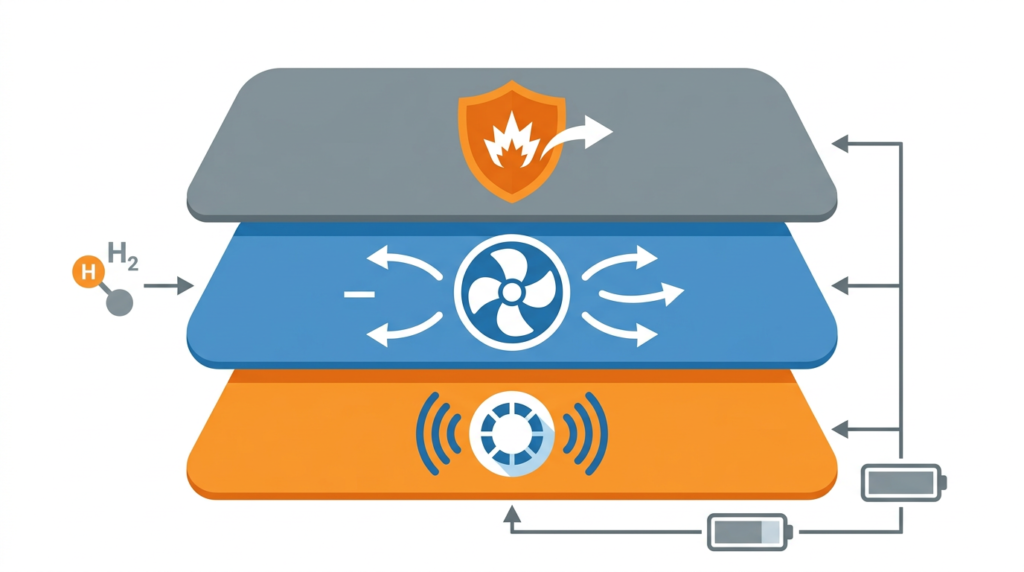
◆ Section 6: Detection and Ventilation
A. Gas Detection
A gas detection system is required for hydrogen fuel gas rooms and many other enclosed installations. It must:
- Detect hydrogen at or below 25% of the lower flammable limit
- Activate audible and visible alarms inside and outside the room
- Automatically start the mechanical exhaust ventilation
- On system failure, start ventilation and shut down hydrogen generation or supply
B. Detection Technologies
Common technologies include thermal conductivity, electrochemical, and semiconductor sensors, plus catalytic types where suitable. Ultrasonic leak detectors can help for high-pressure releases. Hydrogen-capable flame detectors (UV or multi-spectrum IR) address the invisible flame. Each technology has limits, such as sensor poisoning, drift, and response time, so selection must match the application.
C. Sensor Placement
Hydrogen rises. Place gas sensors at high points, near the ceiling, and in roof pockets, plus near likely leak sources such as valves, fittings, and equipment enclosures. Mounting detectors only at low levels, as for heavier-than-air gases, is a design error.
D. Ventilation
Mechanical exhaust is required for hydrogen fuel gas rooms and enclosed installations. It should:
- Maintain negative pressure relative to adjacent spaces
- Provide enough air change to prevent accumulation
- Draw from high points where hydrogen collects
- Be on standby power
- Start automatically on a detection alarm
E. The Detection-Ventilation Link
Detection and ventilation must be interlocked. Detection triggers ventilation, and detection can also trigger shutoff of the hydrogen supply.
Key point: Detection and ventilation are the first line of defense. They prevent accumulation before ignition is possible.
Pro Tip: Ventilation needs standby power. A power failure during a release is when it is needed most.
◆ Section 7: Electrical Classification and Ignition Control
Hydrogen is a Class I, Group B material under the NEC, which is the most demanding group and needs specially rated equipment. Electrical equipment in classified areas must be listed for the classification (Division or Zone) and for Group B.
- Define classified areas around vents, relief discharges, fittings, enclosures, and dispensers according to NFPA 2 and NFPA 70.
- Use listed equipment for those areas, and prohibit non-rated equipment inside them.
- Ground and bond equipment, piping, and vehicles to control static electricity.
- Post signs prohibiting smoking, open flames, and other ignition sources in hydrogen storage and use areas.
- Control hot work with a permit program (see Article on hot work permit programs).
Pro Tip: The classification drawing should be part of the design package so electrical and mechanical designers use the same boundaries.
◆ Section 8: Pressure Relief and Venting
Hydrogen systems rely on pressure relief devices (PRDs) and vent lines to avoid overpressure.
- Relief devices and vent stacks must discharge to a safe location outdoors, away from people, ignition sources, air intakes, and structures.
- Vent lines should be sized, routed, and supported to avoid back pressure, blockage, and rain or ice intrusion.
- Fire-exposed vessels need thermally activated relief (TPRDs) as required by the standards, and their release path must be considered in site design.
- Purging before service and during startup is a high-risk activity and needs written procedures.
Key point: Relief and vent design controls where hydrogen goes during abnormal events. A badly placed vent can create the fire it is meant to prevent.
◆ Section 9: Explosion Control
Where hydrogen is used or stored in enclosed spaces, explosion control may be required.
A. When It Is Required
IFC Section 911 requires explosion control where a deflagration hazard exists and is not otherwise mitigated. NFPA 68 and NFPA 69 provide design guidance.
B. Methods
| Method | Application |
|---|---|
| Deflagration venting (NFPA 68) | Releases pressure to a safe outdoor location |
| Explosion prevention (NFPA 69) | Prevents ignition or keeps concentrations below hazardous levels, for example by inerting or ventilation |
| Barricade or blast-resistant construction | Contains or directs the effects of an explosion |
C. Design Basis
Design must consider the worst credible release, the enclosure volume, congestion, the ventilation rate, and hydrogen’s high reactivity. Venting hydrogen deflagrations is difficult because of the fast burning velocity, so engineering analysis is needed.
Pro Tip: Coordinate explosion control with the structure early. Vent panels need a safe discharge path, and the structure must withstand the design pressure.
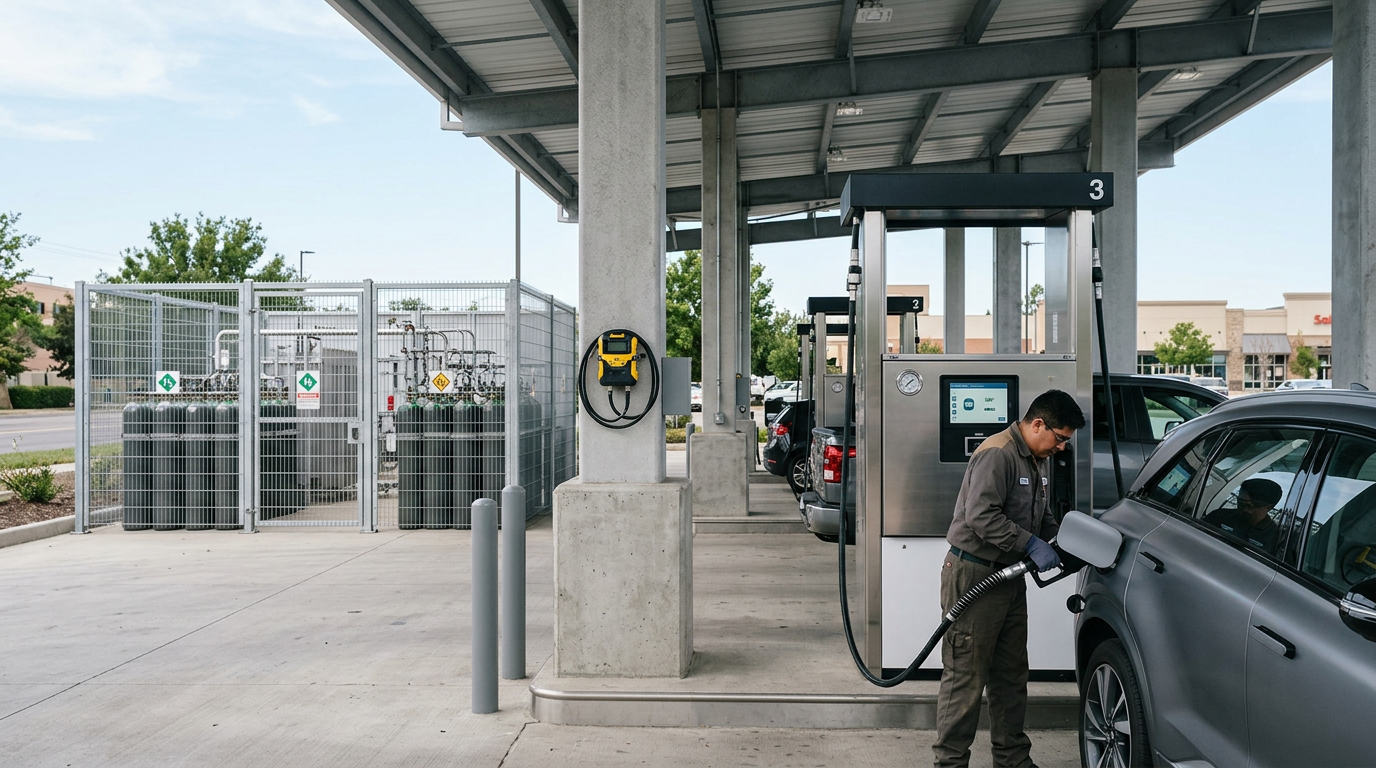
◆ Section 10: Hydrogen Fueling Stations
A. Typical IFC and NFPA 2 Requirements
| Requirement | Detail |
|---|---|
| Operating instructions | Posted at each dispenser |
| Emergency procedures sign | Posted conspicuously |
| Communications | Means to notify the fire department |
| Fire extinguishers | Minimum 2-A:20-B:C within 75 feet of dispensers (verify in your edition) |
| Emergency shutdown | Manual devices in dispensing, generation, and compression areas |
| Vehicle impact protection | Barriers for dispensers and storage |
| Breakaway devices | Fueling hoses and nozzles that release safely when pulled |
B. Emergency Shutdown
Emergency manual shutdown devices must be accessible, labeled, and located away from the hazard. Activation should shut off power and hydrogen supply to affected equipment.
C. Canopies
Where a canopy covers dispensing, its design must prevent hydrogen from collecting beneath it. Avoid pockets, include venting, and keep ceilings free of traps.
D. Fueling Safety Features
Dispensing systems typically include pressure and temperature limits, communication with the vehicle, and leak checks before fueling.
Pro Tip: Give the fire department a pre-incident plan showing the shutdown locations, the gas detection panel, storage locations, and separation distances.
◆ Section 11: Hydrogen Fuel Gas Rooms (Indoor Installations)
Where hydrogen is used or stored indoors, a dedicated hydrogen fuel gas room may be required. IFC Section 5808 (verify the section number in your adopted edition) sets requirements such as:
| Requirement | Detail |
|---|---|
| Location | Not below grade |
| Separation | Fire-resistance-rated separation from other areas per the IBC |
| Pressure | Negative relative to adjacent spaces |
| Ventilation | Mechanical exhaust |
| Gas detection | Required; activates alarm and ventilation |
| Explosion control | Where required by IFC 911 |
| Standby power | Ventilation and detection |
| Windows | Operable windows in interior walls not permitted; fixed windows per IBC 716 |
Negative pressure keeps hydrogen from migrating to adjacent spaces if a leak occurs.
Pro Tip: Verify negative pressure during commissioning and periodically afterward. A room that is not under negative pressure is not containing the hazard.
◆ Section 12: Fire Protection and Emergency Response
A. Fire Protection Approach
Hydrogen fires are controlled mainly by cutting off the fuel, not by extinguishing the flame. Fixed protection supports this goal:
- Automatic or manual shutoff of hydrogen supply
- Sprinklers or water spray for exposure protection and cooling of nearby equipment, as required by NFPA 2, NFPA 13, and the adopted codes
- Portable extinguishers at dispensers and equipment areas
- Fire alarm integration, so gas alarms and shutdowns report through NFPA 72 systems
B. The “Let It Burn” Principle
Extinguishing a hydrogen flame without stopping the leak can allow an unburned cloud to form and re-ignite explosively. The standard strategy is to isolate the supply, let the fire burn out, and cool exposures with water.
C. Firefighter Considerations
- Use thermal imaging cameras, since the flame is nearly invisible.
- Approach from upwind and avoid enclosed spaces where gas may collect.
- Cool nearby vessels, but do not spray water on liquid hydrogen vents or cold piping in ways that cause freezing and blockage.
- Treat any hydrogen vessel exposed to fire as a potential BLEVE or relief-release hazard.
D. Hydrogen Vehicles in Garages
Fuel cell vehicles have onboard storage with thermally activated relief devices that vent hydrogen in a fire. Parking facilities should consider ventilation and detection, as required by the adopted codes, and responders should be trained in vehicle emergency response.
E. Pre-Incident Planning
Provide the fire department with site plans, the hazard summary, shutoff and detection locations, and contact information for the system operator.
◆ Section 13: Maintenance, Operations, and Training
A. Inspection and Maintenance
NFPA 2, NFPA 55, and the IFC establish maintenance and inspection requirements, including:
- Periodic maintenance by qualified personnel (typically annually)
- Checks for physical damage, leak tightness, grounding, vents and relief devices, equipment identification, warning signs, and alarm and shutdown function
- Calibration and function testing of gas detectors
- Written records retained for the period the code requires (commonly at least 3 years; verify in your edition)
B. Personnel Training
Personnel must be trained in hydrogen hazards, safe operation, leak response, emergency shutdown, and evacuation. Keep training records.
C. Management of Change
Changes to hydrogen quantities, piping, or equipment need review before they are implemented, so the safety layers remain valid.
Pro Tip: Include the hydrogen system in the building’s fire safety management system. The maintenance and training records are the evidence of compliance.
◆ Section 14: Common Challenges and Mistakes
| Challenge or Mistake | Why It Happens | Solution |
|---|---|---|
| Treating hydrogen like natural gas | Unfamiliar hazard | Design for invisible flame, wide flammability, and low ignition energy |
| Relying on visual detection | Flame is invisible | Use flame detectors and thermal imaging |
| Gas sensors placed low | Assumed to behave like heavy gases | Place at ceilings and high points, plus near leak sources |
| No detection in enclosed spaces | Overlooked | Install detection interlocked with ventilation |
| Ventilation not on standby power | Not required or overlooked | Connect to standby power |
| Negative pressure not maintained | Design or commissioning issue | Verify during commissioning and maintenance |
| Incompatible materials | Embrittlement not considered | Select hydrogen-compatible materials per ASME B31.12 |
| Unclassified or improper electrical equipment | Classification not coordinated | Define hazardous areas and use listed equipment |
| Vents or relief discharge poorly located | Late design decisions | Route to a safe outdoor location |
| Separation distances reduced without basis | Site constraints | Use QRA and AHJ approval |
| Emergency shutdown not accessible | Not coordinated | Locate with fire department input |
| Extinguishing a flame with the leak still active | Normal fire response habits | Isolate supply first; let burn; cool exposures |
| Maintenance and training records missing | No program | Establish a documented program |
Key point: Most hydrogen safety failures are failures of the safety layers (detection, ventilation, electrical control, and procedures), not of the equipment alone.
◆ Section 15: Design Checklist
| Item | Status | Notes |
|---|---|---|
| Adopted NFPA 2, IFC, and IBC editions confirmed | ☐ | NFPA 2 primary; IFC Ch. 58, 23, 50 |
| Application, quantity, pressure, and storage form identified | ☐ | Gas, liquid, generation, fuel cell |
| Occupancy classification and control area limits checked | ☐ | Group H or MAQ implications |
| Siting and separation distances determined | ☐ | NFPA 2; equivalency if reduced |
| Gas detection specified | ☐ | High-point placement; alarm and ventilation |
| Flame detection or thermal imaging provided | ☐ | Invisible flame |
| Ventilation specified | ☐ | Negative pressure; standby power |
| Electrical classification defined | ☐ | Class I, Group B |
| Grounding and bonding provided | ☐ | Static control |
| Pressure relief and vent discharge located | ☐ | Safe outdoor location |
| Explosion control evaluated | ☐ | IFC 911, NFPA 68/69 |
| Emergency shutdown devices specified | ☐ | Accessible and labeled |
| Signage specified | ☐ | No smoking, emergency procedures |
| Fire extinguishers and fire protection provided | ☐ | Per NFPA 2 and IFC |
| Communications provided | ☐ | Means to notify fire department |
| Hydrogen fuel gas room (if indoor) | ☐ | Negative pressure, detection, ventilation |
| Maintenance program and records | ☐ | Annual; retained per code |
| Personnel training | ☐ | Hazards, emergency procedures |
| Fire department coordination | ☐ | Pre-incident planning |
◆ Section 16: Conclusion
Hydrogen presents a fire hazard fundamentally different from conventional fuels. The flame is nearly invisible, the flammability range is very wide, the ignition energy is very low, and the gas can embrittle the metals that contain it. Protection must address these specific hazards through layers: siting, material selection, leak prevention, detection, ventilation, ignition control, relief and venting, explosion control, and emergency response.
The most common failure is treating hydrogen like a conventional fuel. Design for how hydrogen actually behaves, engage the AHJ and the fire department early, and maintain the safety systems for the life of the installation.
Key Takeaways:
- Hydrogen flames are nearly invisible in daylight, so visual detection is unreliable.
- The flammability range is very wide (about 4% to 75% in air).
- Ignition energy is very low; static electricity can ignite hydrogen.
- Hydrogen can embrittle metals, so material selection matters.
- NFPA 2 is the primary standard; NFPA 55 directs users to NFPA 2.
- Hydrogen rises, so place gas detection at high points and near leak sources.
- Ventilation must be interlocked with detection and on standby power.
- Electrical equipment in hydrogen areas must be rated for Class I, Group B.
- Vents and relief discharges must go to a safe outdoor location.
- Fires are usually handled by isolating the supply, not by extinguishing the flame.
- Maintenance, training, and records are the evidence that the system is being managed.
Take Action Today:
- Confirm the adopted NFPA 2, IFC, and IBC editions.
- Identify the hydrogen application, quantity, pressure, and storage form.
- Verify separation distances or obtain equivalency approval.
- Install gas detection at high points, interlocked with ventilation.
- Verify ventilation is on standby power.
- Define electrical classification and confirm equipment ratings.
- Verify the location of vents and relief discharge.
- Evaluate explosion control for enclosed spaces.
- Install emergency shutdown devices and verify accessibility.
- Establish a maintenance program with detector testing and records.
- Train personnel on hydrogen hazards and emergency response.
- Coordinate with the fire department on pre-incident planning.
Continue Reading from Our Series:
- Related guide: Article 151, Lithium-Ion Battery Fire Safety and Energy Storage Systems
- Related guide: Article 152, Solar Panel and PV System Fire Safety
- Related guide: Article 153, Electric Vehicle Charging Station Fire Safety
- Read more: Article 155, Wildfire Resilience for Commercial Buildings (planned)
About This Guide: This article is part of a series on commercial building fire safety, written for facility managers, architects, and code officials. It references model codes and standards for educational purposes. Always consult your local AHJ and a qualified fire protection engineer for project-specific requirements.