IMPORTANT DISCLAIMER: This guide references the International Fire Code (IFC), including Section 1207 (Energy Storage Systems) and Section 320 (Lithium-Ion Battery Storage, where applicable); NFPA 1, Fire Code; NFPA 101, Life Safety Code; NFPA 70 (National Electrical Code, NEC), including Article 625 (Electric Vehicle Power Transfer System); NFPA 13 (Sprinkler Systems); NFPA 72 (National Fire Alarm and Signaling Code); NFPA 88A (Parking Structures); NFPA 855 (Stationary Energy Storage Systems, where EV charging is paired with battery storage); UL 2202 (EV Charging System Equipment); UL 2594 (EV Supply Equipment); UL 2251 (Plugs, Receptacles, and Couplers for EVs); UL 2231 (Personnel Protection Systems for EV Supply Circuits); UL 9741 (Bidirectional EV Charging System Equipment); and UL 9540 (Energy Storage Systems and Equipment). Model code editions referenced are the 2021 and 2024 IFC and the 2023 and 2026 NEC. EV charging requirements vary by jurisdiction, by installation type (residential, indoor, outdoor, parking structure, fleet depot), and by the adopted code edition. Some jurisdictions have adopted specific EV charging provisions; others rely on general fire code provisions. Section numbers cited here follow the model codes and may differ in your adopted edition. Local amendments and the edition adopted by your Authority Having Jurisdiction (AHJ) always control. This guide is a starting point only. Always verify the requirements applicable to your project with your AHJ and a qualified fire protection engineer.
Electric vehicles are no longer a niche product. They are a growing share of new vehicle sales, and the charging infrastructure to support them is being installed in every type of building: residential garages, office parking, retail centers, hotels, fleet depots, and public parking structures. Each charging station is a connection point between the building’s electrical system and a high-energy lithium-ion battery.
EV charging station fire safety is the discipline of understanding the hazards that EV charging introduces and applying the codes and standards that address them. The hazards differ from conventional vehicle fires: the battery can enter thermal runaway, the fire can be difficult to extinguish, it can reignite, and the location of the charging station determines the exposure of the building and its occupants.
The regulatory landscape is still evolving. The IFC addresses EV charging in several places rather than in one consolidated section. The NEC governs the electrical installation. NFPA 88A governs parking structures but does not address EV charging specifically. NFPA 855 governs stationary battery storage where it is paired with charging. The AHJ has significant discretion in applying these requirements to a specific installation.
This article covers the hazards of EV charging, the charging equipment itself, the governing codes, siting for indoor, outdoor, and parking structure installations, ventilation, detection, suppression, pairing with energy storage, fire department response, and how to operate and maintain EV charging infrastructure safely.
◆ Section 1: Why EV Charging Is a Fire Safety Concern
An EV charging station is a connection point to a high-energy lithium-ion battery. The battery is the main fire hazard, not the charging equipment itself, but the equipment and its location determine the exposure.
| Factor | Conventional Vehicle Fire | EV Fire |
|---|---|---|
| Fuel | Gasoline or diesel | Lithium-ion battery (plus conventional vehicle materials) |
| Fire development | Rapid, but generally predictable | Thermal runaway can be sudden and difficult to predict |
| Suppression | Water, foam, dry chemical | Sustained water cooling; smothering is not effective |
| Reignition | Possible but uncommon | Possible; can occur hours or days later |
| Gas generation | Combustion products | Flammable and toxic gases (hydrogen, CO, hydrogen fluoride, electrolyte vapors) |
| Extinguishing effort | Minutes to hours | Often hours and large volumes of water |
| Location | Vehicle | Vehicle and charging equipment |
Research generally finds that peak heat release from an EV fire is comparable to that of a modern conventional vehicle. The difference is in what follows: battery reignition, toxic gas, and the effort needed to cool the battery fully. Sprinklers can control the spread of an EV fire, but they typically will not extinguish a burning battery pack.
A. The Thermal Runaway Risk
A lithium-ion battery can enter thermal runaway under conditions such as:
- Internal short circuit (manufacturing defect, damage, degradation)
- Overcharging (rare with a modern battery management system, but possible with equipment failure)
- External heat exposure (adjacent vehicle fire, building fire)
- Mechanical damage (collision, impact, underbody strike)
- Water damage: vehicles that have been flooded, especially by saltwater, can ignite days or weeks later
B. The Charging Equipment Risk
The charging equipment (electric vehicle supply equipment, or EVSE) is not the primary hazard, but it can contribute to a fire:
- Electrical faults can create arc hazards
- Worn, contaminated, or damaged connectors can create resistance and overheating
- Cable damage can cause short circuits
- Improper installation, such as loose terminations or undersized conductors, can cause overheating
C. The Location Risk
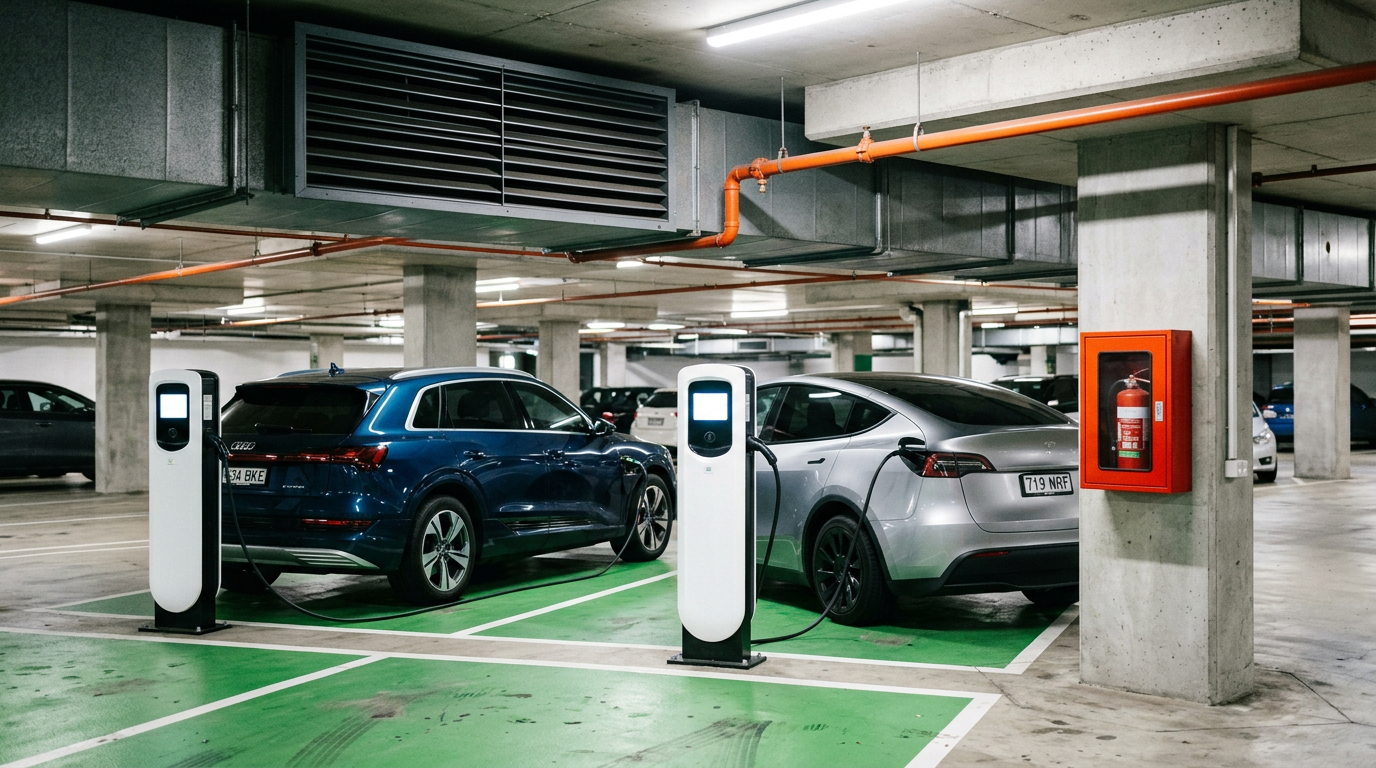
- Indoor garage: fire can spread to the building, and smoke and gases accumulate
- Parking structure: fire can spread to adjacent vehicles and challenge the structure
- Outdoor surface lot: fire is more contained but can spread to adjacent vehicles
- Near building openings: fire and smoke can enter the building
- Residential garage: often attached to sleeping areas, with limited detection and suppression
Key point: The fire hazard of EV charging is the battery in the vehicle, not the charging equipment. The charging equipment is the connection point, and the location determines the exposure.
Key Article: Article 151 — Lithium-Ion Battery Fire Safety and Energy Storage Systems
Pro Tip: Treat an EV fire as a lithium-ion battery fire, not a conventional vehicle fire. The strategies are different, and the incident may require hours of cooling and monitoring.
◆ Section 2: Charging Equipment and Power Levels
The fire safety considerations depend partly on how much power is delivered and how the equipment is built.
| Charging Level | Typical Supply | Typical Power | Common Locations |
|---|---|---|---|
| Level 1 | 120 V AC, cord-and-plug | About 1.4 to 1.9 kW | Residential garages, some workplaces |
| Level 2 | 208/240 V AC | About 3.3 to 19.2 kW | Homes, workplaces, hotels, retail, parking structures |
| DC fast charging | Three-phase AC input converted to DC in the charger | 50 kW to 350 kW or more | Corridors, retail, fleet depots |
Key considerations:
- Continuous load. EV charging is a continuous load, so conductors and overcurrent devices are sized accordingly (NEC Article 625 and Article 220 load calculations).
- Load management. Energy management systems can limit demand so that more chargers can share a service. The NEC recognizes them, but they must be listed and configured correctly so that they do not overload conductors.
- Connectors. Standardized interfaces (such as SAE J1772, CCS, and NACS/J3400) reduce compatibility problems. The practical connector risk is wear, contamination, bent pins, and damaged cables, not mismatched hardware.
- Bidirectional charging. Vehicle-to-load and vehicle-to-grid systems can feed power back into a building. They add interconnection and isolation requirements (see Section 9).
- Higher power, more heat. DC fast chargers carry high currents and often use liquid-cooled cables. They warrant closer attention to installation quality, thermal monitoring, and maintenance.
Key point: Understand the power level and equipment type before determining the protection strategy. Higher power increases the electrical and thermal stress on connectors, cables, and conductors.
◆ Section 3: The Codes and Standards
EV charging is governed by a combination of codes and standards. The requirements overlap and depend on the installation type.
A. IFC
| IFC Provision | Subject |
|---|---|
| Chapter 5 | Fire service features (fire department access, water supply) |
| Chapter 9 | Fire protection systems (sprinklers, standpipes, alarm and detection) |
| Chapter 10 | Means of egress |
| Chapter 12 | Energy systems, including Section 1207 for energy storage systems paired with charging |
| Section 320 | Lithium-ion battery storage, where applicable |
| Chapter 23 | Motor fuel-dispensing facilities, where charging is co-located with fuel dispensing |
The IFC does not have a single consolidated section for EV charging. Requirements are distributed, and the AHJ applies them based on the installation.
B. NEC Article 625
The NEC governs the electrical installation. Key requirements include (confirm section numbers in your edition):
- Listed equipment (UL 2202, UL 2594) and listed personnel protection (UL 2231)
- Disconnecting means for EVSE rated above 60 A or above 150 V to ground (625.43)
- GFCI protection for personnel for applicable receptacles (625.54)
- Mounting height: indoor EVSE at least 18 in. above the floor, outdoor at least 24 in. (625.50)
- Ventilation where the equipment is listed for charging that requires it, such as vehicles with vented lead-acid batteries (625.52)
- Cord and cable management and protection from damage
- Overcurrent protection, grounding, and bonding
C. NFPA 88A
NFPA 88A governs parking structures, including ventilation, fire protection, and construction. It is a general parking structure standard and does not contain EV-specific charging provisions, so the AHJ decides how it is applied to EV charging.
D. NFPA 855
Where EV charging is paired with a stationary battery system, NFPA 855 and IFC Section 1207 apply to the battery system.
E. UL Standards
| Standard | Subject |
|---|---|
| UL 2202 | EV Charging System Equipment |
| UL 2594 | EV Supply Equipment |
| UL 2251 | Plugs, Receptacles, and Couplers for EVs |
| UL 2231 | Personnel Protection Systems for EV Supply Circuits |
| UL 9741 | Bidirectional EV Charging System Equipment |
| UL 9540 | Energy Storage Systems and Equipment |
Key point: EV charging is governed by multiple codes and standards. The AHJ determines which apply based on the installation type and the adopted editions.
Pro Tip: Engage the AHJ early. The requirements are not consolidated, and the AHJ’s interpretation determines the scope of protection.
◆ Section 4: Siting and Installation: Indoor, Outdoor, and Parking Structures
A. Outdoor Installations
| Consideration | Good Practice |
|---|---|
| Separation from building | Keep charging spaces away from building openings, combustible cladding, and combustible storage |
| Vehicle spacing | Provide spacing or layout that limits fire spread between vehicles |
| Fire department access | Keep clear access to the charging area |
| Water supply | Hydrant or other water source within reach |
| Physical protection | Bollards or wheel stops to prevent vehicle impact on equipment |
| Canopies | Do not let canopies or weather protection add combustible fuel load |
| Signage | Emergency contact information and shutdown procedures |
B. Indoor Installations
| Consideration | Good Practice |
|---|---|
| Ventilation | Mechanical ventilation to remove smoke and gases |
| Detection | Smoke, heat, or other detection appropriate to the space |
| Suppression | Sprinkler protection per NFPA 13 |
| Separation | Separation from other occupancies as required by the building code |
| Egress | Egress paths kept clear of cables and equipment |
| Fire department access | Access to the charging area and to the equipment disconnects |
| Signage | Emergency contact information and shutdown procedures |
C. Parking Structures
Parking structures are a hybrid case: partially enclosed but often open to the exterior. Requirements depend on how open the structure is, how many chargers are installed, the fire protection features present, and the AHJ’s interpretation. Enclosed parking garages are generally required to be sprinklered by the building code (IBC Section 903.2.10); open parking structures generally are not, which affects how much protection is available at the charger.
D. Where to Place Chargers
The following are common good practices, not universal code requirements:
- Cluster chargers rather than scattering them, so that protection, signage, and access can be concentrated
- Keep charging spaces away from exit stairs, exit doors, and the main egress path
- Locate them within full sprinkler coverage and near perimeter openings where smoke can vent
- Avoid placing them directly under or beside air intakes, occupied spaces, or critical equipment
- Favor ground-level or easily reached locations for fire department operations
- Provide clear separation between charging bays and storage of combustibles
Key point: Indoor installations need more protection than outdoor ones because smoke and fire are confined. Siting decisions made early cost far less than retrofits.
Pro Tip: For indoor installations, provide ventilation, detection, and suppression as a coordinated package. For parking structures with significant EV charging, use a fire protection engineer experienced with parking structures.
◆ Section 5: Ventilation
Ventilation serves two purposes: normal operation and emergency smoke and gas removal.
A. Normal Ventilation
Normal ventilation maintains air quality and removes heat. NEC 625.52 requires mechanical ventilation only for equipment listed for charging that requires it (for example, vehicles with vented lead-acid batteries). Modern lithium-ion EVs generally do not need ventilation for normal charging, but enclosed garages still need ventilation under NFPA 88A and the mechanical code to control carbon monoxide.
B. Emergency Ventilation
Emergency ventilation removes smoke and flammable gases during a fire. It may be part of a smoke control system or a dedicated exhaust system, as required by the AHJ. Ventilation cannot prevent or stop thermal runaway; its purpose is to help occupants and responders manage smoke and gas.
C. Design Considerations
| Factor | Consideration |
|---|---|
| Exhaust rate | Based on expected smoke and gas generation and the applicable code |
| Makeup air | Adequate makeup air so the exhaust system performs |
| Controls | Automatic activation on detection, with manual override for firefighters |
| Reliability | Standby power where required |
| Discharge location | Away from occupied areas and air intakes |
Key point: Ventilation is a critical layer for indoor EV charging. It supports occupant safety and firefighting operations.
Pro Tip: Coordinate the ventilation design with the fire alarm system so that it activates on detection and can be controlled from a location accessible to firefighters.
◆ Section 6: Detection and Alarm
Detection provides early warning of a fire or thermal runaway event.
A. Detection Types
| Type | Application and Limitations |
|---|---|
| Smoke detection | General area coverage; vehicle exhaust and dust can cause nuisance alarms in garages |
| Heat detection | Common in garages where smoke detection is impractical; slower to respond |
| Air sampling or video flame/smoke analytics | Option for large or open spaces |
| Off-gas detection | Early warning of battery venting; well proven for enclosed stationary batteries, but less proven for vehicles that arrive and leave |
| Thermal imaging | Continuous monitoring of high-value or high-density charging areas |
| EVSE self-monitoring | Many chargers monitor temperature and faults and can stop charging automatically |
B. Off-Gas Detection in Context
A failing battery vents flammable and toxic gases before ignition, and detection of that gas can provide earlier warning than smoke detection. Off-gas detection is well established for stationary battery rooms. For vehicles it is an emerging option and is not currently required by the model codes, so treat it as a supplement to, not a replacement for, code-required detection.
C. Alarm Integration
Detection should be integrated with the building fire alarm system, in accordance with NFPA 72. The alarm should:
- Notify occupants
- Activate emergency ventilation where provided
- Notify the fire department
- De-energize the charging equipment where an automatic shutdown or shunt trip is provided
D. The AHJ’s Requirements
Detection requirements depend on the AHJ and the installation. Some jurisdictions require smoke detection; others accept heat detection or other approaches.
Key point: Detection provides early warning, but the right type depends on the environment. Garages are difficult environments for smoke detection.
Pro Tip: For high-density indoor charging, discuss supplemental detection (such as thermal imaging or off-gas detection) with the AHJ and make sure it is monitored by someone who can act on it.
◆ Section 7: Suppression and Water Supply
Suppression of an EV fire is fundamentally about cooling the battery, not smothering the fire.
A. Water Is the Most Effective Agent
Water absorbs heat and can slow or stop thermal runaway from propagating to adjacent cells and vehicles. Large, sustained volumes are typically needed to cool the battery pack.
B. Sprinkler Protection
In a sprinklered building, the sprinkler system provides general protection. NFPA 13 classifies parking garages as Ordinary Hazard Group 1. NFPA 13 does not currently include a special design density for EV fires, so the system is designed as for any parking garage. Sprinklers help control fire growth and limit spread to adjacent vehicles and the structure. They are not expected to extinguish a battery fire. Any enhanced protection beyond the code minimum is a decision for the owner, insurer, and AHJ.
C. Specialized Suppression
Some installations use water mist, aerosol, or proprietary agents. Any such system should be listed or approved for the application and evaluated by the AHJ. Evidence of effectiveness on full-size vehicle battery fires is limited, so do not assume a specialized system replaces fire department operations.
D. Standpipes and Water Supply
Standpipes, hydrants, and fire department connections allow the fire department to deliver the sustained water flow an EV fire may require. Verify that the water supply, hose reach, and access routes support extended operations (NFPA 14, NFPA 24, and IFC Chapter 5 as applicable).
E. The Fire Department’s Role
The fire department is the primary resource for extinguishing an EV fire. Building fire protection features support that work by providing early detection, controlling the fire until responders arrive, providing ventilation, and providing access.
Key point: The building’s suppression system controls the fire until the fire department arrives. The fire department is the primary resource for extinguishing an EV fire.
Pro Tip: Coordinate with the fire department on EV fire tactics and water supply before an incident, not during one.
◆ Section 8: EVSE Installation, Shutdown, and Signage
A. Listing and Installation
EVSE must be listed (UL 2202, UL 2594) and installed per the NEC and the manufacturer’s instructions. Listing verifies that the equipment meets safety standards; proper installation verifies that it is connected and protected correctly. Torque on terminations, conductor sizing, and ground-fault protection are common areas where installation quality affects fire risk.
B. Disconnecting Means and Emergency Shutdown
The NEC requires a disconnecting means for larger EVSE (above 60 A or above 150 V to ground). The disconnect, and any emergency shutoff provided, should be:
- Readily accessible to responders
- Clearly labeled
- Located in a place that does not require entering a hazardous area
If the AHJ requires or the owner provides an emergency shutoff for a charging area, make sure it is tested and shown on the pre-incident plan.
C. Cable Management and Physical Protection
Keep cables off the ground and out of egress paths when not in use, and protect equipment from vehicle impact. Damaged cables and connectors should be removed from service immediately.
D. Signage
Each charging station or group of stations should identify:
- The equipment rating
- Emergency contact information
- Shutdown procedures and disconnect location
- Instructions for users to report damage or abnormal operation
Key point: The charging equipment is a code-regulated electrical installation. It must be listed, installed correctly, labeled, and maintained.
◆ Section 9: EV Charging with Energy Storage and Bidirectional Charging
EV charging is increasingly paired with stationary battery storage to buffer demand, provide backup power, or support grid services. Bidirectional charging (UL 9741) lets vehicle batteries serve similar roles.
A. The Interaction
A stationary battery paired with charging creates two lithium-ion hazards in the same location: the vehicles and the stationary battery. The hazards are similar (thermal runaway, propagation, gas generation), but the systems are separate and governed by different requirements.
B. NFPA 855 and IFC 1207
Where the stationary battery is a significant installation, NFPA 855 and IFC Section 1207 apply. Requirements include detection, suppression, explosion control, spacing, and separation from vehicles and exposures.
C. Bidirectional Systems
Bidirectional charging introduces interconnection requirements (NEC Article 625 and the interconnection provisions of Article 705). Isolation, anti-islanding, and shutdown behavior must be verified so that responders are not exposed to an unexpectedly energized system.
D. The Fire Risk
A fire in the stationary battery can involve nearby vehicles, and a vehicle fire can involve the stationary battery. The fire safety design must address both.
Key point: EV charging paired with stationary storage introduces additional hazards. Design for both the vehicles and the storage system.
Key Article: Article 151 — Lithium-Ion Battery Fire Safety and Energy Storage Systems
◆ Section 10: Fire Department Response and Pre-Incident Planning
EV incidents require tactics and planning beyond conventional vehicle fires.
A. Response Considerations
- Identify the vehicle. Manufacturer emergency response guides explain how to identify the vehicle, locate high-voltage components, and de-energize it. Responders should treat high-voltage cables (typically orange) as energized.
- Sustained water application. Cooling a battery fire can take large volumes of water, often thousands of gallons, and extended operating time.
- Monitoring. Thermal imaging cameras help responders track battery temperature and detect reignition risk after the visible fire is out.
- Containment. Some departments use fire blankets or other containment tools to limit spread. These are not a substitute for cooling the battery.
- Gas and smoke. Responders should expect toxic and flammable gases and use appropriate respiratory protection and ventilation.
B. After the Fire
- A damaged or burned EV can reignite hours or days later. It should be moved to an open area away from buildings, other vehicles, and combustibles, and monitored.
- Tow operators and storage yards should be told that the vehicle is an EV involved in a fire.
- Remove damaged vehicles from parking structures and garages as soon as it is safe to do so.
C. Pre-Incident Planning
The pre-incident plan for a property with EV charging should include:
- The location of chargers, disconnects, and any emergency shutoff
- Water supply and standpipe locations
- Ventilation controls and how to operate them
- Locations of any stationary battery systems
- Facility contacts and the charging network operator’s emergency contact
- Access routes and staging areas
Key point: Fire department familiarity with the installation before an incident is one of the most effective and least expensive safety measures.
Pro Tip: Invite the local fire department to walk the charging area and review the plan. Offer to share the equipment’s shutdown procedures.
◆ Section 11: Operations, Maintenance, and Training
A. Maintenance Program
Include EVSE in the building’s inspection and maintenance program:
- Inspect cables, connectors, and housings for wear, heat damage, or contamination
- Verify signage, labels, and disconnect accessibility
- Test GFCI and ground-fault protection per the manufacturer
- Have a qualified electrician perform periodic thermographic scanning and verify terminations, where the facility’s program calls for it
- Test ventilation and detection controls on the same schedule as other life safety systems
B. User Guidance
Post simple instructions: do not use damaged cables or connectors, do not charge a visibly damaged or flooded vehicle, and report unusual smells, smoke, or sparks immediately.
C. Vehicle Restrictions
Consider a policy against charging or parking vehicles with known battery damage or that have been flooded, especially in enclosed structures.
D. Fire Safety Plan and Training
Update the building fire safety plan to include EV charging: who calls the fire department, how to shut down chargers safely, how to evacuate, and who meets responders. Train facility staff on the plan.
Key point: EV charging safety depends on ongoing maintenance and operations as much as on the original design.
◆ Section 12: Common Challenges and Solutions
| Challenge or Mistake | Why It Happens | Solution |
|---|---|---|
| Treating an EV fire as a conventional vehicle fire | Hazard is not recognized | Plan for lithium-ion battery behavior |
| No consolidated IFC section | Requirements are distributed | Engage the AHJ early and use multiple code sections |
| Only normal ventilation | Emergency conditions not considered | Add emergency ventilation where required or advised |
| Detection too late or nuisance alarms | Smoke detection in a garage environment | Select detection suited to the space; consider supplemental options |
| Assuming sprinklers will extinguish the fire | Misunderstanding of sprinkler role | Plan for control, then fire department cooling |
| Parking structure requirements overlooked | NFPA 88A not considered | Engage a fire protection engineer |
| Stationary battery not addressed | NFPA 855 not considered | Evaluate and apply NFPA 855 and IFC 1207 |
| Disconnect not accessible or labeled | Overlooked | Verify location, labeling, and responder access |
| Signage missing | Overlooked | Install at each station |
| Fire department not informed | No pre-incident planning | Coordinate and share the plan |
| Maintenance not performed | EVSE not in the maintenance program | Add periodic inspection |
| No fire safety plan | EV charging not addressed | Develop and implement a plan |
Key point: Most EV charging fire safety failures come from not recognizing that the hazard differs from conventional vehicle fires and that the requirements are spread across multiple documents.
◆ Section 13: Design Checklist
| Item | Status | Notes |
|---|---|---|
| Adopted IFC and NEC editions confirmed | ☐ | IFC 2021 or 2024; NEC 2023 or 2026 |
| Installation type identified | ☐ | Indoor, outdoor, parking structure, fleet |
| AHJ pre-submittal meeting held | ☐ | Confirm requirements |
| EVSE listed and installed per NEC | ☐ | UL 2202, UL 2594, UL 2231 |
| Disconnecting means provided | ☐ | Accessible and labeled |
| Charger locations reviewed | ☐ | Away from egress, within sprinkler coverage, protected from impact |
| Ventilation provided (indoor) | ☐ | Normal and emergency as required |
| Detection provided | ☐ | Suited to the space |
| Suppression provided | ☐ | Sprinkler per NFPA 13; water supply verified |
| NFPA 88A applied (parking structure) | ☐ | Ventilation, fire protection, construction |
| NFPA 855 and IFC 1207 applied (stationary battery) | ☐ | If applicable |
| Bidirectional charging reviewed | ☐ | UL 9741, interconnection, shutdown |
| Signage installed | ☐ | At each station |
| Fire department coordinated | ☐ | Pre-incident plan |
| Fire safety plan updated | ☐ | Include EV charging |
| Maintenance program includes EVSE | ☐ | Periodic inspection |
◆ Section 14: Conclusion
EV charging station fire safety is a distinct discipline. The hazard is the lithium-ion battery in the vehicle, not the charging equipment. The charging equipment is the connection point, and the location determines the exposure.
The regulatory landscape is evolving. The IFC addresses EV charging in multiple sections, the NEC governs the electrical installation, NFPA 88A governs parking structures, and NFPA 855 governs stationary battery storage. The AHJ determines which requirements apply to a specific installation.
The critical elements are:
- Recognition: EV fires are lithium-ion battery fires
- Code compliance: IFC, NEC, NFPA 88A, NFPA 855
- Siting: away from egress and exposures, within sprinkler coverage
- Ventilation, detection, and suppression: designed as a coordinated package for indoor installations
- Equipment: listed, correctly installed, labeled, and maintained
- Fire department coordination: pre-incident planning and response
- Operations: maintenance, user guidance, and training
The most common failure is treating EV charging as a conventional electrical installation. The fire hazard is different, and the protection must be designed for it.
Key Takeaways:
- The fire hazard of EV charging is the lithium-ion battery in the vehicle, not the charging equipment.
- EV fires involve thermal runaway, gas generation, and the potential for reignition.
- The IFC addresses EV charging in multiple sections; the AHJ determines which apply.
- The NEC governs the electrical installation; NFPA 88A governs parking structures.
- Indoor installations need coordinated ventilation, detection, and suppression.
- Sprinklers control an EV fire; sustained water cooling by the fire department extinguishes it.
- Off-gas detection is an emerging supplement for vehicles, not a replacement for code-required detection.
- NFPA 855 applies where charging is paired with stationary battery storage.
- Pre-incident planning, maintenance, and training keep the installation safe over time.
Take Action Today:
- Confirm the adopted IFC and NEC editions and hold a pre-submittal meeting with the AHJ.
- Identify the installation type and review charger locations against egress and sprinkler coverage.
- Verify EVSE is listed, installed per the NEC, and has an accessible, labeled disconnect.
- Provide ventilation, detection, and suppression appropriate to the hazard.
- Apply NFPA 88A and NFPA 855 where they are relevant.
- Install signage, coordinate with the fire department, and update the fire safety plan.
- Add EVSE inspection to the maintenance program.
Continue Reading from Our Series:
- Related guide: Article 152 — Solar Panel and PV System Fire Safety
- Related guide: Article 151 — Lithium-Ion Battery Fire Safety and Energy Storage Systems
- Read more: Article 154 — Hydrogen Fuel Systems and Fire Safety (planned)
About This Guide: This article is part of a series on commercial building fire safety, written for facility managers, architects, and code officials. It references model codes and standards for educational purposes. Always consult your local AHJ and a qualified fire protection engineer for project-specific requirements.