IMPORTANT DISCLAIMER: This guide references NFPA 101, Chapter 43 (Building Rehabilitation) and NFPA 914, Code for the Protection of Historic Structures, where applicable to existing building retrofits. NFPA 101 and NFPA 914 requirements vary significantly by edition and are frequently amended by state and local jurisdictions. NFPA 101 editions include 2018, 2021, and 2024. NFPA 914 editions include 2019 and 2023. The most recent published editions are NFPA 101 (2024) and NFPA 914 (2023), but AHJ-adopted editions commonly lag behind by one or more cycles. Local amendments and the edition adopted by your Authority Having Jurisdiction (AHJ) always control. This guide is a starting point only—always verify the specific requirements applicable to your project with your local AHJ.
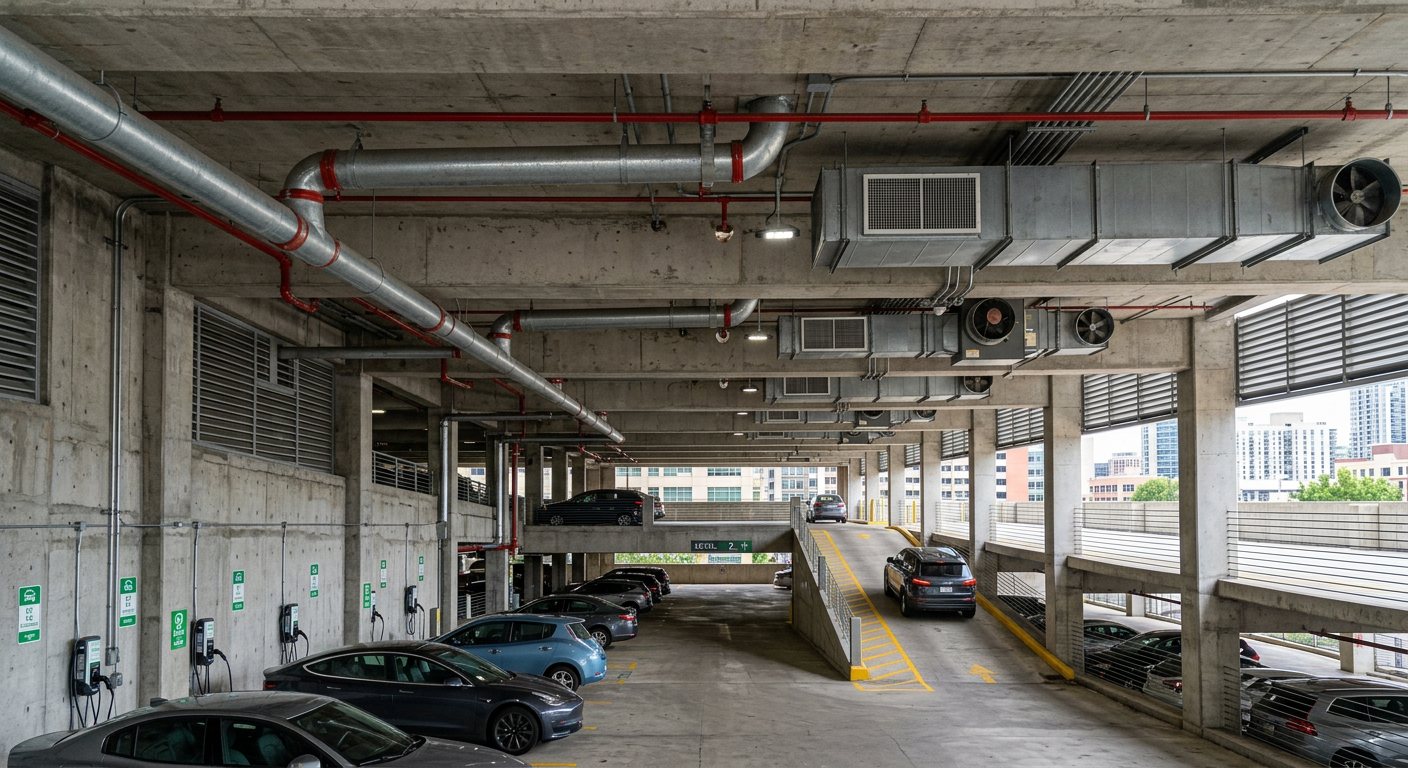
Parking structures present a fire safety challenge unlike any other occupancy. They are simultaneously high-fuel-load environments — every parked vehicle carries gasoline, plastics, and increasingly lithium-ion batteries — and low-occupancy spaces that may sit largely empty for hours. They are often open to the outside for natural ventilation, yet vertically connected through ramps that can act as chimneys for smoke and fire.
The fire safety landscape for parking structures has shifted significantly in recent years. Modern vehicles contain substantially more plastics and combustible materials than their predecessors. Electric vehicles introduce lithium-ion battery hazards that behave differently from conventional vehicle fires. And in response, the 2024 editions of NFPA 101, NFPA 88A, and NFPA 5000 introduced automatic sprinkler requirements for all new parking structures — a change driven by serious garage fires and the evolving composition of the vehicle fleet.
This guide covers the unique fire safety challenges of parking structures and the practical solutions for protecting them.
◆ Section 1: Why Parking Structures Are Different
Parking structures are not warehouses, not offices, and not assembly spaces. They have a distinct fire risk profile.
| Factor | Challenge |
|---|---|
| High fuel load | Vehicles contain fuel, plastics, and combustible materials; modern vehicles have significantly more plastic content than older models |
| Lithium-ion batteries | EVs introduce thermal runaway hazards that resist conventional suppression |
| Vertical openings | Ramps connect floors, allowing smoke and fire to spread vertically |
| Low occupant density | Fewer people to detect and report a fire, especially during off-hours |
| Open vs. enclosed | Configuration determines ventilation, suppression, and detection requirements |
| Occupant unfamiliarity | Drivers may not know exit locations or egress paths |
| Vehicle proximity | Vehicles are parked close together, facilitating fire spread |
Key point: The fire load in a parking structure is concentrated in the vehicles themselves. A fire that starts in one vehicle can spread to adjacent vehicles, creating a cascade that overwhelms suppression systems if not controlled early. The Fire Protection Research Foundation (FPRF) has documented that fires in parking structures not protected by sprinklers can become major conflagrations leading to catastrophic losses.
Pro Tip: The 2024 code changes reflect a recognition that vehicle materials have changed substantially — not enough information exists to appropriately classify parking garages under the old OH1 hazard designation. The technical committee statement noted: “Based on the increase of plastics and other challenges that modern vehicles present, a higher hazard level of protection is more appropriate. Further research in this area is needed” .
◆ Section 2: Open vs. Enclosed Parking Structures
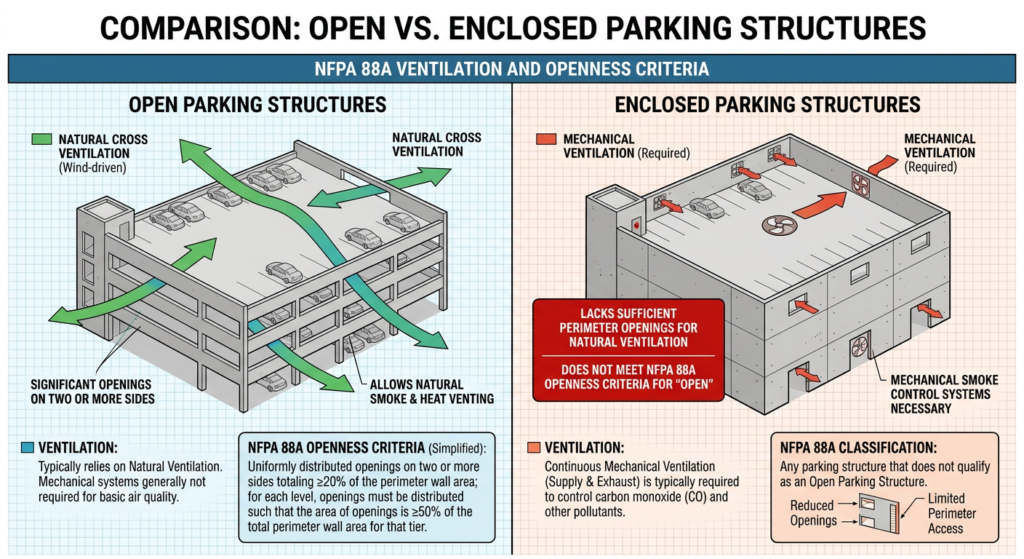
NFPA 88A distinguishes between open and enclosed parking structures based on the fraction of wall surface that is open to the outside.
A. Definition of an Open Parking Structure
An open parking structure has uniformly distributed openings on two or more sides, with:
- At least 20% of the total area of the outside perimeter and interior walls being open
- Openings distributed over at least 40% of the length of the building perimeter, or on two opposing sides
B. Why Classification Matters
| Feature | Open Parking Structure | Enclosed Parking Structure |
|---|---|---|
| Mechanical ventilation | Not required | Required — minimum 1 cfm per ft² (300 L/min per m²) during normal operation |
| Natural ventilation | Relies on openings | Not available |
| Construction materials | Type I or II only (noncombustible or limited combustible) | May use other construction types |
| Sprinkler requirements | Required in new structures (2024 NFPA 101) | Required |
| Fire separation | Per NFPA 88A | Per NFPA 88A |
Pro Tip: A parking structure that appears open may not meet the NFPA 88A definition. The openness calculation is specific: 1.4 ft² of opening per linear foot of exterior perimeter, distributed over 40% of the building perimeter or uniformly on two opposing sides. If a structure fails these criteria, it is classified as enclosed and must meet mechanical ventilation requirements.
◆ Section 3: The Regulatory Framework
Parking structure fire safety is governed by a layered set of codes and standards.
| Code/Standard | Scope | Application |
|---|---|---|
| NFPA 88A | Construction and protection of parking structures | Open and enclosed parking structures; parking systems |
| NFPA 101 Ch. 42 | Life safety requirements for parking structures | Means of egress, protection features |
| NFPA 1 29.1.2 | Fire code protection of parking garages | References NFPA 88A and NFPA 101 42.8 |
| NFPA 13 | Sprinkler system installation | Required by NFPA 88A 6.4 for all parking structures |
| IBC | Building code | Occupancy classification (S-2), construction type, height/area |
Key point: NFPA 88A does not apply to private garages not exceeding 1,000 ft² (92.9 m²) associated with residential buildings.
Key Article: Article 23 — Commercial Building Code Requirements for Fire Sprinkler Systems
Pro Tip: For larger residential garages, verify whether NFPA 88A or NFPA 13R applies. The threshold matters.
◆ Section 4: Vehicle Fire Hazards — ICE vs. EV
The fire hazard profile of parking structures has shifted with the rise of electric vehicles.
A. Internal Combustion Engine (ICE) Vehicle Fires
ICE vehicle fires are well-understood. The primary fuel is gasoline or diesel, supplemented by plastics, rubber, and synthetic materials in the vehicle interior. These fires are typically controlled by standard water-based suppression systems.
B. Electric Vehicle (EV) Fires
EV fires involving lithium-ion traction batteries present distinct challenges:
| Challenge | Detail |
|---|---|
| High dynamics | Rapid fire development |
| Long duration | Fires can burn for hours |
| Reignition risk | Thermal runaway can restart after apparent extinguishment |
| Toxic and corrosive smoke | Release of large amounts of smoke and chemicals |
| Difficult access | Especially in enclosed garages where access to the fire source is limited |
Key point: The FPRF study (Boehmer, Klassen, and Olenick 2020) notes that “lithium-ion batteries are more difficult to extinguish than gasoline or diesel fuel vehicle fires, requiring large amounts of water to fully contain and mitigate the hazard”.
Key Article: Article 98 — Fire Safety for Data Centers and IT Facilities (lithium-ion battery parallels)
Pro Tip: The fire safety architecture for EV charging areas increasingly relies on a three-layer approach: passive (compartmentation), active (detection and suppression), and tactical (operational protocols specific to thermal runaway events).
◆ Section 5: Ventilation Requirements
Ventilation is a critical fire safety function in parking structures.
A. Enclosed Parking Structures
NFPA 88A requires mechanical ventilation for all enclosed parking structures:
| Requirement | Specification |
|---|---|
| Minimum ventilation rate | 1 cfm per ft² (300 L/min per m²) of floor area during normal operation |
| Installation standard | Per NFPA 90A |
| Ductwork | Noncombustible material |
B. Open Parking Structures
Mechanical ventilation is not required in open parking structures. Natural ventilation through openings is considered adequate.
C. New in NFPA 88A 2023: Mixing Fans (Jet Fans)
The 2023 edition introduced requirements for mixing fans (also known as jet fans) in certain configurations:
| When Mixing Fans Are Required | Threshold |
|---|---|
| Distance between supply and exhaust air points | Exceeds 300 ft (91 m) |
| Open structures with opposing openings | Greater than 300 ft (91 m) |
| Average air velocity | Below 1.3 ft/s (0.4 m/s) |
Mixing fan specifications:
- Must ensure no more than 10% of the space volume has air velocities below 1.3 ft/s
- Must be arranged to distribute supply air throughout the structure
- Design documentation must be provided by a registered design professional
- Must be controlled with an electronic interface to the automatic fire suppression system and fire detection and alarm system
- Control systems must turn off the fans when the fire suppression system is activated and provide post-fire override operations
Pro Tip: Mixing fans are not typically necessary for open parking garages unless the opposing openings exceed 300 ft or the distance between supply and exhaust points exceeds 300 ft.
◆ Section 6: Suppression Systems and the 2024 Code Changes
The 2024 code changes fundamentally altered suppression requirements for parking structures. This section consolidates the regulatory, technical, and historical context for those changes.
A. The 2024 NFPA 101 Change
NFPA 101 Section 42.8.3.5 “Extinguishing Requirements” was added in the 2024 edition. The new requirement states that automatic sprinkler systems shall be installed in all new parking structures.
Why this change? The AESG analysis explains: “Because of the changes in the materials used to manufacture cars, and based on several serious garage fires in the past few years, it was determined that sprinklers should be required. Similar changes were made to NFPA 88A and NFPA 5000.”
B. NFPA 88A 6.4 — Sprinkler Requirements
NFPA 88A 6.4.1 states: “Automatic sprinkler systems shall be installed in all parking structures in accordance with NFPA 13 and NFPA 13R as applicable” .
C. Hazard Classification Change
The annex to NFPA 13 was changed from OH1 to OH2 for vehicle parking areas. The 2025 edition of NFPA 13 lists a typical automotive parking garage as Ordinary Hazard Group 2 (OH2) . The technical committee statement noted: “Automobile materials have changed substantially since parking garages were considered OH1. Not enough information is currently available to appropriately classify parking garages” .
Current practice: Sprinkler protection is “typically” being designed to OH2 for standard parking structures, but it is ultimately the engineer’s responsibility to classify the hazard for a particular project.
Emerging classification conflict: Some local plan reviewers and AHJs are classifying any parking garage with electric charging stations as Extra Hazard Group 2 (EH2). The rationale is that charging stations introduce additional fuel load and ignition potential. However, the technical justification for EH2 is debated — the 2028 edition of NFPA 13 has public inputs to modify these requirements, but only minor changes were accepted in the first draft meeting without more data.
Pro Tip: The hazard classification change from OH1 to OH2 increases the required sprinkler density. For a given area, OH2 requires more water than OH1 (approximately 0.2 gpm/ft² vs. 0.15 gpm/ft²). This affects pipe sizing, water supply requirements, and potentially fire pump capacity.
Key Article: Article 23 — Commercial Building Code Requirements for Fire Sprinkler Systems
D. Why the Change Happened — Research and Testing
The Fire Protection Research Foundation (FPRF) — NFPA’s research affiliate — has conducted a multi-phase project titled “Modern Vehicle Hazards in Parking Garages and Vehicle Carriers” . The Phase I report (Boehmer, Klassen, and Olenick 2020) highlighted the persistent risk of vehicle fires in parking structures and the potential for fire spread from one vehicle to multiple neighboring vehicles.
The Phase II effort updated the 2020 analysis and identified fire safety knowledge gaps. The Phase III project, titled “Characterizing EV Hazards in Parking Structures to Inform Fire Safety Design Guidance: Full-Scale Testing,” is now underway. It involves full-scale fire and sprinkler testing to determine the optimal sprinkler design density to control vehicle fires and prevent spread to neighboring vehicles. The testing program includes:
- Three baseline unsprinklered calorimetry tests to characterize ICE and EV hazards
- Six tests in a mockup open parking garage with sprinkler densities aligned with current standards
- One test of a two-car stacker arrangement with sprinkler protection
The goal is to provide data on what hazard classification in NFPA 13 is appropriate for ICE vehicles and EVs in a parking garage.
Key limitation: The literature review identified that “more research is needed to properly design sprinkler systems to prevent vehicle-to-vehicle fire spread in parking garages”.
E. Existing Structures
The 2024 requirement applies to new structures only . However, renovations or changes of occupancy may trigger compliance requirements. Verify with your AHJ.
◆ Section 7: Detection and Alarm
Detection requirements for parking structures vary by configuration and jurisdiction.
| Detection Type | Application | Notes |
|---|---|---|
| Carbon monoxide detection | Enclosed structures with mechanical ventilation | Required for ventilation control and life safety |
| Smoke detection | Enclosed structures | Where required by NFPA 101 or local amendments |
| Heat detection | Specific areas | Where smoke detection is impractical |
| Off-gas detection | EV charging areas | Emerging requirement for lithium-ion battery safety |
Key point: Early detection is critical for EV charging areas. The FPRF research emphasizes that “early fire detection, which allows firefighting measures to be taken in the initial stages,” is among the most important safeguards .
Key Article: Article 21 — Fire Alarm System Requirements for Commercial Buildings
Pro Tip: For parking structures with EV charging, consider off-gas detection in charging areas. This technology detects gases released by overheated batteries before thermal runaway occurs — the same approach used in data center UPS rooms (Article 98).
◆ Section 8: EV Charging in Parking Structures
EV charging introduces new fire safety considerations that are still evolving.
| Consideration | Challenge | Mitigation |
|---|---|---|
| Thermal runaway | Lithium-ion battery fires resist conventional suppression | Early detection; compartmentation; tactical protocols |
| Charging equipment | Electrical hazards; potential ignition source | Electrical protection for charging points |
| Enclosed environments | Smoke and toxic gas accumulation | Enhanced ventilation; detection |
| Fire spread | EV fire can spread to adjacent vehicles | Vehicle spacing; fire-rated barriers |
| Hazard classification uncertainty | Some AHJs classifying EV garages as EH2 | Verify AHJ expectations early |
Regulatory status: The FPRF Phase III project is specifically designed to address the hazard classification question for EV charging areas. The technical committee for NFPA 13 is actively reviewing the issue, but current data is insufficient to definitively classify EV charging as EH2 .
Key point: The hazard classification for EV charging areas remains unsettled. As Sprinkler Age noted: “I’m not sure EH2 is correct, but we need more data”.
Pro Tip: The three-layer architecture for EV fire safety — passive (structural compartmentation), active (detection and suppression), and tactical (operational protocols) — provides a framework for designing protection that goes beyond prescriptive code requirements.
Key Article: Article 97 — Fire Safety for Green Buildings (EV charging and PV integration)
◆ Section 9: Design Checklist for Parking Structure Fire Safety
| Item | Status | Notes |
|---|---|---|
| Openness calculation | ☐ | Per NFPA 88A 5.5; verify open vs. enclosed classification |
| Mechanical ventilation (if enclosed) | ☐ | 1 cfm per ft² (300 L/min per m²) minimum |
| Mixing fans (if required) | ☐ | Verify distance/velocity thresholds |
| Automatic sprinklers | ☐ | Required for all new structures per 2024 NFPA 101 |
| Sprinkler hazard classification | ☐ | Typically OH2; verify with fire protection engineer |
| Carbon monoxide detection | ☐ | Enclosed structures with mechanical ventilation |
| EV charging area protection | ☐ | Off-gas detection; enhanced ventilation; verify AHJ expectations |
| Fire separation from other occupancies | ☐ | Per NFPA 88A |
| Means of egress | ☐ | Per NFPA 101 Ch. 7 and 42.8 |
| Fire department access | ☐ | Per NFPA 1 and local requirements |
| Pre-incident planning | ☐ | Coordinate with fire service; document EV hazards |
| Electrical protection for charging | ☐ | Per NFPA 70 and local amendments |
◆ Section 10: Common Mistakes and How to Avoid Them
| Mistake | Why It’s a Problem | How to Fix |
|---|---|---|
| Assuming “open” without calculation | Misclassification as open; inadequate ventilation | Perform openness calculation per NFPA 88A 5.5 |
| Using OH1 hazard classification | Under-designed sprinkler system | Use OH2 or verify with fire protection engineer |
| Omitting sprinklers in new structures | Violates 2024 NFPA 101 42.8.3.5 | Install automatic sprinklers per NFPA 13 |
| Neglecting mixing fan requirements | NFPA 88A 2023 non-compliance | Verify distance/velocity thresholds |
| Ignoring EV charging hazards | Thermal runaway risk unaddressed | Implement three-layer approach |
| Assuming EH2 is required for EV garages | May over-design unnecessarily | Verify AHJ expectations; NFPA 13 committee still reviewing |
| Skipping pre-incident planning | Firefighters unprepared for EV hazards | Coordinate with fire service |
| Inadequate ventilation for enclosed structures | CO accumulation; smoke spread | Provide 1 cfm per ft² mechanical ventilation |
◆ Section 11: Conclusion
Parking structure fire safety has entered a new era. The 2024 code changes — requiring automatic sprinklers in all new parking structures — reflect a recognition that modern vehicles pose a greater fire hazard than the OH1 classification assumed for decades. Electric vehicles add a new dimension: lithium-ion battery fires that resist conventional suppression and require early detection, compartmentation, and tactical response protocols.
Key Takeaways:
- Openness classification matters — open vs. enclosed determines ventilation, suppression, and detection requirements.
- Mechanical ventilation is required in enclosed structures at 1 cfm per ft².
- Automatic sprinklers are now required in all new parking structures per 2024 NFPA 101 42.8.3.5.
- Hazard classification has shifted to OH2 for vehicle parking areas.
- EV fires require early detection and fire spread limitation.
- Mixing fans may be required in certain configurations per NFPA 88A 2023.
- EV charging hazard classification remains unsettled — some AHJs are classifying as EH2, but data is insufficient.
- The FPRF is actively researching the optimal sprinkler design density for modern vehicle fires.
Take Action Today:
- Verify your parking structure’s open vs. enclosed classification with a formal openness calculation.
- Confirm sprinkler requirements for your project — especially if it is new construction.
- Review the hazard classification used for your sprinkler design.
- Assess EV charging areas for detection and protection adequacy.
- Evaluate ventilation system capacity for enclosed structures.
- Coordinate with your fire service for pre-incident planning.
- Verify local amendments and the edition adopted by your AHJ.
Continue Reading from Our Series:
- Related guide: Fire Safety for Mixed-Occupancy Buildings
- Learn more: Fire Safety for Data Centers and IT Facilities
- Read more: What Are the Requirements for Fire Engine Access and Hardstanding