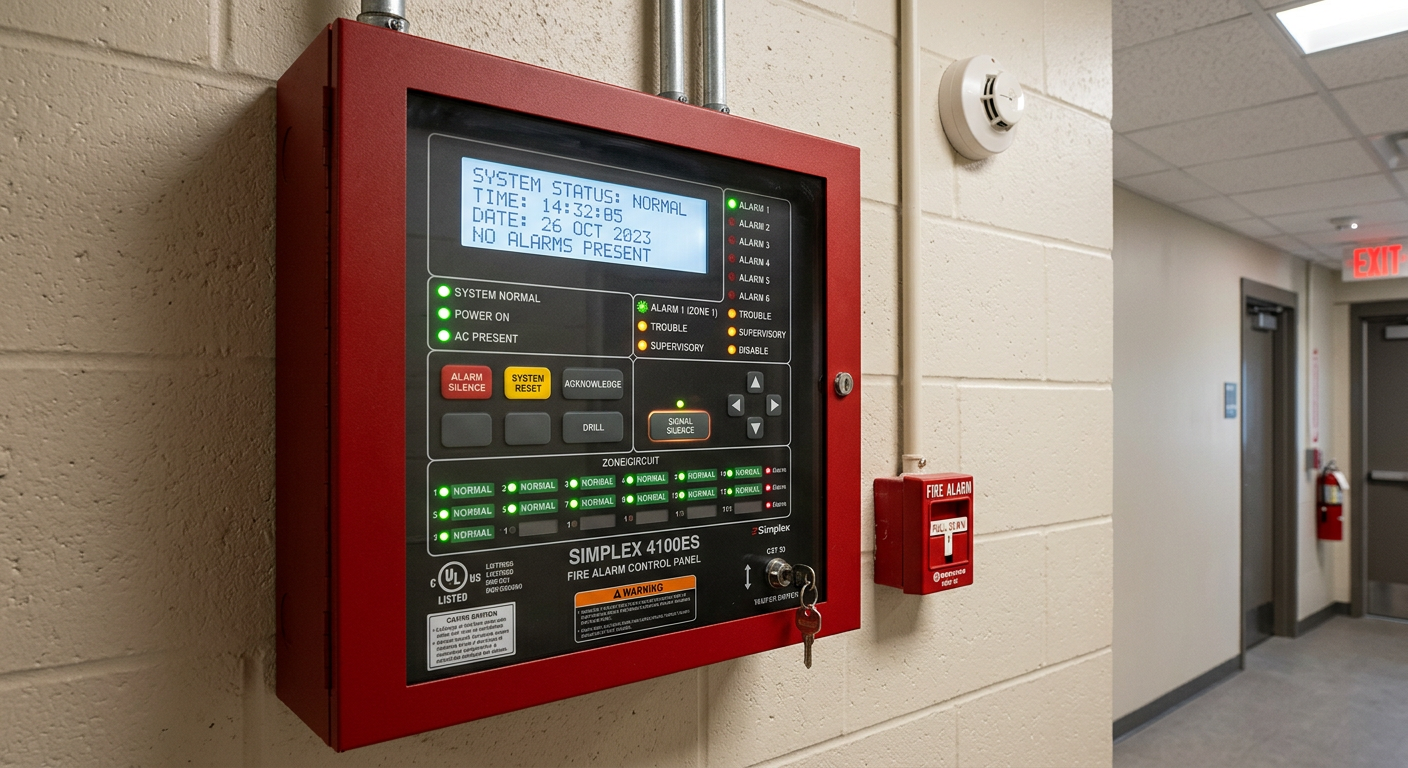
Fire alarm systems are the backbone of any commercial building’s fire safety plan. They provide early warning, alert occupants, and notify emergency services—buying precious time for evacuation and fire suppression.
NFPA 72 (National Fire Alarm and Signaling Code) and the IBC (International Building Code) set strict requirements for fire alarm systems in commercial buildings.
This guide covers:
-
When a fire alarm system is required.
-
Key system components (detectors, pull stations, notification appliances).
-
Installation and testing requirements.
-
Common violations and how to avoid them.
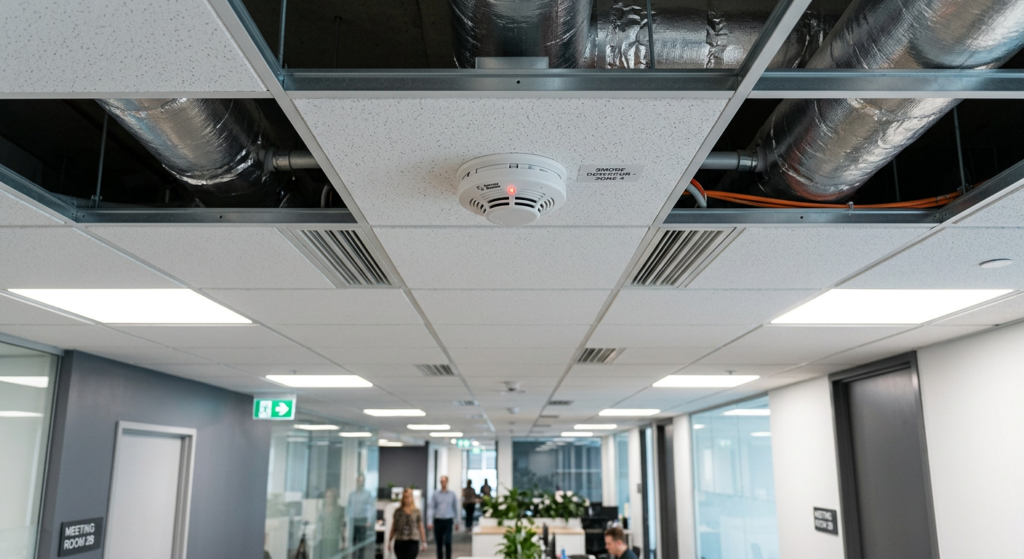
Section 1: When Is a Fire Alarm System Required?
Not all commercial buildings require a fire alarm system. The IBC and NFPA 72 specify when one is mandatory.
| Condition | Requirement | Code Reference |
| Occupant Load > 300 | Fire alarm system required. | IBC 907.2 |
| High-Rise Buildings | Fire alarm system required (with voice evacuation). | IBC 907.2.12.1 |
| Assembly Occupancies | Required if occupant load > 300 (or > 100 in some jurisdictions). | IBC 907.2.2 |
| Educational Occupancies | Required for all educational buildings (K-12). | IBC 907.2.3 |
| Healthcare Occupancies | Required for all healthcare buildings. | IBC 907.2.6 |
| Hotels & Dormitories | Required for all hotels and dormitories. | IBC 907.2.8 |
| Apartments | Required for buildings with > 6 units. | IBC 907.2.9 |
| Business Occupancies | Required if occupant load > 500 (or as specified by local code). | IBC 907.2.1 |
Pro Tip: Even if not required, installing a fire alarm system is a best practice that can save lives and property.
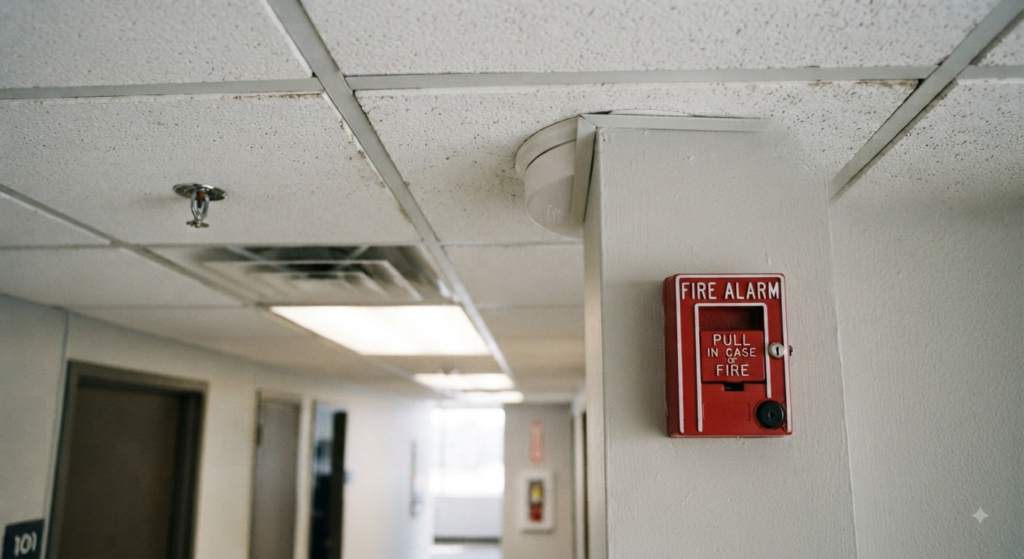
Section 2: Key Components of a Fire Alarm System
A commercial fire alarm system consists of several interconnected components.
| Component | Function | Code Reference |
| Fire Alarm Control Panel (FACP) | The “brain” of the system; receives signals from detectors and initiates alarms. | NFPA 72, 10.2 |
| Smoke Detectors | Detect smoke particles and send a signal to the FACP. | NFPA 72, 17.7 |
| Heat Detectors | Detect rapid temperature rise or high temperatures. | NFPA 72, 17.6 |
| Manual Pull Stations | Allow occupants to manually activate the alarm. | NFPA 72, 17.15 |
| Notification Appliances | Audible (horns) and visual (strobes) devices to alert occupants. | NFPA 72, 18.1 |
| Voice Evacuation System | Provides pre-recorded or live voice instructions to occupants. | NFPA 72, 24.5 |
| Remote Monitoring | Sends alarm signals to a central monitoring station. | NFPA 72, 26.1 |
| Power Supply | Primary power (building electrical) + secondary power (battery/generator). | NFPA 72, 10.5 |
Pro Tip: All components must be listed by an approved testing laboratory (e.g., UL, Intertek).
Section 3: Smoke Detector Placement (NFPA 72)
Proper placement of smoke detectors is critical for early detection.
| Location | Requirement | Code Reference |
| Ceilings | Detectors must be mounted on the ceiling (or wall within 12 inches of the ceiling). | NFPA 72, 17.7.4 |
| Spacing | Maximum spacing is 30 feet between detectors (per NFPA 72 guidelines). | NFPA 72, 17.7.4 |
| Dead Air Spaces | Avoid placing detectors near corners or high air movement areas. | NFPA 72, A.17.7.4 |
| Mechanical Rooms | Heat detectors are preferred in dusty or humid environments. | NFPA 72, 17.6 |
| Kitchens | Heat detectors or specialized smoke detectors (avoid false alarms). | NFPA 72, A.17.7.5 |
Common Violation: Placing smoke detectors too close to air supply vents (which can dilute smoke).
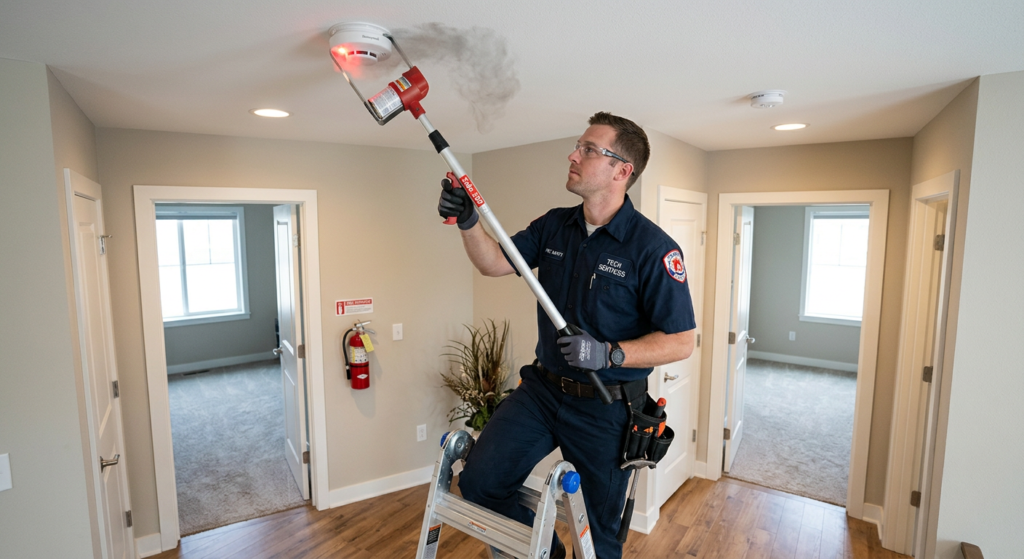
Section 4: Notification Appliance Requirements
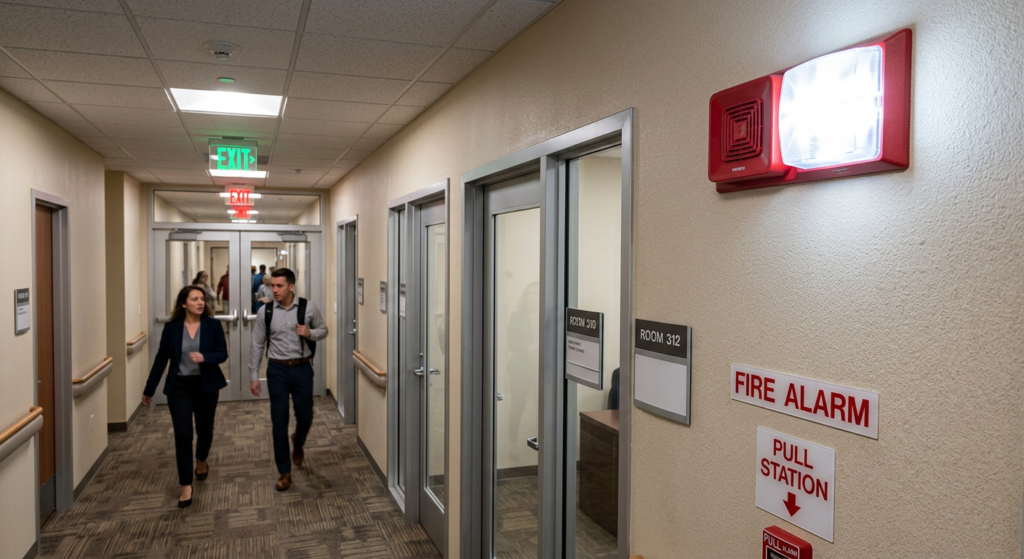
Notification appliances ensure that all occupants are alerted during a fire.
| Type | Requirement | Code Reference |
| Audible Alarms | Minimum 15 dBA above ambient noise level (or 75 dBA minimum). | NFPA 72, 18.4.3 |
| Visual Alarms (Strobes) | Required in public areas and areas with hearing-impaired occupants. | NFPA 72, 18.5 |
| Voice Evacuation | Required in high-rise buildings and large assembly occupancies. | NFPA 72, 24.5 |
| Two-Way Communication | Required for high-rise buildings (to allow firefighter communication). | NFPA 72, 24.6 |
Pro Tip: For areas with high ambient noise (e.g., industrial spaces), audible alarms must be louder to be effective.
Section 5: Testing, Inspection, and Maintenance (NFPA 72)
Fire alarm systems must be regularly tested and maintained to ensure they function properly.
| Test Type | Frequency | Procedure | Code Reference |
|---|---|---|---|
| Visual Inspection | Weekly/Monthly | Check control panel for trouble signals, visible damage, and battery status. | NFPA 72, 14.2 |
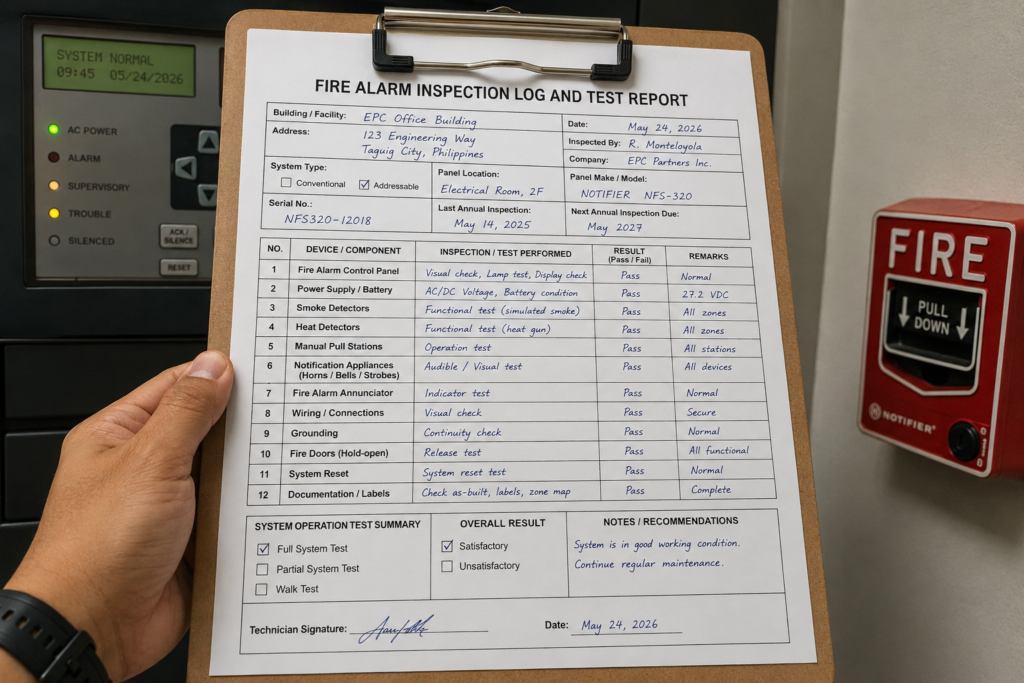
| Functional Test | Annually | Test each detector, pull station, and notification appliance. | NFPA 72, 14.4 |
| Battery Test | Annually | Test secondary power (batteries) under load for 90 minutes. | NFPA 72, 10.5 |
| Full System Test | Annually | Simulate a fire alarm condition; verify all components operate correctly. | NFPA 72, 14.4 |
| Central Station Monitoring Test | Annually | Verify that signals are transmitted to the monitoring station. | NFPA 72, 26.1 |
Documentation: All inspections and tests must be recorded and retained for inspection by authorities (NFPA 72 requires records for at least 3 years).
Section 6: Common Violations and How to Avoid Them
| Violation | Why It’s a Problem | How to Fix |
|---|---|---|
| Missing or damaged detectors | Occupants will not be alerted. | Replace or repair immediately. |
| Improper spacing | Detectors may not detect smoke in a fire. | Verify spacing is within code requirements. |
| Dead batteries | System fails during power outage. | Test batteries annually; replace as needed. |
| Blocked notification appliances | Occupants cannot see or hear alarms. | Keep areas clear of obstructions. |
| Missing documentation | Inspectors cannot verify compliance. | Maintain inspection logs. |
| Unauthorized system modifications | System may not function as designed. | Only licensed contractors should modify systems. |
Conclusion
Fire alarm systems are a critical life-safety feature in commercial buildings. By ensuring proper design, installation, and maintenance, you can protect occupants and comply with NFPA 72 and IBC requirements.
Take Action Today:
-
Verify your building has a fire alarm system (if required).
-
Schedule an annual professional inspection to ensure compliance.
-
Test batteries and system components regularly.
-
Maintain inspection records for at least 3 years.