IMPORTANT DISCLAIMER: This guide references NFPA 101, Chapter 43 (Building Rehabilitation) and NFPA 914, Code for the Protection of Historic Structures, where applicable to existing building retrofits. However, NFPA 101 and NFPA 914 requirements vary significantly by edition (2018, 2021, 2023) and are frequently amended by state and local jurisdictions. Local amendments and the edition adopted by your Authority Having Jurisdiction (AHJ) always control. This guide is a starting point only—always verify the specific requirements applicable to your project with your local AHJ.
Fire safety is at an inflection point. The systems, materials, and hazards that defined the profession for decades are being reshaped by forces that didn’t exist—or weren’t mainstream—twenty years ago. Lithium-ion batteries power everything from phones to vehicles to entire buildings. Artificial intelligence can detect fires from video feeds without ever being “trained” on fire footage. Buildings are becoming sensor-rich environments that generate data faster than traditional codes can respond to.
This article surveys the trends and technologies that will define fire safety over the coming decade. It is not a prediction piece. Every technology described here is either deployed, in pilot, or under active research—and each is anchored to real standards activity, published research, or documented deployments. Where something remains speculative, we say so.
The goal is not to tell you what the future will be, but to help you recognize the direction of travel—and prepare for it.
◆ Section 1: Why Fire Safety Is at an Inflection Point
Three converging forces are driving change:
| Force | What It Means |
|---|---|
| New hazards | Lithium-ion batteries, hydrogen systems, mass timber, and energy storage introduce fire behaviors that traditional suppression was not designed for |
| New capabilities | AI, IoT, digital twins, and robotics offer detection, prediction, and response options that didn’t exist at commercial scale a decade ago |
| New expectations | Building owners and occupants expect proactive safety, not just reactive alarm systems—and they expect data to prove it |
The fire protection industry has historically moved slowly, and for good reason: life safety systems must be reliable, and reliability comes from tested, proven technology. But the pace of change in building materials, energy systems, and digital infrastructure is outpacing the code development cycle. The gap between what’s possible and what’s codified is widening.
The SFPE Foundation’s 2025 research on fire testing of resilient and sustainable materials captures this tension directly: current fire tests are often inadequate for evaluating novel materials, and bridging that gap requires new test methods and increased reliance on performance-based design .
Pro Tip: The most successful fire safety professionals in the coming decade will be those who can navigate the space between prescriptive code compliance and performance-based innovation—and who can document their reasoning for the AHJ.
◆ Section 2: AI and Machine Learning in Detection and Risk Prediction
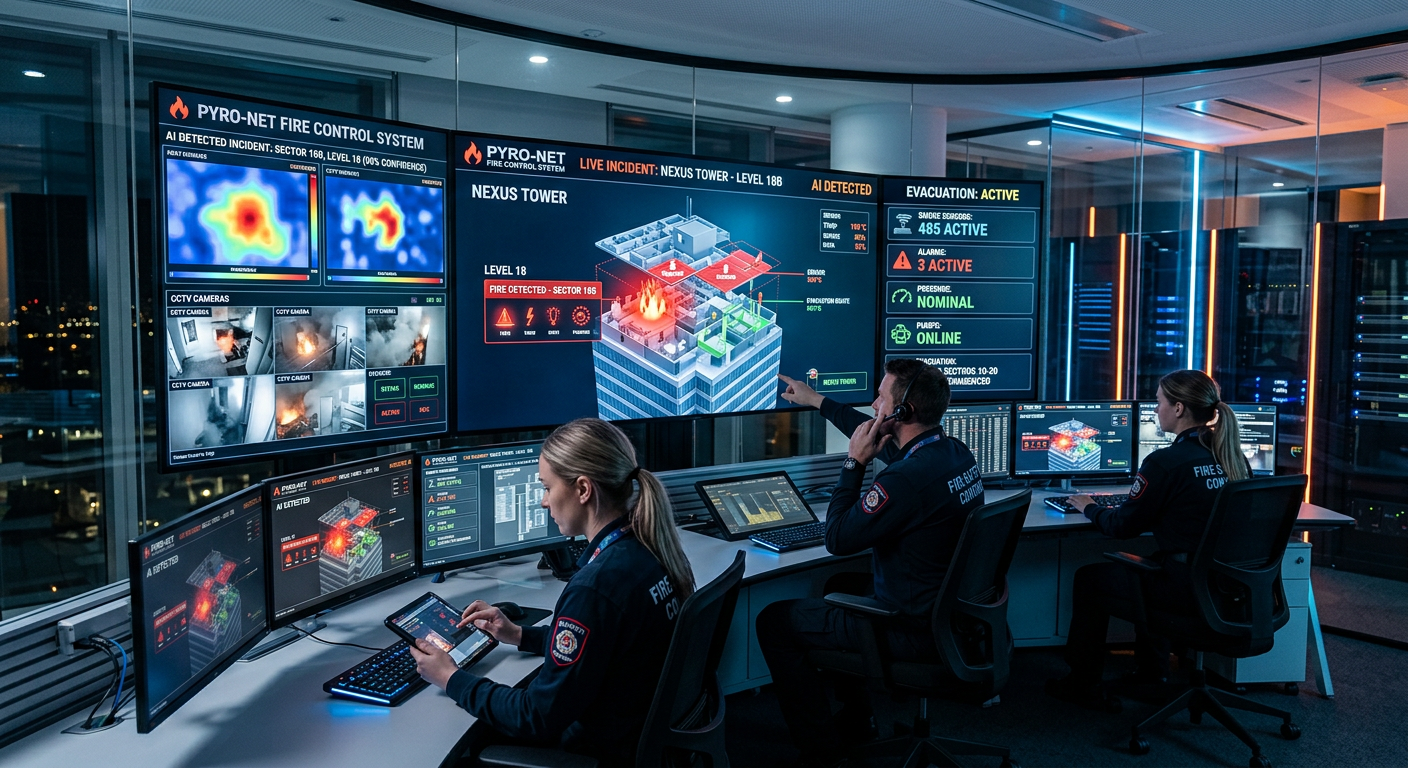
Artificial intelligence is moving from novelty to utility in fire detection. The most significant development is zero-shot fire detection—systems that can identify fire in video feeds without being trained on labeled fire data.
A 2025 paper in Neurocomputing introduced a framework that leverages large language models and contrastive learning to detect fires without any training, outperforming established methods like ResNet, ViT, and YOLOv8 in detecting small fires in complex environments . The system uses enhanced self-attention mechanisms and dynamic threshold calculations to improve robustness across diverse scenarios.
This matters because traditional fire detection AI requires extensive labeled datasets—images of fire and non-fire—which are expensive to curate and may not generalize to new environments. Zero-shot approaches reduce that barrier.
| AI Application | Current Status | What It Enables |
|---|---|---|
| Zero-shot video fire detection | Research / early deployment | Detection without labeled training data |
| AI-enhanced risk assessment | Commercial (early) | Predictive maintenance and hazard identification |
| False alarm reduction | Commercial | Pattern recognition to distinguish fire from nuisance sources |
| Fire growth prediction | Research | Modeling fire spread based on sensor data |
The Security Sales & Integration industry survey notes that intelligent, connected systems can deploy “hundreds of thousands of sensors” and shift fire safety “from its react-and-respond stance toward a more proactive, predict-and-prevent approach” . One integrator reports a 30% reduction in service calls from connected systems that diagnose issues before they require emergency attention .
Pro Tip: AI in fire detection is most valuable when it augments human decision-making, not replaces it. The SFPE Foundation’s research on digital buildings and fire service operations found that incident commanders want clear, actionable information—not raw data or predictive models that lack practical grounding .
◆ Section 3: IoT and Smart Building Integration
The Internet of Things is transforming fire alarm systems from isolated panels into networked, data-generating platforms.
The industry is moving away from POTS (plain old telephone service) lines toward IP- and cellular-based communicators integrated with cloud platforms and mobile apps. This enables remote diagnostics, real-time alerts, and new recurring revenue models for service providers . Multi-carrier cellular communicators provide redundancy—if one carrier fails, the communicator switches to another to ensure life-safety signals are delivered .
| Legacy Fire Alarm | Connected Fire Alarm |
|---|---|
| Reactive—alarm when threshold crossed | Predictive—identifies trends before failure |
| Single communication path | Redundant cellular/IP with failover |
| Scheduled maintenance | Condition-based maintenance |
| Limited diagnostic data | Hundreds of data points per device |
| On-site troubleshooting | Remote diagnostics and remediation |
The UAE Fire & Life Safety Code of Practice explicitly addresses Smart Monitoring Systems in Chapter 16, recognizing that continuous monitoring and data-driven maintenance are part of the compliance lifecycle . This regulatory recognition of IoT-enabled fire safety is a significant shift—it signals that authorities are beginning to treat connected systems as a legitimate compliance pathway, not just a convenience.
Pro Tip: Connected systems generate valuable data, but they also introduce cybersecurity risk. NFPA 72 (2025) dramatically expanded its cybersecurity requirements, introducing security levels for network-connectable equipment. Systems connected to publicly accessible networks require the highest level of protection .
◆ Section 4: Digital Twins and BIM for Fire Safety
Digital twins—virtual replicas of physical buildings that sync with real-time data—are moving from concept to practical application in fire safety.
The interface between digital buildings and fire service operations is an active research area. A 2026 SFPE Foundation study interviewed 47 incident commanders across three countries to understand how different types of information affect decision-making. The findings: real-time and well-presented static data enable quicker, more targeted fire service responses, and early access to such information—especially at dispatch—is critical .
However, the study also identified a gap: advanced predictive tools don’t always meet the practical needs of incident commanders . The lesson is that technology must translate complex data into clear, actionable information—not just generate more data.
| Digital Twin Application | Maturity | Value for Fire Safety |
|---|---|---|
| BIM-based egress modeling | Established | Design-phase validation of egress paths |
| Real-time sensor integration | Early deployment | Live monitoring of fire system health |
| Fire service pre-planning | Pilot / research | Building schematics and hazard data at dispatch |
| Predictive fire modeling | Research | Scenario planning and response optimization |
For existing buildings, digital twins face a data problem: most buildings lack the sensor infrastructure and accurate as-built documentation to support them. Retrofitting IoT sensors into legacy buildings is possible but requires investment that many owners haven’t yet made.
Pro Tip: Start with BIM if you’re designing new construction—the data captured during design can become the foundation for a digital twin during operations. For existing buildings, focus first on digitizing fire system documentation and integrating with building management systems.
◆ Section 5: Robotics, Drones, and Autonomous Response
Robotics in fire safety remains largely in the research and pilot stage, but the trajectory is clear.
The most mature applications are inspection and monitoring rather than suppression:
| Application | Status | Notes |
|---|---|---|
| Drone-based building inspection | Commercial | Thermal imaging for fire risk assessment |
| Robotic fire system inspection | Early deployment | Automated testing of detectors and sprinklers |
| Autonomous fire suppression | Research / pilot | Limited to specific industrial applications |
| UAV for post-fire assessment | Commercial | Damage documentation and investigation support |
For most commercial buildings, the near-term value of robotics is in reducing inspection costs and improving coverage. Drones can access roofs and high spaces faster than human inspectors. Robotic systems can test detectors on a schedule without manual intervention.
Fully autonomous firefighting robots remain confined to high-risk industrial settings—refineries, chemical plants, and similar environments where human access is dangerous. The complexity of navigating occupied buildings, identifying victims, and making suppression decisions in real time remains a significant barrier.
Pro Tip: The most practical near-term robotics investment for building owners is automated inspection technology. It reduces labor costs, improves documentation, and addresses the skilled-labor shortage that the industry consistently identifies as a top challenge .
◆ Section 6: New Hazard Classes — Lithium-Ion, Hydrogen, Energy Storage
The most significant fire safety challenge of the coming decade is energy storage.
Lithium-ion batteries are now ubiquitous—in vehicles, buildings, data centers, and grid-scale installations. Their fire behavior is fundamentally different from traditional combustibles. Thermal runaway can exceed 1,000°C, resists conventional suppression, and can reignite hours or days after apparent extinguishment.
The SFPE Foundation’s 2025 research on outdoor lithium-ion battery energy storage systems (BESS) developed a methodology to assess health and environmental impacts from thermal runaway events, establishing relationships between exposure distance and variables including wind speed, ambient temperature, event duration, cell chemistry, and toxic gas species .
NFPA 855, Standard for the Installation of Stationary Energy Storage Systems, has been significantly revised for the 2026 edition. Key changes include consolidation of general requirements into Chapter 4, addition of new battery types, new requirements for emergency response plans, EV charging systems with energy storage, flow batteries (Chapter 16), and ESS on barges (Chapter 17) .
| Hazard | Challenge | Standards Activity |
|---|---|---|
| Lithium-ion BESS | Thermal runaway, toxic gas, reignition | NFPA 855 (2026), SFPE research |
| Hydrogen systems | Invisible flame, wide flammability range | NFPA 2, emerging research |
| EV charging | Battery fire during charging, enclosed spaces | NFPA 855, building code updates |
| Grid-scale storage | Large inventory, cascading failure risk | NFPA 855, fire service pre-planning |
Pro Tip: Lithium-ion fire safety is not just a suppression problem—it’s a separation, detection, and emergency response problem. The NIRS data center fire in South Korea (Article 98) demonstrated that battery fires during maintenance can destroy critical infrastructure even when the IT halls themselves are protected.
◆ Section 7: Performance-Based Design and Fire Modeling
Performance-based design (PBD) is not new, but its importance is growing as prescriptive codes struggle to keep pace with novel materials and building types.
The 2025 research on fire testing of sustainable materials concludes that bridging the safety gap for novel materials requires increased reliance on performance-based design . The same conclusion applies to mass timber, double-skin façades, and other green building strategies where prescriptive requirements either don’t exist or would eliminate design flexibility.
For tall timber buildings, researchers note that multi-hazard PBD principles beyond current design guidelines are needed—considering not just fire, but seismic, wind, and other loads in an integrated framework .
| Prescriptive Design | Performance-Based Design |
|---|---|
| Follows code tables and requirements | Establishes safety objectives and demonstrates compliance |
| Limited flexibility | High flexibility |
| Easier to review | Requires expert judgment and documentation |
| Cannot address novel materials | Can accommodate innovation |
The challenge with PBD is review capacity. Many AHJs lack the in-house expertise to evaluate complex fire models and alternative compliance arguments. This creates uncertainty for designers and can extend approval timelines.
Pro Tip: If you’re pursuing performance-based design, engage the AHJ early and document your methodology thoroughly. The most common failure mode for PBD submittals is not technical inadequacy—it’s insufficient communication with the authority who must approve it.
◆ Section 8: Regulatory and Standards Evolution
Codes and standards are evolving to address new hazards, new technologies, and new expectations.
NFPA 101 (2024) key changes include: new automatic sprinkler requirements for all new parking structures, additional carbon monoxide detection requirements, updated emergency action plan requirements addressing security features, new requirements for inflatable amusement devices and modular rooms, and guidance for alternate care sites .
NFPA 72 (2025) key changes include: a new “restricted audible mode operation” (RAMO) scheme allowing lower sound pressure levels in noise-sensitive environments (with risk analysis and AHJ approval), dramatically expanded cybersecurity requirements with defined security levels, and clarification that magnets cannot be used for smoke detector functional testing .
NFPA 855 (2026) consolidates general ESS requirements, adds battery types and emergency response planning requirements, and introduces chapters for flow batteries and ESS on barges .
| Standard | Edition | Key Direction |
|---|---|---|
| NFPA 101 | 2024 | New hazard coverage, healthcare flexibility, parking sprinklers |
| NFPA 72 | 2025 | Cybersecurity, RAMO, pathway survivability |
| NFPA 855 | 2026 | Energy storage expansion, emergency response |
| NFPA 75/76 | 2024 | Lithium-ion → NFPA 855, off-gas detection |
Pro Tip: The regulatory landscape is fragmenting—different standards are evolving at different paces, and the coverage of lithium-ion batteries has shifted from NFPA 76 to NFPA 855. Ensure your design team is tracking which standard governs which hazard.
◆ Section 9: Workforce and Training Transformation
The fire protection industry faces a persistent and worsening talent gap. Industry surveys consistently identify skilled labor availability as a top challenge—particularly in engineering, inspection, and technical service roles .
Technology is both a cause and a potential solution. As systems become more complex, the training required to service them correctly increases. But connected systems also enable remote diagnostics, condition-based maintenance, and automated testing—reducing the need for on-site labor for routine tasks .
| Workforce Challenge | Technology Response |
|---|---|
| Skilled technician shortage | Remote diagnostics and guided troubleshooting |
| Complex systems require specialized training | AI-assisted maintenance and inspection |
| Inspection costs | Automated testing and one-person inspections |
| Knowledge loss from retirements | Digital documentation and knowledge capture |
One integrator reports that connected systems enable one-man inspections—eliminating the need for one person to man the panel while another walks the floor—cutting inspection labor costs roughly in half .
Pro Tip: The workforce challenge is not just about hiring—it’s about retaining institutional knowledge. As experienced professionals retire, their expertise in navigating code interpretations, AHJ relationships, and practical problem-solving leaves with them. Documented procedures and digital knowledge bases are not optional.
◆ Section 10: What Won’t Change
Amid all the change, some fundamentals remain:
-
Reliability matters more than sophistication. A simpler system that works is better than a complex system that fails. This is why fire alarm systems have 20–30 year lifespans and why the industry is cautious about rapid adoption.
-
The AHJ controls. No amount of technology changes the fact that the Authority Having Jurisdiction determines compliance. Engage early, document thoroughly, and respect the process.
-
Human behavior is unpredictable. Evacuation modeling, training, and drills still matter. Technology can guide people, but it cannot replace their judgment or overcome poor planning.
-
Maintenance is the foundation. The NIRS data center fire (Article 98) was caused by maintenance failures, not technology failures. No system is better than the people who maintain it.
-
Fire safety is a system, not a product. Detection, suppression, compartmentation, egress, and management work together. Optimizing one component while neglecting others creates vulnerability.
Pro Tip: When evaluating new technology, ask: Does this make the system more reliable, or just more impressive? The best fire safety technology is the technology that works when everything else fails.
◆ Section 11: Readiness Assessment for Your Organization
| Question | Yes / No / Partial | Action |
|---|---|---|
| Do we know which standards (NFPA 101, 72, 855, etc.) govern our facility? | Verify current editions and local amendments | |
| Have we assessed lithium-ion battery risks in our buildings? | Conduct BESS risk assessment; check NFPA 855 compliance | |
| Is our fire alarm system connected or legacy? | Evaluate upgrade path; consider cybersecurity requirements | |
| Do we have a digital record of our fire system documentation? | Digitize as-builts, inspection records, and maintenance logs | |
| Have we engaged our AHJ on any planned technology upgrades? | Schedule pre-application meeting | |
| Do we have a performance-based design path if needed? | Identify qualified fire protection engineer | |
| Are our maintenance procedures verified—not just documented? | Audit contractor work; spot-check procedures | |
| Do we have a plan for workforce training and knowledge retention? | Invest in training; document institutional knowledge |
◆ Section 12: Conclusion
The future of fire safety is not a single technology or trend. It is the convergence of new hazards, new capabilities, and new expectations—playing out across an industry that must balance innovation with the absolute requirement for reliability.
Key Takeaways:
-
AI is becoming practical for detection and risk assessment, with zero-shot approaches reducing the data barrier .
-
IoT and connectivity are transforming fire alarms from isolated panels to networked, data-rich systems .
-
Lithium-ion batteries are the defining hazard of the coming decade, requiring dedicated standards (NFPA 855) and new emergency response approaches .
-
Digital twins and BIM offer value for design and operations, but practical adoption lags the technology .
-
Performance-based design is increasingly necessary as prescriptive codes struggle with novel materials .
-
The workforce gap is real and technology is both a contributor and a partial solution .
-
Fundamentals don’t change—reliability, maintenance, human behavior, and AHJ authority remain central.
Take Action Today:
-
Assess your facility’s exposure to lithium-ion and energy storage hazards.
-
Evaluate whether your fire alarm system is due for connectivity upgrade—and plan cybersecurity accordingly.
-
Review your fire system documentation for digital readiness.
-
Identify the standards and editions that govern your facility.
-
Engage your AHJ before pursuing any technology-driven changes.
-
Invest in workforce training and knowledge documentation.
-
Ask whether any new technology makes your system more reliable—not just more impressive.
Continue Reading from Our Series:
-
Learn more: Fire Safety for Data Centers and IT Facilities
-
Related guide: Fire Safety for Green Buildings: Balancing Sustainability and Safety
-
Read more: How to Integrate Fire Safety with Building Information Modeling (BIM)