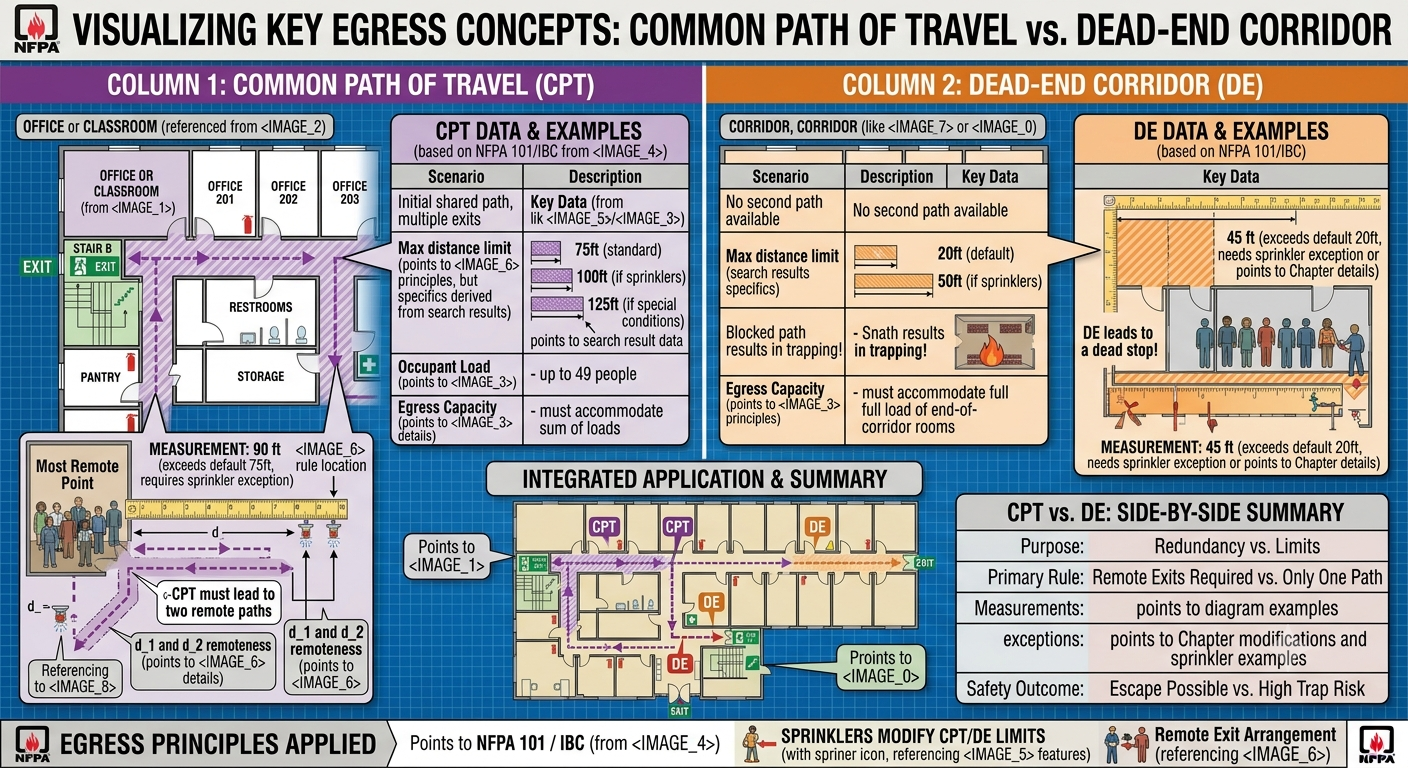
Two of the most frequently misunderstood concepts in NFPA 101 are Common Path of Travel and Dead-End Corridors.
While they sound similar, they are distinct concepts with different code requirements. Misunderstanding these terms can lead to design errors, failed inspections, and costly redesigns.
This guide explains:
-
What is a Common Path of Travel?
-
What is a Dead-End Corridor?
-
The key differences between them.
-
How to calculate and comply with both.

Section 1: What Is a Common Path of Travel?
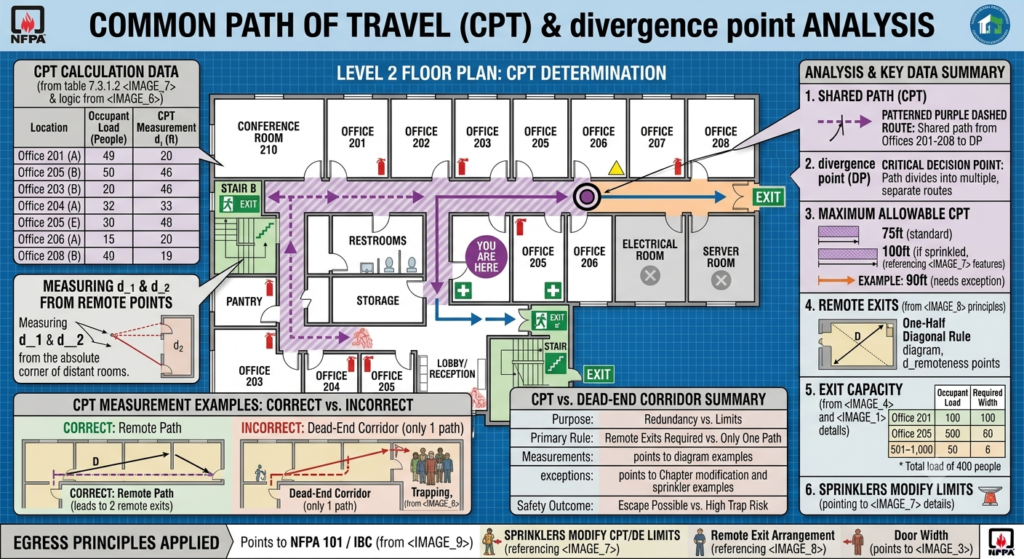
Common Path of Travel is defined as “that portion of the exit access which the occupants are required to traverse before two separate and distinct paths of egress travel to two exits are available” (NFPA 101, 3.3.71).
In plain English: It is the distance you must walk before you have a choice of which exit to take.
Example: Imagine you are in a small office. You walk out of your office door and down a single corridor. You cannot choose between two exits yet—there is only one way to go. The distance from your office door to the point where you can choose between Exit A and Exit B is your Common Path of Travel.
Section 2: What Is a Dead-End Corridor?
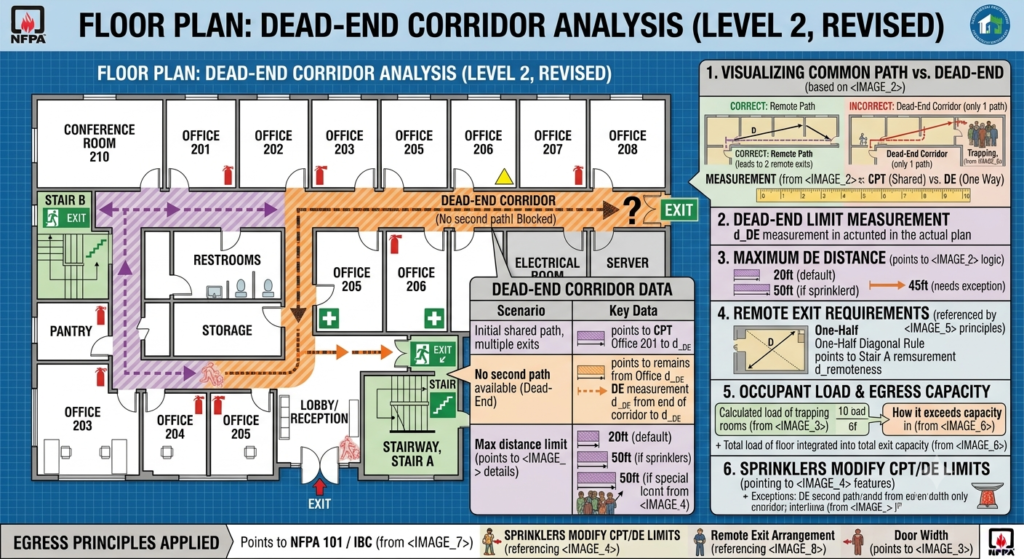
A Dead-End Corridor is a corridor or path where there is only one direction of travel, and it does not lead to an exit.
In plain English: It is a hallway that goes nowhere—like a cul-de-sac. If you walk into a dead-end corridor, you must turn around and go back the way you came to reach an exit.
Example: A long hallway that ends in a storage room with no exit door. Anyone who walks down that hallway must turn around and come back to the main corridor to exit the building.
Section 3: Key Differences
| Feature | Common Path of Travel | Dead-End Corridor |
|---|---|---|
| Definition | Distance before you can choose between two exits. | A path that ends without an exit. |
| Location | Occurs at the beginning of the egress path. | Occurs at the end of a corridor or path. |
| Code Reference | NFPA 101, 7.5.1.3 | NFPA 101, 7.5.1.1 |
| Limit | Typically 15–30 m (depending on sprinklered/non-sprinklered). | Typically 6–15 m (depending on occupancy). |
| Solution | Add an alternative exit path earlier. | Extend the corridor to an exit or add an exit. |
The Golden Rule: The common path of travel is measured before two exits are available. The dead-end corridor is measured after two exits are available.
Section 4: Common Path of Travel Limits
NFPA 101 sets specific limits for common path of travel based on the occupancy type and whether the building is sprinklered.
| Occupancy Type | Sprinklered | Not Sprinklered | Code Reference |
|---|---|---|---|
| Ambulatory | 30 m | 23 m | 20.2.5, 38.2.5.3 |
| Assembly | 23 m (if OL > 50) 6.1 m (if OL < 50) | Same | 12.2.5 |
| Business | 30 m | 23 m | 38.2.5.3 |
| Educational | 30 m | 23 m | 14.2.5.3 |
| Healthcare | 30 m | 30 m | 18.2.5.3 |
| Hotels & Dormitories | 15 m | 10.7 m | 28.2.5.3, 28.2.5.4 |
| Apartments | 15 m | 10.7 m | 30.2.5.3 |
| Mercantile | 30 m | 23 m | 36.2.5.3 |
| Storage | 30 m | 15 m | Table 42.2.5 |
Section 5: Dead-End Corridor Limits
NFPA 101 also sets specific limits for dead-end corridors.
| Occupancy Type | Sprinklered | Not Sprinklered | Code Reference |
|---|---|---|---|
| Ambulatory | 15 m | 6 m | 20.2.5, 38.2.5.2 |
| Assembly | 6 m | 6 m | 12.2.5.1.3 |
| Business | 15 m | 6 m | 38.2.5.2.1, 38.2.5.2.2 |
| Educational | 15 m | 6 m | 14.2.5.2 |
| Healthcare | 9 m | 9 m | 18.2.5.2 |
| Hotels & Dormitories | 15 m | 10.7 m | Table A.7.6 |
| Apartments | 15 m | 10.7 m | Table A.7.6 |
| Mercantile | 15 m | 6 m | Table A.7.6 |
| Storage | 15 m | 15 m | Table 42.2.5 |
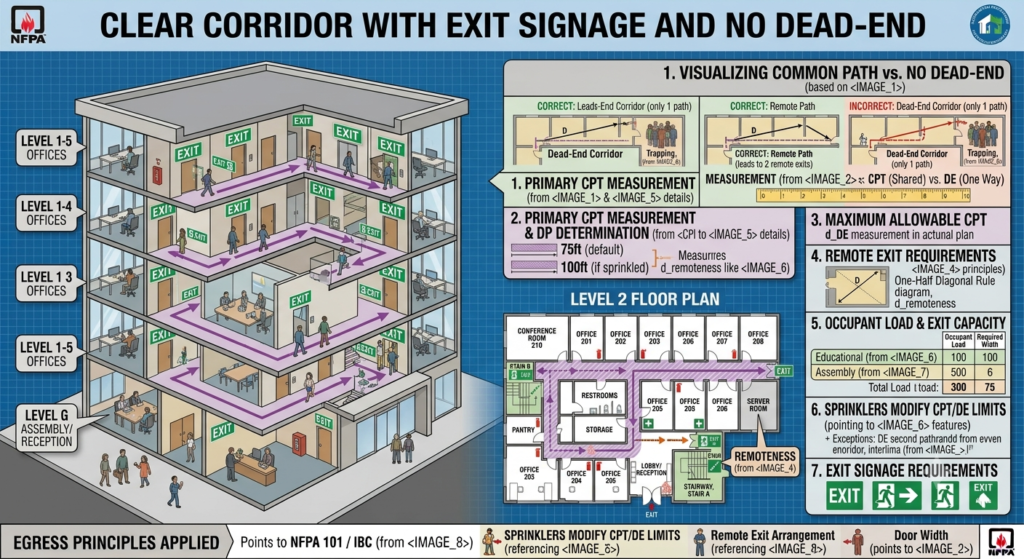
Section 6: How to Avoid Common Path of Travel and Dead-End Violations
| Strategy | How It Helps |
|---|---|
| Provide two exits early | Reduces common path of travel by giving occupants a choice sooner. |
| Extend corridors to exits | Eliminates dead-ends by ensuring every corridor leads to an exit. |
| Add additional exits | Reduces both common path and dead-end distances. |
| Use smoke barriers | Can help subdivide spaces and reduce travel distances. |
| Sprinkler the building | Increases allowable distances for both common path and dead-ends. |
Section 7: Common Mistakes and How to Avoid Them
| Mistake | Why It’s a Problem | How to Fix |
|---|---|---|
| Confusing common path with dead-end | Leads to incorrect design calculations. | Understand the difference: common path = before two exits; dead-end = after two exits. |
| Ignoring sprinklered vs. non-sprinklered | Applies the wrong distance limit. | Always verify whether the building is sprinklered. |
| Not accounting for occupancy type | Different occupancies have different limits. | Always check the specific occupancy chapter. |
| Measuring incorrectly | Incorrect distances lead to failed inspections. | Measure along the natural path of travel (not straight-line distance). |
| Not verifying with AHJ | Local amendments may differ. | Always confirm with your local Authority Having Jurisdiction. |
Conclusion
Understanding the difference between Common Path of Travel and Dead-End Corridors is essential for compliant life safety design. By knowing the limits and how to measure them, you can avoid costly redesigns and ensure occupant safety.
Take Action Today:
-
Identify all common paths of travel in your building.
-
Identify all dead-end corridors.
-
Measure the distances to verify compliance.
-
Add exits or extend corridors where needed.
Continue Reading from Our NFPA 101 Series:
-
Read more about: How to Know How Many Exits Are Required
-
Learn more: How to Determine Occupant Load
-
Related guide: NFPA 101 Means of Exit Requirements