IMPORTANT DISCLAIMER: This guide references NFPA 72, National Fire Alarm and Signaling Code (Chapter 18 for notification, Chapter 24 for Emergency Communications Systems); NFPA 101, Life Safety Code; and the International Building Code (IBC). These codes vary significantly by edition and are frequently amended by state and local jurisdictions. NFPA 72 editions include 2019, 2022, and 2025 (current). The most recent published edition is NFPA 72 (2025), but AHJ-adopted editions commonly lag behind by one or more cycles. The 2025 edition added detailed instructions for voltage drop calculations in notification appliance circuits, standardizing the procedure in Chapters 18 and 24. Section numbers for intelligibility and message repetition have shifted between editions — verify against your AHJ-adopted edition. Local amendments and the edition adopted by your Authority Having Jurisdiction (AHJ) always control. This guide is a starting point only. Always verify the requirements for your project with your local AHJ.
Voice evacuation and mass notification systems go beyond horns and strobes. They deliver intelligible voice messages that guide occupants through evacuation, relocation, or shelter-in-place. NFPA 72 Chapter 24 governs their design, and the distinction between in-building fire emergency voice/alarm communication systems (EVACS) and mass notification systems (MNS) matters for design, installation, and testing.
A simple horn tells occupants something is wrong. A voice message tells them what to do. That difference—instruction versus alert—is the core value of voice systems, and it is why they are required in occupancies where occupants need guidance: high-rises, large assembly spaces, and anywhere that relocation or partial evacuation is part of the emergency strategy.
This guide covers the fundamentals of voice evacuation and mass notification systems under NFPA 72 Chapter 24, with a focus on intelligibility, system types, and the design decisions that determine whether occupants understand the message.
◆ Section 1: Voice Evacuation vs. Mass Notification
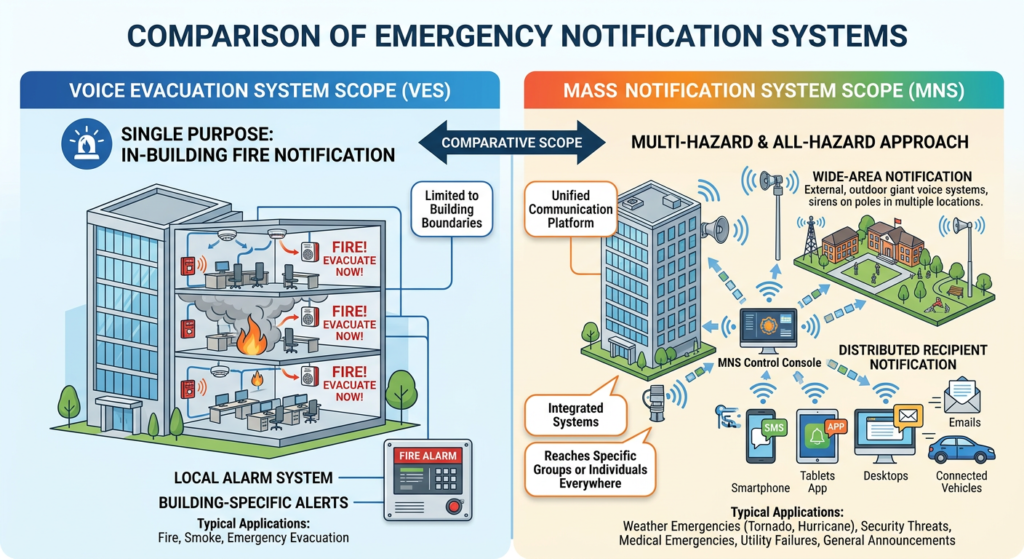
The terms “voice evacuation” and “mass notification” are often used interchangeably, but they describe different systems with different purposes.
| Feature | Fire Voice Evacuation (EVACS) | Mass Notification System (MNS) |
|---|---|---|
| Primary purpose | Fire evacuation | All-hazard notification |
| Trigger | Fire alarm system | Risk analysis; manual activation |
| Scope | In-building | In-building, wide-area, or distributed recipient |
| Risk analysis required | No | Yes |
| Control unit listing — standalone | UL 864 | UL 2572 |
| Control unit listing — combination | Both UL 864 and UL 2572 | Both UL 864 and UL 2572 |
| Message content | Fire evacuation instructions | Any emergency: weather, security, shelter-in-place |
Key point: A fire voice evacuation system is a one-way emergency communication system under Chapter 24, but it is not a mass notification system. The distinction matters because MNS requires a risk analysis to determine design and installation details. A standalone MNS control unit must be UL 2572 listed. A combination system must carry both UL 864 (fire alarm) and UL 2572 (MNS) listings.
Combination systems: Buildings that require voice evacuation and also need mass notification often install a combination MNS/voice evacuation system that performs both functions using shared equipment.
Pro Tip: If your building needs both voice evacuation and mass notification, design a combination system. Separate systems duplicate speakers, wiring, and control equipment—and create coordination problems during simultaneous events.
◆ Section 2: When Voice Systems Are Required
NFPA 72 does not itself mandate where voice systems are required. The requirement comes from the building code or NFPA 101 occupancy chapters.
A. Common Triggers
| Trigger | Threshold | Source |
|---|---|---|
| High-rise buildings | Occupied floor more than 75 ft above the lowest level of fire department vehicle access | IBC definition; high-rise provisions |
| Covered mall buildings | Verify threshold against adopted edition | IBC |
| Open mall buildings | Verify threshold against adopted edition | IBC |
| Group A occupancies | Verify threshold against adopted edition | IBC |
Key point: The IBC requires EVACS for high-rise buildings, covered and open mall buildings, and certain other occupancies depending on edition and occupant load. It does not generally require mass notification systems—MNS is driven by owner requirements and risk analysis, though local amendments and campus requirements vary.
Note on relocation or partial evacuation: Relocation and partial evacuation are design strategies, not code triggers. When a building’s emergency strategy includes relocation or partial evacuation, a voice system is typically necessary to coordinate it—but the requirement comes from the code trigger, not from the strategy itself.
B. Risk Analysis for MNS
Where an MNS is installed, a risk analysis is required to determine the system’s design and installation details. The code defines risk analysis as a process to characterize the likelihood, vulnerability, and magnitude of incidents associated with natural, technological, and manmade disasters and other emergencies.
Key Article: Article 77 — How to Design for Fire Safety in High-Rise Buildings
Pro Tip: The risk analysis is not optional for MNS. It drives system scope, message content, and activation protocols. Without it, the MNS has no documented basis for its design.
◆ Section 3: Audibility and Intelligibility
Voice systems have two performance requirements: audibility (can the message be heard?) and intelligibility (can the message be understood?).
A. Audibility Requirements
NFPA 72 requires audible notification appliances to deliver sound levels at least 15 dB above the average ambient sound or 5 dB above the maximum ambient sound lasting at least 60 seconds, whichever is greater.
In sleeping areas, the requirement is more stringent: the sound level at the pillow must be 15 dB above average ambient, 5 dB above the maximum sound of at least 60 seconds, or 75 dBA—whichever is greater.
Design implication: Avoid over-amplifying speakers to meet a higher dBA. Overdriving distorts voice signals. Increasing the number of speakers while using lower power taps is usually a better option.
B. Intelligibility Requirements
The body of the code requires voice intelligibility in ADS designated as requiring it, and Annex D provides the measurement methods and quantitative criteria.
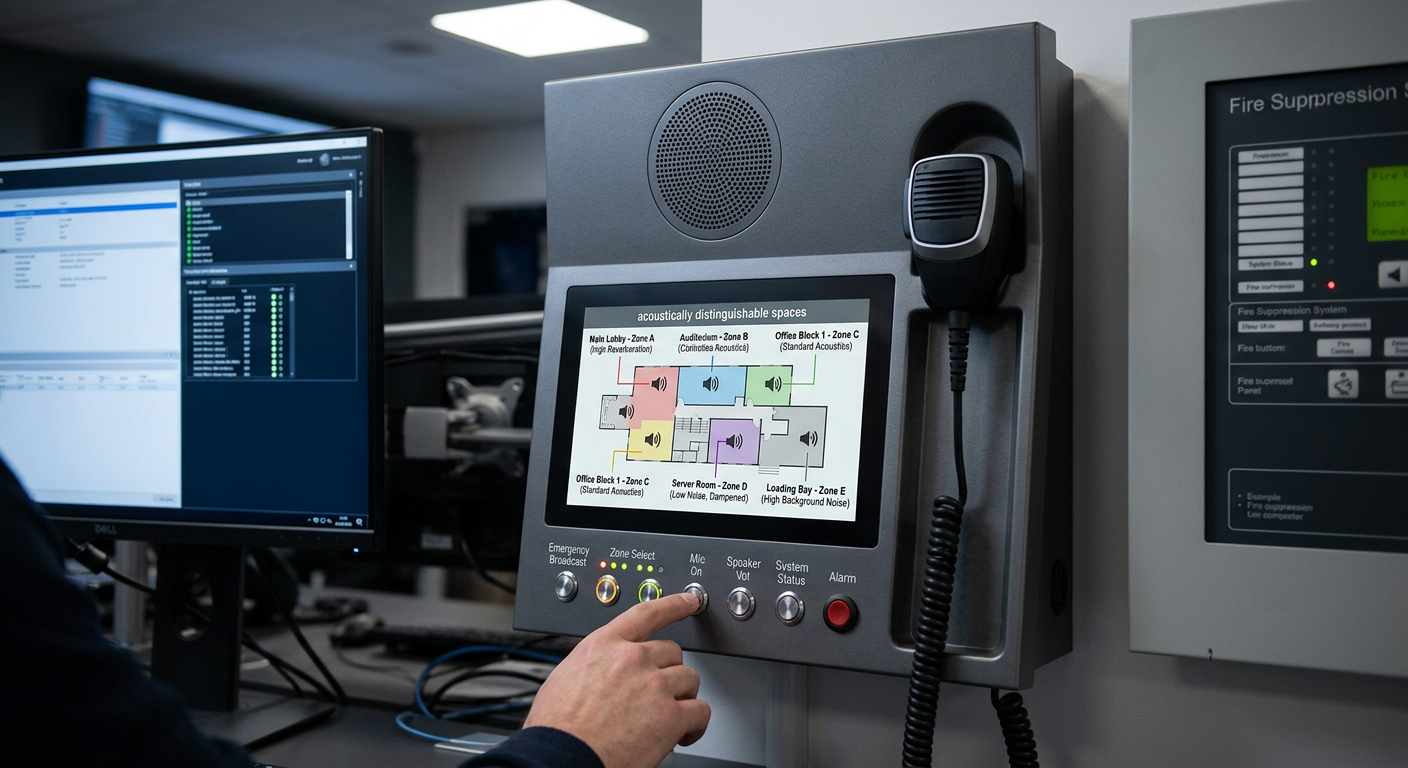
Within acoustically distinguishable spaces (ADS) where voice intelligibility is required, voice communications systems shall reproduce messages with voice intelligibility. Quantitative measurements are not mandatory; a simple listen test is acceptable.
Where quantitative testing is used, Annex D provides the baseline criterion:
| Criterion | Requirement |
|---|---|
| Annex D (baseline) | ≥0.45 STI (0.65 CIS) at 90% of measurement locations; average ≥0.50 STI (0.70 CIS) |
Stricter local criteria exist. For example, the City of Henderson requires:
| Criterion | Requirement |
|---|---|
| Henderson (local) | ≥0.50 STI (0.70 CIS) at 90% of measurement locations; average ≥0.55 STI (0.74 CIS) |
C. Acoustically Distinguishable Spaces (ADS)
An ADS is an ECS notification zone or subdivision that is distinguished from adjacent spaces by different acoustical, environmental, or use characteristics—such as reverberation time and ambient sound pressure level.
Designer responsibility: The system designer must identify all ADS during the planning phase and assign each ADS as requiring or not requiring intelligibility.
Key point: NFPA 72 does not require intelligibility in every space. It requires intelligibility where required by the governing code or owner specification—and the designer must document which spaces require it and which do not.
Pro Tip: For spaces where the ambient sound level is 85 dBA or greater, meeting intelligibility criteria may not be possible. Other means of communication may be necessary.
◆ Section 4: Speaker Layout and Design
Speaker layout is driven by the ADS identification and the acoustical characteristics of each space.
A. Factors Affecting Intelligibility
| Factor | Impact |
|---|---|
| Signal-to-noise ratio (SNR) | Higher ratio = greater intelligibility; 15 dB over ambient is recommended |
| Frequency response | Speech energy lies primarily between 500 Hz and 4 kHz; consonants (critical for understanding) are mainly in the 2–4 kHz region |
| Reverberation | Hard surfaces reflect sound; carpet absorbs it |
| Harmonic distortion | Distortion reduces comprehension |
| Speaker spacing and tap | More speakers at lower power often outperform fewer speakers at higher power |
B. Design Approach
The designer must:
-
Identify all ADS in the building.
-
Determine which ADS require intelligibility based on use, occupancy, and governing code.
-
Select speaker type, spacing, and tap to achieve the required performance in each ADS.
-
Document the ADS table and floor plan showing which spaces require intelligibility.
Key point: The ADS identification is not a formality. It determines where speakers are placed, how many are needed, and what power taps are used.
Pro Tip: Sound modeling software is recommended but not required. For complex spaces with challenging acoustics, modeling can identify problems before installation.
◆ Section 5: Message Prioritization and Content
Voice systems deliver messages that guide occupant action. The messages must be approved and their priority must be defined.
A. Message Approval
All emergency messages—pre-recorded and templates for live messages—must be reviewed and approved by the AHJ. This includes:
-
Messages developed for each scenario in the emergency response plan
-
Templates for live announcements
Key point: The AHJ approval is not optional. Messages that have not been approved may contain deficiencies that are unacceptable for the AHJ.
B. Live Messages
All live messages broadcast during fire or non-fire emergencies shall only be broadcast by responding firefighters or other authorized personnel.
Key point: Live messages should not be broadcast by untrained persons. This can create unsafe conditions and confusion.
C. Message Priority — Determined by Risk Analysis and Emergency Response Plan
Priority between MNS and fire alarm messages is determined by the risk analysis and the emergency response plan. Override of fire alarm by MNS is common practice and is required by some federal criteria (such as UFC 4-021-01), but it is not a universal NFPA 72 mandate.
When a mass notification event occurs simultaneously with a fire alarm event:
-
The MNS may override the fire alarm system notification appliances, based on the risk analysis and emergency response plan.
-
After the MNS relinquishes control, the fire alarm system must automatically restore to normal operation (if no active fire alarm) or to the alarm condition (if fire alarm is active).
D. Signal Duration and Repetition
NFPA 72 §18.4.2.2 requires the evacuation signal (the alert tone) to be repeated for a period appropriate for evacuation, but for not less than 180 seconds, and until the fire alarm system has been silenced or reset by emergency personnel.
The code also permits an automatic cutoff after not less than 180 seconds where approved by the AHJ. The voice message sequence follows the alert tone in accordance with Chapter 24.
Key point: The 180-second requirement applies to the evacuation signal (alert tone), not to an individual voice message. Verify the applicable section numbers for the message sequence against your AHJ-adopted edition.
◆ Section 6: Interface with Fire Alarm and Other Systems
Voice systems do not operate in isolation. They interface with the fire alarm system, suppression systems, and building automation.
A. Fire Alarm System Interface
The voice system is typically integrated with the fire alarm control panel. When the fire alarm activates, the voice system broadcasts the appropriate message.
Combination systems: A combination fire alarm/MNS control unit must carry both UL 864 (fire alarm) and UL 2572 (MNS) listings.
B. Suppression System Interface
Special suppression systems may require pre-discharge notification through the voice system. This alerts occupants before agent discharge.
C. Visible Notification
Where audible notification is provided, MNS must also provide visible notification (strobes) to serve the hearing impaired and for high-noise areas. Strobes must meet NFPA 72 synchronization requirements.
Textual, graphic, or visual displays are also permitted, meeting NFPA 72 requirements.
Key point: Voice systems must serve all occupants—including those who cannot hear the message. Visible notification is not optional.
◆ Section 7: Inspection, Testing, and Maintenance
NFPA 72 Chapter 14 establishes ITM requirements for emergency communication systems.
A. Testing Frequency
| Interval | Activity |
|---|---|
| Annual | Performance testing of speakers, amplifiers, and backup power; signal strength verification; integration testing |
| Varies by type | Battery inspection and load voltage testing — frequency depends on battery type; check Table 14.4.3.2 |
Note: ITM frequencies vary by component. Use NFPA 72 Chapter 14 tables (Table 14.3.1 for inspection, Table 14.4.3.2 for testing) for specific requirements. Table 14.4.3.2 lists audible textual notification appliances (speakers) with an annual testing frequency.
Monthly operational testing is a recommendation or owner/AHJ requirement, not an NFPA 72 code requirement.
B. Intelligibility Testing
Where intelligibility is required, testing must be conducted after substantial completion of construction to ensure finished materials are in place. Test results must include CIS or STI scores with room names, numbers, and test locations.
Practical note: A score of 1.0 is not achievable in field testing and will not be accepted—this is a matter of testing practice and AHJ acceptance, not code text.
C. Records
ITM records must be retained per NFPA 72 requirements. Documentation of ADS identification and intelligibility testing should be maintained as permanent building records.
Pro Tip: The most common failure mode for voice systems is degraded speaker performance that goes undetected because regular testing is not performed properly. Annual code-required testing is the minimum; monthly operational checks are a recommended practice for critical facilities.
◆ Section 8: Design Checklist
| Item | Status | Notes |
|---|---|---|
| System type determined | ☐ | EVACS, standalone MNS, or combination |
| Governing code requirement confirmed | ☐ | IBC, NFPA 101, or AHJ |
| Risk analysis completed (MNS) | ☐ | Required for MNS design |
| Control unit listing verified | ☐ | UL 864 (EVACS); UL 2572 (MNS); both (combination) |
| ADS identified and documented | ☐ | Designer responsibility |
| Intelligibility requirement determined per ADS | ☐ | Required or not required |
| Audibility levels calculated | ☐ | 15 dB above average ambient or 5 dB above maximum 60-second ambient, whichever is greater |
| Speaker layout designed | ☐ | Based on ADS acoustics and use |
| Messages developed and approved | ☐ | AHJ approval required |
| Message priority defined | ☐ | Per risk analysis and emergency response plan |
| Signal duration verified | ☐ | ≥180 seconds for evacuation signal per §18.4.2.2 |
| Visible notification provided | ☐ | Strobes for hearing impaired |
| Interface with suppression systems | ☐ | Pre-discharge notification where required |
| Voltage drop calculations | ☐ | 2025 edition standardized procedure in Chapters 18 and 24 |
| ITM scheduled | ☐ | Annual performance testing per Table 14.4.3.2; battery per type |
| Intelligibility testing planned | ☐ | After substantial completion |
| Documentation prepared | ☐ | ADS table, floor plan, test results |
◆ Section 9: Common Mistakes and How to Avoid Them
| Mistake | Why It’s a Problem | How to Fix |
|---|---|---|
| Confusing EVACS with MNS | MNS requires risk analysis; different listing | Determine system type early |
| Using UL 864 alone for combination system | Not approved for MNS use | Verify both UL 864 and UL 2572 listings |
| Skipping risk analysis for MNS | No documented basis for design | Conduct risk analysis per Chapter 24 |
| Not identifying ADS | Cannot determine where intelligibility is required | Identify and document all ADS |
| Assuming intelligibility is required everywhere | Over-design; unnecessary cost | Determine per ADS based on use and code |
| Unapproved messages | AHJ rejection; unsafe instructions | Obtain AHJ approval for all messages |
| Untrained persons broadcasting live messages | Confusion; unsafe conditions | Restrict live messages to authorized personnel |
| Assuming MNS always overrides fire alarm | Priority is set by risk analysis, not code | Define priority in risk analysis and emergency response plan |
| Over-amplifying speakers | Distortion reduces intelligibility | Use more speakers at lower taps |
| No visible notification | Hearing-impaired occupants not served | Provide strobes meeting synchronization requirements |
| No regular testing | Degraded speakers go undetected | Perform annual code-required testing; monthly operational checks as recommended practice |
| Intelligibility testing before construction complete | Test results invalid | Test after substantial completion |
◆ Section 10: Conclusion
Voice evacuation and mass notification systems transform a fire alarm from an alerting device into a communication tool. They tell occupants what to do—not just that something is wrong. But that capability comes with design requirements that horns and strobes do not have.
Key Takeaways:
-
EVACS and MNS are different systems. EVACS is fire evacuation; MNS is all-hazard notification. MNS requires a risk analysis.
-
Standalone MNS = UL 2572; combination = both UL 864 and UL 2572.
-
Audibility is enforceable: 15 dB above average ambient, or 5 dB above maximum 60-second ambient, whichever is greater.
-
The body of the code requires voice intelligibility in ADS designated as requiring it. Annex D provides the measurement methods and criteria.
-
Annex D baseline: ≥0.45 STI (0.65 CIS) at 90% of locations; average ≥0.50 STI (0.70 CIS). Stricter local criteria may apply.
-
ADS identification is a designer responsibility. Each ADS must be designated as requiring or not requiring intelligibility.
-
Messages must be approved by the AHJ—both pre-recorded and live templates.
-
Live messages shall only be broadcast by authorized personnel.
-
Message priority is determined by the risk analysis and emergency response plan, not by a blanket code rule.
-
The evacuation signal sounds for ≥180 seconds per §18.4.2.2; automatic cutoff may be permitted by the AHJ.
-
Visible notification is required where audible notification is provided.
-
ITM: annual performance testing per Table 14.4.3.2. Battery testing frequency varies by type. Monthly operational testing is a recommendation, not code.
Take Action Today:
-
Determine whether your building needs EVACS, standalone MNS, or a combination.
-
For MNS, conduct a risk analysis per Chapter 24.
-
Verify control unit carries required listings (UL 864, UL 2572, or both).
-
Identify and document all ADS; determine intelligibility requirements.
-
Verify audibility levels meet 15 dB above ambient or 5 dB above maximum 60-second ambient.
-
Develop messages and obtain AHJ approval.
-
Define MNS/fire alarm priority in the risk analysis and emergency response plan.
-
Verify evacuation signal duration meets §18.4.2.2 (≥180 seconds).
-
Provide visible notification meeting synchronization requirements.
-
Schedule annual performance testing per Table 14.4.3.2; verify battery testing frequency per type.
-
Plan intelligibility testing after substantial completion.
Continue Reading from Our Series:
-
Related guide: Fire Alarm System Zoning and Addressable Design (NFPA 72)
-
Learn more: How to Design for Fire Safety in High-Rise Buildings
-
Read more: Fire Alarm System Requirements for Commercial Buildings