IMPORTANT DISCLAIMER: This guide references the International Building Code (IBC), Chapter 7 (Fire and Smoke Protection Features), Chapter 14 (Exterior Walls), Chapter 17 (Special Inspections and Tests), and Chapter 26 (Plastic); NFPA 285, Standard Fire Test Method for Evaluation of Fire Propagation Characteristics of Exterior Wall Assemblies Containing Combustible Components; ASTM E2307, Standard Test Method for Determining Fire Resistance of Perimeter Fire Barriers Using Intermediate-Scale, Multi-story Test Apparatus; and NFPA 101, Life Safety Code. These codes and standards vary by edition and are frequently amended by state and local jurisdictions. NFPA 285 has been published in multiple editions (including 2019 and 2023), and AHJ-adopted editions commonly lag behind the most recent published edition by one or more cycles. Section numbers, exceptions, and compliance paths in IBC Chapters 7, 14, and 26 have changed across editions, so verify every requirement against your AHJ-adopted edition. Local amendments and the edition adopted by your Authority Having Jurisdiction (AHJ) always control. This guide is a starting point only. Always verify the specific requirements applicable to your project with your local AHJ.
Curtain walls are non-structural exterior cladding systems that hang from the building structure. They are designed to resist wind, rain, and thermal movement, but their fire performance is a separate and equally critical design consideration. A curtain wall that performs perfectly in service can become a vertical fire spread path if its components and details are not properly evaluated.
Two test standards are central to curtain wall fire safety. NFPA 285 evaluates how the entire exterior wall assembly performs when an interior fire breaks out through a window opening. ASTM E2307 evaluates whether the perimeter fire barrier, the seal between the curtain wall and the floor slab, can maintain its integrity during a fire. Both are pass/fail tests, and both are assembly tests, not material tests. The IBC adds prescriptive provisions for perimeter fire containment, spandrels, and fireblocking that work together with these tests.
This article covers the regulatory framework, the testing standards, perimeter fire containment, spandrels and glazing, the risks posed by combustible components, design variations and listings, inspection and maintenance, retrofit considerations, and the lessons from major façade fires including First Interstate Bank and Grenfell Tower.
◆ Section 1: Why Curtain Walls Are Different
A curtain wall is not a fire-rated wall assembly in the traditional sense. It is a cladding system that hangs from the building structure and may contain combustible components: aluminum composite panels (ACP), foam plastic insulation, combustible water-resistive barriers, and laminated veneers.
| Factor | Challenge |
|---|---|
| Non-structural | Curtain walls do not carry building loads; their fire performance is separate from structural fire resistance |
| Combustible components | Many modern curtain walls contain foam plastic insulation, ACP cores, or combustible WRBs |
| Perimeter joint | The void between the curtain wall and the floor slab is a potential fire spread path |
| Vertical spread | Curtain walls span multiple floors; fire can travel vertically through the assembly |
| Window openings | Interior fires that break through windows expose the exterior wall to flame |
| Glass and framing | Glass can fracture and fall out, and aluminum framing softens at relatively low temperatures |
Key point: NFPA 285 is an assembly test. It evaluates how the entire wall system (cladding, insulation, WRB, sheathing, framing, and air cavities) performs when exposed to fire. A material that passes ASTM E84 (flame spread) does not automatically contribute to an NFPA 285 compliant assembly.
Key Article: Article 131 — Fire-Resistance-Rated Assemblies and UL Listings
Pro Tip: NFPA 285 is a pass/fail test, but the data it generates (temperatures at dozens of thermocouples throughout the assembly) is increasingly used for engineering analysis of design variations.
◆ Section 2: Regulatory Framework
Curtain wall fire safety is governed by a coordinated set of codes and standards.
| Standard | Scope | Key Provisions |
|---|---|---|
| IBC Chapter 7 | Fire and smoke protection features | Perimeter fire containment (§715.4); vertical separation of openings (§705.8.5); fireblocking (§718) |
| IBC Chapter 14 | Exterior walls | Triggers for NFPA 285 testing; combustible WRB requirements |
| IBC Chapter 17 | Special inspections | Inspection of fire-resistant joints and penetrations |
| IBC Chapter 26 | Plastic | Foam plastic insulation in exterior walls; NFPA 285 requirement |
| NFPA 285 | Exterior wall assembly fire propagation | Test method for vertical and lateral flame spread |
| ASTM E2307 | Perimeter fire barrier | Fire resistance of the joint at the floor/wall intersection |
| NFPA 101 | Life safety | Where adopted, governs egress, compartmentation, and building construction features; it does not replace the IBC or NFPA 285 façade provisions |
Key point: The IBC establishes when NFPA 285 testing is required. NFPA 285 establishes how the test is conducted. The IBC also requires perimeter fire containment tested to ASTM E2307, and ASTM E2307 establishes how that joint is tested. Check which code family your jurisdiction has adopted, because NFPA 101 and the IBC are used in different places.
Key Article: Article 62 — Building Envelope Fire Safety — Design and Materials
Pro Tip: Recent IBC editions have expanded the ways of demonstrating NFPA 285 compliance, including approved engineering analysis based on tested assemblies. Confirm exactly which methods your adopted edition and your AHJ accept.
◆ Section 3: NFPA 285 — The Assembly Test
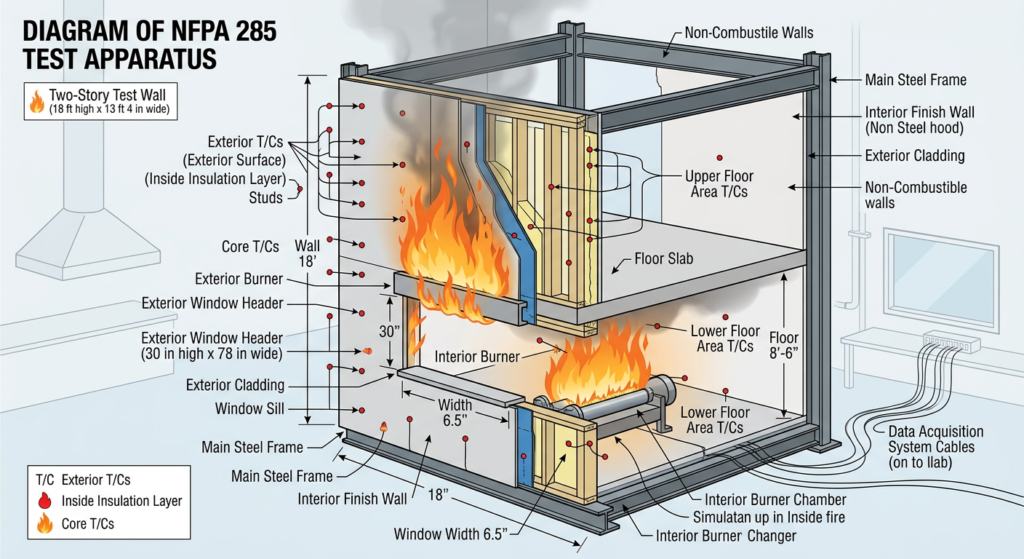
NFPA 285 evaluates the fire propagation characteristics of exterior wall assemblies containing combustible components.
A. What NFPA 285 Tests
The test is run on a two-story mock-up. A room fire is allowed to reach flashover and break out through a window opening, with a burner at the window exposing the exterior wall. Flame propagation is assessed:
- Vertically and horizontally across the exterior surface
- Within the assembly layers (through insulation, WRB, and cladding)
- Through air gaps and cavities
- From floor to floor
The test is pass/fail. Criteria include limits on how far flames spread vertically and laterally from the window opening, flames entering the second-story room, and temperature limits at thermocouples within the assembly. The test also generates extensive temperature data. Refer to the standard for the exact criteria.
B. When NFPA 285 Is Required
The IBC triggers NFPA 285 testing for exterior walls of Type I, II, III, or IV construction that are greater than 40 feet in height above grade plane and contain combustible components. The trigger applies when the exterior wall covering, insulation, or water-resistive barrier is combustible.
Common triggers include:
- Foam plastic insulation in the exterior wall
- Combustible water-resistive barriers
- Metal composite material (MCM) systems with combustible cores
- Exterior wall veneers or panels using combustible adhesives or cores (check the language in your adopted edition)
C. Exceptions
Exceptions exist where the combustible component is limited. For example, walls where the WRB is the only combustible component and the exterior covering is brick, concrete, stone, terra cotta, stucco, or steel may be exempt. The WRB must also meet heat release limits under ASTM E1354 testing to use the exception. Typical limits are on the order of 150 kW/m² peak heat release rate, 20 MJ/m² total heat release, and 18 MJ/kg effective heat of combustion, but verify the exact values and conditions in your adopted edition.
Key point: NFPA 285 is not required for every curtain wall. It is required when the wall assembly contains combustible components and exceeds the height threshold. A curtain wall with noncombustible cladding and no combustible insulation or WRB may not trigger the requirement. Sprinklers do not remove the requirement.
Pro Tip: Recent code editions allow compliance by an approved analysis based on a tested assembly. This lets subject-matter experts evaluate modifications to tested assemblies through fire science analysis, submitted to the AHJ for approval.
◆ Section 4: ASTM E2307 — Perimeter Fire Barriers
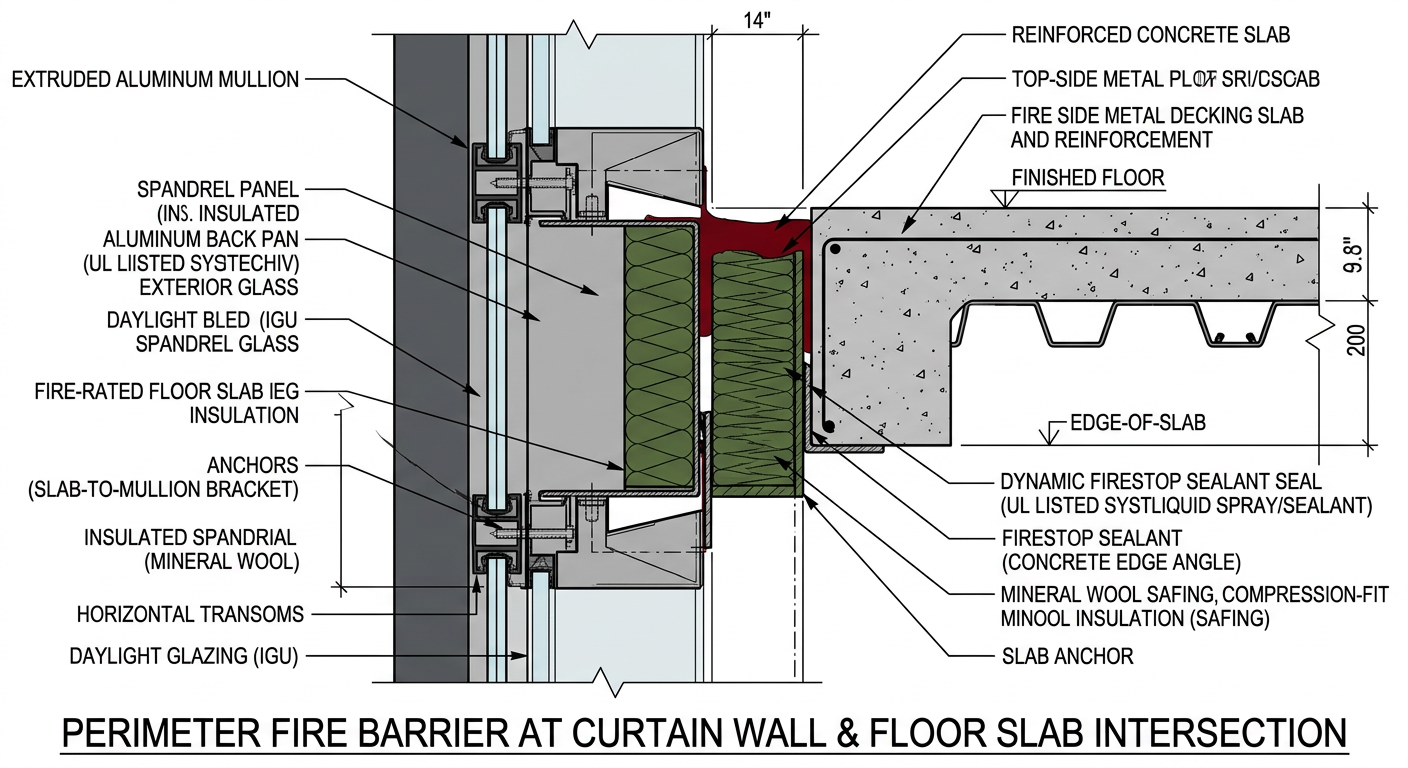
The perimeter fire barrier is the seal between the exterior wall assembly and the floor slab. It prevents fire from spreading from one floor to the next through the void at the floor/wall intersection.
A. What ASTM E2307 Tests
ASTM E2307 measures the perimeter fire barrier’s ability to maintain a seal to prevent fire spread during the deflection and deformation of the exterior wall assembly and floor assembly during a fire test. The test uses an intermediate-scale, multi-story apparatus and subjects the perimeter joint to:
- Fire exposure from an interior compartment fire
- Flame plume from a window burner below
- Deflection and deformation of the wall and slab as the fire develops
The result is reported as an F rating, in hours, based on the barrier’s ability to resist the passage of flame.
B. Test Conditions
The fire exposure conditions are those specified by the test method for the first 30 minutes, then conform to the ASTM E119 time-temperature curve for the remainder of the test.
C. What ASTM E2307 Does Not Measure
The test does not provide quantitative information about:
- Smoke or gas leakage through the perimeter fire barrier
- Flame spread over the exterior face of the assembly
- Spread of flame within the combustible core of sandwich panels
- Spread of flame over the interior surface
These are addressed by other test methods, notably NFPA 285 for exterior flame propagation.
D. E2307 Versus Joint System Tests
Perimeter fire barriers are not the same as joint systems tested to UL 2079 or ASTM E1966. Joint systems address movement joints within rated assemblies. The perimeter barrier at an exterior curtain wall is evaluated to E2307 because the exterior fire exposure and wall deflection are different. Do not substitute one for the other.
Key point: ASTM E2307 and NFPA 285 are complementary. ASTM E2307 evaluates the perimeter joint; NFPA 285 evaluates the entire wall assembly including vertical and lateral flame spread.
Pro Tip: The perimeter fire barrier is a critical detail that is often value-engineered out or improperly installed. It must be specified, inspected, and maintained.
◆ Section 5: Perimeter Fire Containment in the IBC (§715.4)
The IBC requires voids at the intersection of an exterior curtain wall assembly and a fire-resistance-rated floor or floor/ceiling assembly to be sealed with an approved system. The system must be tested to ASTM E2307 and provide an F rating for a period not less than the fire-resistance rating of the floor assembly. This is the code provision that makes E2307 mandatory, and it is distinct from the NFPA 285 trigger.
Key point: E2307 produces an F rating only. It does not produce an L (leakage) rating, so smoke sealing at the perimeter requires its own specification and detail.
Pro Tip: Check your adopted edition for exceptions and for any separate smoke-sealing language. Do not assume the F rating alone addresses smoke.
◆ Section 6: Spandrels and Vertical Separation of Openings (§705.8.5)
Windows stacked vertically are a fire path through the façade even with a perfect perimeter barrier. For buildings of more than three stories, the IBC generally separates vertically aligned openings that are close horizontally. The separation is a spandrel of at least 3 feet with a 1-hour fire-resistance rating, or a flame barrier projecting at least 30 inches from the wall. Buildings fully protected by an automatic sprinkler system under the applicable IBC provisions are generally exempt, but verify the exceptions and the horizontal distance criteria in your adopted edition.
Key point: Spandrel areas are where perimeter safing, backpan insulation, mullion fireblocking, and the spandrel panel itself all meet. Coordinate them in a single detail rather than as separate trades.
◆ Section 7: Perimeter Barrier Details That Fail in the Field
The tested system is a specific combination of products, thicknesses, compression, and gap widths. Failures in the field commonly come from:
- Mineral wool safing that is not compressed to the tested percentage or not sized to the actual slab-edge gap
- Missing or incorrect mechanical support, such as impaling clips or angles called for in the listing
- Missing or wrong sealant or coating at the face, or a smoke seal that is omitted
- Unsealed mullion cavities, gaps at columns, and slab-edge irregularities
- Gaps wider than the tested range once building movement is accounted for
- Substituted products that void the listing
Key point: If the field condition is not covered by the listing, it is not a tested system.
◆ Section 8: Combustible Components in Curtain Walls
Many modern curtain walls contain combustible components that must be evaluated as part of the assembly.
A. Foam Plastic Insulation
Foam plastic insulation is common in curtain wall systems for thermal performance. The IBC requires foam plastic in exterior walls of Type I–IV construction to comply with Section 2603.5, which includes:
- A thermal barrier separating foam from the building interior (unless special approval)
- Potential heat limits (not exceeding that of the tested assembly)
- Flame spread and smoke-developed indices of 25/450 or less
- NFPA 285 compliance for vertical and lateral fire propagation
B. Aluminum Composite Materials (ACM/MCM)
ACM panels with combustible cores (often polyethylene) have been implicated in major façade fires. The IBC requires MCM systems containing foam plastic insulation to comply with Section 2603, including NFPA 285 testing. MCM also has its own provisions in Chapter 14.
C. Water-Resistive Barriers (WRB)
Combustible WRBs are a common NFPA 285 trigger. NFPA 285 is required when the WRB is combustible, unless the exception applies (WRB is the only combustible component with an approved noncombustible cladding).
D. Combustible Adhesives and Cores
Some veneers and panels use combustible adhesives to laminate a metal core with noncombustible facings. Check whether your adopted edition requires these systems to comply with NFPA 285.
Key point: The trend in code development has been to expand NFPA 285 triggers as new combustible components are introduced.
Pro Tip: When reviewing curtain wall submittals, verify every combustible component and whether it triggers NFPA 285. A single combustible WRB can trigger the requirement even if the cladding is noncombustible.
◆ Section 9: Vertical Fire Spread and the Stack Effect
Curtain walls can contribute to vertical fire spread through three mechanisms:
A. Combustible Core Spread
In ACM panels with combustible cores, fire can spread within the panel core from floor to floor, bypassing the perimeter fire barrier.
B. Cavity and Air Gap Spread
Air gaps and cavities within the curtain wall assembly can act as chimneys, drawing flames and hot gases upward. NFPA 285 specifically evaluates flame propagation through air gaps and cavities. At Grenfell Tower, the ventilated cavity and the combustible insulation worked together with the burning panels to accelerate spread.
C. Window-to-Window Spread
Flames leaving a window can lap up the exterior and enter the window above, especially when glass fails. This is addressed by spandrel and vertical separation provisions and by sprinklers, not by NFPA 285 or E2307 alone.
Key point: The perimeter fire barrier prevents spread through the floor/wall joint, but it does not prevent spread through the curtain wall assembly itself or between windows. NFPA 285 (assembly), ASTM E2307 (perimeter joint), and the IBC spandrel provisions are all needed.
◆ Section 10: Glazing and Vision Glass
Windows are where an interior fire exits the building. Glass fracture and fall-out expose the floor above to flame and can allow the fire to extend vertically even when the cladding is noncombustible.
- Annealed and some tempered glass can crack and fall out early; heat-strengthened and laminated glass may behave differently.
- Aluminum mullions soften at relatively low temperatures, which allows frame deformation and glass loss.
- Sprinklers near glazing can reduce glass fracture and flame exposure to the floor above.
- Fire-rated glazing is used where the IBC requires rated openings or rated spandrels.
Key Article: Fire-Rated Glazing: Types, Ratings, and Applications
Pro Tip: A rating on the glass is not a rating on the frame or the joint to the slab. Evaluate the complete system.
◆ Section 11: Design Variations, Listings, and Engineering Judgments
Tested assemblies are narrow. Changes to insulation type or thickness, panel size, attachment, cavity depth, or WRB can fall outside the test. Compliance options typically include:
- A direct test of the exact assembly
- A third-party listed assembly
- An approved engineering analysis or Engineering Judgment (EJ) based on tested assemblies
For any variation, document the reasoning, submit it to the AHJ for approval, and keep the record in the project file.
Key point: An EJ is only as strong as the test data and expertise behind it. Early AHJ engagement avoids late rejection.
◆ Section 12: Case Studies
A. First Interstate Bank Building, Los Angeles (1988)
This unsprinklered high-rise fire burned through several floors, spreading largely through the exterior. Glass broke and flames moved from window to window while fire also extended through the curtain wall. The case predates Grenfell and shows that perimeter joint performance, glass failure, and the lack of sprinklers drive vertical spread, not only combustible cladding.
B. Grenfell Tower, London (2017)
The Grenfell Tower fire in London on June 14, 2017, killed 72 people and led to a fundamental reassessment of façade fire safety worldwide.
What happened. The fire broke out in a fourth-floor apartment and spread rapidly up the building’s exterior. The cladding consisted of aluminum composite panels with a combustible polyethylene core, combined with combustible foam insulation and a ventilated cavity.
The inquiry findings. The Phase 2 report, published in September 2024, concluded that the fire resulted from decades of failure by government and industry bodies to address the danger of combustible materials in the external walls of high-rise residential buildings. The inquiry concluded that all deaths were avoidable.
Regulatory response. The fire led to:
- A ban in England on combustible materials in the external walls of new high-rise residential buildings above a set height (Scotland and Wales have separate rules)
- Enhanced oversight through the Building Safety Act 2022 and the Building Safety Regulator
- Global reevaluation of NFPA 285 compliance and façade fire safety
C. Other Façade Fires
Lacrosse Building (Melbourne, 2014) and The Address Downtown (Dubai, 2015) are widely cited examples of fires spreading over combustible panels and cladding.
Key point: Grenfell demonstrated that the consequences of non-compliant or inadequately tested façade systems are catastrophic. First Interstate demonstrated that even without combustible cladding, exterior and perimeter weaknesses can carry fire upward.
◆ Section 13: Construction, Inspection, and Maintenance
- IBC Chapter 17 special inspection of fire-resistant joints and penetrations. Verify the section number and scope in your edition.
- Inspect and photograph the perimeter barrier before it is concealed by ceilings, cladding, or other trades.
- Control fire risk during construction, when combustible façade materials may be exposed (see NFPA 241).
- Re-inspect after alterations. New penetrations, replaced panels, or added insulation can break compliance.
- Keep the tested assembly documentation, listings, and submittals as part of the building records.
◆ Section 14: Existing Buildings and Retrofit
Re-cladding, façade upgrades, and adding insulation can trigger NFPA 285 even if the original wall did not. Treat the new work as new construction and check the applicable existing-building code. For older high-rises, a façade fire audit is advisable, especially where ACM, foam insulation, or unlisted perimeter joints are suspected.
◆ Section 15: International Comparison
Many countries use different tests. The UK uses BS 8414 with BR 135 for external fire spread, Canada uses CAN/ULC S134, and Europe uses EN 13501-1 reaction-to-fire classes. They are not interchangeable with NFPA 285. Global projects should confirm which test the local authority accepts.
◆ Section 16: Design Checklist for Curtain Wall Fire Safety
| Item | Status | Notes |
|---|---|---|
| Height threshold confirmed | ☐ | NFPA 285 triggered at >40 ft for Type I–IV construction with combustible components |
| Combustible components identified | ☐ | WRB, insulation, cladding core, adhesives |
| NFPA 285 compliance determined | ☐ | Direct test, listed assembly, or engineering analysis |
| ASTM E2307 perimeter barrier specified | ☐ | Tested system for floor/wall joint |
| IBC §715.4 perimeter containment | ☐ | F rating not less than floor rating |
| Spandrel / vertical separation of openings (§705.8.5) | ☐ | Spandrel or flame barrier, or sprinkler exception |
| Foam plastic insulation compliant | ☐ | IBC §2603.5: thermal barrier, potential heat, NFPA 285 |
| MCM/ACM systems reviewed | ☐ | Core combustibility; NFPA 285 compliance |
| Perimeter fire barrier detailed | ☐ | Mineral wool, sealant, and attachment per listing |
| Mullion cavity fireblocking and spandrel safing | ☐ | IBC §718 and the tested system |
| Glazing fracture behavior and sprinkler coordination | ☐ | Window-to-window spread |
| Engineering Judgments documented | ☐ | If used for design variations |
| Special inspection records for perimeter joints | ☐ | IBC Chapter 17 |
| AHJ coordination | ☐ | Early engagement on compliance path |
◆ Section 17: Common Mistakes and How to Avoid Them
| Mistake | Why It’s a Problem | How to Fix |
|---|---|---|
| Assuming NFPA 285 applies only to foam plastic | Combustible WRBs and adhesives also trigger | Identify all combustible components |
| Confusing NFPA 285 with ASTM E2307 | Different tests, different purposes | Specify both where required |
| Using a UL 2079 joint system as a perimeter barrier | Different test and exposure | Specify an E2307 tested system |
| Using ASTM E84 Class A as sole basis | E84 is not an assembly test | Require NFPA 285 compliance for the assembly |
| Assuming sprinklers remove the need for NFPA 285 | The trigger is construction type, height, and combustibles | Evaluate the trigger independently of sprinklers |
| Omitting perimeter fire barrier | Fire can spread through floor/wall joint | Specify ASTM E2307 tested system |
| Value-engineering out the perimeter barrier | Code violation; fire spread path | Include in base scope; inspect installation |
| Substituting safing or sealant on site | Voids the listing | Require the listed system and verify in the field |
| No engineering analysis for design changes | Compliance unverifiable | Document EJ and submit to AHJ |
| Ignoring combustible core in MCM | Vertical fire spread path | Verify core combustibility and NFPA 285 compliance |
| Not coordinating with AHJ | Delays; rejected submittals | Early engagement on compliance path |
◆ Section 18: Conclusion
Curtain walls present unique fire safety challenges because they are non-structural cladding systems that often contain combustible components. NFPA 285 evaluates the entire wall assembly for vertical and lateral flame propagation. ASTM E2307 evaluates the perimeter fire barrier at the floor/wall intersection, and the IBC requires it. Spandrels, glazing, and fireblocking complete the strategy. All are needed.
The First Interstate and Grenfell fires showed two different ways façades fail: through exterior and perimeter weaknesses, and through combustible cladding that was never properly tested as an assembly. Façade fire safety cannot be assumed; it must be tested, detailed, inspected, and maintained.
Key Takeaways:
- NFPA 285 is an assembly test, not a material test; it evaluates the entire exterior wall system.
- NFPA 285 is triggered for Type I–IV construction over 40 ft with combustible WRBs, insulation, or cladding.
- ASTM E2307 evaluates the perimeter fire barrier’s ability to maintain a seal during fire and movement, and IBC §715.4 makes it mandatory with an F rating at least equal to the floor rating.
- E2307 does not address smoke leakage; smoke sealing needs its own specification.
- Spandrels, glass failure, and mullion cavities are fire paths even when the cladding is noncombustible.
- Combustible components (WRBs, foam insulation, MCM cores, and adhesives) trigger NFPA 285 requirements.
- Tested assemblies are narrow; design variations need listings or documented, AHJ-approved engineering analysis.
- Inspection during construction and re-inspection after alterations are essential to keep the system compliant.
- First Interstate shows fire spread without combustible cladding; Grenfell shows the catastrophic result of untested combustible façades.
Take Action Today:
- Determine whether your building triggers NFPA 285 (height and combustible components).
- Identify all combustible components in the curtain wall assembly.
- Verify NFPA 285 compliance through direct test, listing, or engineering analysis.
- Specify an ASTM E2307 tested perimeter fire barrier with the required F rating.
- Detail spandrels, safing, mullion fireblocking, and smoke sealing together.
- Verify foam plastic insulation compliance with IBC §2603.5.
- Document any Engineering Judgments and submit to the AHJ.
- Arrange special inspections and photograph the perimeter barrier before concealment.
- Coordinate with the AHJ early on the compliance path.
Continue Reading from Our Series:
-
Related guide: Fire-Resistance-Rated Assemblies and UL Listings
-
Learn more: Building Envelope Fire Safety — Design and Materials
-
Read more: How to Design Fire-Safe Building Envelopes