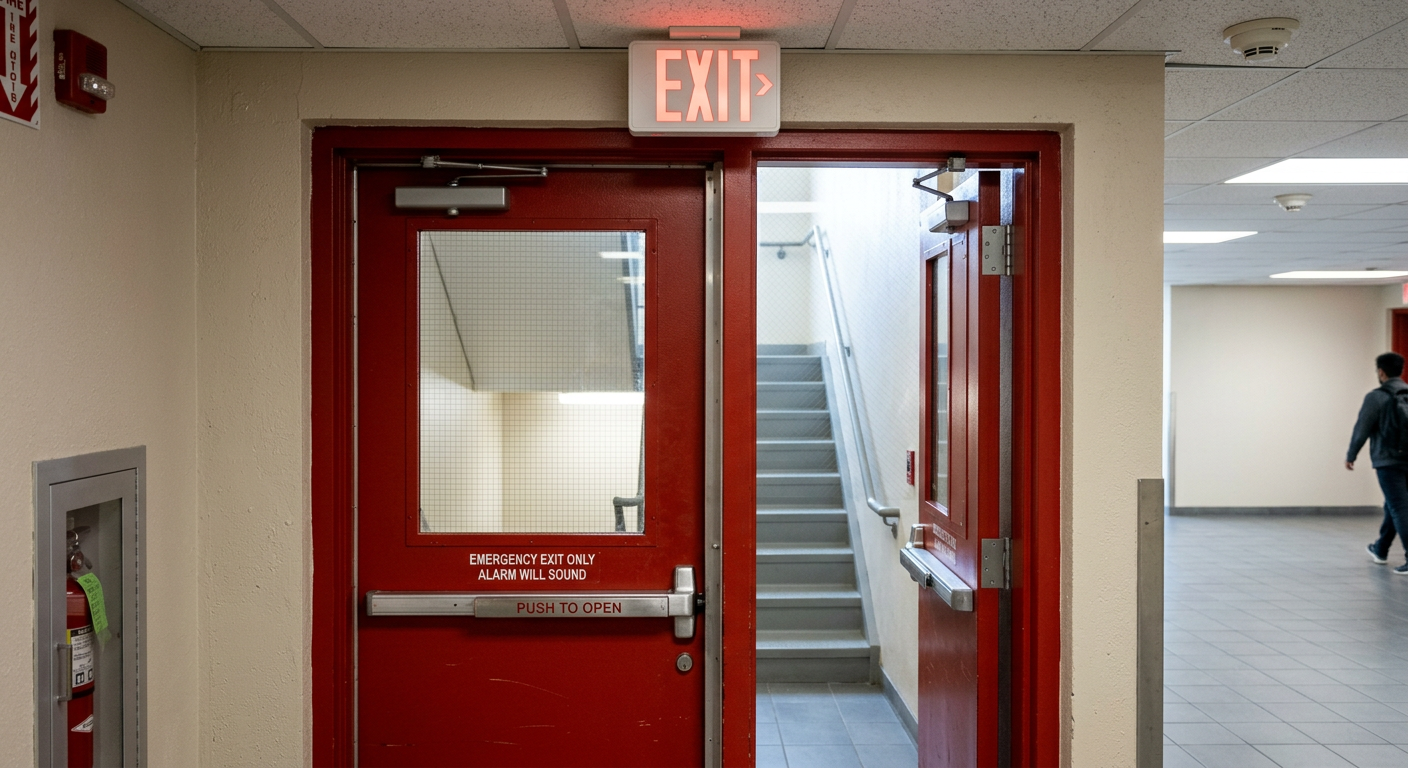
In the world of commercial building safety, a fire door is only effective if it can be opened quickly and easily during an emergency. However, building owners also have legitimate security concerns about keeping doors unlocked.
NFPA 101 (The Life Safety Code) walks a delicate line between security and safety. It establishes strict rules for egress door locking, and these rules vary depending on the occupancy type.
This article serves as a quick-reference guide to egress door locking requirements, highlighting which occupancies must have doors that are freely openable from the inside and which have special exceptions.
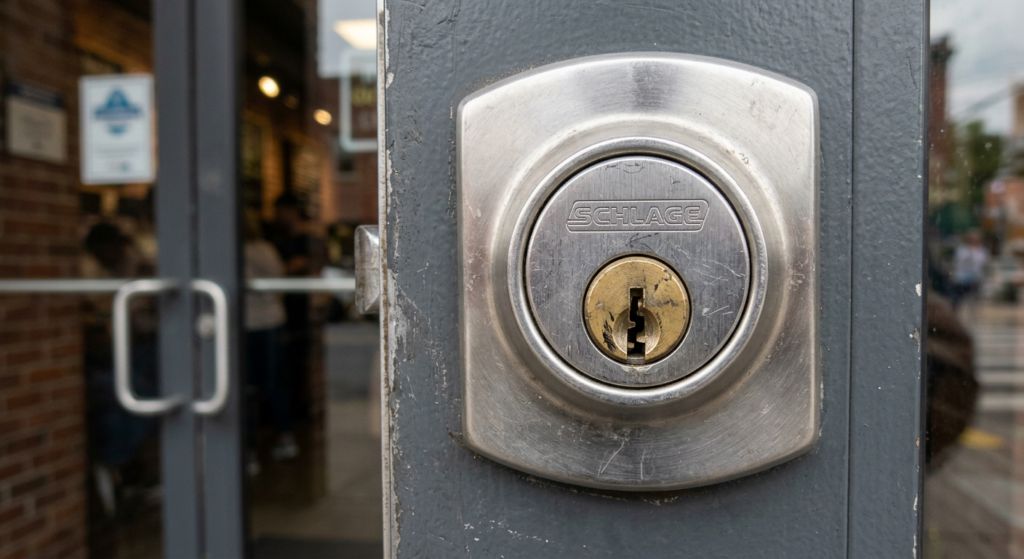
The Golden Rule: Section 7.2.1.5.3
The base requirement for most occupancies comes from NFPA 101, Section 7.2.1.5.3. It states that:
“A door shall be openable from the inside without the use of a key, tool, special knowledge, or effort.”
This means that for most commercial spaces (offices, retail, storage, etc.), anyone inside must be able to simply turn a lever or push a bar to exit—no key required.
Egress Door Locking Requirements by Occupancy
The following table summarizes the specific egress door locking rules for different occupancy types.
| Occupancy Type | Code Reference | Requirement |
| Ambulatory Health Care | NFPA 101 – 20.1.1.1.7 | Locking Permitted: Doors can be locked to confine and protect building inhabitants (e.g., patients who may wander). |
| Assembly (Theaters, Arenas, Restaurants) | NFPA 101, 7.2.1.5.3 | Openable from inside: Exit doors must be openable without a key during all times the building is occupied. |
| Business (Offices) | NFPA 101, 7.2.1.5.3 | Openable from inside: Exit doors must be openable without a key. |
| Educational (Schools) | NFPA 101, 7.2.1.5.3 | Openable from inside: Exit doors must be openable without a key (Note: Classroom security measures are addressed separately). |
| Healthcare (Hospitals) | NFPA 101 – 20.1.1.1.7 | Locking Permitted: Doors can be locked to confine and protect building inhabitants (e.g., psychiatric units). |
| One & Two Family Dwellings | NFPA 101, 7.2.1.5.3 | Openable from inside: Exit doors must be openable without a key. |
| Hotels & Dormitories | NFPA 101, 7.2.1.5.3 | Openable from inside: Guest room doors must be openable without a key from the inside. |
| Apartments | NFPA 101, 7.2.1.5.3 | Openable from inside: Dwelling unit doors must be openable without a key. |
| Mercantile (Retail) | NFPA 101, 7.2.1.5.3 | Openable from inside: Exit doors must be openable without a key during business hours. |
| Storage (Warehouses) | NFPA 101, 7.2.1.5.3 | Openable from inside: Exit doors must be openable without a key. |
| Industrial (Factories) | NFPA 101, 7.2.1.5.3 | Openable from inside: Exit doors must be openable without a key. |
The Special Exception: Ambulatory and Healthcare
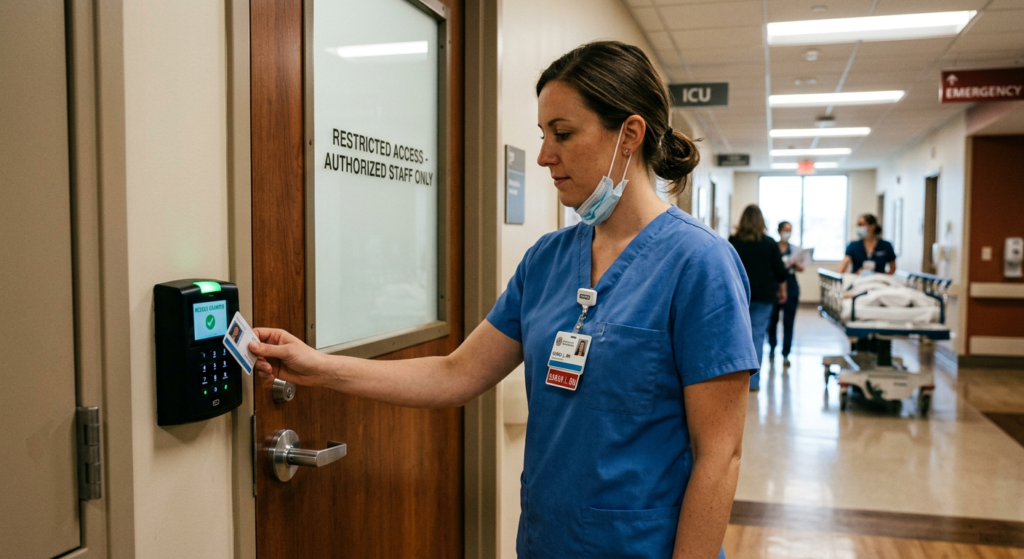
As noted in the table, Ambulatory Health Care (e.g., outpatient clinics) and Healthcare (e.g., hospitals) have a specific exemption (20.1.1.1.7).
Why?
In these occupancies, the safety of patients is the priority. If a patient is disoriented or poses a risk to themselves, locking doors helps confine and protect them. However, these locking arrangements must be part of a documented fire safety plan and are subject to strict staff training requirements.
Additional Prohibited Hardware and Exceptions
Beyond the specific occupancy rules, NFPA 101 includes general rules that apply to all egress doors.
Prohibited Hardware:
-
Manually operated flush bolts: These are often found on inactive doors of a double-door pair and are prohibited on required exits.
-
Sliding bolts or chains: Any device that requires extra effort to disengage is prohibited.
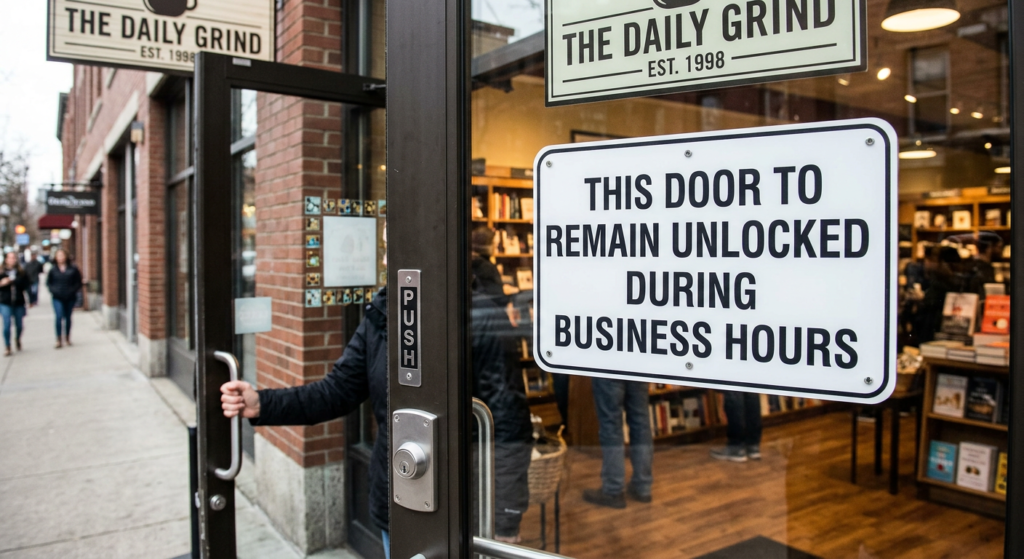
The “Business Hours” Exception (7.2.1.5.3 Exception):
-
A keyed lock may be used on the main exit (if it consists of a single door or a pair of doors) if it is kept unlocked during business hours.
-
If it is locked, there must be a readily visible, durable sign on or above the door stating: “THIS DOOR TO REMAIN UNLOCKED DURING BUSINESS HOURS.”
Swinging Direction (7.2.1.4):
-
All exit doors must swing in the direction of exit travel (i.e., outward) when serving a hazardous area or when the occupant load is 50 or more.
Common Misconceptions
| Myth | Reality |
|---|---|
| “We can lock the front door at the mall during off-hours.” | Yes, but the main exit must have a visible sign reminding employees to unlock it when the store opens. |
| “We can use a padlock on the warehouse exit to prevent theft.” | No. Padlocks, chains, and hasps are never permitted on required means of egress. |
| “Hospitals always need unlocked exits.” | No. Healthcare facilities have specific exceptions to protect patients, provided they are staffed and have a fire plan. |
| “If the door has a push bar, we can lock it.” | Generally, no. Push bars (panic hardware) are designed for egress and should not be locked unless it is a delayed-egress system (which is highly regulated). |
Conclusion
Egress door locking is a critical intersection of security and life safety. While most commercial buildings require doors that are openable from the inside without a key, specific exceptions exist for Healthcare and Ambulatory occupancies to protect vulnerable populations.
Take Action Today:
-
Walk your building and check every exit door.
-
Verify that all doors swing in the proper direction.
-
Remove any chains, padlocks, or flush bolts that restrict egress.
-
Ensure that the “Business Hours” sign is posted if a key lock exists on your main exit.