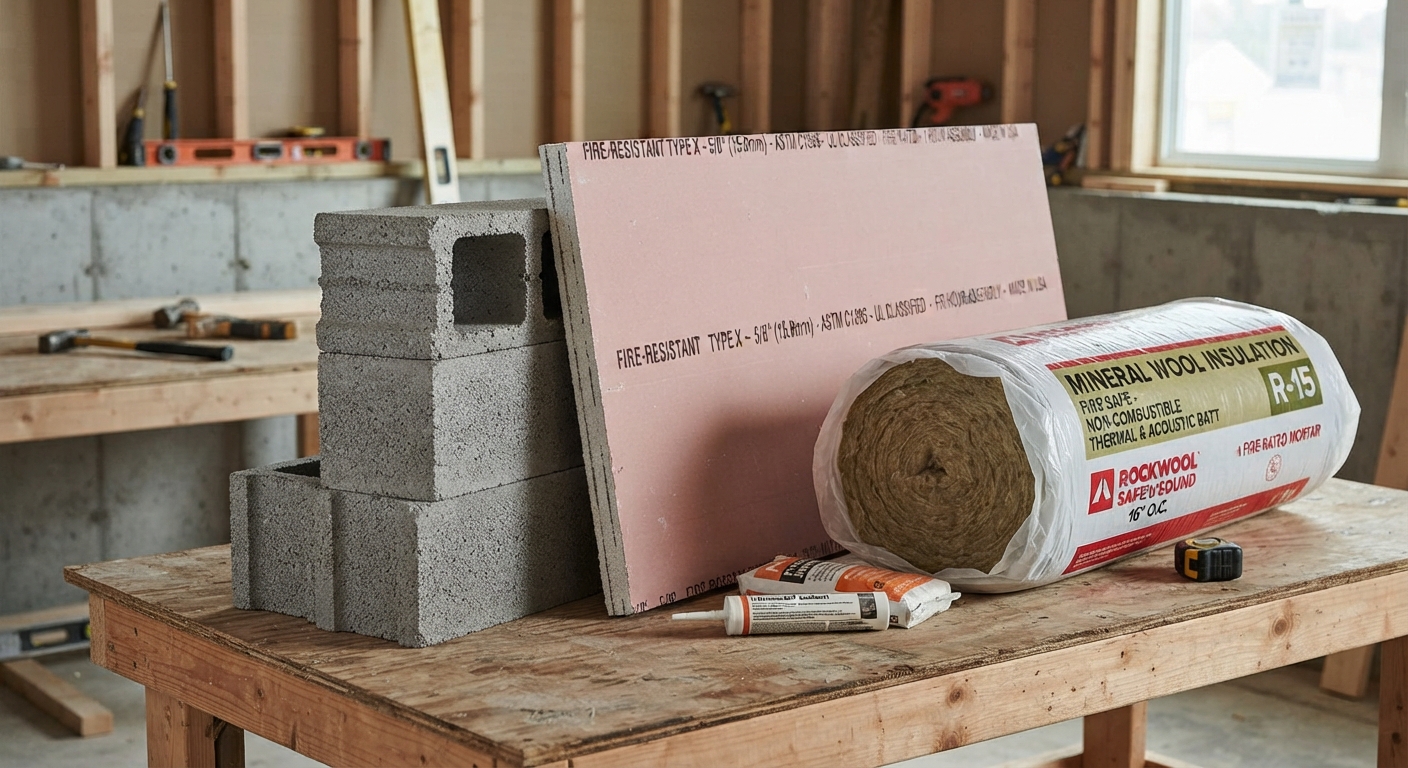
When designing a commercial building, the choice of materials is one of the most critical decisions you will make. The right materials can mean the difference between a building that withstands a fire and one that collapses, between occupants who can evacuate safely and those who cannot.
But choosing fire-resistant materials is not always straightforward. It requires balancing combustibility, fire resistance, cost, sustainability, and code compliance. This guide provides a practical framework for selecting the right building materials for fire safety.
Understanding Fire Resistance vs. Combustibility
Before evaluating materials, it is essential to understand two key concepts:
| Concept | Definition | Example |
|---|---|---|
| Fire Resistance | The ability of a material or assembly to resist the passage of fire and heat. | A 2-hour fire-rated wall that prevents fire spread for 2 hours. |
| Combustibility | The ability of a material to catch fire and for fire to spread on its surface. | Wood burns; steel does not. |
Why This Matters: A material can be non-combustible (like a thin steel facade) but have low fire resistance (heat passes through it easily). Conversely, a material can be combustible (like heavy timber) but have excellent fire resistance because a char layer forms, protecting the core.
The Key Takeaway: Fire-resistant design requires addressing both fire resistance and combustibility—you want assemblies that resist heat transfer and materials that do not contribute to flame spread.
Fire-Resistant Materials: The Options
Here are the most common fire-resistant materials used in commercial construction, along with their key properties:
1. Concrete
| Property | Details |
|---|---|
| Combustibility | Non-combustible |
| Fire Resistance | 1–4 hours (depending on thickness and aggregate type) |
| Key Advantage | Does not burn, emit toxic fumes, or melt |
| Best Use | Walls, floors, foundations, structural frames |
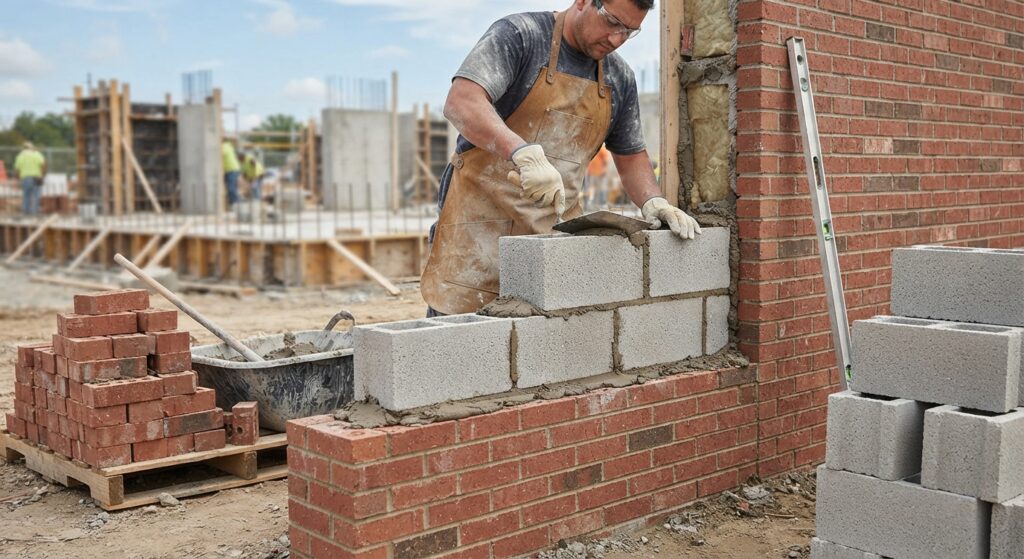
Why It Works: Concrete is one of the most widely used fire-resistant materials. It is non-flammable, does not emit toxic gases, and its high thermal mass delays heat transfer. Concrete Masonry Units (CMUs) can achieve fire-resistance ratings of four hours or more, validated by ASTM E119 testing [2].
Pro Tip: For enhanced fire performance, consider carbonate aggregates (dolomite, limestone) which have higher heat capacity and better fire resistance [1].
2. Brick and Masonry
| Property | Details |
|---|---|
| Combustibility | Non-combustible |
| Fire Resistance | Class A fire rating; can exceed 120 minutes |
| Key Advantage | Fired at 2,000°F during manufacturing—inherently fire-resistant |
| Best Use | Exterior walls, load-bearing walls, firewalls |
Why It Works: Brick is fired in a kiln at extremely high temperatures (1,100°F to 2,100°F), making it inherently fire-resistant and non-combustible. However, the mortar that holds brick walls together has a lower fire resistance—conventional mortar begins to crack at 500°F to 600°F, potentially leading to wall collapse even if the bricks are undamaged [8].
3. Gypsum Board (Fire-Rated)
| Property | Details |
|---|---|
| Combustibility | Limited (surface paper burns, but core is non-combustible) |
| Fire Resistance | 1–2 hours (multiple layers of Type X) |
| Key Advantage | Cost-effective, widely available, easy to install |
| Best Use | Interior walls, ceilings, shaft enclosures |
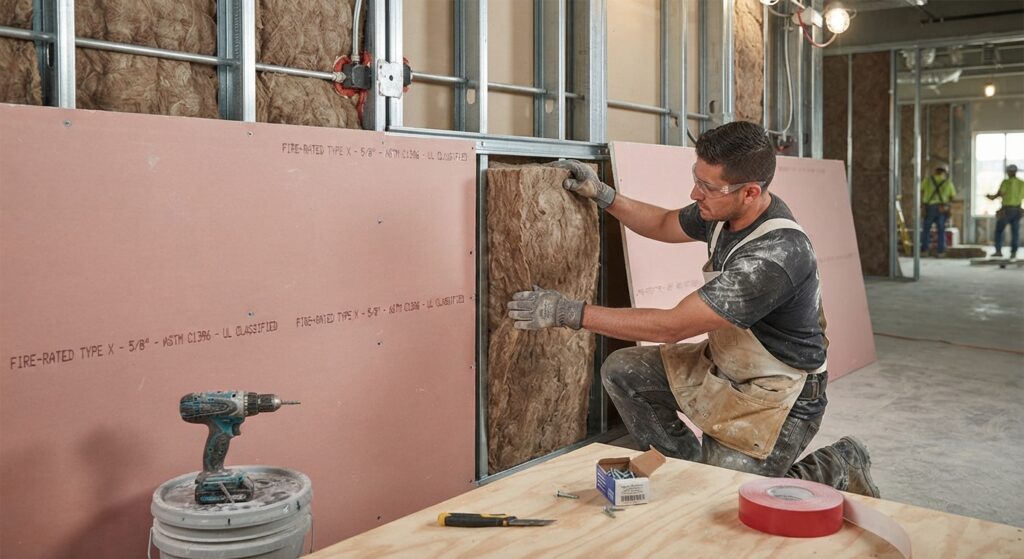
Why It Works: Fire-resistant gypsum boards incorporate glass fibers and additives that improve thermal performance. Gypsum releases water in the form of vapor when heated, slowing the rise in temperature during the early stages of a fire [6].
4. Mineral Wool (Stone/Rock Wool) Insulation
| Property | Details |
|---|---|
| Combustibility | Non-combustible |
| Fire Resistance | High; does not ignite or spread flame |
| Key Advantage | Excellent thermal and acoustic insulation |
| Best Use | Wall cavities, ceiling voids, fireproofing |
Why It Works: Mineral wool is made by melting volcanic rocks (basalt, bauxite, dolomite) or slag in a furnace and spinning the molten material into fibers. It does not ignite, even at high temperatures, and helps contain fires by preventing heat transfer.
5. Fire-Resistant Glass
| Property | Details |
|---|---|
| Combustibility | Non-combustible |
| Fire Resistance | Up to 60+ minutes (depending on EI rating) |
| Key Advantage | Maintains visibility while providing fire protection |
| Best Use | Atriums, stairwells, corridors, storefronts |
Why It Works: Fire-resistant glass is composed of layers of glass and intumescent gel, which acts as an effective barrier against flames, radiant heat, and gases. It can maintain its integrity for over 60 minutes, providing both safety and design flexibility [12].
6. Fire-Retardant-Treated Wood (FRTW)
| Property | Details |
|---|---|
| Combustibility | Combustible but treated to resist ignition |
| Fire Resistance | Varies; often Class A or B |
| Key Advantage | Aesthetic appeal of wood with improved fire performance |
| Best Use | Interior finishes, exposed structures (with limitations) |
Why It Works: Wood treated with fire-retardant substances can qualify for use in applications where untreated wood would not be permitted. The California Building Code offers many options developed to account for wildfire risk. (No specific citation for this California Building Code claim was included in the original article’s reference list — verify against the current CBC/California Fire Code before publishing.)
7. Terra-Cotta
| Property | Details |
|---|---|
| Combustibility | Non-combustible |
| Fire Resistance | Class A fire-rated assemblies |
| Key Advantage | Aesthetic clay tiles with inherent fire resistance |
| Best Use | Roofing, exterior cladding |
Why It Works: Terra-cotta clay is fired at extremely high temperatures (1,100°F to 2,100°F) to harden and vitrify the clay, making it non-combustible. When used with a Class A underlayment, terra-cotta roofing assemblies provide excellent fire protection, especially in wildfire-prone areas [6].
8. Solid Surface Materials (e.g., Krion® Lux)
| Property | Details |
|---|---|
| Combustibility | Limited combustibility (Euroclass B) |
| Fire Resistance | B-s1-d0 classification: limited contribution to fire |
| Key Advantage | Does not generate flaming droplets or toxic fumes |
| Best Use | Interior surfaces, cladding, healthcare, commercial spaces |
Why It Works: Krion® Lux is composed mainly of alumina trihydrate (ATH) and high-strength resins, giving it excellent thermal stability and low thermal conductivity. It withstands high temperatures without deforming or degrading and does not feed flames or contribute to the spread of fire [5]. (Note: this claim is sourced from the manufacturer’s own product material, not independent third-party testing — treat as a vendor claim rather than an independently verified performance figure.)
How to Evaluate Fire-Resistant Materials
When selecting materials, consider the following criteria:
| Evaluation Criteria | What to Assess | Why It Matters |
|---|---|---|
| Thermal Resistance | How well does the material resist heat transfer? | Delays heat penetration and structural failure. |
| Structural Integrity at High Temperatures | Does the material maintain its strength during a fire? | Prevents collapse during evacuation. |
| Flame Spread | How quickly does flame spread across the surface? | Slower spread gives occupants more time to evacuate. |
| Smoke Development | How much smoke does the material produce? | Smoke is the leading cause of fire-related deaths. |
| Toxicity | Does the material release toxic fumes when heated? | Toxic gases can incapacitate occupants. |
| Cost | What is the upfront and lifecycle cost? | Balances safety with budget. |
| Sustainability | What is the environmental impact of the material? | Aligns with green building goals. |
| Code Compliance | Does the material meet applicable codes? | Ensures legal and safety compliance. |
Wildfire Considerations
With extreme wildfire activity more than doubling worldwide and wildfires extending beyond the typical summer season, builders and architects must consider wildfire resilience. (No specific citation for the “more than doubling worldwide” statistic was included in the original article’s reference list — this specific figure should be traced to a primary climate/wildfire research source before publishing.)
| Strategy | Application |
|---|---|
| Non-Combustible Exterior Materials | Cement, plaster, stucco, masonry. |
| Class A Roof Assemblies | Terra-cotta tiles with fire-rated underlayment. |
| Fire-Rated Windows | Fire-resistant glass for openings. |
| Defensible Space | Vegetation management around the structure [9]. |
Common Mistakes and How to Avoid Them
| Mistake | Why It’s a Problem | How to Fix |
|---|---|---|
| Confusing non-combustibility with fire resistance | May choose materials that fail under fire conditions. | Evaluate both properties. |
| Ignoring the mortar | Mortar may fail before the brick. | Use fire-resistant mortar and proper detailing. |
| Not considering smoke and toxicity | Occupants may be incapacitated by smoke. | Select materials with low smoke emission ratings. |
| Overlooking assembly rating | Individual materials may be fire-resistant, but the assembly may not. | Test assemblies, not just individual materials. |
| Ignoring wildfire risk | Buildings in wildfire-prone areas require additional protection. | Use non-combustible exterior materials and Class A roofing. |
Conclusion
Choosing the right building materials for fire safety is a critical responsibility. By understanding the difference between combustibility and fire resistance, evaluating materials against key criteria, and considering assembly performance, you can create buildings that are safe, compliant, and resilient.
Take Action Today:
- Evaluate your material choices against fire-resistance criteria.
- Consider the assembly—not just the individual material.
- Balance cost, sustainability, and fire performance.
- Consult with a fire protection engineer for complex projects.
Continue Reading from Our Series:
- Read more about: Parametric Architecture for Commercial Buildings
- Learn more: The Ultimate Guide to Commercial Building Safety
- Related guide: Interior Floor, Wall, and Ceiling Finishes
References & Notes
[1] Building Materials and Engineering Structures, Vol. 3(3), September 2025.
[2] SCMA, “Fire Activity Is on the Rise: Choose Safety with Concrete Masonry,” 2025.
[3] South Dakota Legislature, 44:75:13:25 Ducts (NFPA 101 references). Not connected to any claim in this article — covers HVAC duct flame-spread/smoke-development requirements in South Dakota hospital construction code, an unrelated topic. Recommend removing this reference unless it was meant to support content that was edited out.
[4] “Performance-Based Approach for Classifying the Degree of Combustibility of Building Products,” Wiley, 2025.
[5] Krion, “Krion: A Fire-Safe Material Suitable for Any Location,” 2025. Manufacturer-published material — see note on Section 8 above.
[6] gb&d Magazine, “7 Fire Resistant Building Materials,” 2024.
[7] “Structural feasibility of glass fiber reinforced gypsum (GFRG) panels,” Springer, 2025. Not connected to any claim in this article — the article’s gypsum section discusses standard Type X fire-rated gypsum board, not GFRG panels specifically. Recommend removing or reworking the gypsum section to actually reference GFRG if that was the intent.
[8] Elsevier, “Construction Materials and Their Properties for Fire Resistance and Insulation,” 2024.
[9] GAO, “Technology Assessment: Protecting Structures and Improving Communications during Wildland Fires.”
[10] South Dakota Legislature, 44:70:10:23 Ducts (NFPA 101 references). Same issue as [3] above — an unrelated HVAC duct citation from a different South Dakota facility-type code chapter. Recommend removing.
[11] ScienceDirect, “Development of high-strength and lightweight insulating CSA cement-blended mortars,” 2025. Not clearly connected to any claim in this article — the mortar discussion in the Brick and Masonry section describes conventional mortar cracking at 500–600°F, not CSA cement-blended lightweight insulating mortars specifically. Recommend removing or clarifying the connection.
[12] Buildings.com, “How to Build and Maintain Fire-Resistant Facilities,” 2025.
Note: inline citation markers have been added above to connect specific claims to their references, which the original article’s reference list lacked. Four references ([3], [7], [10], [11]) could not be connected to any claim actually made in the article body and are flagged for removal or reconciliation. Two claims (the California Building Code wildfire options, and the “wildfire activity more than doubling worldwide” statistic) have no corresponding reference in the original list at all and should be sourced before publication.