IMPORTANT DISCLAIMER: This guide references NFPA 303, Fire Protection Standard for Marinas and Boatyards; NFPA 30A, Code for Motor Fuel Dispensing Facilities and Repair Garages (2024 edition); NFPA 302, Fire Protection Standard for Pleasure and Commercial Motor Craft; NFPA 1, Fire Code; NFPA 10, Standard for Portable Fire Extinguishers; NFPA 13, Standard for the Installation of Sprinkler Systems; NFPA 14, Standard for the Installation of Standpipe and Hose Systems; NFPA 306, Standard for the Control of Gas Hazards on Vessels; NFPA 307, Standard for the Construction and Fire Protection of Marine Terminals, Piers, and Wharves; NFPA 70, National Electrical Code (Article 555, Marinas, Boatyards, Floating Buildings, and Commercial and Noncommercial Docking Facilities); the International Fire Code (IFC), Chapter 23 (Motor Fuel-Dispensing Facilities and Repair Garages, Section 2310 — Marine) and Chapter 36 (Marinas); and ABYC standards (voluntary industry standards) where referenced. These codes vary significantly by edition and are frequently amended by state and local jurisdictions. NFPA 303 editions include 2016, 2021, and 2026. The most recent published edition is NFPA 303 (2026), but AHJ-adopted editions commonly lag behind by one or more cycles. The 2026 edition of NFPA 303 expanded the requirements for shrink-wrapping boats and clarified scope to include maintenance and servicing. Local amendments and the edition adopted by your Authority Having Jurisdiction (AHJ) always control. This guide is a starting point only—always verify the specific requirements applicable to your project with your local AHJ.
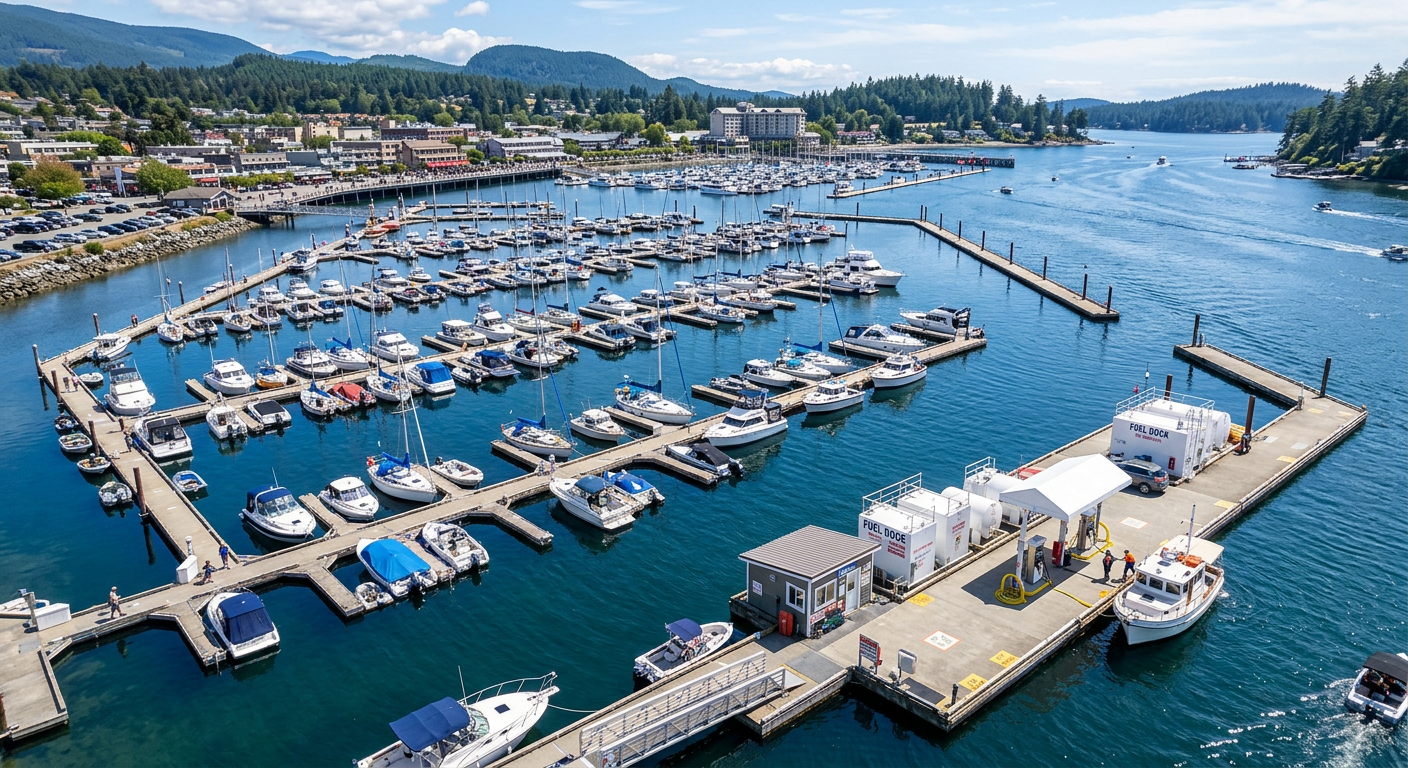
Marinas and waterfront structures present fire safety challenges that exist nowhere else. Vessels are packed tightly in slips, each carrying fuel, batteries, and often propane. A fire on one boat can spread to adjacent boats within minutes—and there is no fire wall between them. Firefighting access is limited by water, tide, and the geometry of piers and floats. And the structures themselves—floating docks, piers over water, gangways—create unique egress and fire spread conditions.
The regulatory landscape reflects this complexity. NFPA 303, Fire Protection Standard for Marinas and Boatyards, is the primary standard, referenced by NFPA 1 and adopted by jurisdictions that regulate marinas. The IFC addresses marina fire protection equipment and operations in Chapter 36, and fuel dispensing in Chapter 23 (Section 2310). NFPA 30A governs the fuel dispensing systems that present the highest hazard on the waterfront. And NFPA 307 is referenced for combustible-pier protection and special-use piers.
This guide covers the fire safety requirements for marinas, piers, and waterfront structures, based on NFPA 303, NFPA 30A, and the IFC.
◆ Section 1: Why Marinas Are Different
Marinas combine hazards that rarely coexist in other occupancies.
| Factor | Challenge |
|---|---|
| Vessel density | Boats moored side-by-side with no fire separation |
| Fuel on board | Every vessel carries gasoline or diesel in tanks |
| Limited firefighter access | Water, tide, and pier geometry constrain apparatus and hose deployment |
| Floating structures | Docks move with tide and wave action; fire protection systems must accommodate |
| Electrical hazards | Shore power, stray current, and galvanic corrosion create shock and fire risks |
| Transient population | Boat owners and guests may be unfamiliar with emergency procedures |
| Fire spread potential | A single vessel fire can spread to multiple boats and the dock structure |
Key point: The fire safety challenge at a marina is not any single vessel—it is the density of vessels and the lack of separation between them. A fire on one boat can ignite the next within minutes, and without intervention, the entire row can become involved.
Pro Tip: Walk the docks and look at how close the boats are to each other. The gap between vessels is the fire spread corridor. As a rule of thumb, boats moored within a few feet of each other present the highest cascade risk—but the actual code requirement is that each berth must allow a boat to be removed in an emergency without moving other boats .
◆ Section 2: Regulatory Framework
Marina fire safety is governed by a layered set of standards.
| Standard | Scope | Application to Marinas |
|---|---|---|
| NFPA 303 | Fire protection for marinas and boatyards | Construction and operation of marinas, piers, docks, and floats |
| NFPA 30A (2024) | Motor fuel dispensing facilities | Fuel dispensing on piers and floating structures |
| NFPA 302 | Pleasure and commercial motor craft | Vessel-side fire protection |
| NFPA 1 Chapter 28 | Marinas and boatyards | Fire code provisions for marinas |
| NFPA 10 | Portable fire extinguishers | Extinguisher selection, placement, and maintenance |
| NFPA 14 | Standpipe and hose systems | Standpipe design and installation |
| NFPA 306 | Control of gas hazards on vessels | Gas-freeing and hot work on vessels |
| NFPA 307 | Marine terminals, piers, and wharves | Combustible-pier protection; special-use piers |
| NFPA 70 Article 555 | Marinas, boatyards, floating buildings | Shore power, grounding, and electrical safety |
| IFC Chapter 23 (2310) | Motor fuel-dispensing facilities — marine | Fuel dispensing, attendant requirements, safety provisions |
| IFC Chapter 36 | Marinas | Fire protection equipment, standpipes, staging areas, operations |
Key point: NFPA 303 is the primary standard for marina fire protection. The IFC Chapter 36 provides parallel provisions for jurisdictions that adopt the International Fire Code. Fuel dispensing is in IFC Chapter 23, not Chapter 36. NFPA 307 is referenced for combustible-pier protection and special-use piers—not as a general marina standard.
NFPA 303 (2026) updates: The 2026 edition expanded requirements for shrink-wrapping boats—covering materials and equipment, fire prevention, post-operation monitoring, and training. The prior edition (2021) already contained a section on shrink-wrap operations. The 2026 edition also clarified scope to include maintenance and servicing, and added a requirement that flammable vapor concentration during hot work be less than 10 percent of the lower flammable limit—a limit aligned with NFPA 306 guidance.
Pro Tip: Verify which standard your AHJ has adopted—NFPA 303, IFC Chapter 36, or both. Note that some jurisdictions still enforce the 2016 edition of NFPA 303.
◆ Section 3: Egress, Berthing, and Pier Protection
Marinas present unique egress and structural fire protection challenges.
A. Egress from Piers and Floats
Pier and gangway egress is generally governed by the adopted building or fire code and the AHJ. NFPA 303 itself does not contain a dedicated egress chapter. Egress design must account for:
| Challenge | Consideration |
|---|---|
| Single access point | Many piers have one gangway or ramp—a single point of failure |
| Tidal movement | Gangways must accommodate changing water levels without creating fall hazards |
| Distance to shore | Long piers mean long travel distances to land |
| Darkness | Verify lighting requirements against your AHJ-adopted code |
| Slip hazards | Wet, algae-covered surfaces create fall hazards |
B. Combustible Pier Protection
NFPA 1 Chapter 28 (which reproduces NFPA 303 text) requires that combustible piers and substructures exceeding 25 ft in width or 5,000 ft² in area, or located within 30 ft of protected structures, be protected in accordance with Section 4.3 of NFPA 307 . This is one of the few direct applications of NFPA 307 to marina piers.
Pier sprinkler protection: Where sprinkler protection is provided on combustible piers, NFPA 13 applies. Clearance between the sprinkler deflector and the top of stored materials or vessels must be maintained —the 36-inch clearance requirement applies. Verify against your adopted edition.
C. Berthing Density and Emergency Removal
NFPA 303 7.1.1 requires that each berth be arranged so a boat can be removed in an emergency without moving other boats . This requirement is intended to prevent a single fire from trapping multiple boats at the dock.
Pro Tip: Berthing density is not just a financial decision—it is a life safety decision. A berth arrangement that prevents emergency removal violates NFPA 303 7.1.1.
◆ Section 4: Fuel Storage and Dispensing
Fuel dispensing is the highest-hazard operation at a marina. Gasoline (Class I liquid) has a flash point below 100°F and can form ignitable vapors at ambient temperatures.
A. Fuel Dispensing Facility Requirements
The marine fuel dispensing provisions are in IFC Chapter 23, Section 2310, and NFPA 30A.
| Requirement | Specification |
|---|---|
| Class I fuels | IFC 2310.4.1 prohibits fueling floating craft with Class I fuels at other than a marine motor fuel-dispensing facility . |
| Class II/III fuels | Permitted under the conditional exceptions in the IFC (approved premises, tank-vehicle rules, listed automatic-closing nozzle) |
| Attendant required | An attendant or supervisor must be on duty whenever the facility is open, responsible for supervising dispensing |
| Nozzles | Automatic-closing type without a latch-open device |
| Hose protection | Hoses must be reeled, racked, or otherwise protected from mechanical damage when not in use |
| Emergency disconnects | Clearly identified, readily accessible; interlocked to shut off power to all pump motors |
Note on mobile fueling: NFPA 30A (2024) added Chapter 15, Marine Mobile Fueling. The scope of what Chapter 15 permits should be verified against your adopted edition. The IFC’s Class I prohibition remains the baseline—mobile fueling provisions may modify how fueling is conducted, not whether Class I is permitted outside a facility.
B. Operational Safety
The ignition-source restrictions and warning signs are in the IFC marine fuel-dispensing provisions (2310.5.1 through 2310.5.7) .
| Requirement | Specification |
|---|---|
| Vessel mooring | No vessel shall be made fast to another vessel at a fuel dock during fueling |
| Smoking and open flames | Prohibited within 50 feet of fueling operations — IFC 2310.5.5.1 |
| Tank preparation | Tanks must be properly vented to dissipate fumes |
| Warning signs | Required at each wharf, pier, or float; letters not less than 3 inches high |
| No Smoking signs | Letters not less than 4 inches high |
Required warning sign text (IFC): The warning sign carries fuller text than a simple “No Smoking” notice:
“WARNING — NO SMOKING — STOP ENGINE WHILE FUELING — SHUT OFF ELECTRICITY — DO NOT START ENGINE UNTIL AFTER BELOW-DECK SPACES ARE VENTILATED”
Key point: The prohibition on Class I fuel dispensing outside a facility is firm. Class II and Class III fuels may be dispensed under the conditional exceptions in the IFC. Verify the applicable provisions for your jurisdiction.
Key Article: Article 46 — Hazard Classification (Low, Ordinary, High) and Hazardous Areas (NFPA 101)
Pro Tip: The attendant’s primary function is to supervise, observe, and control dispensing. This is not a convenience—it is a code requirement. An unsupervised fuel dock is a violation.
◆ Section 5: Fire Protection Equipment
NFPA 303 and the IFC require specific fire protection equipment. The requirements apply to piers, marinas, and wharves with facilities for mooring or servicing five or more vessels, and to marine motor fuel-dispensing facilities. Note: Some states exempt private waterfront structures from these requirements—verify with your AHJ.
A. Portable Fire Extinguishers — NFPA 303 6.1
| Requirement | Specification |
|---|---|
| Standard | NFPA 303 6.1 (Portable Fire Extinguishers) and NFPA 10 |
| Type | Ordinary (moderate) hazard type at each standpipe hose connection |
| Maintenance | Per NFPA 303 4.2 (Inspection, Testing, and Maintenance) and NFPA 10; IFC references Section 906 |
B. Standpipe Systems — NFPA 303 6.3
The IFC requires standpipes throughout marinas and boatyards in accordance with NFPA 303, with hose connections placed so that no point on the pier or float is more than 150 feet from one. NFPA 303 6.3 requires standpipes to be designed in accordance with NFPA 14.
C. Hydrants and Water Supplies — NFPA 303 6.5
NFPA 303 6.5 addresses hydrants and water supplies for marina firefighting operations.
D. Emergency Operations Staging Areas
The IFC requires emergency operations staging areas on float systems, at least 4 ft × 10 ft clear area exclusive of walkways, at each standpipe hose connection . Fire apparatus access roads and hydrants may also be required where applicable.
E. Transmittal of Fire Emergency — NFPA 303 6.8
A telephone not requiring a coin to operate, or other approved means to notify the fire department, must be provided on site in an approved location . NFPA 303 6.8 (Transmittal of Fire Emergency) addresses this requirement.
F. Automatic Fire Detectors — NFPA 303 6.9
NFPA 303 6.9 (Automatic Fire Detectors) addresses detection requirements for marinas.
Pro Tip: The emergency notification method must be accessible and clearly identified. In an emergency, seconds matter—and fumbling for a phone number is not an option.
◆ Section 6: Fuel Dock Design and Location
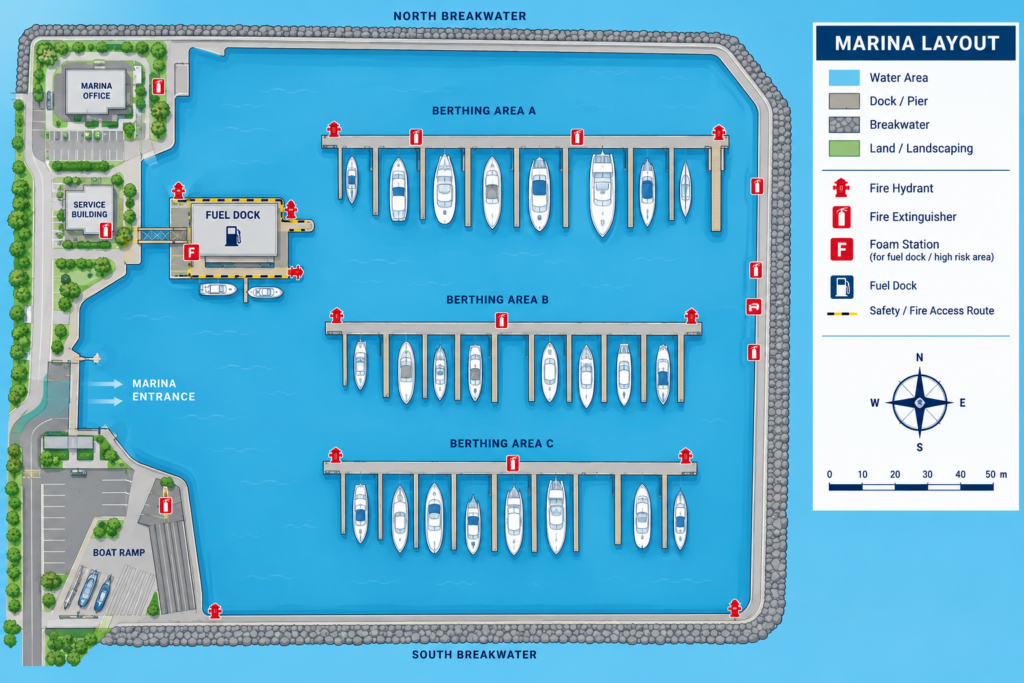
Fuel dock design and location are critical to limiting fire spread.
| Requirement | Specification |
|---|---|
| Location | Dispensing devices shall be located so exposure to other berthing facilities is minimized |
| Outside main berthing | Where tide and weather permit, fuel handling shall be outside the main berthing areas |
| Inside berthing areas | If located inside, fueling facilities must be positioned to minimize danger to other craft in case of fire |
| Separation from bulk plants | Marine fuel dispensing facilities at bulk plants must be separated by fence or barrier |
Key point: The location of the fuel dock is a fire safety decision. A fuel dock surrounded by berthed vessels creates a cascade risk—a fire at the dock can involve multiple boats before firefighters arrive.
Pro Tip: If your fuel dock is inside the main berthing area, verify that the arrangement allows emergency removal of adjacent vessels and that fire department access is not obstructed.
◆ Section 7: Electrical Safety and Shore Power
Electrical hazards at marinas are a recognized cause of fires and shocks. NFPA 70 Article 555 governs marinas, boatyards, floating buildings, and docking facilities.
A. Grounding and Ground-Fault Protection — NFPA 303 4.8
| Requirement | Specification |
|---|---|
| Electrical equipment | Must be used in accordance with listing for wet, damp, and hazardous locations |
| Shore power | Grounding must comply with NFPA 70 Article 555 |
| Ground-fault testing — applicability (NFPA 303 4.8) | Vessels must be tested for AC ground faults at the time of initial connection — where the marina is not fitted with ground-fault protection as specified in Article 555 of NFPA 70 |
| Ground-fault threshold | Connection is barred if leakage exceeds 30 mA |
| Retroactive applicability | The requirement applies retroactively to all marinas within two years of adoption of the 2021 edition |
| Testing frequency | At least annually for permanently docked vessels, or at each docking for transient vessels (annex guidance) |
| Galvanic isolation | Galvanic isolators or isolation transformers may be used to block DC current while retaining AC safety grounding |
B. Electric Shock Drowning
Electric shock drowning (ESD) is a recognized hazard at marinas. Faulty shore power can energize the water, creating a lethal shock risk for swimmers. The safety ground must never be disconnected to prevent corrosion —use a certified galvanic isolator instead.
Key point: Stray current and galvanic corrosion are not just maintenance issues—they are fire and shock hazards. Verify shore power grounding at every pedestal.
Pro Tip: Test shore power connections for ground faults at initial connection where the marina lacks Article 555 ground-fault protection. A leakage current above 30 mA is a red flag that requires investigation before the vessel remains connected.
◆ Section 8: Firefighter Access, Water Supply, and Vessel-Side Standards
Firefighter access to marinas is constrained by water, tide, and structure.
| Consideration | Challenge |
|---|---|
| Apparatus access | Limited to shore; may not reach floating docks |
| Hose deployment | Long lays from shore to fire |
| Water supply | Standpipes per NFPA 303 6.3; 150 ft max to hose connection |
| Tidal range | Gangways and access must accommodate |
| Smoke and heat | Fire on water creates unique conditions |
A. Fire Department Liaison
NFPA 303 requires fire department liaison as part of marina management. This means coordinating with the fire department on pre-incident planning, access, and water supply.
B. Vessel-Side Standards
NFPA 302, Fire Protection Standard for Pleasure and Commercial Motor Craft, addresses fire protection on the vessel itself. NFPA 306, Standard for the Control of Gas Hazards on Vessels, provides guidance for gas-freeing and hot work—the NFPA 303 hot-work 10% LFL limit is aligned with NFPA 306’s approach. U.S. Coast Guard requirements apply to vessel safety equipment, including fire extinguishers, fuel systems, and electrical installations.
Key point: The fire department must know the marina before an emergency. Pre-incident planning—showing access points, standpipe locations, and fuel dock layout—saves time when seconds matter.
Pro Tip: Invite your fire department to walk the marina. Show them the standpipe connections, the emergency operations staging areas, the fuel dock emergency disconnects, and the berth arrangement for emergency boat removal.
◆ Section 9: Additional Hazards — Dry Stack, LPG, and Lithium Batteries
A. Dry Stack and Rack Storage
Dry stack storage—where boats are stored on racks rather than in the water—presents fire spread risks similar to high-piled storage. NFPA 303 (2021) revised fire protection requirements for in-out dry storage and rack storage; refer to the applicable NFPA 303 section for your adopted edition.
Key Article: Article 108 — Fire Safety for Warehouses with High-Piled Storage
B. LPG (Propane) on Vessels
Many vessels carry propane for cooking and heating. LPG is heavier than air and can accumulate in bilges—a serious explosion hazard. NFPA 303 Section 8.13 covers servicing LPG and CNG systems, and NFPA 302 addresses vessel-side requirements. ABYC standards provide additional voluntary guidance for recreational vessels.
C. Lithium-Ion Batteries
Lithium-ion batteries are increasingly common on vessels for house power and propulsion. They introduce thermal runaway hazards that differ from conventional lead-acid batteries. NFPA 303 Section 8.12 addresses battery service and storage. ABYC E-13 provides voluntary industry guidance. Recommended practice: verify charging system compatibility, ensure ventilation, and consider off-gas or smoke detection in battery compartments.
Key Article: Article 98 — Fire Safety for Data Centers and IT Facilities (lithium-ion battery parallels)
◆ Section 10: Design Checklist for Marinas and Waterfront Structures
| Item | Status | Notes |
|---|---|---|
| NFPA 303 compliance verified | ☐ | Verify edition adopted by AHJ (2016, 2021, or 2026) |
| Fire protection equipment | ☐ | Required for five or more vessels; extinguishers at standpipe connections; verify private exemption |
| Standpipe system (NFPA 303 6.3) | ☐ | Per NFPA 14; 150 ft max to hose connection |
| Hydrants and water supplies (NFPA 303 6.5) | ☐ | Verify per adopted edition |
| Emergency operations staging area | ☐ | 4 ft × 10 ft clear area exclusive of walkways at each standpipe connection |
| Transmittal of fire emergency (NFPA 303 6.8) | ☐ | Telephone or approved means on site |
| Automatic fire detectors (NFPA 303 6.9) | ☐ | Where required by adopted edition |
| Fuel dispensing facility | ☐ | Per NFPA 30A and IFC Chapter 23; attendant required |
| Class I fuel prohibition | ☐ | Class I fuels prohibited outside approved facility (IFC 2310.4.1) |
| Fuel dock location | ☐ | Outside main berthing where feasible |
| Berthing density (NFPA 303 7.1.1) | ☐ | Each berth allows emergency boat removal without moving others |
| Electrical safety | ☐ | NFPA 70 Article 555; wet/damp location compliance |
| Ground-fault testing (NFPA 303 4.8) | ☐ | Required where marina lacks Article 555 ground-fault protection; 30 mA threshold |
| Ground-fault testing frequency | ☐ | Annual (permanent) / each docking (transient) |
| Galvanic isolation | ☐ | Galvanic isolator or isolation transformer |
| Combustible pier protection | ☐ | Per NFPA 1 Ch. 28 / NFPA 307 4.3; sprinkler clearance where protected |
| Pier and gangway egress | ☐ | Per adopted building/fire code and AHJ |
| Fire department liaison | ☐ | Pre-incident planning; access and water supply |
| Warning signs | ☐ | At fuel docks; letters not less than 3 inches |
| No Smoking signs | ☐ | Letters not less than 4 inches |
| Smoking/open flame restrictions | ☐ | Prohibited within 50 feet of fueling (IFC 2310.5.5.1) |
| Shrink-wrap operations | ☐ | Per NFPA 303 2026 expanded requirements |
| Dry stack storage | ☐ | Per NFPA 303 dry storage and rack storage provisions |
| LPG systems | ☐ | Per NFPA 303 Section 8.13 and NFPA 302 |
| Lithium-ion batteries | ☐ | Per NFPA 303 Section 8.12; ABYC E-13 as voluntary reference |
◆ Section 11: Common Mistakes and How to Avoid Them
| Mistake | Why It’s a Problem | How to Fix |
|---|---|---|
| Underestimating berthing density risk | Fire spreads between boats with no separation | Verify emergency removal capability per NFPA 303 7.1.1 |
| Unsupervised fuel dock | Violates NFPA 30A; fire risk during dispensing | Attendant required whenever open |
| Allowing Class I fueling outside a facility | Violates IFC 2310.4.1 | Fuel only at approved marine motor fuel-dispensing facility |
| Disconnecting safety ground to stop corrosion | Creates shock hazard and ESD risk | Use galvanic isolator or isolation transformer |
| No standpipe system | Firefighters must lay hose from shore | Install per NFPA 303 6.3 and NFPA 14 |
| Fuel dock inside main berthing | Cascade fire risk | Locate outside berthing where feasible |
| No fire department liaison | Fire service unfamiliar with marina | Pre-incident planning per NFPA 303 |
| Ignoring combustible pier protection | NFPA 307 4.3 applies to qualifying piers | Verify pier dimensions and proximity to protected structures |
| No warning signs at fuel dock | Violates IFC; missing safety communication | Post full warning text with 3-inch letters; “No Smoking” 4-inch |
| Missing emergency operations staging area | Firefighters lack space to work | Provide 4 ft × 10 ft clear area at each standpipe connection |
| No ground-fault testing | Shock and fire risk | Test per NFPA 303 4.8 where required; 30 mA threshold |
◆ Section 12: Conclusion
Marina fire safety is a discipline of density, fuel, and access. Vessels are packed tightly, each carrying fuel. Firefighting access is constrained by water and tide. And the structures themselves—floating docks, piers, gangways—create unique egress and fire spread conditions.
Key Takeaways:
-
NFPA 303 is the primary standard for marina fire protection, referenced by NFPA 1 and adopted by jurisdictions.
-
Fuel dispensing provisions are in IFC Chapter 23 (Section 2310); NFPA 30A (2024) also applies.
-
Class I fuel dispensing outside a facility is prohibited (IFC 2310.4.1); Class II/III fuels are permitted under conditions.
-
Berthing density must allow emergency boat removal per NFPA 303 7.1.1—a single fire should not trap multiple boats.
-
Fire protection equipment is required for marinas serving five or more vessels; standpipes per NFPA 303 6.3 and NFPA 14; 150 ft max to hose connection.
-
Emergency operations staging areas (4 ft × 10 ft clear area) are required at each standpipe connection.
-
Electrical safety is critical—NFPA 70 Article 555; ground-fault testing per NFPA 303 4.8; 30 mA threshold; use galvanic isolators, not disconnection.
-
Combustible piers exceeding 25 ft width or 5,000 ft², or within 30 ft of protected structures, require protection per NFPA 307 4.3.
-
NFPA 303 (2026) expanded shrink-wrap requirements; 2016 edition still in use in some jurisdictions.
-
Pier and gangway egress is generally governed by the adopted building or fire code and the AHJ.
Take Action Today:
-
Verify NFPA 303 compliance for your marina.
-
Confirm fuel dispensing is attended and equipped per NFPA 30A and IFC Chapter 23.
-
Verify berthing arrangements allow emergency boat removal per NFPA 303 7.1.1.
-
Check standpipe system (NFPA 303 6.3, NFPA 14) and fire extinguisher placement (NFPA 303 6.1, NFPA 10).
-
Verify emergency operations staging areas at standpipe connections.
-
Verify shore power grounding and consider galvanic isolators.
-
Conduct ground-fault testing per NFPA 303 4.8 where required (30 mA threshold).
-
Coordinate with your fire department for pre-incident planning.
-
Review shrink-wrap operations against the 2026 edition requirements.
-
Assess dry stack storage, LPG systems, and lithium-ion battery hazards.