
IMPORTANT DISCLAIMER: This guide references NFPA 101, Life Safety Code (Chapter 4 on General Requirements, §4.7 on Emergency Egress and Relocation Drills, and the occupancy chapters that set drill frequencies); OSHA 29 CFR 1910.38 (Emergency Action Plans), 1910.39 (Fire Prevention Plans) and 1910.165 (Employee Alarm Systems); the International Fire Code (IFC), Chapter 4 (Emergency Planning and Preparedness); and NFPA 1600, Standard on Continuity, Emergency, and Crisis Management. These codes vary by edition and are frequently amended by state and local jurisdictions. [VERIFY the current NFPA 101 edition status before publishing.] Adopted editions commonly lag one or more cycles behind the latest published edition. Drill frequencies and plan requirements vary by occupancy and edition. Local amendments and the edition adopted by your Authority Having Jurisdiction (AHJ) always control. This guide is a starting point only. Verify the requirements applicable to your project with your AHJ.
The best-designed egress system fails if occupants do not know how to use it. NFPA 101 and the IBC establish the physical requirements for exits, corridors and doors, but those requirements only save lives when people know what to do, where to go and how to help others. That is the role of emergency action plans and evacuation drills.
An emergency action plan (EAP) is a written document that establishes procedures for reporting emergencies, evacuating occupants, accounting for people afterward, and performing rescue or medical duties. Evacuation drills test the plan and train occupants to carry it out.
This article covers EAP and drill requirements under NFPA 101, OSHA and the IFC, with a focus on the occupancy-specific drill frequencies that determine how often buildings must practice.
Section 1: Why Plans and Drills Matter
Plans and drills prepare occupants to respond correctly, test systems and procedures, and document that the building is ready.
| Factor | Why It Matters |
|---|---|
| Human behavior under stress | Occupants default to familiar actions; training establishes correct responses |
| Occupant familiarity | First-time visitors and new employees do not know exit locations |
| System verification | Drills test alarms, doors, lighting and communication systems under realistic conditions |
| Regulatory compliance | OSHA requires written plans, alarms and training where an EAP is required; NFPA 101 and the IFC require drills and records for covered occupancies |
| Special needs occupants | Plans must address assistance for people who cannot evacuate independently |
| Continuous improvement | After-action reviews identify problems and corrective actions |
Key point: A drill that earns a checkmark but teaches nobody anything is a failed drill. The goal is measurable improvement in evacuation time, occupant behavior and system performance.
Key Article: Article 28, Commercial Building Fire Safety Plan: Development and Implementation
Pro Tip: Do not assume an evacuation caused by an unplanned alarm counts as a required drill. Confirm with your AHJ and document it either way. [VERIFY]
Section 2: Regulatory Framework
| Standard | Scope | Key Provisions |
|---|---|---|
| NFPA 101 Ch. 4 (§4.7) and occupancy chapters | General requirements; drills | Drill principles; frequency and participation by occupancy |
| OSHA 29 CFR 1910.38 | Emergency action plans | Minimum plan elements; alarm system; training; review |
| OSHA 29 CFR 1910.39 | Fire prevention plans | Fire prevention procedures |
| OSHA 29 CFR 1910.165 | Employee alarm systems | Alarm recognition, distinctiveness, testing |
| IFC Chapter 4 | Emergency planning and preparedness | Plan content; employee training; drill frequency; records |
| NFPA 1600 | Continuity, emergency, crisis management | Program framework |
Key point: OSHA protects employees and does not set drill frequencies. NFPA 101 and the IFC address all occupants and are enforced by the AHJ or fire code official where adopted.
Key Article: Article 21, Fire Alarm System Requirements for Commercial Buildings
Pro Tip: The IFC requires fire safety and evacuation plans to be available in the workplace for employee review and furnished to the code official on request.
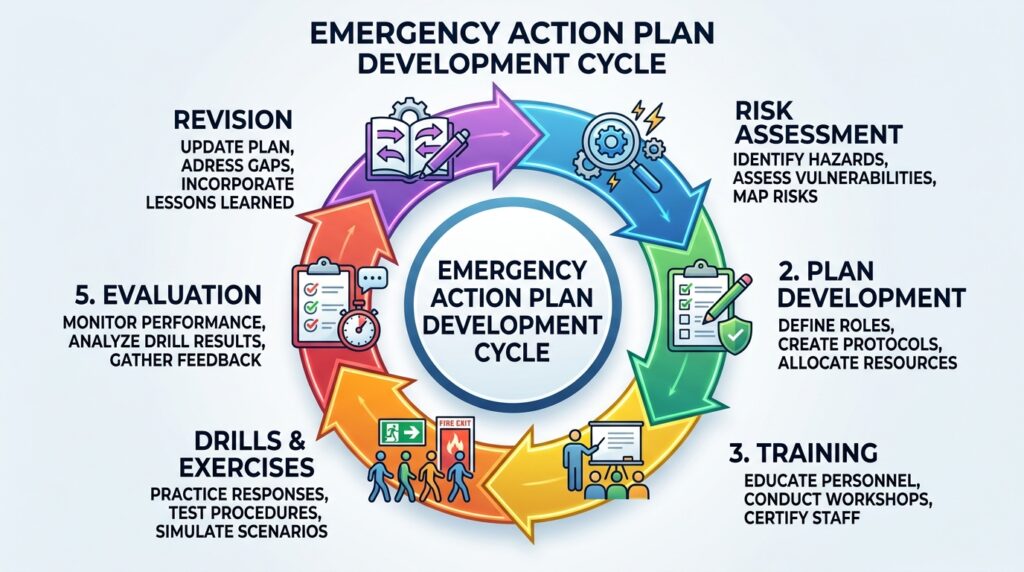
Section 3: Emergency Action Plan Requirements
A. OSHA Minimum Elements (29 CFR 1910.38)
OSHA requires an EAP where a specific OSHA standard calls for one (1910.38(a)). Where required, the plan must include at a minimum:
- Procedures for reporting a fire or other emergency
- Procedures for emergency evacuation, including type of evacuation and exit route assignments
- Procedures for employees who remain to operate critical plant operations before evacuating
- Procedures to account for all employees after evacuation
- Procedures for employees performing rescue or medical duties
- Name or job title of every employee who may be contacted for more information about the plan
Alarm system: The employer must have an alarm system that complies with 1910.165 and alerts employees in an emergency. The alarm must be distinctive and recognizable.
Training: The employer must designate and train employees to assist in a safe and orderly evacuation (1910.38(e)).
Written vs. oral: The plan must be in writing, kept in the workplace and available for employee review. An employer with 10 or fewer employees may communicate the plan orally.
Review requirement: The employer must review the plan with each employee:
- When the plan is developed or the employee is initially assigned to a job
- When the employee’s responsibilities under the plan change
- When the plan is changed
B. IFC Fire Safety Plan Elements (IFC §404.3.2)
The IFC requires fire safety plans to include:
- Procedure for reporting a fire or other emergency
- Life safety strategy and procedures for notifying, relocating or evacuating occupants
- Site plans indicating assembly point, fire hydrants and fire department vehicle access
- Floor plans identifying exits, primary and secondary evacuation routes, accessible egress routes, areas of refuge and exterior areas for assisted rescue
- List of major fire hazards
- Personnel responsible for maintenance of fire protection systems
- Personnel responsible for housekeeping and controlling fuel hazard sources
The IFC also requires employee training in the plan and in the duties assigned to them.
C. NFPA 101 Written Plan Guidance
NFPA 101 annex guidance on written fire emergency response plans addresses [VERIFY annex paragraph for your edition]:
- Methods and devices for alerting occupants
- How the fire department is alerted, including backup procedures
- Removal of occupants in immediate danger
- Methods of confining fire and its byproducts
- Control of occupant actions during evacuation and at assembly areas
- Facility policy on staff attempting to extinguish a fire
Key point: The plan must say what staff should do and what they should not do, particularly regarding firefighting attempts.
D. EAP vs. Emergency Response Plan (Industrial Plants)
An EAP tells people how to get out. An emergency response plan tells designated responders how to act. Industrial plants often need both.
| Document | Purpose | Related Requirements |
|---|---|---|
| Emergency action plan | Reporting, evacuation, accountability | 29 CFR 1910.38 |
| Fire prevention plan | Hazard control and housekeeping | 29 CFR 1910.39 |
| Emergency response plan | Response to releases, fires, rescue | 29 CFR 1910.119(n) (PSM); 1910.120(q) (HAZWOPER) |
| Fire brigade requirements | Organization, training, equipment of in-house responders | 29 CFR 1910.156 |
Pro Tip: Decide in writing whether employees will fight fires or only evacuate. That decision drives training, equipment and legal obligations.
Key Article: Emergency Response Planning for Industrial Plants
Section 4: Evacuation Strategies
The strategy in the plan determines what drills must exercise.
| Strategy | Description | Typical Use |
|---|---|---|
| Total evacuation | All occupants leave the building | Most business, educational, industrial |
| Phased evacuation | Fire floor and adjacent floors first, others later | High-rise buildings with voice communication |
| Defend in place | Occupants stay in unaffected areas | Health care, detention, some high-rise |
| Relocation | Move to a safe area within the building (horizontal exits, smoke compartments) | Health care, detention |
| Shelter in place | Remain indoors for outdoor hazards (severe weather, hazmat release) | Weather, external releases |
Key point: The plan should state which strategy applies to each hazard. A fire strategy does not automatically suit a tornado, chemical release or security threat.
Pro Tip: Occupants should not use elevators for evacuation unless the building has an approved occupant evacuation elevator system.
Key Article: Evacuation Elevators and Occupant Evacuation Operations
Section 5: Drill Frequency by Occupancy
Drill frequencies vary by occupancy type. The table summarizes requirements from NFPA 101 and the IFC. OSHA 29 CFR 1910.38 requires a written plan, alarm system and employee training where an EAP is required, but it does not set a drill frequency. Verify every row and section number against the editions your AHJ has adopted.
| Occupancy | Frequency | Participation | Source |
|---|---|---|---|
| Educational (Group E) | Monthly when in session | All occupants | NFPA 101 Ch. 14/15; IFC |
| Health care (Group I-2) | Quarterly on each shift | Employees | NFPA 101 Ch. 18/19 [VERIFY paragraph]; IFC |
| Assembly (Group A) | Quarterly | Employees | IFC |
| Business (Group B) | NFPA 101: required in buildings over 500 occupants or over 100 above or below the level of exit discharge. IFC: annually | Employees | NFPA 101 Ch. 38/39 [VERIFY paragraph]; IFC |
| Factory (Group F) | Annually | Employees | IFC [VERIFY] |
| Hotels (R-1) | Quarterly on each shift | Employees | IFC [VERIFY] |
| Residential board and care | 6 per year (bimonthly); at least 2 at night | Staff and residents | NFPA 101 Ch. 32/33 |
| Dormitories | Specific annual minimum; verify | All occupants | NFPA 101 Ch. 28/29; IFC [VERIFY] |
| Day-care | Monthly when in session | All occupants | NFPA 101 Ch. 16/17 |
High-rise buildings: A high-rise is not a separate occupancy. Drill requirements follow the building’s occupancy chapter plus the IFC and NFPA 101 high-rise provisions as adopted. Confirm with your AHJ which provisions apply.
A. Special Considerations for Health Care
- Drills must include transmission of a fire alarm signal and simulation of emergency fire conditions
- Infirm or bedridden patients are not required to be moved during drills
- Drills conducted between 9:00 p.m. and 6:00 a.m. may use a coded announcement instead of audible alarms
B. Special Considerations for Educational
Educational occupancies require monthly drills when in session. Deferral is permitted in severe-weather climates, provided the required number of drills is met and at least four are conducted before deferral. NFPA 101 also has timing provisions for early-session drills, and the IFC has its own first-drill timing. [VERIFY both against your adopted editions.] Many states also mandate lockdown or other security drills by statute, so check state requirements separately.
C. Special Considerations for Residential Board and Care
Six drills per year on a bimonthly basis, with at least two during the night when residents are sleeping. Drills normally involve actual evacuation of all residents to an assembly point and experience egressing through all exits and means of escape.
D. NFPA 101 §4.7 General Drill Principles
Beyond occupancy frequency, §4.7 sets general principles. Drills are designed in cooperation with local authorities, are held at expected and unexpected times and under varying conditions to simulate unusual emergency conditions, and require participants to relocate or evacuate to a designated location. [VERIFY paragraph numbers for your edition.]
Key point: Drill frequencies are minimums. The AHJ may require more frequent drills.
Key Article: Article 128, Egress Requirements for Educational Occupancies
Pro Tip: Some jurisdictions modify drill frequency based on sprinkler protection or the nature of the occupancy. Do not assume a reduction applies without written AHJ approval. [VERIFY]
Section 6: Types of Drills and Exercises
| Type | Description | When to Use |
|---|---|---|
| Orientation / walk-through | Tour of exits, assembly points, alarm devices | New hires, new tenants |
| Tabletop exercise | Discussion-based walk-through of a scenario | Test plan logic and roles |
| Functional drill | Tests one function (alarm, communication, accountability) | Targeted improvement |
| Full-scale evacuation drill | Actual evacuation of occupants to assembly point | Required occupancy drills |
| Announced drill | Occupants told in advance | Initial training |
| Unannounced drill | No advance notice to occupants | Realistic performance test |
Key point: Start with announced drills to teach, then move to unannounced drills to test. Vary scenarios, such as blocked exits, a different fire location or off-shift staffing.
Section 7: Roles and Responsibilities
| Role | Typical Duties |
|---|---|
| Plan coordinator | Maintains plan, schedules drills, keeps records |
| Floor or area wardens | Ensure area is cleared, direct occupants to exits |
| Sweepers | Check restrooms, closets, break rooms |
| Assisters | Help occupants who need evacuation assistance |
| Assembly area coordinator | Performs headcount; reports missing persons |
| Incident liaison | Briefs responding fire department |
| Crowd managers | Required in assembly occupancies over 1,000 |
Pro Tip: Name backups for every role and update the list when staff change. Wardens who left the company last year are a common finding.
Section 8: Accountability and Assembly Areas
- Select assembly areas away from the building and from fire apparatus access
- Use more than one assembly area where needed so exit discharge is not blocked
- Account for employees, visitors, contractors and delivery personnel
- Use a roster, badge or sign-in system that can be accessed during an emergency
- Define who reports the headcount and to whom
- Do not allow re-entry until the fire department or AHJ clears the building
- In multi-tenant buildings, coordinate tenant plans and communicate through building management
Key point: A headcount is not complete until every missing person is found or reported to responders.
Section 9: Drill Documentation and Evaluation
A. Required Records
Records of required drills must be maintained and include:
- Identity of the person conducting the drill
- Date and time of the drill
- Notification method used
- Employees or staff on duty and participating
- Number of occupants evacuated
- Special conditions simulated
- Problems encountered and corrective actions taken
- Weather conditions when occupants were evacuated
- Time required to accomplish complete evacuation
Retain records for the period required by your AHJ and insurer. [VERIFY]
B. After-Action Review
A meaningful drill includes an after-action review that identifies what worked, what failed, root causes, and owned corrective actions with closeout dates.
Key questions:
- Did evacuation occur within the target time?
- Was a 100% headcount achieved?
- Were all exits and means of escape used?
- Did communication systems function?
- Were occupants with disabilities assisted appropriately?
- What problems were encountered, and how will they be corrected?
C. Performance Metrics
Track these across drills to show improvement:
- Total evacuation time and time to complete headcount
- Time from alarm to first exit use
- Percentage of occupants who used the correct route
- Number of corrective actions opened and closed
- Number of occupants needing assistance and time to assist them
D. Notification of Monitoring Company
Where a fire alarm system is provided, notify the monitoring company before the drill and again at its conclusion.
Key point: Documentation is evidence of compliance and the basis for continuous improvement.
Pro Tip: Use a standardized drill record form that captures all required fields. Inspectors will verify them.
Section 10: Special Considerations
A. Occupants with Disabilities
Plans must address assistance for occupants who cannot evacuate independently. OSHA requires employers to designate and train employees to assist. Personal Emergency Egress Plans (PEEPs) for people with mobility, visual, hearing or cognitive disabilities are a best practice. Include areas of refuge, evacuation chairs and communication methods in the plan.
Key Article: Article 129, Accessible Means of Egress and Areas of Refuge
B. High-Rise Buildings
High-rise buildings may use phased evacuation or defend-in-place rather than total evacuation. Drills should exercise these strategies, including communication with occupants on floors not being evacuated.
Key Article: Article 77, How to Design for Fire Safety in High-Rise Buildings
C. Assembly Occupancies
Assembly occupancies with more than 1,000 occupants require trained crowd managers at a ratio of 1 per 250 occupants, subject to exceptions in NFPA 101. [VERIFY exceptions for your edition.] Crowd managers are responsible for knowing the evacuation plan and keeping exits clear.
Key Article: Article 127, Egress Requirements for Assembly Occupancies
D. Multiple Shifts and Off-Hours
Drills must reach all shifts. Health care occupancies specifically require drills on each shift. A drill conducted only during day shift does not prepare night-shift staff.
E. Language and Communication Access
Plans, signage and alarm messages should be understood by all occupants. Provide multilingual materials, visible alarms and voice instructions where needed.
F. Visitors, Contractors and Multi-Tenant Buildings
Visitors and contractors do not know the plan. Brief them on arrival, give them exit information and include them in headcounts. In multi-tenant buildings, coordinate drills so all tenants evacuate together and share assembly areas.
G. Drill Safety
Drills create their own hazards. Control them by:
- Clearing stairs and exits of trip hazards
- Not requiring people to run
- Providing alternatives for occupants who cannot use stairs
- Keeping medical staff available
- Stopping the drill if a real emergency occurs
- Not simulating conditions (smoke, noise) that could cause panic or injury
Section 11: Other Hazards and Related Plans
Fire is not the only reason to evacuate or shelter. The EAP should address:
| Hazard | Typical Response |
|---|---|
| Severe weather (tornado, hurricane, flood) | Shelter in place or relocate to refuge area |
| Hazardous material release | Evacuate upwind or shelter; call emergency responders |
| Bomb threat | Evacuate or search per policy; coordinate with law enforcement |
| Active threat | Run, hide, fight; lockdown per facility policy |
| Utility failure | Defined response for power, water or gas loss |
Key point: Active-threat and security drills supplement fire drills. They do not replace them. Check state law, as many states regulate school drills.
Section 12: Interface with Fire Safety Management
| Element | Integration Point |
|---|---|
| Fire safety plan | EAP is a component; coordinate with Article 28 |
| Training programs | Drills are practical training; coordinate with Article 70 |
| Fire safety committee | Reviews drill results and corrective actions; coordinate with Article 74 |
| Maintenance programs | Drills verify system readiness; coordinate with Article 30 |
| Post-fire investigation | After-action reviews use similar methods; coordinate with Article 72 |
| Emergency response planning | Industrial plants link the EAP to the ERP and mutual aid |
Pro Tip: Review the EAP at least annually and whenever staff assignments, occupancy or building arrangement changes. Annual review is best practice rather than an OSHA mandate.
Section 13: Design Checklist for Emergency Action Plans and Drills
| Item | Status | Notes |
|---|---|---|
| Requirement for EAP confirmed | ☐ | OSHA standard, IFC, NFPA 101 |
| EAP developed and written | ☐ | Meets OSHA and IFC |
| Plan kept in workplace | ☐ | Available to employees |
| Alarm system meets 1910.165 | ☐ | Distinctive, tested |
| Employees trained | ☐ | At hire, duty change, plan change |
| Reporting procedures documented | ☐ | Fire department; backup methods |
| Evacuation strategy defined per hazard | ☐ | Total, phased, defend in place, shelter |
| Routes and assembly points identified | ☐ | Primary and secondary |
| Accountability procedures documented | ☐ | Includes visitors and contractors |
| Rescue/medical duties assigned | ☐ | Named people or job titles |
| Roles and backups assigned | ☐ | Wardens, sweepers, assisters |
| Assistance for people with disabilities | ☐ | PEEPs; areas of refuge |
| Drill frequency determined | ☐ | Per occupancy and AHJ |
| Drills varied and on all shifts | ☐ | Announced and unannounced |
| Drill records maintained | ☐ | All required fields |
| After-action review conducted | ☐ | Corrective actions assigned |
| Monitoring company notified | ☐ | Before and after |
| Crowd managers assigned (if required) | ☐ | Over 1,000 occupants; 1 per 250 |
| Plan reviewed annually | ☐ | Or when conditions change |
Section 14: Common Mistakes and How to Avoid Them
| Mistake | Why It’s a Problem | How to Fix |
|---|---|---|
| Plan not in writing | OSHA violation where an EAP is required and the employer has more than 10 employees | Document the plan |
| Assuming OSHA sets drill frequency | Misses NFPA 101 and IFC requirements | Check occupancy and adopted codes |
| Drill frequency too low | Occupants unprepared; code violation | Verify occupancy-specific frequency |
| Only day-shift drills | Night staff untrained | Drill on all shifts |
| Same scenario every time | Occupants memorize rather than learn | Vary scenarios |
| No after-action review | Problems not found or corrected | Review after every drill |
| Incomplete drill records | Cannot demonstrate compliance | Use a standard form |
| No assistance plan for disabilities | Occupants left behind | Develop PEEPs |
| Unplanned alarm counted as a drill | May not satisfy requirements | Hold and document actual drills |
| Visitors and contractors not counted | Unresolved missing persons | Include them in accountability |
| Plan not updated | Outdated procedures and contacts | Review annually |
| Monitoring company not notified | Unnecessary emergency dispatch | Notify before and after |
| Fire strategy applied to every hazard | Wrong response to weather or hazmat | Define strategy per hazard |
Section 15: Conclusion
Emergency action plans and evacuation drills are the operational side of fire safety. They turn the physical design of exits and egress systems into life-saving action.
NFPA 101, OSHA and the IFC establish the requirements. OSHA requires the plan, alarm and training, while NFPA 101 and the IFC set the drills. The occupancy determines drill frequency: monthly for educational and day-care, quarterly for health care and assembly, and for business buildings either the IFC annual drill or the NFPA 101 occupant-load thresholds, whichever the AHJ has adopted. Documentation and after-action reviews drive continuous improvement.
Key Takeaways:
- An EAP is required where an OSHA standard or adopted code calls for one, and it must include reporting, evacuation, accountability and rescue procedures
- OSHA covers employees and does not set drill frequency; NFPA 101 and the IFC apply to all occupants where adopted
- Drill frequency varies by occupancy: monthly (educational, day-care), quarterly (health care, assembly), and threshold-based or annual for business buildings, per the adopted code
- Business occupancy drills under NFPA 101 apply to buildings over 500 occupants or over 100 above or below the level of exit discharge [VERIFY paragraph]
- High-rise buildings follow their occupancy chapter plus high-rise provisions, not a separate drill row
- Health care drills must include alarm transmission and simulated conditions; drills between 9 p.m. and 6 a.m. may use coded announcements
- Residential board and care requires six drills per year, with two at night
- The plan should define a strategy for each hazard, not just fire
- Roles, backups and training must stay current
- Visitors, contractors and tenants must be part of accountability
- People who need assistance must be addressed in the plan
- Crowd managers are required for assembly occupancies over 1,000, at 1 per 250 subject to exceptions
- Records must show date, time, participants, conditions, problems and evacuation time
- After-action reviews and metrics turn drills into improvement
- The plan is a living document, reviewed annually and when conditions change
Take Action Today:
- Confirm which codes and editions your AHJ has adopted.
- Confirm whether your occupancy requires an emergency action plan and what it must contain.
- Develop or update the plan to meet OSHA, NFPA 101 and IFC requirements.
- Determine the required drill frequency for your occupancy.
- Assign roles and backups, and train them.
- Schedule drills on all shifts and vary the scenarios.
- Develop assistance plans for occupants who need help.
- Assign crowd managers if required.
- Set up a standard drill record form and a retention schedule.
- Run an after-action review after every drill and track corrective actions.
- Notify the monitoring company before and after drills.
- Review and update the plan at least annually.
Continue Reading from Our Series:
-
Related guide: Commercial Building Fire Safety Plan — Development and Implementation (Article 28)
-
Learn more: How to Design and Implement a Fire Safety Training Program (Article 70)
-
Read more: How to Train Employees for Fire Emergencies (Article 53)