IMPORTANT DISCLAIMER:
This guide is based on the base text of NFPA 101, Chapters 18 (new) and 19 (existing). However, NFPA 101 requirements vary significantly by edition (2018, 2021, 2024) and are frequently amended by state and local jurisdictions.
Local amendments and the edition adopted by your Authority Having Jurisdiction (AHJ) always control.
This guide is a starting point only—always verify the specific requirements applicable to your project with your local AHJ.
Section numbers cited in this guide are based on the 2018 edition of NFPA 101; verify section numbers with the edition adopted in your jurisdiction.
Healthcare occupancies represent one of the most complex and critical fire safety challenges in the built environment. These facilities house patients who are often incapable of self-preservation due to age, physical or mental disability, or security measures not under their control. Unlike other occupancies where full evacuation is the primary strategy, healthcare facilities rely on a “defend-in-place” philosophy—moving patients to protected areas of refuge rather than evacuating the entire building.
NFPA 101 addresses healthcare occupancies in Chapter 18 (new) and Chapter 19 (existing). This guide covers the essential fire safety requirements for healthcare occupancies, including hospitals, nursing homes, and other inpatient care facilities.
◆ Section 1: Defining Healthcare Occupancies
NFPA 101 defines a healthcare occupancy as an occupancy used to provide medical or other treatment or care simultaneously to four or more patients on an inpatient basis, where such patients are mostly incapable of self-preservation due to age, physical or mental disability, or because of security measures not under the occupants’ control .
| Occupancy Type | Description | NFPA 101 Chapter |
|---|---|---|
| Healthcare Occupancy | Inpatient care for 4+ patients incapable of self-preservation | Chapter 18 (New) / Chapter 19 (Existing) |
| Ambulatory Health Care Occupancy | Outpatient care for 4+ patients incapable of self-preservation | Chapter 20 (New) / Chapter 21 (Existing) |
| Business Occupancy | Outpatient services where patients are capable of self-preservation | Chapter 38/39 |
Key Distinction:
Hospital outpatient surgical departments are required to be classified as an Ambulatory Health Care Occupancy regardless of the number of patients served .
◆ Section 2: Multiple Occupancies
Healthcare facilities often contain spaces that are not used for inpatient care. These sections may be classified as other occupancies, but strict separation requirements apply.
A. Healthcare Occupancy Separation (19.1.3.3)
Sections of healthcare facilities shall be permitted to be classified as other occupancies, provided they meet all of the following conditions :
| Condition | Details |
|---|---|
| 1. Not Intended for Inpatients | The space is not intended to provide services simultaneously for four or more inpatients for purposes of housing, treatment, or customary access by inpatients incapable of self-preservation |
| 2. 2-Hour Separation | They are separated from areas of healthcare occupancies by construction having a minimum 2-hour fire resistance rating in accordance with Chapter 8 |
| 3. Sprinkler Protection | The entire building is protected throughout by an approved, supervised automatic sprinkler system in accordance with Section 9.7 |
B. Ambulatory Health Care Separation (20.1.3.2/21.1.3.3)
Sections of ambulatory health care facilities shall be permitted to be classified as other occupancies, provided they meet both of the following conditions :
| Condition | Details |
|---|---|
| 1. Not Intended for Patients | The occupancy is not intended to serve ambulatory health care occupants for treatment or customary access |
| 2. 1-Hour Separation | They are separated from the ambulatory health care occupancy by a 1-hour fire resistance rating |
C. Contiguous Non-Health Care Occupancies (19.1.3.4.1)
Ambulatory care facilities, medical clinics, and similar facilities that are contiguous to healthcare occupancies, but primarily intended to provide outpatient services, shall be permitted to be classified as business occupancies or ambulatory health care facilities, provided that :
- The facilities are separated from the healthcare occupancy by not less than 2-hour fire resistance-rated construction
- The facility is not intended to provide services simultaneously for four or more inpatients who are litter borne
Separation Construction Requirements:
| Element | Requirement |
|---|---|
| Walls | Not less than required fire resistance rating, extending from floor slab to roof slab |
| Doors | Constructed of not less than 1-3/4 inches thick, solid-bonded wood core or equivalent, equipped with positive latches |
| Door Operation | Self-closing and kept in the closed position, except when in use |
| Windows | Fixed fire window assemblies per NFPA 101 Section 8.3 |
Pro Tip:
Failure to provide required separation between healthcare and non-healthcare occupancies is a common citation. In one case, a physical therapy outpatient treatment center was cited for not being separated from the hospital by a 2-hour firewall .
◆ Section 3: Means of Egress
Healthcare occupancies have specific egress requirements that reflect the “defend-in-place” philosophy and the challenges of moving patients who may be litter-borne.
A. Egress Capacity
The capacity of egress components in healthcare occupancies is determined by the capacity factors in NFPA 101 Table 7.3.3.1. For healthcare occupancies, the factors are :
| Area/Occupancy | Stairways (width/person) | Level Components & Ramps (width/person) |
|---|---|---|
| Health care, sprinklered | 0.3 in. (7.6 mm) | 0.2 in. (5 mm) |
| Health care, nonsprinklered | 0.6 in. (15 mm) | 0.5 in. (13 mm) |
| All others | 0.3 in. (7.6 mm) | 0.2 in. (5 mm) |
These factors apply to the required egress width calculation (Occupant Load × Capacity Factor). The application of sprinklered vs. non-sprinklered capacity factors is a general life-safety provision. For healthcare occupancies, the “All Others” factors in Table 7.3.3.1 effectively provide the same values as the sprinklered healthcare factors, meaning the reduced width factors are available to a broad range of occupancies. The factors for non-sprinklered healthcare (0.6 in. and 0.5 in.) are more conservative than the standard “All Others” factors, which are 0.3 in. and 0.2 in. .
Important Note:
For projects governed by the International Building Code (IBC), note that IBC Table 1005.1 applies a more conservative 0.3/0.2 factor to healthcare (I-2) occupancies even when sprinklered, and the NFPA 101 factors may not apply. Always verify the applicable code for your jurisdiction.
B. Minimum Exits
At least one exit from each floor or fire section shall be either a door leading directly to the outside, a stair, a smokeproof enclosure, a ramp, or an exit passageway.
C. Exit Signage and Illumination
| Requirement | Details |
|---|---|
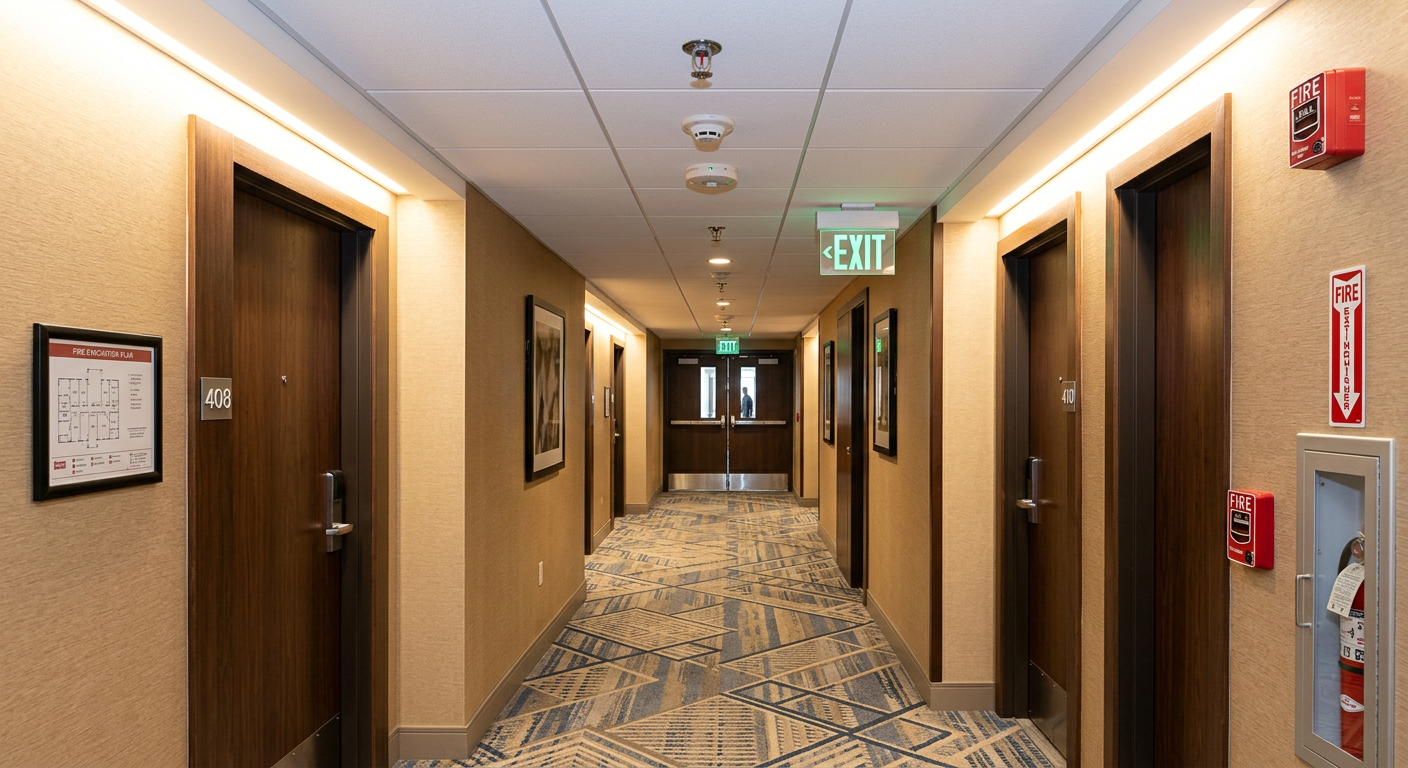
| Exit Signs | For all new healthcare occupancies, the means of egress shall be marked (signed) |
| Illumination | Illumination of means of egress shall be continuous during the time that conditions of occupancy require the means of egress to be available for use |
| Floor Illumination | The floors of means of egress shall be illuminated at all angles and points of corridors and passageways, ramps, stairways, landings, and exit doors |
D. Emergency Lighting
All new healthcare facilities shall be provided with emergency lighting . Emergency lighting systems shall be arranged to provide the required illumination automatically in the event of any interruption of normal lighting, such as power failure, opening of a circuit breaker, or manual acts . The emergency lighting shall be provided in :
- All interior stairs, ramps, and corridors
- Normally occupied areas
- All portions of buildings that are interior or windowless
E. Door Locking
Doors in a required means of egress shall not be equipped with a latch or lock that requires the use of a tool or key from the egress side . However, NFPA 101 provides several specific exceptions for locking patient sleeping room doors in healthcare occupancies when necessary for patient safety or security :
1. Clinical Needs or Security Threat Locking: Permitted in units where patients pose a security threat (e.g., psychiatric, Alzheimer’s, dementia units) or have clinical needs requiring specialized security measures . These locks must allow rapid removal of occupants via remote control, staff-carried keys, or other reliable means .
2. Special Needs Locking Arrangements: Permitted for patients requiring additional protective measures (e.g., pediatric, maternity, emergency departments) . These require fail-safe electrical locks, building-wide sprinkler protection, complete smoke detection in the locked space, and automatic unlocking upon sprinkler/detection activation .
3. Delayed-Egress Locking: Permitted on doors serving low/ordinary hazard contents in buildings with sprinkler or fire detection systems . Doors unlock after a 15-second (or up to 30-second with AHJ approval) delay when force is applied . Audible signals and specific signage are required; relocking must be manual .
4. Access-Controlled Egress: Electrically locked doors released by motion sensors or “push to exit” buttons.
5. Classroom-Style Locking: Key-locking devices that restrict access from the corridor but do not restrict egress from the room.
Important:
Each locking arrangement has strict requirements. Mixing features from different arrangements is not compliant . Always verify with the local AHJ.
◆ Section 4: Fire Alarm and Detection Systems
A. General Requirement
All new healthcare occupancies shall be provided with an approved fire alarm system .
B. Smoke Detection Requirements
All new healthcare occupancies shall have an approved automatic smoke detection system installed in all corridors. The spacing and location of smoke detectors shall be based on anticipated smoke flows, ceiling conditions, and manufacturer’s instructions in accordance with NFPA 72 . In general, spot-type smoke detectors on smooth ceilings are typically spaced at a nominal spacing of 30 feet (9.1 m), with detectors located within 15 feet (4.6 m) of any wall . NFPA 72 also provides alternative methods for detector placement in complex room configurations.
C. Total Coverage Smoke Detection
Total coverage (complete) automatic smoke detection is required in healthcare occupancies in specific circumstances, such as when specialized door locking arrangements are used or when certain sleeping suites are used. When total coverage detection is required, it is only required for occupiable areas —not above ceilings or in other non-occupiable spaces . This is a key distinction: NFPA 101, 2018 Edition, Section 9.6.2.9 states that where total coverage smoke detection is required, it shall be provided “in all occupiable areas in environments that are suitable for proper smoke detector operation.”
D. Emergency Forces Notification
Existing healthcare occupancies must ensure the fire alarm system automatically notifies emergency forces according to the requirements of 19.3.4.3.2 .
E. Fire Alarm Power Source
Fire alarm systems must be powered by a permanently-wired, dedicated branch circuit that is powered from a commercial power source in accordance with NFPA 70, and must have a secondary, emergency power source meeting the requirements of NFPA 72.
◆ Section 5: Fire Suppression Systems
A. Automatic Sprinkler Systems
All new healthcare occupancies shall be protected with automatic sprinklers . Automatic sprinklers shall be provided in each habitable patient room. The sprinkler head(s) in each patient room shall be the quick-response type head .
Sprinkler Exceptions for Healthcare Occupancies:
| Exception | Details | Code Reference |
|---|---|---|
| AHJ Prohibition | In Type I and Type II construction, alternative protection measures shall be permitted to be substituted for sprinkler protection without causing a building to be classified as nonsprinklered in specified areas where the AHJ has prohibited sprinklers | 18/19.3.5.5 |
| Small Clothes Closets | Sprinklers shall not be required in clothes closets located within patient sleeping rooms where the area of the closet does not exceed 6 sq ft (0.55 m²), provided that the distance from thesprinkler in the patient sleeping room to the back wall of the closet does not exceed the maximum distance permitted by NFPA 13 | 18/19.3.5.10 |
B. Portable Fire Extinguishers
Portable fire extinguishers shall be provided in all healthcare occupancies in accordance with NFPA 101 Section 9.7.4.1 . Where required, portable fire extinguishers shall be installed, inspected, and maintained in accordance with NFPA 10 .
Common requirements include:
| Requirement | Details |
|---|---|
| Travel Distance | Portable fire extinguishers must be located in corridors so the travel distance from any point to an extinguisher is no more than 75 feet |
| Mounting Height | ≤40 lbs: top ≤5 feet above floor; >40 lbs: top ≤3.5 feet above floor; bottom ≥4 inches from floor |
| Kitchen/Mechanical Rooms | At least one approved 20-B:C portable fire extinguisher in each laundry, kitchen, and walk-in mechanical room |
◆ Section 6: Compartmentation and Hazardous Area Protection
A. Hazardous Areas Protection
In new healthcare occupancies, any hazardous area shall be either safeguarded by a fire barrier of 1-hour fire resistance rating or provided with an automatic fire extinguishing system . Those areas accompanied by an asterisk (*) shall have both fire-resistant separation and a complete extinguishment system :
| Hazardous Area | Protection Required |
|---|---|
| Boiler and heater rooms | 1-hour separation OR automatic extinguishing |
| Laundries | 1-hour separation OR automatic extinguishing |
| Repair shops | 1-hour separation OR automatic extinguishing |
| Handicraft shops | 1-hour separation OR automatic extinguishing |
| Employee locker rooms | 1-hour separation OR automatic extinguishing |
| Soiled linen rooms* | BOTH 1-hour separation AND automatic extinguishing |
| Paint shops* | BOTH 1-hour separation AND automatic extinguishing |
| Trash collection rooms* | BOTH 1-hour separation AND automatic extinguishing |
| Storage of combustible supplies (hazardous quantities) | 1-hour separation OR automatic extinguishing |
| Laboratories (less than severe hazard) | 1-hour separation OR automatic extinguishing |
B. Laboratories
Laboratories employing quantities of flammable, combustible, or hazardous materials which are considered as severe hazards shall be protected in accordance with NFPA 99.
C. Vertical Openings
Vertical openings must be protected according to the requirements of NFPA 101 Chapter 18.3.1 .
◆ Section 7: Life Safety Drawings
The Joint Commission requires that healthcare organizations maintain current and accurate drawings denoting features of fire safety and related square footage. For mixed occupancy buildings where portions of the building are business occupancy and other portions are healthcare occupancy or ambulatory healthcare occupancy, life safety drawings are required for the whole building, including the sections that are business occupancy.
Required Features on Life Safety Plans:
| Feature | Description |
|---|---|
| Sprinklered Areas | Areas of the building that are fully sprinklered |
| Hazardous Storage Areas | Locations of all hazardous storage areas |
| Fire-Rated Barriers | Locations of all fire-rated barriers |
| Smoke-Rated Barriers | Locations of all smoke-rated barriers |
| Smoke Compartments | Locations of designated smoke compartments |
| Equivalencies or Waivers | Any approved equivalencies or waivers |
◆ Section 8: Special Considerations
A. Patient Sleeping Room Windows
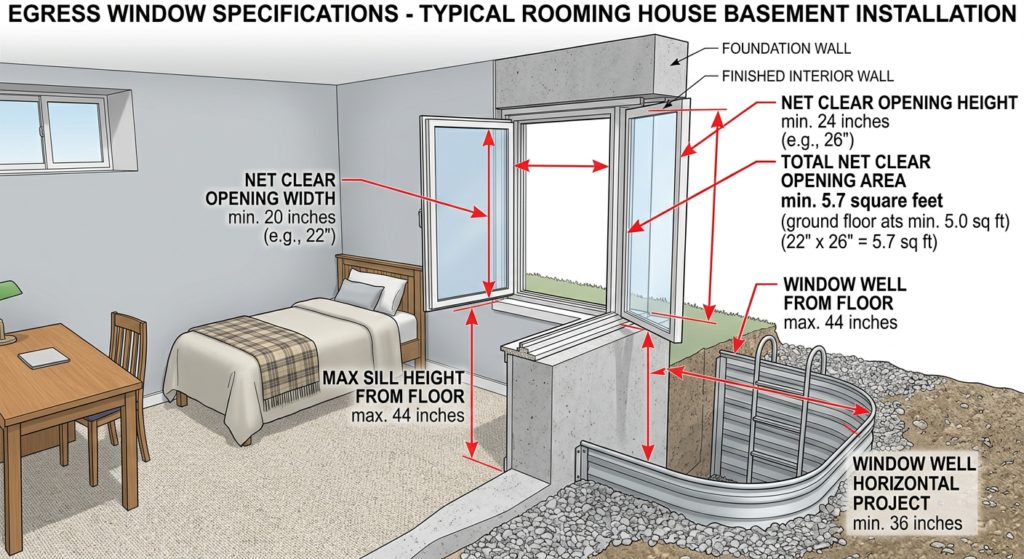
Every patient sleeping room shall have a window or door to the outdoors arranged and located so that it can be opened from the inside to permit venting of products of combustion and to permit any occupant to have direct fresh air in case of emergency.
Exceptions:
| Exception | Details |
|---|---|
| ICU/CCU/Hemodialysis/Neonatal | Areas housing ICU, CCU, hemodialysis, and neonatal patients |
| Short-Stay Areas | Rooms intended for occupancy of less than 24 hours, labor rooms, recovery rooms, and observation areas in emergency departments and newborn nurseries |
| Smoke Control Systems | Buildings designed with approved engineered smoke control systems |
B. No Smoking
No smoking shall be permitted in any patient areas of any new healthcare facility. Only in those areas approved by the Fire Chief will smoking be permitted.
C. No Portable Space Heaters
The Healthcare Interpretations Task Force has clarified that portable heating devices are subject to the code edition in effect for the building, and a UL 1278 listing does not independently satisfy earlier code requirements. AHJs may evaluate equivalencies under Section 1.4.
D. Carbon Monoxide Detection
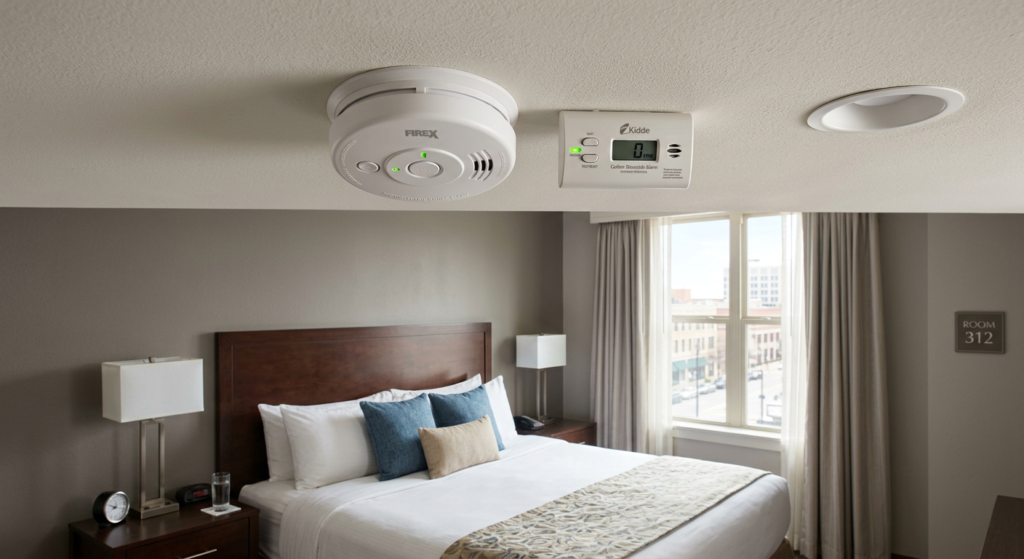
Carbon monoxide detection requirements for healthcare occupancies may apply where fuel-burning appliances or attached garages are present. These requirements may be addressed by state regulations and should be verified with the local AHJ.
E. Existing Healthcare Occupancies
Existing healthcare occupancies (Chapter 19) have distinct requirements that may differ from new construction. Key distinctions include:
| Requirement | New (Chapter 18) | Existing (Chapter 19) |
|---|---|---|
| Sprinkler System | Required throughout | Required in accordance with 19.3.5.3 |
| Fire Alarm System | Required | Required in accordance with 19.3.4 |
| Emergency Forces Notification | Required | Required in accordance with 19.3.4.3.2 |
◆ Section 9: Design Checklist
Use this checklist to verify fire safety provisions in healthcare occupancy design:
| Item | Status | Notes |
|---|---|---|
| Occupancy Classification | ☐ | Healthcare (4+ inpatients incapable of self-preservation) |
| Multiple Occupancy Separation | ☐ | 2-hour separation from other occupancies |
| Emergency Lighting | ☐ | In stairs, ramps, corridors, occupied areas, windowless areas |
| Fire Alarm System | ☐ | Approved system with smoke detectors in corridors |
| Sprinkler System | ☐ | Quick-response heads in patient rooms |
| Fire Extinguishers | ☐ | NFPA 10 compliance; 75 ft travel distance |
| Hazardous Area Protection | ☐ | 1-hour separation OR automatic extinguishing |
| Severe Hazard Areas | ☐ | BOTH 1-hour separation AND extinguishing |
| Patient Room Windows | ☐ | Openable for venting (exceptions apply) |
| Life Safety Drawings | ☐ | Current and accurate |
| Verify Local AHJ Requirements | ☐ | Local amendments and adopted edition control |
◆ Section 10: Common Mistakes and How to Avoid Them
| Mistake | Why It’s a Problem | How to Fix |
|---|---|---|
| Misclassifying Outpatient Areas | Applying business occupancy instead of healthcare requirements | Hospital outpatient surgical departments are healthcare/ambulatory healthcare regardless of patient count |
| Inadequate Multi-Occupancy Separation | Fire can spread between occupancies | Provide 2-hour separation for healthcare/non-healthcare |
| Missing Emergency Forces Notification | Fire department response delayed | Ensure automatic notification per 19.3.4.3.2 |
| Inadequate Smoke Detection | Fire may go undetected | Install detectors in corridors; verify spacing per NFPA 72 |
| No Quick-Response Sprinklers in Patient Rooms | Delayed sprinkler activation | Use quick-response heads in patient sleeping rooms |
| Missing Life Safety Drawings | Cannot demonstrate compliance | Maintain current drawings for whole building |
| Confusing Total Coverage Detection | May over-install in non-occupiable areas | Total coverage applies only to occupiable areas |
| Misunderstanding Door Locking Exceptions | May assume no locking permitted | Review the five permitted locking arrangements |
| Incorrect Egress Capacity Calculation | May overestimate stair capacity | Use Table 7.3.3.1 factors: 0.3/0.6 inches per person for stairs |
| Applying NFPA 101 Factors Under IBC | May use the wrong table | For IBC-governed projects, use IBC Table 1005.1 (0.3/0.2 for healthcare even when sprinklered) |
◆ Section 11: Conclusion
Healthcare occupancies require comprehensive fire safety strategies that reflect the unique needs of patients who may be incapable of self-preservation. By providing adequate egress, reliable fire alarms, proper compartmentation, and comprehensive emergency planning, you can design facilities that protect patients, staff, and visitors.
Take Action Today:
- Confirm the occupancy classification (healthcare, ambulatory healthcare, or business).
- Provide proper separation between healthcare and other occupancies (2-hour for healthcare, 1-hour for ambulatory).
- Install fire alarm and smoke detection systems in accordance with NFPA 101 and NFPA 72.
- Provide automatic sprinkler protection with quick-response heads in patient rooms.
- Protect hazardous areas with 1-hour separation or automatic extinguishing.
- Understand the permitted door locking exceptions and their strict requirements.
- Calculate egress capacity using the correct factors for your applicable code (NFPA 101 Table 7.3.3.1 vs. IBC Table 1005.1).
- Maintain current Life Safety drawings for the whole building.
- Always verify local amendments and the adopted NFPA 101 edition with your AHJ.
Continue Reading from Our Series:
- Read more about: How to Design Fire Safety for Day-Care Occupancies
- Learn more: How to Design Fire Safety for Educational Occupancies
- Related guide: How to Design Fire Safety for Ambulatory Health Care Occupancies